
Intelligence
Latest Articles
Latest intelligence on infrastructure operators, policy decisions, market moves, and digital power shifts.

Asia-Pacific National Telecom Trends
Y.3335 standardizes the path, not the service
ITU-T has approved a common framework for low-latency, energy-efficient communication across operator domains. Y.3335 can align how networks describe the problem, but it does not yet prove that a multi-operator path will meet a latency target, consume less energy or survive a…

CASE FILE
The Public Path Looked Cleaner. Its History Had Been Rewritten: BGP Private-AS Removal and the Authority to Erase a Hop
The customer route arrived with three private autonomous systems in its path. At one public exit they vanished. At another, one survived. At a third, all three returned wearing the provider's number. Each operator had configured something called private-AS removal. The public…

History
The Last Uncompressed Line: How IMAP COMPRESS Changed Every Byte That Followed
The server's answer looked ordinary: a tag, `OK`, a short confirmation, then CRLF. That line was ordinary for the last time. If the client had asked for IMAP compression, the next server octet no longer belonged to the visible command language at all. A single successful reply…

CASE FILE
Trusted channels, no command: who can speak for FIRST in a cyber crisis?
A warning enters a trusted channel during a cross-border incident. Three decisions follow, and they do not belong to the same institution: who may enter the room, who may speak for the network, and who may act on an affected system. FIRST has substantial control over the first…

History
The Greeting That Had to Be Repeated: How STARTTLS Reset SMTP Trust
The first greeting crossed the network in the clear. So did the client's name and the server's list of abilities. When SMTP added encryption without abandoning its old port, the protocol could not simply wrap that conversation and pretend it had always been protected. It had to…

CASE FILE
Empowered without a vote: what the IGF Leadership Panel can actually command
The IGF Leadership Panel was designed to carry messages, recruit senior attention and find resources. Appointment by the UN Secretary-General gives that work institutional access. The operative rules still leave the annual programme with the MAG, execution with the Secretariat…

ICANN
The drafting room behind root advice: who controls the RSSAC Caucus pipeline?
Most RSSAC reports are built in a body far larger than the committee that formally approves them. The current rules make that division visible: experts may propose, research and draft; root server operator representatives keep the gates for admission, scope, amendment and…

ICANN
The security advisers the Board appoints: where SSAC authority stops
Three dates describe the gate. On 25 November 2025, an internal membership committee recommended three candidates. On 10 December, SSAC approved them by consensus. On 25 January 2026, the ICANN Board appointed them. Expertise entered through a committee of incumbents and acquired…

CASE FILE
A database governed by its entries: who gets a vote in PeeringDB?
A legal business entity can cross PeeringDB's membership threshold with two credentials: an active account and a representative or role subscribed to the governance list. The vote that follows is real. It is also only the first layer of authority over a database whose daily…

History
The Credential That Could Not Sign the Message: How SMTP AUTH Bounded Submission Identity
A password could open a mail submission gate. It could not sign the letter that passed through it. SMTP AUTH became useful precisely because the protocol kept those propositions apart: this client authenticated here; this account may act in certain ways; this message claims a…

Global Institutional
linuxptp and the control loop behind precision time
linuxptp turns a Linux host, hardware clock and network timing source into a precision-time system. Its daemons coordinate IEEE 1588 state, packet timestamps, servos and system clocks, but software alone cannot manufacture accuracy: the result still depends on NICs, oscillators…

Academics
Laurent Vanbever and the network that must be tested while it changes
Laurent Vanbever’s work treats network configuration as executable software whose failures can emerge before, during or after deployment. From safe routing migrations and configuration synthesis to runtime BGP detection and energy-aware operations, his research at ETH Zurich asks…

CASE FILE
The 30 Percent Congress Legalised After It Was Collected
For two and a half years, every covered domain registration carried a public-purpose assessment that Congress had not specifically authorised. One month after a judge exposed the defect, Congress made the past lawful “as if” it had acted first.

Global Cloud Services Trends
The Denominator Behind the Uptime Promise
Cloud uptime percentages look like simple guarantees. They are not. As of 22 August 2026, the major public cloud SLAs examined here show something more precise: a bounded mechanism for allocating a narrow slice of outage risk, defined by what is measured, how the service must be…

History
The Address That Could Not Be Downgraded: How SMTPUTF8 Made the Route Part of the Name
An accented display name could cross old email systems because it was decoration around an ASCII address. A non-ASCII mailbox name was different: it was the destination itself. SMTPUTF8 made every relay prove that it could carry that identity without inventing another one.
Academics
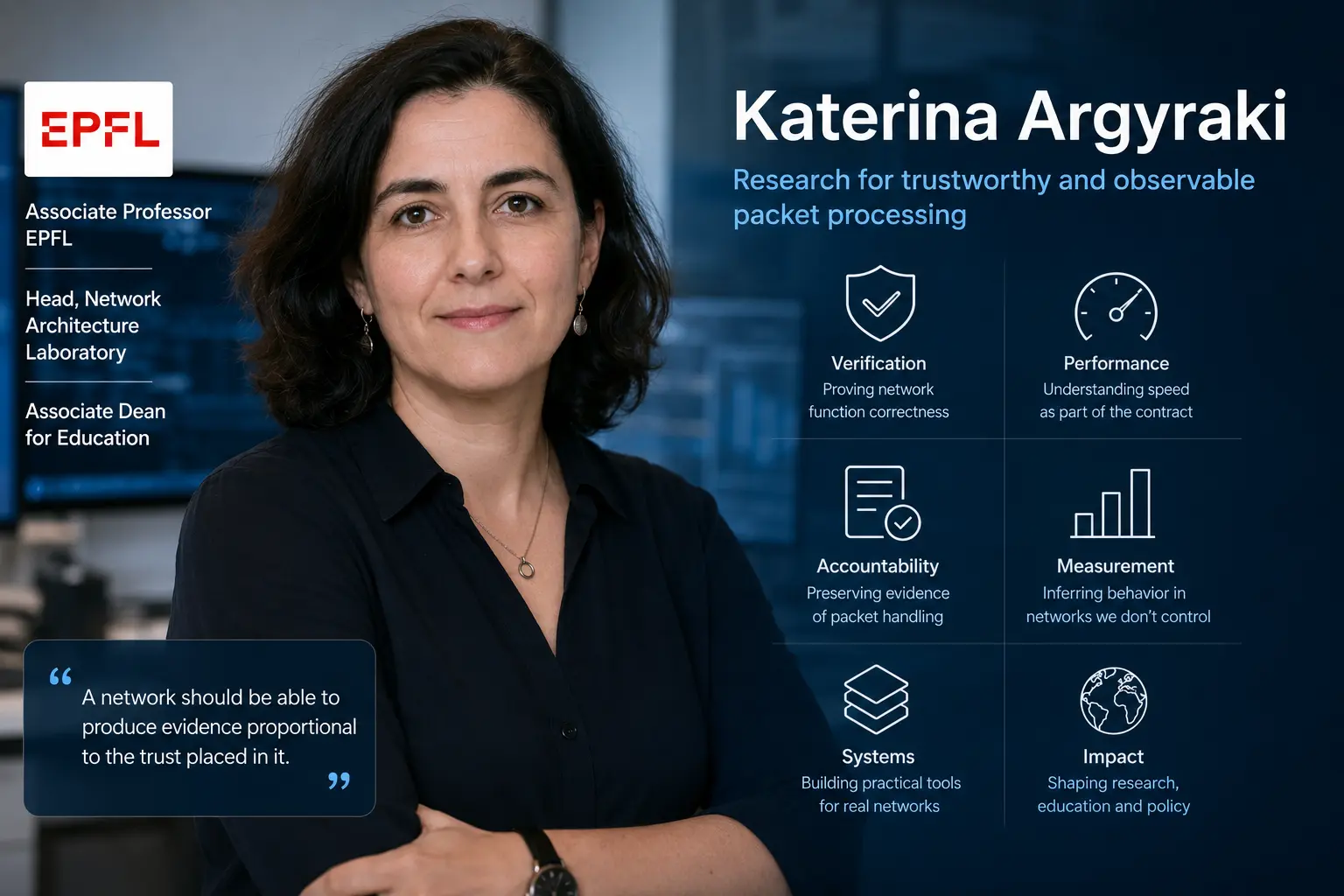
Katerina Argyraki and the search for proof in packet forwarding
Katerina Argyraki’s research follows a problem that becomes harder as networks become more programmable: a packet-processing system may be fast and flexible, yet operators and users often have little evidence that it behaved correctly. Her work at EPFL connects software-router…

Global Institutional
FreeRADIUS and the trust decisions behind network access
A network login may be decided in a few packets, but the trust behind it can span certificates, directories, access devices, roaming partners and accounting systems. FreeRADIUS makes that policy inspectable and programmable, while leaving operators responsible for the legacy…

Creators
Dave Maltz and the operating stack behind Azure networking
Dave Maltz’s role at Microsoft is best understood through the breadth of the organisation he leads. Azure Networking spans customer-facing services, DNS, security, distributed control, host offload, switch software, data-centre fabrics, wide-area links and optical systems. That…

History
The Receipt That Could Not Promise Delivery
SMTP DSN turned the bounce into structured evidence while preserving a crucial limit: a sender could request a report, but no receipt could promise more than the reporting system had observed.

CASE FILE
The Tag Fit. The Authority Did Not: BGP Large Communities and the Namespace That Executes Policy
The route carried exactly the value the interconnection handbook prescribed. One provider acted on it, another erased it, and a third would have accepted the same instruction from a party that had never been authorized to give it. Twelve octets solved the numbering problem. They…