
Summary
- linuxptp is a widely used Linux-native open-source implementation of IEEE 1588 Precision Time Protocol, built around modern kernel interfaces for hardware clocks, packet timestamps, external events and clock adjustment.
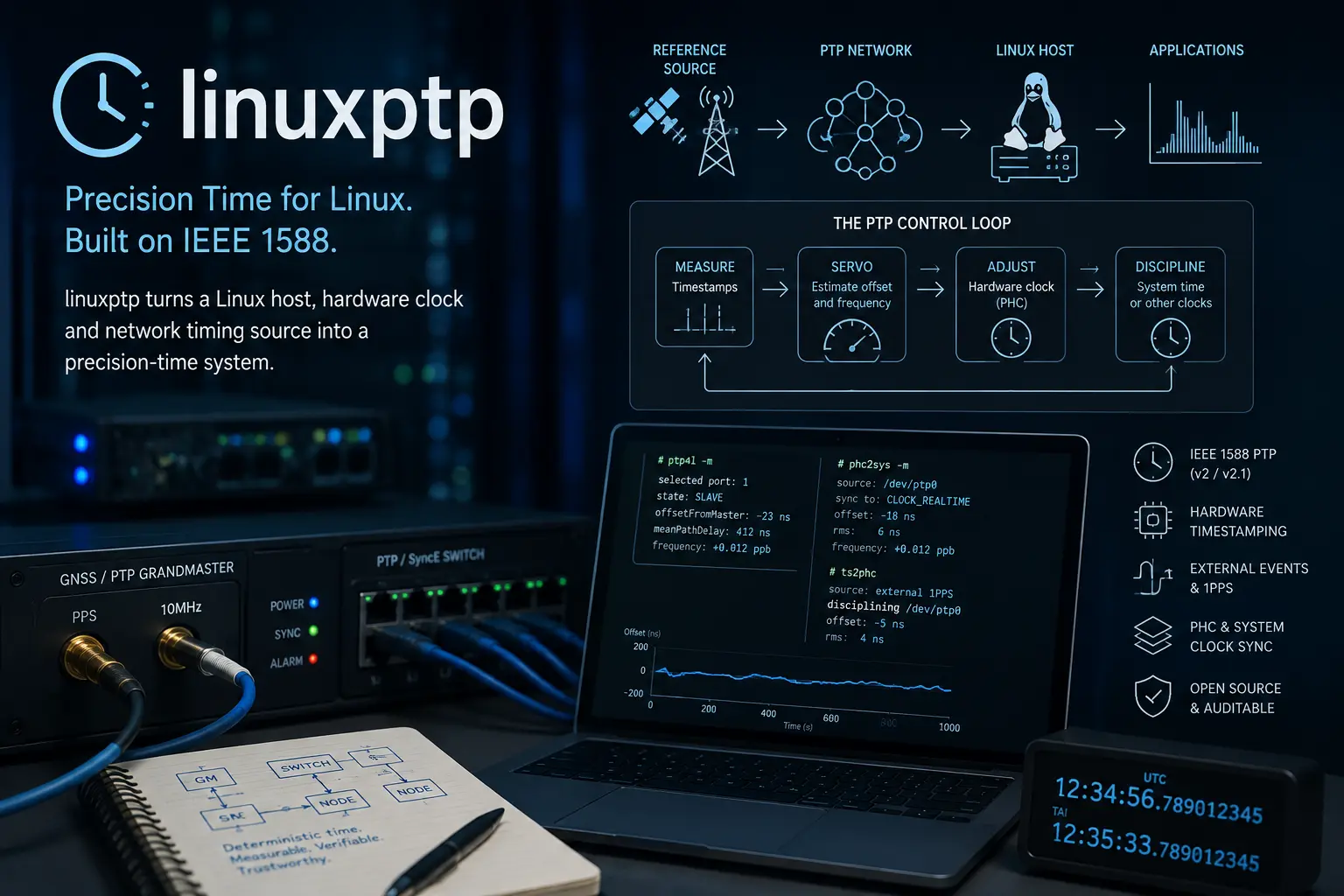
- The suite divides timing work among tools:
ptp4lruns PTP state and delay measurement,phc2sysconnects hardware clocks to system time,ts2phcdisciplines clocks from external timestamps, and management utilities expose configuration and state. - Accuracy is a property of the complete chain. A correct daemon cannot compensate for asymmetric paths, an unstable oscillator, an incorrect UTC offset, poor timestamp hardware, a spoofed GNSS reference or incompatible profile settings.
- The public release picture is fragmented: SourceForge identifies Richard Cochran as maintainer and still labels version 4.2 from December 2023 as its latest released download, while the actively maintained source tree identifies itself as version 4.4 and contains 2026 changes. Operators therefore need to distinguish release artefacts from current development state.
Precision time begins where ordinary timestamps stop being trustworthy
Most computers maintain time well enough for logs, certificates and human schedules. A quartz oscillator drifts, and a network protocol periodically corrects the system clock. For many applications, an error of milliseconds is acceptable. Telecom synchronisation, industrial control, power systems, market infrastructure and some data-centre workloads can require far tighter bounds and, equally important, evidence about when the bound is no longer being met.
The difficulty is not simply reading a better clock. A timestamp passes through a chain. A reference source provides frequency and phase. A receiver and oscillator turn that reference into a local clock. Hardware records when a packet crosses a boundary. A network transports timing messages through queues and switches. A servo estimates offset and frequency error. Software applies corrections to a hardware clock or the operating-system clock. The application consumes the result.
Error enters at every stage. Antenna cable delay can bias a GNSS reference. Forward and reverse network paths can have different delay. A driver can expose only some timestamp modes. A local oscillator can drift rapidly when the reference disappears. A stale UTC offset can create a large, clean-looking error. The daemon may report a selected master and still be following a compromised or degraded source.
linuxptp coordinates this chain on Linux. It is not the IEEE 1588 standard, the kernel’s PTP Hardware Clock subsystem, a grandmaster appliance or an NTP implementation. It supplies user-space daemons and tools that use modern Linux timing APIs. The project explicitly focuses on Linux and does not treat compatibility with legacy APIs or other operating systems as a primary goal.
That focus is important. Precision time depends on close integration between user space, kernel and device. A portability layer that hides hardware differences too aggressively can obscure the exact timestamp and adjustment capabilities the operator needs to know. linuxptp assumes that drivers expose clocks through standard kernel interfaces and then builds protocol state and control loops around them.
The project’s value is therefore architectural. It lets an operator combine timing-capable NICs or cards, Linux servers, PTP profiles and chosen reference sources without buying one closed software stack for every device. The operator gains inspectability and supplier choice. It also inherits calibration, validation and monitoring work often bundled into a commercial timing appliance.
Precision-time infrastructure fails differently from ordinary service software. A stopped daemon is visible. A clock that continues running with a plausible but incorrect offset can corrupt event ordering while every process appears healthy. The objective is not only availability; it is truth within a known uncertainty.
Linux created a common hardware-clock interface before linuxptp could coordinate it
Hardware timestamping existed before linuxptp, but device-specific interfaces made generic timing software difficult. Linux’s PTP Hardware Clock class gave drivers a standard way to expose a clock through devices such as /dev/ptp0. User space could read and adjust the clock through familiar clock APIs and specialised ioctls rather than relying on one vendor utility.
The kernel also provides packet timestamping through SO_TIMESTAMPING. A driver and device can record when selected packets are transmitted or received close to the MAC or PHY boundary. That location reduces the variability introduced by interrupts, scheduling and user-space processing. The exact boundary still matters; a timestamp at the MAC and one at the PHY include different parts of the physical path.
External timestamp inputs let a PTP Hardware Clock capture the arrival of a physical event such as a pulse-per-second signal. Periodic outputs can drive other equipment. PPS integration, cross-timestamping and clock adjustment APIs provide additional pieces for connecting device time with the rest of the system.
These interfaces separate the kernel’s responsibility from linuxptp’s. The kernel exposes clocks, timestamps and adjustment mechanisms. The driver maps device capability into those interfaces. The NIC, PHY or timing card contains the counter and timestamp hardware. linuxptp runs protocol state, computes corrections and coordinates clocks.
A standard interface improves portability without guaranteeing parity. One NIC may timestamp all required PTP event messages and expose configurable pins. Another may support only a subset. Firmware can change filters or calibration. A driver can implement the API and still contain a defect. Operators need a capability matrix tied to exact hardware, firmware and kernel versions.
The kernel boundary also affects security and operations. Direct clock adjustment requires privileges. A process with access to a PHC can disrupt time even if it cannot change the grandmaster. Device naming can change when hardware is added. Containers may see system time without direct access to the underlying PHC. Orchestration has to assign the right device to the right timing workload.
linuxptp emerged around these modern APIs and was registered as a public SourceForge project on 1 October 2011. Source history may predate that registration, but the date marks its public project infrastructure. The design choice to depend on current Linux timing mechanisms produced a coherent suite rather than a collection of compatibility shims.
The result is a form of hardware-software co-design. The open daemon can support many devices because the kernel normalises the control surface. The highest precision remains dependent on device implementation. Openness reduces software lock-in; it does not turn every oscillator and timestamp unit into a commodity.
ptp4l runs the state machine that decides which clock to follow
ptp4l is the main daemon in the suite. It participates in a PTP domain, exchanges protocol messages, measures path delay and disciplines a clock. It can operate as an ordinary clock, boundary clock or, subject to support and configuration, a transparent clock.
PTP nodes announce information about clock quality, priority and identity. The Best Master Clock Algorithm compares the data and determines which clock becomes grandmaster and which ports operate as master or slave. The result is not simply “choose the most accurate oscillator.” Operator priorities and profile rules can make a particular source preferred. Topology and permitted roles constrain the election.
Once a port follows a master, Sync and related messages provide timing information. In one-step operation, an accurate transmit timestamp can be placed in the event message. In two-step operation, the timestamp follows in a separate message. Delay messages estimate how long packets take through the path. The daemon combines these observations to estimate offset between clocks.
The estimate depends on assumptions about delay. Many calculations treat forward and reverse delay as sufficiently symmetric. If one direction consistently takes longer, half the round-trip estimate is biased. Queueing, route changes, different fibres and switch behaviour can all create asymmetry. The protocol can measure and correct some components; it cannot infer every hidden physical difference.
ptp4l then uses a servo to adjust phase and frequency. A proportional-integral controller, linear-regression approach or other strategy can trade convergence speed against noise. Large initial offsets may be stepped; steady-state errors are often slewed to preserve application expectations. An aggressive servo can chase packet-delay variation. A conservative one can take too long to recover.
Port state and master selection must be monitored, not assumed. A slave can remain synchronised while the grandmaster identity changes. The new source may be less trusted or located on an unexpected path. A healthy offset after failover can hide that redundancy has collapsed to one remaining reference.
The daemon’s configuration contains profile, transport, domain, priority, delay and servo choices. Two devices can both claim IEEE 1588 support and fail to interoperate because one uses end-to-end delay and the other peer-to-peer, or because their profiles require different message rates and roles. “PTP enabled” is not an interoperability statement.
ptp4l therefore implements a control protocol, not a universal clock-quality guarantee. It can select and discipline the best source visible under the configured rules. The operator must ensure that the candidates, topology and hardware make that selection meaningful.
End-to-end and peer-to-peer delay describe different network contracts
PTP commonly uses end-to-end or peer-to-peer delay measurement. The mechanisms are not interchangeable, and a deployment must align devices and profile expectations.
End-to-end delay measures between a slave and its master across the network path. Delay request and response messages help estimate the round trip. The method can operate through ordinary switches, but queueing and path asymmetry accumulate across the path. Intermediate devices may not expose their residence time.
Peer-to-peer delay measures the link between neighbouring PTP-aware devices. Transparent clocks can account for the time an event message spends inside a switch and add a correction. The approach requires participating infrastructure and consistent support along the path.
A boundary clock terminates timing on one port and regenerates it on another. It has a local clock disciplined from upstream and acts as a master downstream. This can limit error and scale domains, while adding another oscillator, servo and failure point. A transparent clock does not become a time source; it measures and reports residence time so endpoints can correct for it.
An ordinary clock has one PTP port and may operate as master or slave. Grandmaster appliances are ordinary clocks with high-quality references and oscillator designs, but the protocol role alone says little about holdover or source integrity.
Topology determines which design is appropriate. Telecom networks may require full on-path timing support and carefully engineered boundary clocks. An industrial segment may use peer delay inside a controlled domain. A data centre may choose a profile that fits its switch and NIC capabilities.
Misconfiguration can produce a system that exchanges messages without meeting its error budget. A node may lock to a master through the wrong delay mechanism. A transparent clock may be absent on one path. Load balancing can move messages between unequal routes. The daemon can report stable state while a systematic asymmetry remains.
Testing needs more than offset between two software clocks. Operators use calibrated instruments, loopback methods, PPS comparison and path analysis to identify where error enters. Cable lengths, SFPs, switch firmware and timestamp points belong in the test record.
linuxptp exposes the protocol controls needed for these architectures. It does not certify the physical network. That boundary is one reason project support and operator expertise remain valuable even when the software is free.
phc2sys connects the network-facing clock to the time applications actually read
A NIC’s PTP Hardware Clock can be closely synchronised to the network while Linux system time remains wrong. Applications generally read CLOCK_REALTIME, not /dev/ptp0. phc2sys bridges that gap by synchronising one clock to another.
The direction matters. In a common slave host, ptp4l disciplines the NIC PHC from the network, and phc2sys disciplines the system clock from that PHC. In a grandmaster design, an external source may discipline the PHC and the system clock may follow. A reversed configuration can cause clocks to fight or make a less accurate source control the better one.
Automatic modes can derive relationships from ptp4l state, reducing manual error. Complex hosts can contain several NIC PHCs and interfaces. The tool may need to track which port is active and which clock should be the source. Hardware replacement or interface renaming can break an assumption that appeared stable.
Timescales create another risk. PTP time and UTC are related but not identical. The current UTC offset and leap-second state must be handled consistently. A stale offset can produce an error of whole seconds while the servo reports a stable relationship. An application may receive monotonic corrections and still be wrong relative to civil time.
Stepping the system clock can disrupt applications that assume time never moves backward. Slewing preserves continuity but may take longer to correct a large offset. Operators need a policy for startup, failover and recovery. The correct behaviour for a telecom radio can differ from that for a database or logging system.
phc2sys can also synchronise multiple PHCs, depending on configuration and support. That is useful in boundary-clock hosts or systems with several ports. Cross-timestamp quality and device capabilities affect the achievable precision.
Monitoring should show source and destination, offset, frequency adjustment, state and last successful update. A single “synchronised” flag is insufficient. The service should alarm when the source changes, the servo saturates or the UTC offset becomes inconsistent.
The tool demonstrates why linuxptp is a suite rather than one daemon. Network protocol state and application-visible time are separate control loops. A deployment can operate the first correctly and fail the second. Precision infrastructure has to trace the entire path from reference to consumer.
ts2phc brings physical reference signals into Linux hardware clocks
Grandmaster and timing-card systems often receive a pulse-per-second signal from GNSS or another high-quality reference. A pulse provides precise phase but not complete date and time by itself. Separate time-of-day information identifies which second the pulse represents.
ts2phc uses external timestamp inputs on supported PTP Hardware Clocks to discipline them from such signals. The PHC captures the event close to hardware, avoiding much of the uncertainty of a user-space interrupt timestamp. The tool can connect one physical reference to several device clocks.
Hardware support is decisive. The timing card or NIC must expose configurable pins and external timestamp capability through the kernel driver. Polarity, channel mapping and edge selection must match the wiring. A pin configured for output instead of input can produce no useful evidence while software remains running.
Cable delay and receiver behaviour need calibration. A long antenna or PPS cable adds a fixed offset. Temperature and component ageing can change it. The reference may be stable but biased. Calibration values should be documented with hardware serials and installation details.
GNSS supplies globally available absolute time but introduces security and availability risks. Jamming can remove the signal. Spoofing can present a plausible false time. Antenna failure, multipath and receiver faults can degrade quality. ts2phc disciplines a clock from the input it receives; it cannot determine that the sky signal is truthful without additional evidence.
Multi-constellation receivers, antenna monitoring, source comparison and holdover can improve resilience. An independent reference such as another GNSS path, terrestrial service or atomic source can reveal disagreement. The selection and voting logic may sit outside linuxptp.
External timestamps can also come from laboratory or industrial sources other than GNSS. The architecture is general: hardware captures a physical event, and software controls the clock based on it. The accuracy remains tied to the source, input path and device.
ts2phc makes an open Linux host capable of participating in designs previously associated with proprietary grandmaster appliances. The trade is that the operator must engineer the analogue and physical details the appliance vendor would otherwise integrate and certify.
timemaster coordinates PTP with NTP rather than declaring one universal protocol
PTP and NTP solve overlapping but different problems. NTP and implementations such as chrony are effective for general system time over wide-area networks with variable delay. PTP, especially with hardware timestamping and engineered paths, targets tighter precision and profile-specific environments.
A host may need both. It can use PTP as a local high-precision source and NTP as a fallback or distribution mechanism. timemaster coordinates linuxptp with chrony or ntpd, generating or supervising configuration so the daemons do not fight over the same clock.
Combining sources requires priority and failure policy. An NTP source should not pull the system away from a healthy PTP grandmaster merely because its reachability score changes. PTP should not remain preferred when the selected master is degraded or the servo is no longer trustworthy.
Clock loops are a particular danger. If system time influences a PTP source that then disciplines system time, the apparent redundancy is circular. Topology documentation should include timing dependencies just as a network diagram includes routing dependencies.
Chrony can use PHC or PPS references in several architectures. The exact integration depends on application needs and available hardware. timemaster reduces configuration burden but cannot decide the organisation’s source hierarchy.
NTP also provides a different security and operational ecosystem. Authentication, server diversity and internet reach can complement local PTP. The precision and error model differ. Failover may preserve correct time at lower accuracy, which can be preferable to continuing with a precise but false source.
Mixed-protocol design should expose an error budget for each state. Applications may continue normally under PTP, operate in degraded mode under NTP or stop when uncertainty exceeds a threshold. Without that contract, a failover that looks successful to the daemon may violate the service.
linuxptp’s coexistence with chrony and ntpd demonstrates a practical philosophy: precision time is an architecture, not a protocol contest. The correct combination follows the requirement and failure model.
Management tools make the clock state inspectable—but not self-explanatory
The suite includes pmc for PTP management messages, phc_ctl for direct hardware-clock inspection and adjustment, and hwstamp_ctl for hardware timestamp configuration. These tools give operators access to the state and capabilities that determine timing behaviour.
pmc can query data sets such as clock identity, port state, priorities and timing properties. Management visibility is essential when a node follows the wrong grandmaster or a profile value differs from expectation. Write access requires care because changing a priority or data set can alter domain selection.
phc_ctl provides direct operations on a PHC. It is useful for diagnostics and laboratory tests. A manual adjustment in production can disrupt the control loop. Administrative access should be restricted and changes recorded.
hwstamp_ctl configures NIC timestamping through driver interfaces. Devices vary in which filters and modes they support. A request may be rounded to a broader filter, rejected or accepted with firmware-specific behaviour. The effective configuration should be read back and tested.
Logs and management data need context. An offset value without source identity, delay mechanism and servo state can be misleading. A small offset after the reference changed may hide a loss of diversity. A large transient after a planned failover may be acceptable if it recovers within the application budget.
Timing telemetry is often more useful as a time series than as a dashboard snapshot. Frequency adjustment, path delay, grandmaster identity, GNSS state, oscillator temperature and packet counters can reveal drift before the offset breaches a threshold.
The monitoring path needs independent validation. If the same bad system clock timestamps its own alarms, event order can be confusing. External comparison or hardware signals may be needed for high-assurance deployments.
Open tools make the state accessible to automation. They do not create a universal telemetry schema or incident model. Downstream projects and operators must decide which metrics, alerts and actions fit the profile and application.
Profiles convert a flexible standard into a concrete interoperability contract
IEEE 1588 is deliberately broad. It supports several transports, clock types, delay mechanisms, message rates and selection behaviours. Two products can implement the standard and still be unable to form the intended timing system. Profiles constrain the options for a particular domain.
Telecom uses profile families such as ITU-T G.8265.1 for frequency distribution and G.8275.x for phase and time. The profiles define topology assumptions, message behaviour and clock quality appropriate to carrier networks. Some require full on-path support; others are designed for partial timing support.
Power systems and industrial networks use specialised profiles because event ordering and control have different requirements. IEEE 802.1AS, often called generalized PTP, serves time-sensitive networking environments. Each profile creates expectations about device behaviour beyond a generic “supports PTP” statement.
linuxptp includes options and capabilities for several profiles. Software support means the daemon can be configured to participate. It does not certify the complete product. Accuracy, holdover, oscillator class, redundancy, environmental performance and hardware timestamping remain separate.
Profile conformance also has version and interpretation questions. A vendor may support selected clauses or require proprietary settings. An operator mixing equipment should test message rates, BMCA behaviour, announce timeouts, delay mechanism and failover.
Telecom architecture frequently combines PTP with Synchronous Ethernet. SyncE distributes frequency through the physical layer, reducing the frequency error the PTP servo must correct. PTP supplies phase and time. The two systems have separate quality and failure messages whose interaction needs management.
A node can remain phase-aligned temporarily after SyncE or GNSS fails because its oscillator enters holdover. The profile may define quality signalling, but the operator needs to know how long the clock remains within budget. Software cannot infer oscillator ageing and temperature performance from a label alone.
Profiles therefore make the deployment more disciplined and more dependent on complete system qualification. linuxptp’s open implementation gives operators access to the protocol logic. Certification and interoperability require hardware and test evidence around it.
Holdover determines whether a reference failure becomes a service failure
When a clock loses its reference, its oscillator continues running. Holdover describes how accurately it maintains time during that interval. A low-cost oscillator may drift quickly. An oven-controlled crystal oscillator can perform better. A chip-scale atomic clock offers different stability, power and cost.
linuxptp can report state and control clocks, but it does not change the physical oscillator’s quality. A system designed around continuous GNSS may meet its specification in normal operation and fail rapidly during jamming. A system with strong holdover may preserve service while the reference is investigated.
Holdover claims require conditions. Temperature range, ageing, prior lock time and duration affect performance. A headline such as “microsecond holdover” is incomplete without the interval and environment. Vendors and operators should state the error envelope over time.
The servo’s history matters. An oscillator disciplined for a long period may have a better frequency estimate than one that just started. A sudden reference loss after a temperature change can produce different behaviour. Monitoring should preserve the estimate and confidence, not only switch to a binary holdover state.
Source recovery also needs policy. Immediately stepping back to a returned GNSS signal can be dangerous if the signal is spoofed or inconsistent. The system can compare references, validate the offset and slew gradually. A secure design treats reacquisition as a decision, not automatic truth.
Redundant grandmasters can reduce dependence on one device while sharing the same antenna, power or constellation. Physical and logical diversity should be documented. Two clocks in one rack are not independent if one GNSS splitter or power feed controls both.
Applications need a degraded-mode contract. Some can tolerate increasing uncertainty and mark timestamps accordingly. Others must stop or fail over before order can no longer be guaranteed. Precision time without an exposed error bound encourages applications to use a timestamp beyond its validity.
Holdover makes the economics of timing visible. The open software may be free, but oscillator quality, redundant sources and calibration dominate the cost of resilience. linuxptp allows an operator to choose those components; it cannot remove the trade.
Cloud-native orchestration changes deployment scale, not the timing physics
Telecom and edge systems increasingly run workloads on Kubernetes. Projects such as the OpenShift PTP Operator package linuxptp configuration, node selection, monitoring and event handling for clusters. This makes timing part of declarative infrastructure rather than a collection of manually edited host files.
Orchestration can assign profiles to nodes, manage daemon processes and expose timing status to applications. It can coordinate updates and ensure that workloads requiring precision run on hardware with suitable clocks. Events can trigger remediation or workload movement.
The abstraction is useful and potentially misleading. A Kubernetes custom resource can describe a desired timing policy; it cannot create hardware timestamping on a NIC that lacks it. Scheduling a pod onto a “PTP capable” node does not prove the node is within the required offset or following the correct grandmaster.
Container boundaries introduce access questions. The daemon may need privileges, host networking and direct device access. The application may need system time rather than the PHC. Security policies should limit which workloads can adjust clocks while allowing them to read quality information.
Cluster upgrades can change kernels, drivers and daemon versions together. A timing regression may appear as an application issue after an otherwise successful platform update. Qualification should include the complete node image and hardware combination.
Multi-interface nodes can participate in several domains or profiles. Orchestration must select the right PHC and avoid conflicting policies. Device discovery based only on interface names can fail after replacement or PCI enumeration changes.
Cloud-native monitoring can improve scale by aggregating state and raising events. It can also create alert storms during a domain-wide reference change. The event model should distinguish expected topology transitions from loss of accuracy.
The operator does not replace timing engineering. It moves its configuration into a system that can reproduce and audit it. The same principle applies across linuxptp: automation is valuable when it preserves the physical and protocol assumptions rather than hiding them.
Release evidence is fragmented enough to become an operational risk
SourceForge identifies Richard Cochran, using the rcochran account, as maintainer and shows project activity updated on 5 June 2026. Its file browser still lists version 4.2 from 19 December 2023 as the latest released download, while the active source tree identifies itself as version 4.4 and includes 2026 commits. Network Time Foundation separately provides project support, documentation and mailing-list infrastructure.
These facts establish active development and a fragmented release picture, not a simple one-number answer to what is deployed or formally released. A publication or deployment decision should distinguish the SourceForge release archive, the current source tree, downstream packages and any vendor-maintained build, then verify signatures and release notes for the artefact actually being used.
The split matters because operators often build from distribution packages or vendor images. A package may contain a backport, a snapshot or a security fix without matching the mirrored version. A container image can be current while its host driver is not. Version identity should include source, build and downstream modifications.
Release ambiguity can slow security response. An advisory may name an upstream version, while the operator sees a distribution revision. The organisation needs a software bill of materials and a way to map fixes to deployed binaries.
It can also create supply-chain risk. Downloading from an old mirror or an unofficial archive increases the chance of using stale code. Signing keys and checksums should be part of the documented acquisition process. The support organisation and project should communicate which host is authoritative.
The project’s long-running leadership provides continuity, but the public record identifies one principal maintainer more clearly than a broad governance roster. Timing software benefits from experienced review because small arithmetic, timescale or driver changes can create large effects. Concentration creates succession and throughput risk.
Network Time Foundation provides support and hosts the PTP/SyncE Consortium according to project material. That relationship does not establish ownership of every code decision or a published linuxptp budget. Funding, review authority and support commitments should be distinguished.
The issue is not administrative trivia. Precision-time systems need a trustworthy software source. Clear release provenance is part of the clock’s evidence chain, just as source identity and path delay are.
Open software reduces licence dependence while exposing the real timing bill
linuxptp has no published standalone revenue, payroll, valuation or customer register. Its GPLv2 code can be used and modified without a per-node licence. Network Time Foundation and ecosystem vendors offer support, while operators and hardware companies contribute code and testing.
The absence of a software licence does not make precision time inexpensive. Operators purchase timing-capable NICs and switches, grandmasters, GNSS receivers, antennas, oscillators, cabling, instruments and engineering. They test profiles and maintain physical reference paths. Commercial value is distributed across this ecosystem.
Open software can improve bargaining power. A hardware vendor that exposes standard PHC and timestamping interfaces can work with the same daemon used on another device. The operator can inspect servo and protocol behaviour and retain configuration when changing suppliers.
Hardware differentiation remains substantial. A product with better timestamp units, oscillator or calibration may justify a premium. Proprietary stacks can integrate those features tightly and carry certification or support. An open daemon does not guarantee that a cheaper card will meet the same error budget.
The cost shifts toward integration. A commercial appliance vendor may deliver one qualified system with a support contract. A disaggregated design gives the operator choice among components and requires it to validate the combination. The economics depend on scale, skill and the consequence of failure.
Timing also creates hidden application cost. Deploying PTP where no application has a defined need can add devices, attack surface and operational complexity without business benefit. The requirement should state an error budget, holdover duration and consequence of violation before architecture is selected.
Where the requirement is real, open control can be strategically valuable. Telecom and industrial operators can avoid tying a critical timing service to one appliance software stack. Data centres can integrate time quality into orchestration and application decisions. The software remains one component in a capital system.
linuxptp’s economic contribution is therefore not a claim that commodity hardware becomes a grandmaster for free. It gives operators a common, inspectable control layer through which they can make their chosen hardware and sources work together.
Security is moving from keeping the clock available to proving the clock is true
Traditional monitoring often treats time as a service that is either reachable or unavailable. A precision-time system can fail more dangerously by remaining available and wrong. A spoofed grandmaster or GNSS signal can lead clocks smoothly away from correct time.
PTP networks can be attacked through forged Announce messages, delay manipulation, management access or compromised devices. A malicious clock can advertise attractive priority and quality. Network isolation and profile controls reduce exposure but do not authenticate physical truth.
GNSS is vulnerable to jamming and spoofing. Jamming produces an obvious loss if monitored. Spoofing can create a plausible signal whose time drifts gradually. Multi-source comparison and anomaly detection are essential where consequence is high.
Delay attacks exploit the assumption that path measurements reflect ordinary transport. An attacker or congested device can introduce asymmetric delay that biases offset. Cryptographic authentication of messages does not prove that delay is symmetric.
Management interfaces need access control. A legitimate pmc write or direct PHC adjustment can change system behaviour. Logs should record source changes, priority changes and manual actions. Remote administration should be separated from the timing data path.
Source diversity should include failure domains. Two GNSS receivers using one antenna are vulnerable to the same cable and sky event. Two PTP grandmasters following the same upstream source do not provide independent truth. Terrestrial, atomic or cross-site references can improve validation.
Applications should receive quality and uncertainty, not only a timestamp. A database can refuse to order events whose uncertainty overlaps. A radio system can enter holdover mode. A security system can flag logs whose clock source changed. The daemon’s state needs to reach the consumer.
linuxptp supplies much of the control and evidence needed for this architecture, but it is not a complete security certification regime. Operators must build source authentication, anomaly detection and response around it. The strategic shift is clear: the objective is no longer just synchronisation. It is auditable confidence that the selected time remains the right time.
Precision depends on the weakest boundary, not the best component
A deployment can contain an accurate grandmaster and produce poor application time because a NIC timestamps in software. It can use a high-quality NIC and fail because the path is asymmetric. It can achieve a small PHC offset while the system clock follows the wrong direction. It can pass a profile test and fail during GNSS loss because holdover was not qualified.
This weakest-boundary principle is the central discipline of linuxptp operations. Every claim should identify the complete path from source to application. A benchmark of ptp4l cannot establish cable calibration. A hardware specification cannot establish profile configuration. A stable offset cannot establish source integrity.
The project’s architecture helps because responsibilities are visible. The kernel exposes PHCs and timestamps. ptp4l operates the network clock. phc2sys bridges clocks. ts2phc handles external events. pmc exposes management state. Operators can inspect where each correction occurs.
Visibility still needs integration. Metrics from the daemon, GNSS receiver, oscillator and application should share identity and time context. An incident record should show which source was selected, how offset evolved, when holdover began and which clocks remained within budget.
Calibration must be treated as data with a lifecycle. Cable changes, firmware updates and hardware replacement can invalidate compensation. Values should be tied to equipment and verified after maintenance.
Profile compliance should be tested between actual products. Documentation can say that both support G.8275.1 while their defaults or firmware differ. Interoperability events and independent conformance labs can reduce uncertainty, but production topology remains unique.
The project’s release and maintainer model is another boundary. A timing-critical change needs review, reproducible builds and a trusted update path. Open source makes this possible; it does not guarantee the organisation has implemented it.
linuxptp made precision-time control available as standard Linux infrastructure. Its success should not be measured by whether a host can run ptp4l. It should be measured by whether the entire chain can state, monitor and defend an error budget under normal operation and failure.
Calibration decides whether a nanosecond timestamp describes the wire or the laboratory
A hardware timestamp is more precise than a software timestamp and still contains delay. The signal travels through an antenna cable, receiver, oscillator, board traces, PHY and MAC before software reads a clock. Transmit and receive paths can have different fixed offsets. Temperature, firmware and hardware revision can change them. Precision time therefore needs calibration, not only protocol convergence.
Commissioning should begin with the physical reference. A GNSS antenna installation has cable length, connectors, amplifiers and visibility conditions. The receiver may report a valid fix while a damaged cable or incorrect delay compensation shifts time. Multi-constellation support improves availability and can help detect anomalies, but it does not prove that the antenna path is uncompromised.
The PHC path needs similar attention. A NIC or timing card exposes a counter through the Linux PTP Hardware Clock interface. The timestamp point may be at the MAC, PHY or another device boundary. Drivers and firmware determine how that event is delivered. Two interfaces reporting hardware timestamping can therefore have different uncertainty and asymmetry.
A calibration process compares the system against a traceable reference under documented conditions. It should record fixed offsets, temperature range, firmware, driver and cable configuration. The result belongs to that assembly. Replacing a NIC, moving an antenna cable or updating firmware can invalidate it. Treating calibration as a one-time property of a model number hides this lifecycle.
Path asymmetry is one of the most difficult errors because ordinary delay measurement can interpret it as clock offset. If a Sync message and a delay request experience unequal forward and reverse delay, the algorithm’s symmetric-path assumption produces bias. The servo can be stable and precisely wrong. Congestion, different fibre lengths, protection switching or routing changes can introduce asymmetry after commissioning.
Operators need tests that deliberately change paths and loads. A boundary clock or transparent clock can improve the time distribution architecture, but its residence-time correction and port behaviour also need verification. A failover path should be measured before it is needed. Network redundancy that preserves packet reachability may violate the time-error budget because the alternate route is longer or less symmetric.
The best evidence comes from independent comparison. A second reference, travelling clock, calibrated test set or cross-check between separate grandmasters can reveal common-mode errors that ordinary PTP state cannot. Monitoring only the offset reported by the same servo that controls the clock creates a circular assurance claim.
Calibration data should enter inventory and change management. An interface can be “up” and unsuitable for a timing service because the calibration record is missing or expired. Automation can prevent an unqualified port from becoming a grandmaster or boundary-clock path. This is especially important in Kubernetes environments where workloads and configurations can move faster than the physical timing chain.
linuxptp exposes controls and statistics needed for this work. It does not certify the antenna, oscillator, NIC or path. The operator earns precision by maintaining evidence across those boundaries.
Time quality has to be delivered to applications, not assumed from CLOCK_REALTIME
A host can participate successfully in PTP while an application remains unable to judge whether its timestamp is trustworthy. ptp4l may discipline a PHC, and phc2sys may transfer that time to the system clock, but the application usually reads a conventional API that returns a number without its current uncertainty, source or holdover state.
This gap matters when event order is close. Two services can produce timestamps separated by less than the possible clock error. Sorting the numbers creates a definitive order the infrastructure cannot support. Databases, security systems and distributed traces can then infer causality from noise.
An application-facing time service should expose more than seconds and nanoseconds. Useful metadata includes clock identity, synchronisation state, estimated maximum error, last reference update, holdover duration and any step or leap event. Applications can then decide whether to accept a timestamp, enlarge an ordering window or defer an operation.
The estimate has to be honest. Servo offset alone is not a complete error bound. It may omit path asymmetry, calibration uncertainty and reference integrity. A system can report a small local offset while following a spoofed grandmaster. Quality should combine protocol state with source monitoring, calibration and oscillator behaviour.
Timescale is another source of error. PTP commonly operates on a timescale related to International Atomic Time, while applications often expect UTC. Leap seconds and the current UTC offset must be handled correctly. A configuration that transfers the wrong timescale can create a large and stable error that looks like successful synchronisation. phc2sys direction and offset settings are therefore safety-critical.
Clock steps deserve special treatment. An initial large offset may be corrected by stepping, while normal operation slews frequency to avoid discontinuity. Applications sensitive to monotonicity need to know when a step occurred. Some systems should use a monotonic clock for durations and a synchronised real-time clock only for external correlation.
A mixed PTP and NTP environment further complicates quality. timemaster can coordinate daemons, but the operator has to prevent control loops and define source priority. An application should not assume that a clock remains within the same error envelope after falling back from a local PTP grandmaster to a distant NTP source.
The strongest timing architecture therefore treats time as a service with a stated quality rather than a hidden host property. linuxptp supplies much of the control plane. Additional interfaces, monitoring and application design are needed to preserve the uncertainty all the way to the decision using the timestamp.
Holdover tests should last long enough to expose the oscillator, not only the software
When GNSS or another reference disappears, the clock enters holdover. The oscillator continues running based on its recent frequency estimate. Error grows with oscillator quality, temperature, ageing and the servo state at the moment of loss. A brief laboratory disconnect can make almost any system look resilient.
A meaningful test lasts for the outage the service is expected to survive and varies environmental conditions within the deployment envelope. It records time error over the interval, not merely whether the daemon remains in a stable state. An oven-controlled crystal oscillator, chip-scale atomic clock and ordinary oscillator have different cost, power and holdover behaviour. Software cannot make them equivalent.
The transition into and out of holdover also needs testing. A bad reference should not immediately drag a good local clock away from correct time. Source selection and sanity checks can reject an implausible jump. When the reference returns, an aggressive correction can create a step or oscillation. The servo should re-acquire in a manner compatible with application requirements.
Redundant grandmasters reduce one failure mode and can create another if they share GNSS, power, antenna or configuration. Diversity should be assessed at the reference and failure-domain level. Two appliances in one rack using one antenna feed do not provide independent protection against spoofing or cable failure.
Profile compliance does not establish holdover. Telecom profiles constrain messaging and topology; product requirements may specify oscillator and time-error limits. Operators should keep software support, profile interoperability and complete timing-appliance qualification as separate evidence.
linuxptp can report state changes and manage source relationships, but the holdover outcome is a system property. Procurement and operational acceptance should therefore require timed outage curves, temperature conditions, source-failure scenarios and the exact hardware configuration. Without that evidence, “supports PTP” says very little about continuity.
Version provenance is part of timing assurance
The project’s public release picture is fragmented. SourceForge still identifies version 4.2 from December 2023 as its latest released download, while the active source tree identifies version 4.4 and shows development continuing into 2026. A publication should distinguish released artefacts from development state, and an operator should not infer patch status from a package name alone.
Distributions and appliance vendors may backport fixes without changing the upstream version in an obvious way. They may also carry profile patches or driver dependencies. The running service should therefore be traceable to source, package revision and build configuration. A software bill of materials is useful because timing depends on kernel, driver, firmware and daemon versions together.
Upgrade testing should include clock behaviour, not only process startup. A change can alter default servo parameters, profile interpretation, management messages or multi-domain behaviour. The same configuration file may produce a different control response. Recorded PTP exchanges and hardware-in-the-loop tests can compare releases before fleet rollout.
This provenance is especially important in orchestrated deployments. A container image may update independently of the host kernel and NIC firmware. The operator needs a supported matrix rather than an assumption that all modern components interoperate. A precise clock assembled from untracked versions is not auditable precision infrastructure.
Profile interoperability should be demonstrated under failure, not inferred from configuration
Two systems can claim support for the same PTP profile and still fail to provide a dependable service together. Profiles constrain message rates, transport, clock roles and selection rules, but implementations may differ in optional behaviour, management support and fault handling. Product compliance statements therefore need an interoperability test on the intended topology.
The test should include ordinary operation and transitions: grandmaster loss, alternate-master selection, packet delay variation, interface reset, boundary-clock restart and restoration of the preferred source. Operators should measure time error and convergence, not merely whether ports return to a “slave” or “master” state. A state-machine label can be correct while the clock exceeds the application budget.
Telecom environments add SyncE and profile-specific quality signalling. Frequency and phase sources can fail independently. A device may preserve frequency while absolute time drifts, or select a source whose advertised quality does not match reality. Cross-checking reference identity and observed error is necessary.
Interoperability evidence should name software, firmware, oscillator and hardware revisions. A vendor update can change servo or BMCA behaviour without changing the marketing claim. Keeping the test as an automated acceptance suite turns the profile from a paper promise into an operating contract.
Timing incidents need a record of the clock chain at the moment of failure
When logs disagree after an incident, teams often discover that they did not retain enough timing state to explain why. A useful record includes the selected grandmaster, port states, UTC offset, servo mode, estimated offset and frequency, source alarms, PHC-to-system-clock relationship and recent topology changes.
The record should be collected independently of the application logs it is meant to validate. If a host clock steps and rewrites the apparent timeline, a remote collector or monotonic sequence can preserve ordering. Management messages and linuxptp logs can supply state, but retention and correlation have to be configured before the event.
Post-incident analysis should distinguish timestamp error from event-processing delay. A service may emit a correct timestamp late, or record an event promptly against a bad clock. The remediation differs. Without the clock-chain evidence, teams can “fix time” while leaving the actual latency problem untouched.
Treating timing state as incident evidence also improves security response. An unexpected grandmaster change, GNSS alarm or offset pattern can support investigation of spoofing or misconfiguration. The objective is not to prove intent from one signal. It is to preserve enough context that the organisation can explain whether its timestamps remained within the claimed error bound.
Linux became a precision clock by making every layer negotiable
The project did not invent IEEE 1588, hardware timestamps, SyncE, GNSS or PTP Hardware Clocks. Its contribution is the user-space system that joins those components through Linux interfaces and exposes their control to operators.
That joining matters because it changes procurement and architecture. A telecom vendor can build a node around standard Linux. An industrial system can combine a supported NIC with a chosen grandmaster. A Kubernetes operator can schedule timing-sensitive workloads on qualified hosts. A data-centre team can expose clock quality to applications.
The flexibility carries a duty to specify the design. Which profile is in use? Which delay mechanism? Where is the grandmaster? What is the holdover requirement? Which clock does the application read? How is UTC offset managed? Which source is independent? A proprietary appliance may hide some of these decisions; an open stack makes them unavoidable.
The public release ambiguity also illustrates the difference between project activity and operational certainty. A maintained codebase can have a fragmented distribution path. Operators must verify the source rather than assume the most visible mirror is authoritative.
Maintainer concentration remains a strategic concern. Richard Cochran’s long-running leadership is a major part of the project’s continuity. The ecosystem will be more resilient when review and release knowledge are distributed and funding relationships are clearer.
Precision time is likely to spread as more distributed applications care about event order and accelerator coordination. That does not mean every data centre needs telecom-grade PTP. Requirements should drive adoption. A system without an application error budget can become expensive infrastructure whose health no one knows how to interpret.
linuxptp’s enduring value is to make the timing control loop inspectable and composable. It gives Linux a path from a hardware timestamp to an application clock. The result becomes trustworthy only when operators treat the oscillator, path, profile, source and monitoring as part of the same system.
Member Briefing
Deeper Profile Context
Sign in with the right membership level to unlock the full briefing and source notes.
Only for Strategic Circle
Strategic Circle
Open to all readers. Unlock profile briefings after joining and signing in.
Join Strategic CircleOnly for Leadership Alliance
Leadership Alliance
For qualified IP-asset owners and management; sign in to unlock alliance briefings.
Join Leadership Alliance