
Intelligence
Latest Articles
Latest intelligence on infrastructure operators, policy decisions, market moves, and digital power shifts.

History
The Missing Page That Was Not Zero: How FTP STRU P Carried Holes Across Hosts
An FTP transfer could move from one indexed page to a later one without sending anything for the position between them. That gap was not a dropped packet and it was not a page full of zeros. In FTP's page structure, absence itself belonged to the file map—and preserving it…

Europe and Middle East Regional ISP Trends
BSH's single-operator model makes dependency evidence part of the SLA
BSH offers distributed organisations a commercially simple proposition: aggregate communications services into one contract and give the customer one point of responsibility. That can reduce the cost of coordinating a fault. It does not, by itself, show whether the underlying…

History
The Instruction That Had to Survive the Split
One IPv4 datagram entered a router with two options. Loose Source and Record Route, type 131, had its high bit set. Record Route, type 7, did not. When the router cut the datagram into three fragments, the zero-offset fragment kept both options; the other two kept only the…

CASE FILE
The Certificate Was Fresh. The Number Authority Had Its Own Clock.
A verifier receives a PASSporT with an intact signature, a valid certificate path and a certificate that will expire in hours. Between issuance and the call, however, control of the calling number has changed. The credential can be fresh in the precise X.509 sense while the fact…

History
The Rename That Had Not Happened Yet: How FTP Put a File Between RNFR and RNTO
FTP could answer a rename request with a positive code while leaving the file exactly where it was. The first command, `RNFR`, named the source and produced an intermediate state; only the immediately following `RNTO` supplied the destination and could complete the action. The…

CASE FILE
An IETF-Appointed ISOC Trustee Is Not an IETF Delegate
Four routes lead into the Internet Society Board: Chapters, Organization Members, the IETF and the Board itself. The routes are meant to vary who can open the door. They do not divide the table into four instructed caucuses. That distinction became unusually visible in 2026, when…

CASE FILE
IEEE Put Its 2026 Election Behind a ‘Professional Member’ Gate. Its Voting Guide Still Lists Graduate Students
IEEE's annual ballot opened on 17 August with a new public rule: only “professional members” may vote or sign related petitions. Yet a current IEEE voting guide still lists Graduate Student Members, while a separate 2026 notice assigns different rights to graduate students…

CASE FILE
The TLS Session Resumed. The DNS Subscription Did Not
DNS Push can make a changing RRset look continuously current by stopping the client’s TTL clock and replacing polling with a server’s promise to send changes. That promise belongs to one accepted subscription on one live DSO session. A resumed TLS channel is cheaper to rebuild…

Story
LACNIC and the economics of legitimacy after scandal
A balance-sheet test for how a regional Internet registry could restore trust after a verified governance failure without risking continuity.

History
The Byte the Wire Refused to Define
The server accepted `TYPE L 36`. The next nine octets on the data connection carried not nine file units but two. FTP had standardized the carrier at eight bits while leaving the sender free to declare a 36-bit logical byte and the receiver free to choose an invertible local…

History
The Login That Survived a Filesystem Switch: How FTP SMNT Separated Identity from Namespace
An FTP user could authenticate once, set transfer parameters, then ask the server to exchange the file-system structure beneath the session. The command was called `SMNT`, for Structure Mount. Its sparse specification preserved a surprisingly modern distinction: a principal may…

Story
LACNIC's FORT Can Validate ASPA. Its Router Feed Defaults to Version 0
LACNIC announced a validator that can carry ASPA data towards routers. The release also keeps that route behind a configuration value whose default is zero. That is not a contradiction or a defect. It is the difference between shipping a capability and establishing that the…

CASE FILE
The Tokens Stayed Server-Side. The Browser Still Spent the Session.
The incident review found no exported access token, no stolen refresh token and no readable session cookie. Yet a state-changing request had crossed the Backend for Frontend and reached the protected service. The missing fact was not secret custody. Compromised code had run…

Story
A Date Is Not a Review Window: AFRINIC’s Missing Assessment-to-Agenda Record
AFRINIC’s staff impact assessment for `AFPUB-2026-GEN-002-DRAFT01` is dated 23 June 2026. AFRINIC-37 met on 24 June, with the Policy Compliance Dashboard scheduled for 15:15–16:05 local meeting time. The minutes preserve the PDWG Chair’s concern that providing an assessment only…

IETF
IETF's Stand-In Draft Names the Successor, Not the Trigger
Picture a transfer panel with two circuits. One is marked for the IETF Chair; the other is wired to a named stand-in. The second circuit is ready, but the sensor between them is missing. The panel says power will switch “automatically and immediately” when the first circuit…

Story
AFRINIC Invited Members to Test MyAFRINIC v2. The Beta Needs a Defect-to-Release Ledger
AFRINIC used its AfPIF 2026 page to invite members into the next stage of MyAFRINIC v2: workflow interviews, user acceptance testing and a live beta. That is a sensible way to test a member portal against real registry work. It also creates an evidence duty. Every finding should…

CASE FILE
The Record Expired. The Resolver Kept It Alive
DNS Serve Stale can preserve service when authorities cannot answer. It can also keep a retired address or denial alive after the publisher's ordinary freshness claim has ended. The difference lies in who owns the exception and whether its evidence survives.

History
The Message That Tried to Arrive Before the Mailbox: How SMTP Abandoned Terminal Delivery
Early SMTP could ask for more than mail. One command demanded that the text appear on a user's live terminal, another treated the terminal and mailbox as alternatives, and a third attempted both. Those verbs made a fleeting human state—logged in and willing to be interrupted—part…
Story
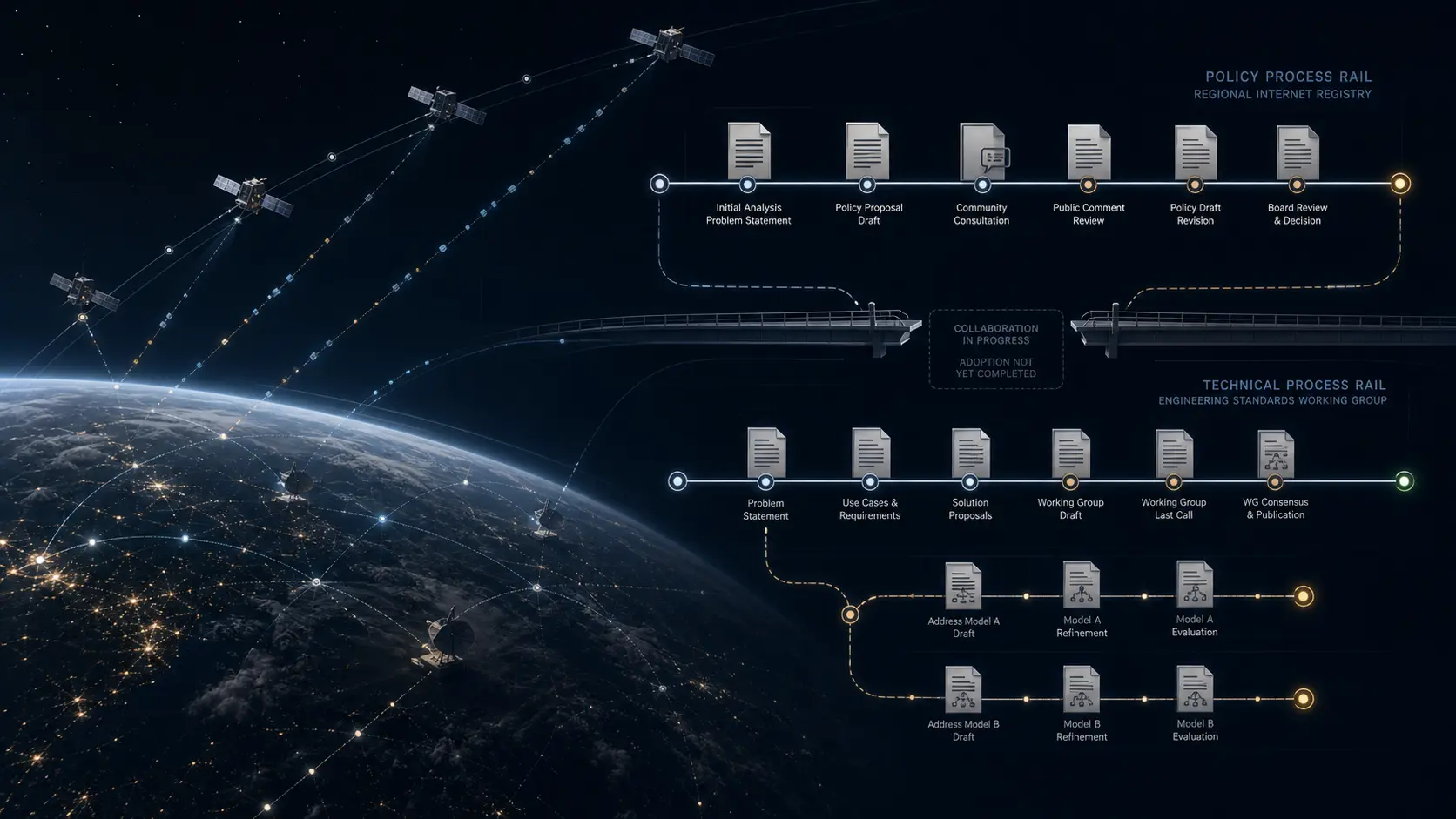
ARIN Calls Its Space Policy Joint. IETF Has Not Adopted the Address Model
ARIN-2026-1 says the proposal is joint with an IETF working group. The linked IETF record says the address model has no formal standing, and the working-group chairs found no clear consensus to adopt it as-is. Both statements can be faithfully recorded only if institutional…

CASE FILE
The SID Chose a Member Link. It Did Not Own the Bundle.
One peering interface was really three physical links. The ordinary Peer Adjacency SID sent traffic to the logical bundle and let its own balancing choose a member. The new member SID could instead place one flow on the lane that looked emptiest. That sharper instruction did not…