
Summary
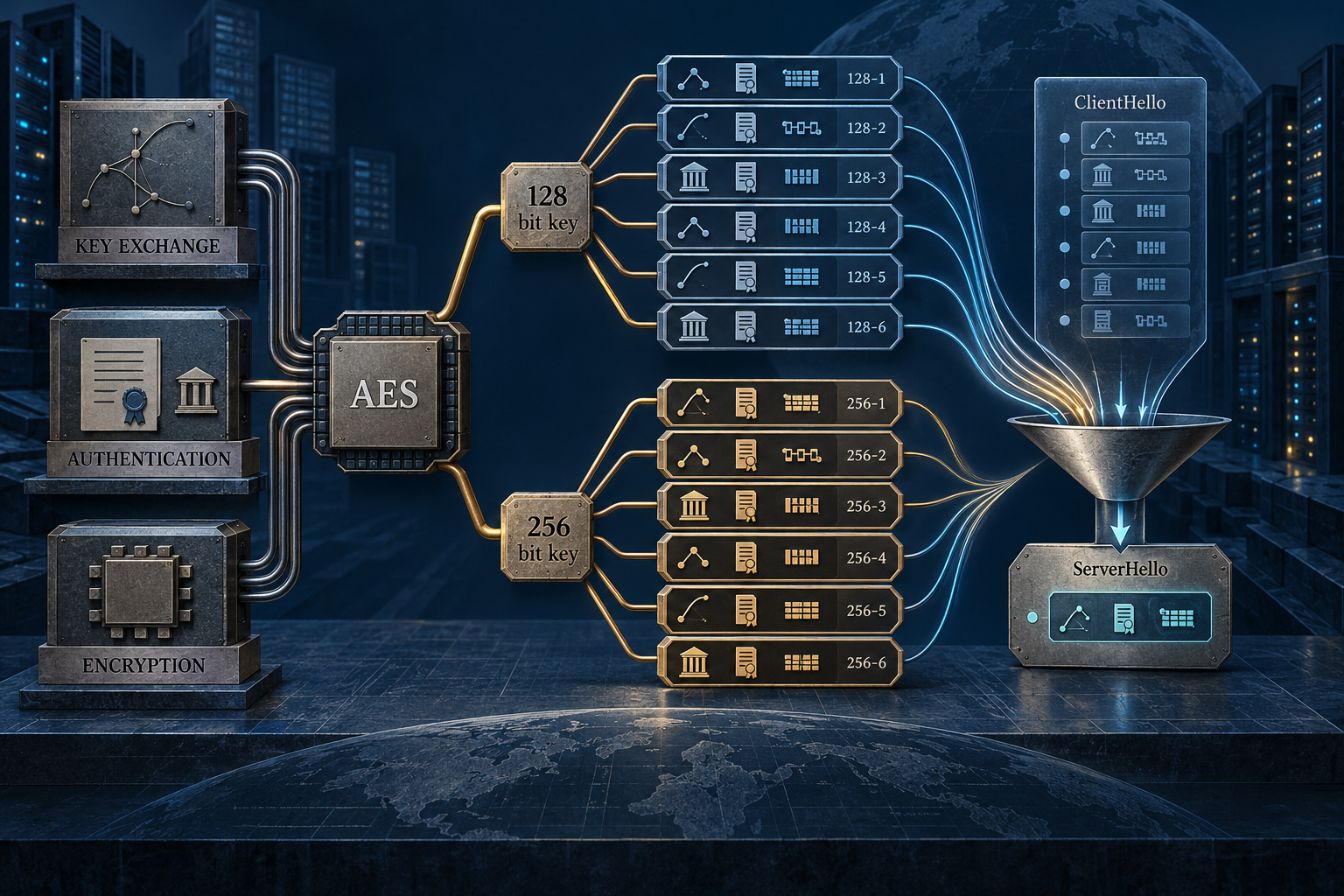
- RFC 3268 did not replace TLS's negotiation machinery. It added twelve AES cipher-suite identifiers to the existing menu: six key-exchange/authentication patterns at each of two key lengths.
- The suite name carried more than an encryption choice. AES-256 did not itself authenticate a peer or create forward secrecy; those properties depended on the selected handshake method and its implementation.
The new cipher arrived through an old menu
The announcement of AES as a new standard did not automatically make it a usable TLS option. A client and server still needed a shared way to name a complete set of record-protection and handshake choices. TLS 1.0 already had that mechanism: the client offered a list of cipher suites in ClientHello, and the server selected one it supported. RFC 2246 defined a suite as a combination that included key exchange, bulk encryption and a message-authentication algorithm.
RFC 3268, published in June 2002, used that existing slot. It introduced AES in CBC mode with HMAC-SHA-1, but not as one indivisible “AES option.” It defined six handshake families—RSA, static DH with DSS or RSA certificates, ephemeral DHE with DSS or RSA signatures, and anonymous DH—at 128- and 256-bit AES key lengths. Six multiplied by two produced twelve suite identifiers.
That matrix preserved choices TLS already exposed. RSA key transport, authenticated finite-field Diffie–Hellman and anonymous Diffie–Hellman did not become equivalent just because their record cipher was AES. DHE could provide forward secrecy, subject to fresh ephemeral keys, secure destruction and sound randomness. Anonymous DH supplied no peer authentication and remained vulnerable to a man in the middle unless another mechanism bound the parties to the same TLS Finished transcript. Those were properties of the handshake choice, not of the AES key length.
The key-size menu was itself selective. AES permits 128-, 192- and 256-bit keys, but RFC 3268 specified only 128 and 256 to avoid multiplying suite names further. All twelve suites used AES's 128-bit block size; a larger key did not mean a larger block. Every suite also retained CBC and SHA-1 in the HMAC construction. “AES” therefore named one component inside a broader, historically specific package.
Compatibility was bought with a larger menu
The RFC's introduction points to a concrete gap: DHE suites then available in TLS centered on triple-DES, alongside export variants with unsatisfactory key lengths. AES could enter while clients and servers kept the TLS 1.0 handshake and its suite-list negotiation. The price of that compatibility was a larger registry surface: each additional combination acquired its own name, code point, policy and implementation obligations.
This is not evidence that products adopted the suites at any particular rate, nor that the strongest-named option was routinely selected. A suite's presence in a protocol registry proves allocation, not support, preference, successful negotiation or safe deployment. Those are distinct observations.
Later TLS design makes the historical coupling easier to see. TLS 1.2 still used suite names that bundled key exchange and record protection in many cases. TLS 1.3 changed what a cipher-suite identifier means: it names an AEAD algorithm and hash, while key exchange groups and signature algorithms are negotiated through separate parameters. The 2002 matrix was not simply “AES in TLS”; it was one step in a long change to where TLS placed its choices.
RFC 3268 is useful history because it exposes the control surface hidden in a familiar label. Algorithm, key length, authentication, key agreement and record construction are not interchangeable assurances. A cipher suite is a negotiated package; reading one component's name as the security verdict mistakes the package for the whole connection.
Sources
Member Briefing
Deeper Profile Context
Sign in with the right membership level to unlock the full briefing and source notes.
Only for Strategic Circle
Strategic Circle
Open to all readers. Unlock profile briefings after joining and signing in.
Join Strategic CircleOnly for Leadership Alliance
Leadership Alliance
For qualified IP-asset owners and management; sign in to unlock alliance briefings.
Join Leadership Alliance