
Intelligence
Latest Articles
Latest intelligence on infrastructure operators, policy decisions, market moves, and digital power shifts.

IETF
Carlos Pignataro and the Watt Reading That Did Not Prove a Greener Network
A power meter can report a precise number while leaving the environmental claim undecided. Turning that number into energy, emissions or permission to switch off spare capacity requires separate evidence—and a record of who accepted the trade.

CASE FILE
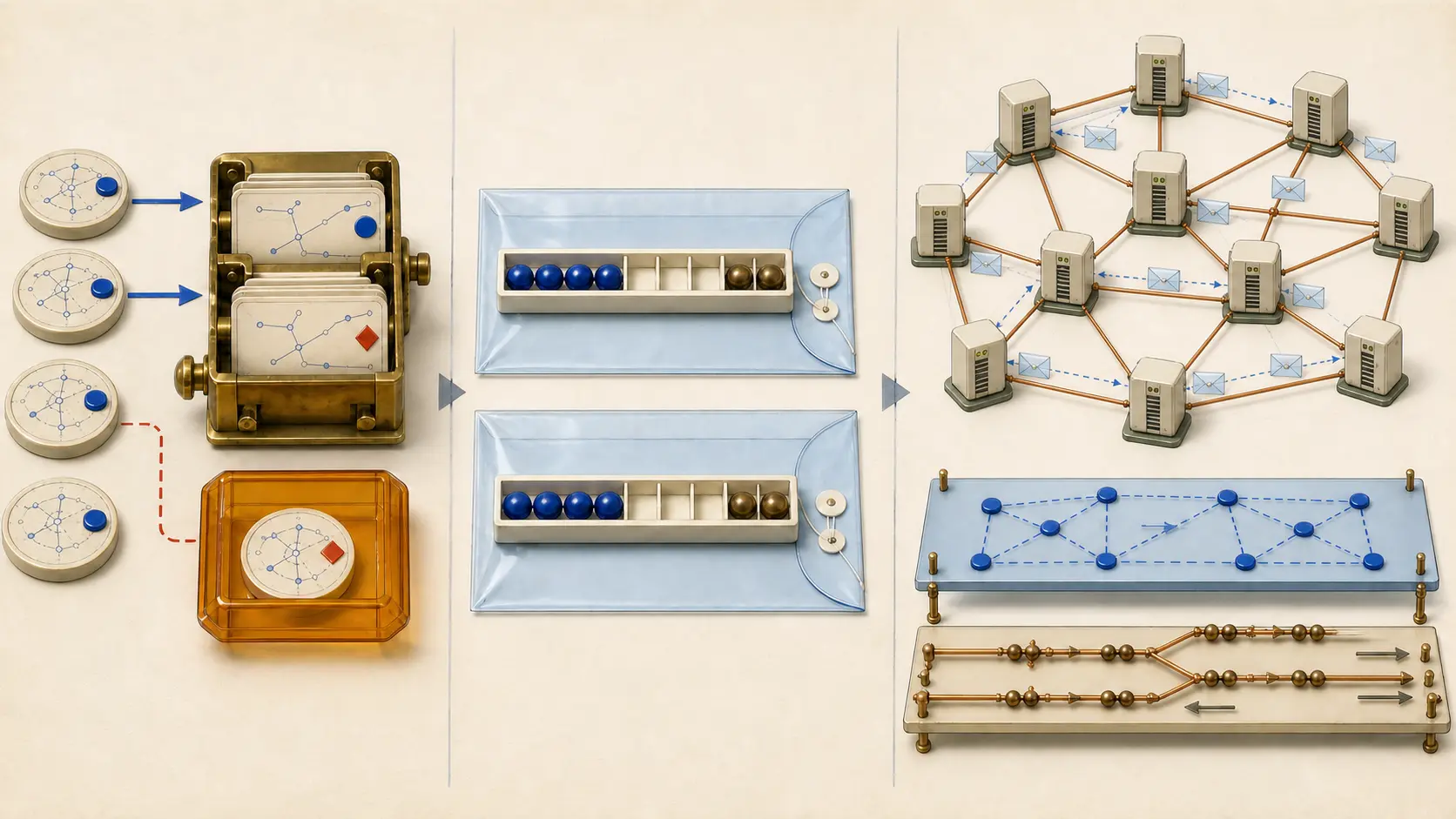
The Multicast Request Reached the Group. It Did Not Authorize the Action: RFC 10020 and CoAP Evidence
One protected request can look wonderfully decisive. A controller addresses a CoAP group, the network fans it out, several endpoints answer, and the panel records a quiet burst of acknowledgements. In a constrained environment, that economy matters. It is also exactly where an…
History
NSFNET Put IP Inside an OSI Address. Policy Still Chose the Route: RFC 1074
Thirteen T1 sites did not become one routing domain by choosing a pure protocol family. The 1988 NSFNET backbone carried IS-IS control packets over IP, fitted Internet addresses into NSAP-shaped fields, and let a policy database decide which EGP claims could become interior…

IETF
IETF Marks Two Capture Controls Incomplete. Their Q4 Proof Needs a Public Map
One line in the IETF Administration LLC’s 2026 Risk Register names the institutional failure that open technical organizations are often least comfortable naming: “The IETF, or a key part of it, is captured.” The same line says two controls are complete and two remain unfinished…

IETF
Sean Turner and the Private-Key Proof That Did Not Authorize a Certificate
A certification request can carry a valid signature and still have no right to become the certificate it asks for. The signature answers a narrow question about a key; identity, namespace entitlement, intermediary action and issuance remain separate decisions.

History
The Client Owned the Window. The Server Owned the Reaction: RFC 1073 and Telnet NAWS
An 80-by-24 terminal window became 80-by-64 without opening a new Telnet connection. Four small values crossed the link, and the remote host gained a better chance of placing its cursor correctly. Nothing in that exchange required the host to use the new geometry. RFC 1073 made…

History
The Name Was Local. The Number Still Needed a Record: RFC 1101’s DNS Mapping Boundary
In 1989, DNS could already distribute host information, but it did not yet offer a standard way to ask what a network number was called. RFC 1101 proposed a small answer: use PTR records, host-zero names and masks in `IN-ADDR.ARPA`. Its lasting discipline is equally small. A…
CASE FILE
What the Aggregate Report Actually Knows: RFC 9990 and the Boundary Before Enforcement
A DMARC dashboard can make a narrow observation look like a verdict. One receiver reports a large count from a source range, records an evaluated policy and shows a disposition. That is valuable operational evidence. It is not a global traffic census, proof of a sender's intent…
History
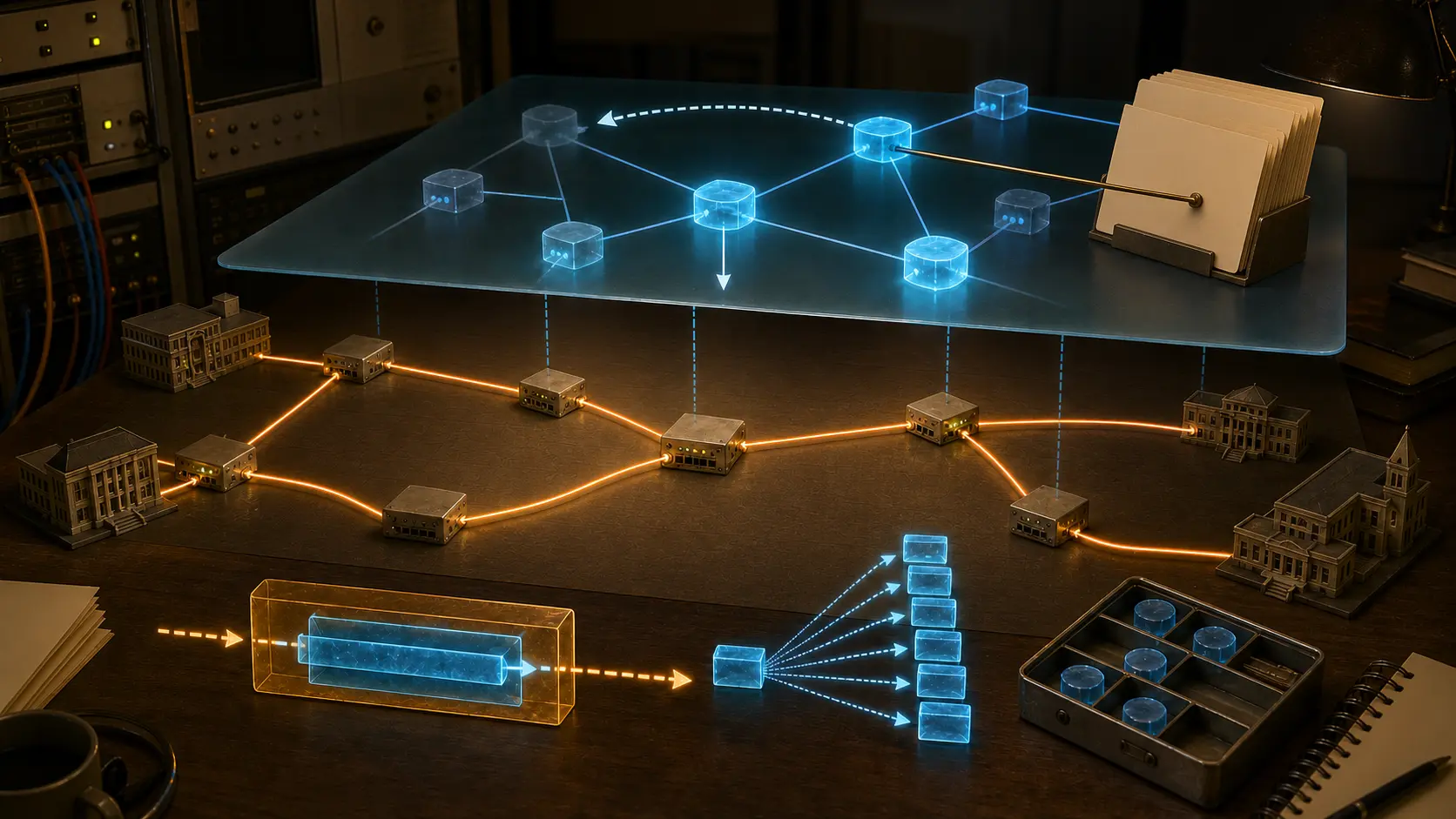
The Internet Was the Link, Not the Network: RFC 1070's Experimental OSI Boundary
In one of RFC 1070's imagined laboratories, two machines could exchange their OSI roles without changing either Internet address or cable. Every host would remain reachable by IP. Yet the experimental network could briefly lose its new router because an old list still pointed…

IETF
Lukasz Kondrad and the RTP Group That Was Not Yet a Reconstructed Scene
A session description can place an atlas, occupancy, geometry and colour stream inside one V3C group. That is a precise statement about membership—not evidence that a receiver rebuilt the same three-dimensional scene.

IETF
IETF Tools Kept Every-Line Review for AI Code. Its Next Boundary Is Still Unwritten
The IETF Tools Team has named a genuine capacity problem: AI can produce ambitious pull requests faster than maintainers can safely absorb them. Yet the contribution guide it actually adopted in August still puts every submitted line in front of a human maintainer. That is a…

History
The Request Was Queued. The File Still Had to Move: RFC 1068 and BFTP's Completion Boundary
In 1988, an Internet file-transfer experiment made the instruction outlive the terminal session. A user could leave after submitting a job; a daemon would remember, retry and report later. That persistence solved a human waiting problem, but it also created a new fact that was…

IETF
Panos Kampanakis and the SSH Session with Three Different Security Receipts
An SSH client can negotiate a hybrid ML-KEM key exchange, verify the server through a conventional host key, and admit a user through a still separate credential. The session is one connection; the evidence is not one claim.

ICANN
ICANN’s $1 Million IGF Offer Draws an Advocacy Firewall
ICANN’s Board did more than authorize a large contribution to the Internet Governance Forum. Its published rationale drew a boundary around what the money was for, what it was not for, who would have to consent to a different use and how much institutional overhead should be…

History
The FDDI Frame Carried IP. It Did Not Carry Identity: RFC 1188’s Encapsulation Boundary
An FDDI interface could put an IP datagram onto a fast local ring only after several small facts agreed: which link grammar carried the payload, how large a packet could be, and which local hardware address represented an IP neighbour. RFC 1188 made those facts interoperable in…

History
The Low-Delay Packet Was Given Less Room to Wait: RFC 1046's Queuing Bargain
In one of the Internet's early experiments with differentiated service, the faster class did not receive an infinite fast lane. It received a smaller waiting room. RFC 1046 proposed that a node bound delay by limiting the low-delay queue, discarding overflow and capping the…

History
The Mailbox Was a Contact. It Was Not a Control Room: RFC 1173’s “Oral Tradition”
Before the Internet had a single operational mythology, it had a more modest arrangement: if a problem crossed a boundary, someone needed to be reachable on the other side. RFC 1173, published in 1990, made that arrangement visible. Its lasting lesson is not that a role mailbox…

IETF
Cullen Jennings and the Capability Document That Was Not a Live SIP Trunk
An enterprise edge device can discover the right URL, pass TLS and OAuth, receive HTTP 200 and parse a valid provider capability document while no production call can cross the trunk. RFC 10006 makes configuration exchange easier; it does not collapse retrieval, activation…

JPNOG
JANOG Gives Officers a Separate Route to Rewrite Its Rules
JANOG’s public rules make mailing-list subscribers members, but they also let an officer supermajority amend the rules—or dissolve the voluntary association—without using the separate membership-approval route.

ICANN
ICANN Changed ‘Five-Year’ to ‘Periodic’—the Audit Clock Still Runs
One word disappeared from ICANN’s Board Risk Committee charter, but the obligation behind it did not necessarily disappear. The adopted text now promises external assessment “periodically” under professional standards. Those standards still contain a five-year outer limit. The…