
Summary
- Lanport-S LLC's public economics are those of a compact access provider in south-east Moscow: consumer internet tariffs run from low hundreds of rubles per month to a 500 Mbps plan at 750 RUB, business access is advertised from 1,000 RUB per month, and the company keeps the old regional-ISP promise of reachable local support, on-site help and building-by-building service.
- The investment test is whether that access revenue can pay for recurring upstream capacity, customer premises friction, local repair labor, router and cable work, payment handling, churn, compliance and periodic network replacement. The company has only one visible routed IPv4 aggregate in current major BGP views, limited visible upstream diversity, no routed IPv6 footprint in those views and enough regulatory exposure to make one large fine material to annual profit.
- The public record supports neither a collapse story nor a high-growth platform story. It supports a narrow-margin local-network story: Lanport-S can be useful where local presence, fast repair and building knowledge matter, but its strategic value depends on keeping each customer connection cash-positive after installation and support, not merely on adding lines at discounted headline prices.
The first useful way to read Lanport-S is not as a brand page, an autonomous system, or a Russian corporate registry entry. It is as one paying connection. A household chooses a 100 Mbps tariff, or a small office asks for Ethernet, or a building owner wants a second provider that can serve tenants without demanding exclusivity. At that moment Lanport-S has taken on several obligations before it has earned much cash.
It must connect the premise, authenticate the user, keep the route reachable, answer the phone, repair local faults, keep the account ledger accurate, collect small payments, carry traffic through another network, and satisfy a regulatory regime designed for licensed operators rather than for hobby networks. The question is whether the monthly price is high enough, and durable enough, to finance all of that.
Lanport-S's own public website places the commercial boundary in a few Moscow districts and streets rather than in a national footprint. The connection form lists streets around Lyublino, Tekstilshchiki, Kuzminki and nearby south-eastern Moscow neighborhoods. The contacts page gives a customer office at Prospekt 40 let Oktyabrya 20, an office phone, a 24-hour contact center number and a technical support email. The corporate records visible through public company databases give a separate legal address on Novorossiyskaya Street and identify the company as a wireline-communications business.
The operational point is not the address difference itself; local access operators often have a service office, a legal address and a network-resource address that do not read like a single campus. The point is that Lanport-S's customer promise is geographically grounded. It is not selling abstract cloud scale. It is selling the ability to connect and support premises inside a limited service area.
That boundary matters because the access business is mostly a density game. The cheapest customer to serve is not simply the one who pays the highest tariff. It is the customer in a building, street or office cluster where the operator already has plant, where a technician can visit without wasting half a day in transit, where the cable route is known, where support problems repeat enough to be solved quickly, and where the same local reputation can attract the next customer. Lanport-S's public service-area form, street list and office-focused pages show a company whose natural advantage is local knowledge.
The risk is that local knowledge does not automatically become pricing power. In a city such as Moscow, the customer's alternative set includes larger fixed-line operators, mobile broadband, building-specific providers and any provider already present in the same entrance or office center.
The consumer price ladder is tight. Lanport-S advertises home internet plans at 30 Mbps, 65 Mbps, 100 Mbps and 500 Mbps, with monthly prices visible at 340 RUB, 430 RUB, 520 RUB and 750 RUB. Annualized, those figures are only 4,080 RUB, 5,160 RUB, 6,240 RUB and 9,000 RUB before discounts, missed payments, promotions, taxes, collection friction and support cost.
The website also shows recurring promotions: a 100 Mbps special offer for new users at 390 RUB per month, free connection, a 500 RUB advance payment, payment bonuses for three-month and six-month prepayment, referral months, and holiday offers that have historically cut the effective monthly cost of 100 Mbps and 500 Mbps service below list price when customers prepaid. Those promotions are rational if they fill already-built plant or pull cash forward. They are dangerous if they train the market to treat access as a commodity whose installation and service labor should be free.
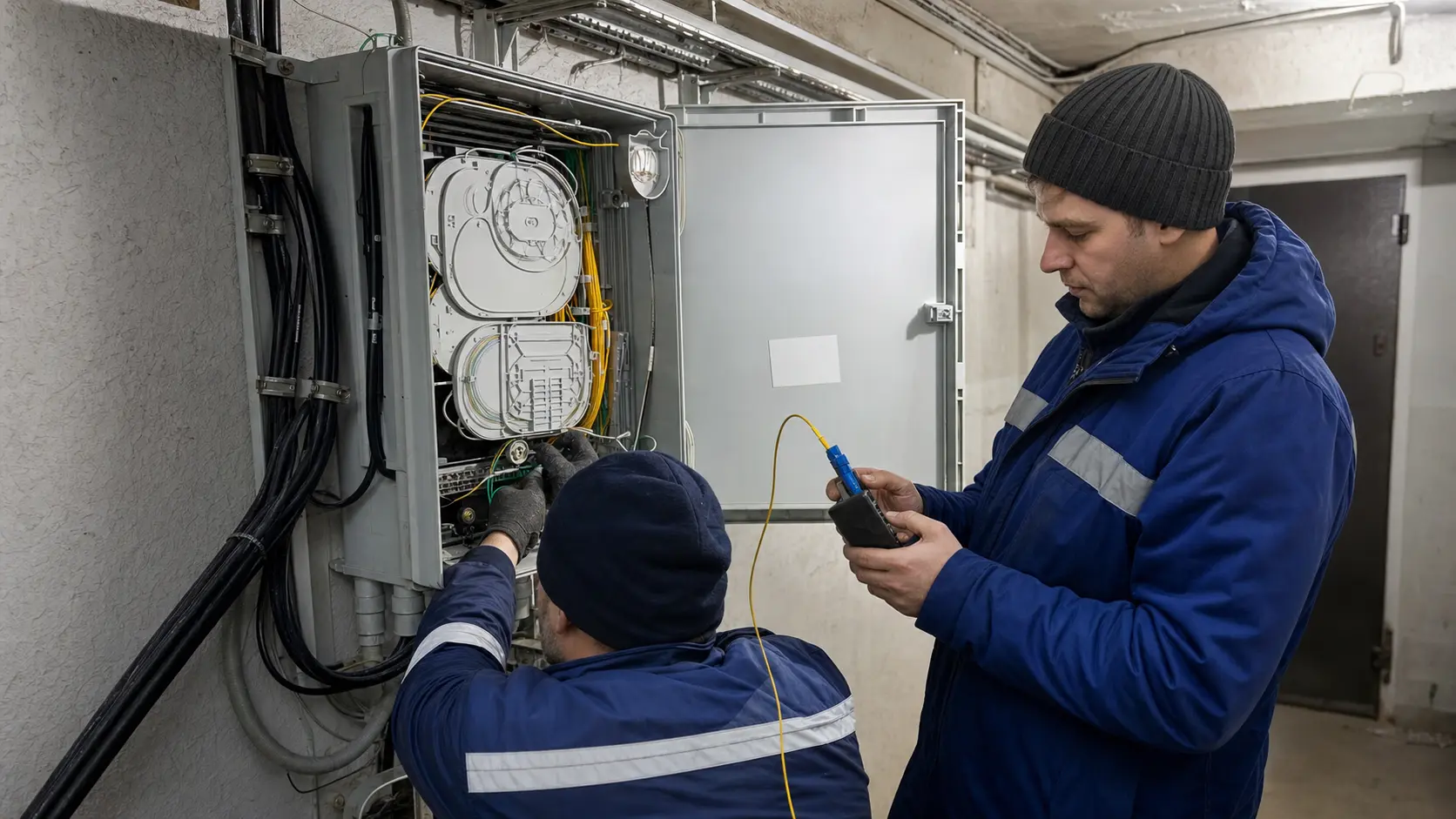
The free-installation language is economically important. The promotion page says a free physical connection can include cable installation from the operator's equipment to the apartment, cable entry into the apartment, necessary cable length to the customer device without full in-apartment cable work, crimping or one network socket, computer network setup, and Wi-Fi router setup when the customer has or buys a router. A connection like that is not free to the operator. Even when the marginal materials are small, technician scheduling, building access, dispatch time, failed appointments, cable handling and first-call support consume cash.
Lanport-S's service menu gives the reader a rough price language for that labor market: an RJ-45 socket is listed at 300 RUB, initial PC diagnostics at 500 RUB, more complex diagnostics from 1,000 RUB, router setup and in-apartment cable repair are advertised as free in some circumstances, and a typical service-engineer hour is listed at 300-500 RUB. These are not full cost accounts, but they show the scale of work that must be recovered through subscriptions.
A simple sensitivity shows the problem. A 100 Mbps household at the list price contributes 520 RUB per month, or 6,240 RUB per year before operating costs. If the connection consumes even one or two hours of technician time, some cable, a support interaction and follow-up troubleshooting, the first months are not pure margin. If the customer arrived through a 390 RUB special tariff, the recovery period lengthens. If the customer pays for six or twelve months in advance, the working-capital picture improves, but the effective price may fall.
This is the core local-ISP bargain: prepayment and density can fund installation, but discounting and churn can turn growth into a cash drain. The right question for Lanport-S is therefore not how many buildings it can claim, but how many connected apartments or offices in those buildings stay long enough to amortize the truck roll and the shared access plant.
The home contract terms sharpen that calculation. Lanport-S provides service on a prepayment basis. The contract says the customer account records service use and payments, and the website terms say blocking happens automatically when the account goes negative. The home internet page says that if the operator is at fault and service is unavailable for more than 24 hours from the customer's support registration, the customer receives compensation equal to one-thirtieth of the tariff plan cost for each 24 hours of downtime. That is a small direct credit in ruble terms: on a 520 RUB plan, one compensated day is roughly 17 RUB.
But the economic cost of an outage is not the credit. It is the support queue, the repair crew, the reputation effect in the building chat, and the chance that a household or small business starts testing substitutes. A local ISP can survive occasional cable faults; it cannot survive being seen as the operator that disappears when the stairwell fiber is cut.
The April 2025 outage notice on Lanport-S's homepage is revealing for this reason. The company told customers a technical problem had temporarily interrupted service in several areas, said the cause was damage to an optical cable in a renovation zone, and stated that a technical crew was working with an expected restoration window of two to three hours. This is not a scandal in itself. Cable damage near construction and renovation is normal in urban access networks. The notice is more useful as a cost signal.
If a small operator's advantage is local support, it must be able to diagnose, communicate and repair quickly enough that customers do not price the risk into their renewal decision. The repair cycle is the business model. Each monthly fee must fund the next fault response, not just the upstream bill.
Lanport-S's business-internet page gives a second revenue shape. It advertises office Ethernet, says the company can offer 10, 20, 50, 100 and 200 Mbps tariff plans with subscription fees from 1,000 RUB per month, and pitches flexible technical and price solutions. It also offers wireless office solutions, video surveillance installation and servicing, and proposals for building owners and business centers, including acting as a second or backup operator or as a wholesale supplier for a local operator.
This is a more attractive margin area than the lowest consumer plan if the company can sell continuity, responsiveness and building-specific service. A small office may care less about saving 100 RUB per month and more about whether the provider can solve a fault before a trading day or booking system is lost.
But the same page also caps ambition. Lanport-S says it does not claim exclusive rights to provide telecom services in a building and is open to second-operator or backup arrangements. That is commercially sensible because exclusivity is hard to defend and often unattractive to building owners who want redundancy. It also means Lanport-S must often win as an additional provider, not as the single utility. Backup-provider economics can be good when a customer pays for standby capacity and support. They can be weak if the operator discounts to enter the building and then receives only small, churn-prone accounts.
The company must therefore separate three cases: buildings where it is the primary household ISP and can sell dense access, offices where it sells service continuity, and buildings where it is a bargaining chip used by landlords or tenants to pressure incumbent providers.
The routing evidence shows a compact network rather than a broad transit platform. Public BGP and registry views identify AS34211, LANPORT-AS, registered in the RIPE region and associated with Lanport-S LLC. Current major third-party views show one originated IPv4 aggregate, 185.44.68.0/22, or 1,024 IPv4 addresses, and no originated IPv6 prefixes. IPinfo classifies the ASN as an ISP or consumer network, shows 100 percent Russian geography for the routed footprint, and records reverse-DNS hostnames in the 185.44.69.0/24 range that follow a pppoe naming pattern.
BGP.tools labels the network as an eyeball network and shows one IPv4 prefix and no IPv6 originated. Hurricane Electric's BGP page similarly shows one IPv4 prefix, no IPv6 prefix and one observed IPv4 peer at the time of its snapshot.
That is enough address space for a local access network with address sharing, careful allocation and customer premises NAT. It is not a large address estate. The shortage matters in two directions. First, IPv4 scarcity can be an asset: 1,024 routed addresses are useful if the customer base needs public addresses, business service, management networks or reputation-clean assignments. Second, a small pool can constrain product design. If Lanport-S has to place many households behind shared addressing or ration public addresses, high-value business users may need explicit arrangements.
The website and public routing records do not reveal subscriber counts or address-assignment policy, so the article should not pretend to know either. The safer conclusion is that the company must treat public IPv4 as a scarce operating resource, not as an unlimited byproduct of membership in the RIPE system.
The upstream picture is also narrow. The RIPE aut-num policy visible through routing mirrors lists import policies from AS59589 and AS48467 and exports back to both. BGP.tools' current connectivity view, however, shows AS59589 as the visible upstream, while other third-party sources differ on whether AS48467 is currently visible or historical. The distinction matters. A routing policy object tells the market what the network is authorized or configured to do. A live BGP table tells the market what collectors currently see. If the paper policy has two upstreams but live collectors mostly see one path, the resilience question remains open.
Lanport-S may have private redundancy, inactive sessions, paths not visible to a given collector, or a genuinely narrow dependency. For an access provider whose customer promise is continuity, that uncertainty is an investment question, not a footnote.
The absence of visible routed IPv6 in the public BGP views is another monitoring item. In the short term, a Moscow household buying 100 Mbps internet may not ask for IPv6. In the medium term, IPv6 changes the cost of address scarcity, customer device support and business-service expectations. A small operator can postpone IPv6 if its customers are price-sensitive and its support scripts are built around PPPoE and IPv4. Postponement has a cost: it keeps the network dependent on IPv4 scarcity workarounds and makes future migration a project rather than a steady operating habit.
The economics of IPv6 are not that it creates immediate new revenue. It reduces the future option value of doing nothing.
The security-routing signal is mixed but not alarming on the public record. Hurricane Electric's snapshot did not show RPKI-originated valid routes for AS34211, and also did not show invalid originated routes. BGP.tools says the visible prefix matches a trusted IRR source. That combination suggests the route is recognized in conventional routing registries but should not be treated as fully modernized routing security without further confirmation. For a small eyeball network, the near-term commercial issue is not whether a consumer asks about RPKI.
It is whether upstream filtering, route authorization and incident response are robust enough that a bad route event does not turn into hours of reachability loss. The public evidence is sufficient to make this a board-level operating priority, not sufficient to declare a present routing failure.
The corporate financial record supports the same narrow-margin reading. Public company-information services drawing on Russian registry and accounting data identify Lanport-S as an active limited-liability company registered in 2006, with the main activity listed as wireline communications, 12 employees, two or three reported communications licenses depending on the source date and presentation, and 2025 revenue around 25.185 million RUB with net profit of 993,000 RUB.
RBC's profile reports 2024 revenue of 27.905 million RUB and 2025 revenue of 25.185 million RUB, with 2025 profit of 993,000 RUB and 2025 cost of sales of 24.444 million RUB. Firmoteka reports the same broad 2025 revenue and profit picture and says taxes and contributions paid in 2025 were about 1.973 million RUB.
Those figures are not audited in this article, and registry mirrors can differ in timing. They are still economically useful. A company with roughly 25 million RUB of annual revenue and 12 employees is not a passive number-resource holder. It is an operating business with a small labor base. Revenue per employee is about 2.1 million RUB per year, or roughly 175,000 RUB per month. Net profit in 2025 is less than 4 percent of revenue. That margin leaves little room for failed installations, equipment replacement mistakes, excessive discounting, large bad-debt pockets or one-off regulatory cost.
Even if the 2024 margin looked better, the 2025 picture says each connection must be managed as a contribution unit. The company cannot rely on scale to absorb many weak accounts.
The court record makes the compliance cost visible. A June 2025 magistrate-court decision reported by a public legal database found Lanport-S guilty under part 3 of Article 13.46 of the Russian Administrative Offenses Code for failing to fulfill operator obligations related to technical means for authorized operational-search activities.
The decision stated that the company had active communications licenses for Moscow and Moscow Region, that the fact of providing communications services was supported by operator-activity and universal-service contribution records, that 2024 communications-service income used in the case was 6.55 million RUB, and that total 2024 revenue was 27.905 million RUB. The court imposed a 500,000 RUB fine with a three-month installment schedule, taking into account microenterprise status.
For readers outside Russia, the policy question is separate from the business question. The business question is blunt: compliance obligations can impose lumpy, non-revenue work on small operators. A 500,000 RUB fine is roughly half of Lanport-S's reported 2025 net profit and about 2 percent of 2025 revenue. If the company also must buy, integrate, document or operate additional compliant systems, the real economic burden is not only the fine. It is management time, vendor selection, technical integration, testing, maintenance and the risk of future enforcement.
A large national operator treats such obligations as a compliance department's workstream. A microenterprise-sized access provider treats them as a capital allocation problem.
This creates a strategic fork. One path is to remain a lean local access provider, keep the footprint tight, avoid overbuilding, use local service quality to defend churn, and accept that regulatory and routing modernization must be funded out of modest retained earnings. The other path is to pursue more buildings, business centers, video surveillance and managed service work to increase revenue per truck roll. The second path is attractive because business customers and building owners can pay more than households.
It is also risky because each new service line can add installation complexity, support scope and liability before it adds durable cash flow. A small operator wins by adding services that reuse the same field team and access plant; it loses by becoming a general IT contractor whose support burden exceeds its tariff base.
Customer concentration is the unknown that could change the valuation most quickly. The public website suggests many household streets and some business-center opportunity, but it does not disclose subscriber counts, revenue split, building concentration or dependence on any institutional customer. Public procurement-oriented profiles show government-contract amounts in some years, and the court record distinguishes communications-service income from total revenue. Those hints matter. If Lanport-S's access revenue is spread across many households, churn and payment behavior are the central risks.
If a meaningful share comes from a few offices, public-sector customers, building owners or service projects, then renewal risk and receivables concentration become central. The same 25 million RUB revenue number can describe very different businesses depending on the customer mix.
The pricing evidence points to a company that uses promotions to manage take-up and cash timing. Three-month and six-month bonuses reward prepayment. New-year offers trade lower effective monthly prices for longer cash commitments. Referral months turn customers into sales channels. Free installation reduces purchase friction. In a dense apartment market, these tools can be rational because the operator's network cost is partly fixed at the building level. Once plant is there, a new customer can be profitable if support stays low and churn is delayed.
The danger is that promotions bring in the most price-sensitive users, who are also the first to leave when a mobile package, larger ISP bundle or building competitor offers a better headline price. Lanport-S must know whether discounted customers generate fewer support calls and longer tenure, or whether they merely lower average revenue per user.
The support model is both asset and liability. The website's support pages include detailed PPPoE setup instructions for Windows 11 and Linux, router setup guidance for D-Link equipment, a technical support email, and a contact-center number described as around the clock. These pages indicate an operator that expects to help users with device configuration rather than simply ship a modem and hide behind a national call center. For a local ISP, that can be a differentiator. It also means customer heterogeneity is costly.
Every old router, operating-system change, forgotten password, failed PPPoE setup and in-apartment cable problem can consume the same human attention that could otherwise connect a new paying user. The right control metric is not only average revenue per user. It is average revenue after support minutes, dispatch time and free-service leakage.
Payment handling is another small but real cost surface. Lanport-S advertises card payment without commission, bank and office payment options, Sberbank Online, Alfa-Bank, Avangard and older QIWI terminal notices. The contract and home-internet page place service on prepayment, which protects the operator from long receivables on ordinary consumer plans. But multiple payment rails create reconciliation, customer-service and bonus-crediting tasks. The offers page says some bonuses are not credited automatically and require the customer to report the payment through a feedback form or by phone.
That is workable at small scale and may help retain customers who like a local office. It is less efficient than fully automated digital billing. In a margin-tight business, every manual credit and phone confirmation is a small tax on the cheap tariff.
The competitive ceiling is easy to underestimate because the company's own pages are friendly and local. A larger fixed operator can bundle internet, television, mobile, equipment and promotional discounts. A mobile operator can provide enough broadband for some households without any building access. A building owner can invite a second provider to improve tenant choice without giving that provider a protected customer base. Lanport-S's answer is not national brand spending. It is immediate local availability, known support, building-specific installation and willingness to serve as a second or backup operator.
That can be enough for customers whose downtime cost is high relative to the monthly bill. It is not enough for customers buying only the cheapest megabit.
The unofficial market signals are sparse in the public material reviewed for this article. There is third-party routing data, registry data, financial-mirror data and one legal decision, but there is not a large public body of customer reviews, incident histories or forum complaints that can be treated as representative. The absence of a loud public reputation is not proof of high service quality. It may simply reflect a small footprint. The market signal that is safer to use is behavioral: Lanport-S keeps publishing local promotions, office contact information, technical configuration pages and service pricing.
That behavior fits a company still trying to win and retain customers through direct service rather than through abstract national advertising.
The biggest contradiction in the evidence is not fatal, but it should be monitored. The company website's footer on some pages shows an OGRN number that differs by one digit from the contacts page and from public company records. The contacts page, RBC, Firmoteka and other company profiles align on OGRN 5067746883310, while some website footers display 5067746893310. This looks like a website/footer error rather than a different company, especially because the INN aligns and the customer office, brand and RIPE resource details point to the same operator. Still, small governance errors on public pages matter.
If a company is trying to sell trust, billing reliability and compliance, the public legal identifiers should be clean.
Another evidence conflict concerns address space. Current BGP.tools, Hurricane Electric, IPinfo and RIPE-derived views focus on 185.44.68.0/22, 1,024 IPv4 addresses and no IPv6. One third-party whois-style page reports an additional older 81.9.48.0/20 block and 5,120 total IP addresses. Without fresh primary confirmation that Lanport-S currently originates that older block, the conservative treatment is to rely on the currently visible 1,024-address footprint and treat the larger figure as a historical or third-party discrepancy. The economic conclusion is unchanged: address resources are not large enough to remove scarcity from the model.
If the company has additional usable addresses through another arrangement, that would improve optionality but should be verified before it is priced into the story.
The building-owner proposition deserves separate treatment because it is where a local ISP can either strengthen or weaken itself fastest. Lanport-S's corporate page offers cooperation with building owners and business centers, and it explicitly leaves room for the company to be a second or backup operator. Economically, that is different from ordinary consumer growth. In a dense apartment building, the operator wants many small accounts attached to one access investment.
In a business center, the operator may want a smaller number of higher-value accounts whose demand is more sensitive to uptime, support availability and route continuity. A second operator can earn attractive revenue if the tenant values resilience and pays for it. But a second operator can also be drawn into a price auction where the building owner uses its presence to force the incumbent down while allocating only residual demand to the newcomer. The difference is not visible in a tariff page.
It appears in contract terms: who pays for building entry, who owns the in-building cabling, how quickly support must arrive, whether the connection is primary or backup, whether installation cost is recovered upfront, and whether the customer can cancel after a short promotional period.
The same caution applies to video surveillance and local computer-help services. These services are close enough to the access business that they can be profitable complements. A technician already visiting a building can install cameras, repair cable, configure a router or inspect a small office network, and that can raise revenue per visit. Yet the complement becomes a trap if it expands the operator's responsibility without a matching fee. Video surveillance creates expectations about storage, camera replacement, power, weather exposure, customer training and evidence access.
Computer-help services create expectations about the customer's operating system, router, printer, malware and Wi-Fi coverage. Lanport-S's published service rates are low enough that these tasks should be treated as retention tools and carefully priced projects, not as a broad managed-services platform. The disciplined version is to sell only services that reinforce the access relationship and are simple enough for the same field team to deliver repeatedly. The undisciplined version is to let each connected customer turn the operator into a low-cost general repair shop.
One reason the distinction matters is that the reported labor base is small. Twelve employees can be effective in a tight footprint, especially if customer premises are clustered and the network is familiar. Twelve employees cannot comfortably absorb every growth ambition at once. Someone has to answer phones, reconcile payments, handle abuse reports, manage RIPE records, monitor BGP, coordinate upstream providers, respond to cable cuts, install new customers, maintain web information, handle regulator correspondence, and keep billing accurate. Small operators often look efficient because the same people handle several of these functions.
They can also become fragile for the same reason. A key employee's absence, a sudden compliance deadline, a cluster of construction-related cable cuts or a burst of router problems after a popular consumer-device update can consume capacity that had been expected to support growth.
The unit economics therefore turn on avoided work as much as on collected revenue. A customer who pays 520 RUB every month and never calls support may be more valuable than a business customer paying several times that amount but requiring repeated site visits and after-hours troubleshooting. A prepaid customer improves cash timing, but only if the discount is not so deep that the operator loses room for maintenance.
A router sale is useful if it reduces future support because the operator knows the device and configuration; it is less useful if the cheap router becomes the source of Wi-Fi complaints the customer attributes to the access line. Free installation is rational where the plant is already present and the expected customer life is long. It is not rational where the company must spend real technician time and then watch the customer churn after a promotional period.
The regulatory fine also changes how replacement capital should be viewed. In a low-margin local access business, replacement capital is not only switches, optics, routers, cable and customer premises equipment. It includes compliance systems, documentation, testing, reporting, and the management discipline to prove that obligations have been met. If a 500,000 RUB fine is material against annual profit, then future compliance work competes directly with network improvements and customer acquisition. Management cannot treat compliance as a separate legal problem if the cash comes from the same tariff base.
The practical control is to budget compliance as part of each connection's lifecycle cost, just as the operator budgets upstream capacity and repair labor. That may make some discounted accounts look less attractive, but it gives a truer picture of sustainability.
There is also a geopolitical and supplier layer that cannot be ignored in Russia's telecom market. The public material reviewed does not identify Lanport-S's equipment vendors, upstream contract prices or sanctions exposure. Still, a small operator in Russia is exposed to procurement friction in a way a customer may not see. Replacement routers, optical modules, switching hardware, security equipment, power supplies and software support can become more expensive or harder to source when imports, warranties and payment channels are constrained.
A large operator may buffer this through inventory, vendor leverage and large engineering teams. A small operator has less room to carry spare equipment that might never be used. It has to choose between tying cash up in inventory and accepting longer repair or replacement windows when equipment fails. That choice feeds directly back into the customer promise of local reliability.
Competition from mobile broadband is another underpriced risk. Fixed access still matters for households and offices that need stable performance, low latency, predictable indoor coverage and multiple devices. But a household that uses the connection mainly for messaging, video and ordinary browsing may compare a low-cost fixed tariff with an existing mobile plan rather than with another wired operator. If mobile capacity is good enough in a given building, the fixed operator's free installation and low monthly price become more important.
For small offices, fixed access remains more defensible because payment terminals, cloud software, remote work, security cameras and VoIP need steadier service. Lanport-S's strategic answer should be to move as much of its revenue as possible toward use cases where downtime and support quality matter, while keeping consumer access dense enough to support the local network.
The public financial profile also suggests caution in interpreting revenue growth. A fall from 27.905 million RUB revenue in 2024 to 25.185 million RUB in 2025 is not, by itself, proof of deterioration. It could reflect project timing, revenue recognition, a customer mix shift, a one-off service sale in the earlier year, or ordinary small-business volatility. But when the same year shows profit under 1 million RUB, the margin for experimentation is visibly thin. If Lanport-S wants to add buildings, expand business services or modernize routing, it has to fund those moves while protecting the base.
That argues for disciplined expansion by cluster, not scattered addresses that raise dispatch time. It also argues for measuring each promotion by retained contribution after six, twelve and twenty-four months, not merely by new signups.
The best strategic case for Lanport-S is therefore neither nostalgia for the small ISP nor a generic claim that local providers always beat national brands. The case is more specific. In a dense urban pocket, a small operator can be close enough to know which buildings are profitable, which cable routes are vulnerable, which customer premises equipment causes support calls, which business centers value backup, and which local repairs protect reputation. That knowledge can beat a national operator's scale in narrow circumstances.
The weakest strategic case is that Lanport-S can chase every low-price household, every small IT service and every building opportunity without raising capital intensity. The public evidence favors the first path if management is disciplined. It gives little support for the second.
Facts that would change the judgment are concrete. First, verified subscriber count and churn would tell whether the household base is dense and sticky or just price-sensitive. Second, the split between consumer access, business access, video surveillance, equipment sales and public-sector contracts would show whether 25 million RUB of revenue is recurring access revenue or a mixture of access and project work. Third, current upstream contracts and live failover tests would show whether route diversity is stronger than public collectors suggest.
Fourth, proof of current RPKI route authorization and IPv6 rollout would reduce future technical-risk questions. Fifth, a resolved compliance status after the 2025 court decision would tell whether the fine was a closed incident or a symptom of continuing underinvestment.
Until those facts change, Lanport-S should be judged as a small local access operator with a defensible niche and a fragile cost base. The niche is real: local building knowledge, human support, business-center flexibility and the ability to act as a second operator can matter more than national scale for a customer whose connection simply has to work. The fragility is also real: consumer tariffs are low, discounting is visible, public routed resources are small, upstream visibility is narrow, support is labor-intensive, and regulatory obligations can consume a meaningful share of annual profit. The cash-flow test is therefore severe.
Each new connection must fund not only the first cable and the next upstream invoice, but the next repair cycle, the next support call, the next compliance requirement and the next customer who leaves when the larger market cuts the price ceiling.
Sources
- https://lanport.ru/
- https://lanport.ru/home-internet
- https://lanport.ru/corporate-internet/
- https://lanport.ru/offers
- https://lanport.ru/shop
- https://lanport.ru/comphelp
- https://lanport.ru/contacts
- https://lanport.ru/files/dogovor.pdf
- https://lanport.ru/files/reglament.pdf
- https://lanport.ru/support/os/windows-11/
- https://lanport.ru/support/os/linux/
- https://lanport.ru/support/wifi/dir615/
- https://lanport.ru/router-free/
- https://lanport.ru/oplata-cherez-terminali/
- https://lanport.ru/new-pay-options-2010/
- https://apps.db.ripe.net/db-web-ui/lookup?source=ripe&type=aut-num&key=AS34211
- https://apps.db.ripe.net/db-web-ui/lookup?source=ripe&type=organisation&key=ORG-LL153-RIPE
- https://apps.db.ripe.net/db-web-ui/query?searchtext=185.44.68.0%2F22
- https://apps.db.ripe.net/db-web-ui/query?searchtext=LANPORT-MNT
- https://bgp.tools/as/34211
- https://bgp.he.net/AS34211
- https://ipinfo.io/AS34211
- https://ipinfo.io/AS34211/185.44.68.0/22
- https://ipinfo.io/185.44.68.223
- https://ipinfo.io/ips/185.44.69.0/24
- https://whois.ipip.net/AS34211
- https://www.iplocate.io/AS34211
- https://www.ipaddress.com/ipdb/ipv4-public/185.44.68.0/22/
- https://www.cidr-report.org/cgi-bin/as-report?as=AS34211&view=2.0
- https://www.bigdatacloud.com/network-lookup/185.44.68.0/22
- https://radar.cloudflare.com/as34211/
- https://whoisrequest.com/ip/AS34211
- https://2ip.io/as/34211/
- https://theipapi.com/asn/34211
- https://companies.rbc.ru/id/5067746883310-ooo-lanport-s/
- https://companies.rbc.ru/amp/ogrn/5067746883310/
- https://firmoteka.ru/7721566839
- https://spark-interfax.ru/moskva-lyublino/ooo-lanport-s-inn-7721566839-ogrn-5067746883310-a4f8408f8a724c0ba6dc4b8325571d12
- https://companium.ru/id/5067746883310-lanport-s
- https://check.tochka.com/company/5067746883310/
- https://star-pro.ru/proverka-kontragenta/organization/5067746883310
- https://www.zakonrf.info/mirsud/doc-21a8844a-4209-57e2-9161-45ee8a3db386/
- https://www.zakonrf.info/mirsud/sudebnyi-uchastok-no-262-raiona-liublino/
- https://www.consultant.ru/document/cons_doc_LAW_43224/ab84cbebf923b9282353500a25e49edc49dffbab/
- https://base.garant.ru/12141783/
- https://rg.ru/documents/2022/08/03/prikaz-245-127-site-dok.html
- https://publication.pravo.gov.ru/documents/block/foiv055?index=6
- https://government.ru/docs/all/160720/
Member Briefing
Deeper Profile Context
Sign in with the right membership level to unlock the full briefing and source notes.
Only for Strategic Circle
Strategic Circle
Open to all readers. Unlock profile briefings after joining and signing in.
Join Strategic CircleOnly for Leadership Alliance
Leadership Alliance
For qualified IP-asset owners and management; sign in to unlock alliance briefings.
Join Leadership Alliance