
Summary
- A 26 August LACNIC Blog essay says copper fixed telephony could, under some conditions, draw power from the exchange, while IP voice depends on locally powered modems, routers and terminals.
- The source is César Díaz’s attributed analysis, not a LACNIC policy. It identifies the new dependency but does not assign responsibility across the premises, access, voice-core and emergency-call chain.
- Operators and regulators need a jurisdiction-specific migration receipt: the devices required, backup promise, emergency-routing and location path, fallback tests, exceptions and named restoration owner.
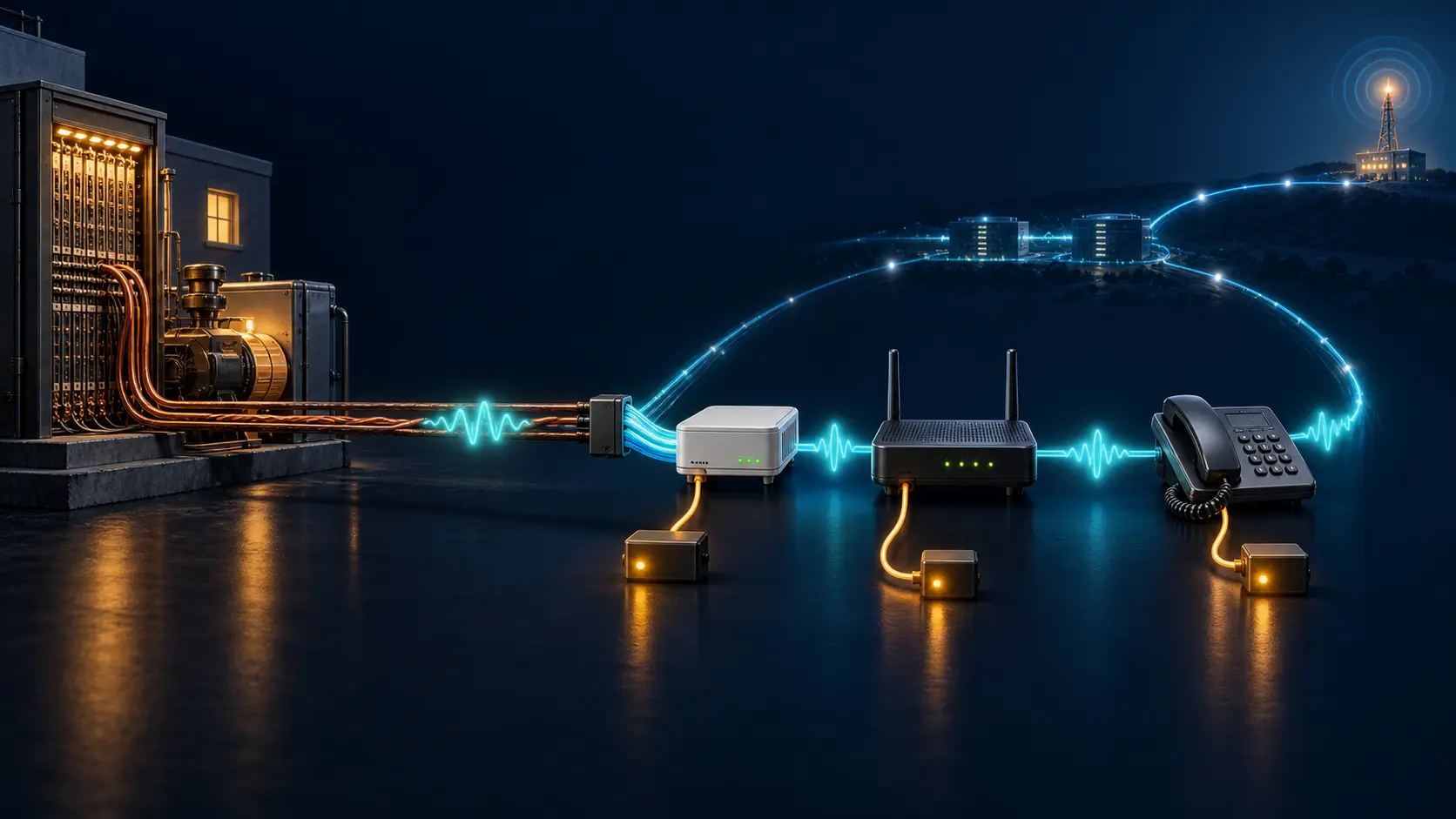
The sentence that matters in César Díaz’s 26 August essay is not about codecs or SIP. It is the short contrast between two power arrangements. A traditional fixed line over copper could receive electricity from the telephone exchange and, in some conditions, continue through a power cut. An IP service depends on equipment at the customer’s premises—modem, router and terminal—that needs electricity of its own.
That is the point at which a network migration becomes a responsibility migration.
The distinction needs careful handling. Díaz writes on LACNIC Blog as LACNIC’s Head of Telecommunications Affairs, but the page also says that authors’ views are their own and do not necessarily reflect LACNIC. This is not a LACNIC policy, and LACNIC is not the telephone regulator for the countries in its service region. Nor was copper a magic source of permanent service: cordless handsets, active street equipment, damaged lines or exhausted central batteries could all defeat the old advantage. A well-designed fibre or wireless service with batteries, generators and diverse access can be more resilient than neglected copper.
But the essay correctly exposes the question that optimistic accounts of All-IP migration often compress into the word “backup”. Backup for what, exactly?
Analysis: the call now crosses several power clocks
At the premises, an IP call may require a handset or analogue adapter, a router and an optical-network terminal or modem. Their batteries may have different capacities, ages and replacement owners. Beyond the door, an access cabinet, radio site or passive optical network leads to aggregation and the operator’s voice platform. An emergency call may then depend on number recognition, caller-location information, service-boundary mapping, SIP signalling, interconnection and the public-safety answering point.
The IETF’s emergency-calling work makes this division visible. RFC 5012 treats emergency service as an end-to-end IP problem and identifies location both as an input to routing and as information for the call taker. RFC 6881 distributes work among devices, access networks, service providers and emergency infrastructure. Dial tone at the handset therefore proves much less than a completed emergency path under outage conditions.
Every link can have a different operator and a different recovery clock. A customer may believe that a battery supplied with the router protects the service, while the optical terminal has no battery. An access provider may keep the broadband path alive while a separate voice provider loses its session platform. The voice platform may work while an address change leaves emergency location stale. A mobile fallback may be named without checking indoor coverage, congestion, disability access or whether the user owns a charged compatible device.
This is not an argument for freezing the public switched telephone network. It is an argument against letting the architectural label “All-IP” stand in for the service promise.
The strongest defence is also the reason to publish a receipt
There is no sensible single battery rule for Latin America and the Caribbean. The region contains dense fibre markets, islands, mountain communities, long distribution feeders, areas where mobile is the practical fallback and homes where it is not. Electricity reliability, storm exposure, equipment ownership, emergency numbering and consumer-protection powers differ by jurisdiction. Publishing exact site autonomy or exploitable topology would also be irresponsible.
The UK example is useful precisely because it is an example, not a model law for the region. Ofcom tells consumers that digital landlines need mains power unless backup is available, requires providers to assess vulnerable users and describes free backup solutions with stated duration expectations. Its 2026 resilience material also acknowledges that migration from the PSTN changes inherited power resilience. The lesson is not “copy one hour” or “copy seven hours”. It is that the responsible party, eligible user, promised duration and fallback can be made explicit.
A public migration receipt would do that without pretending every network is the same. For each material service design it should state which premises devices are necessary; who supplies, owns, maintains and replaces them; who qualifies for backup; what runtime is promised and under what load; whether the promise covers ordinary calling, emergency calling or both; how caller location is obtained and updated; what access and core fallbacks exist; and what customers must do before an outage.
The receipt also needs evidence, not only nouns. Operators should record representative tests with ageing batteries, realistic voice and data load, loss of utility power, congested fallback and a completed emergency-routing test where law and safety procedures permit. Public reporting can aggregate results and exception volumes. Protected diagrams, personal data and exact vulnerabilities can stay private.
Finally, the receipt must say who owns restoration. If a supplied battery has expired, if an optical terminal and router have mismatched autonomy, or if the emergency-location record is wrong, the customer should not have to arbitrate among an equipment vendor, access provider and voice reseller while the service is down. A named escalation path and dated correction history are part of the product.
None of this proves that a particular operator or regulator lacks such controls. Díaz’s essay is explanatory, not an audit. Its value is that it places the changed power boundary in public view. The next step is to give that boundary an owner and a test.
Sources
- LACNIC Blog, 26 August 2026: English, Spanish and Brazilian Portuguese.
- IETF RFC 5012, Requirements for Emergency Context Resolution with Internet Technologies.
- IETF RFC 6881, Best Current Practice for Communications Services in Support of Emergency Calling.
- ETSI TR 102 445 V1.2.1, emergency communications over IP networks.
- Ofcom: digital-landline transition, 2026 network and service resilience guidance and emergency access during a power cut, used only as UK comparisons.
Member Briefing
Deeper Profile Context
Sign in with the right membership level to unlock the full briefing and source notes.
Only for Strategic Circle
Strategic Circle
Open to all readers. Unlock profile briefings after joining and signing in.
Join Strategic CircleOnly for Leadership Alliance
Leadership Alliance
For qualified IP-asset owners and management; sign in to unlock alliance briefings.
Join Leadership Alliance