
Summary
- Kvinnherad Breiband looks economically valuable because it controls a dense local fibre position in its own municipality, claims more than 5,650 customers, and prices ordinary household fibre at NOK 699 to NOK 1,099 per month, but the hard test is whether active paying utilisation can cover renewal and edge-area build costs after the broad coverage phase is mostly complete.
- The company should be judged as a local access-network owner with municipal utility roots, not as a national carrier. RIPE membership, address ranges and AS216374 routing evidence show a real resource-governance and upstream dependency surface, but they do not prove a wholesale transit business or enough independent growth to offset a small rural customer base.
The Last Connection Decides The Economics
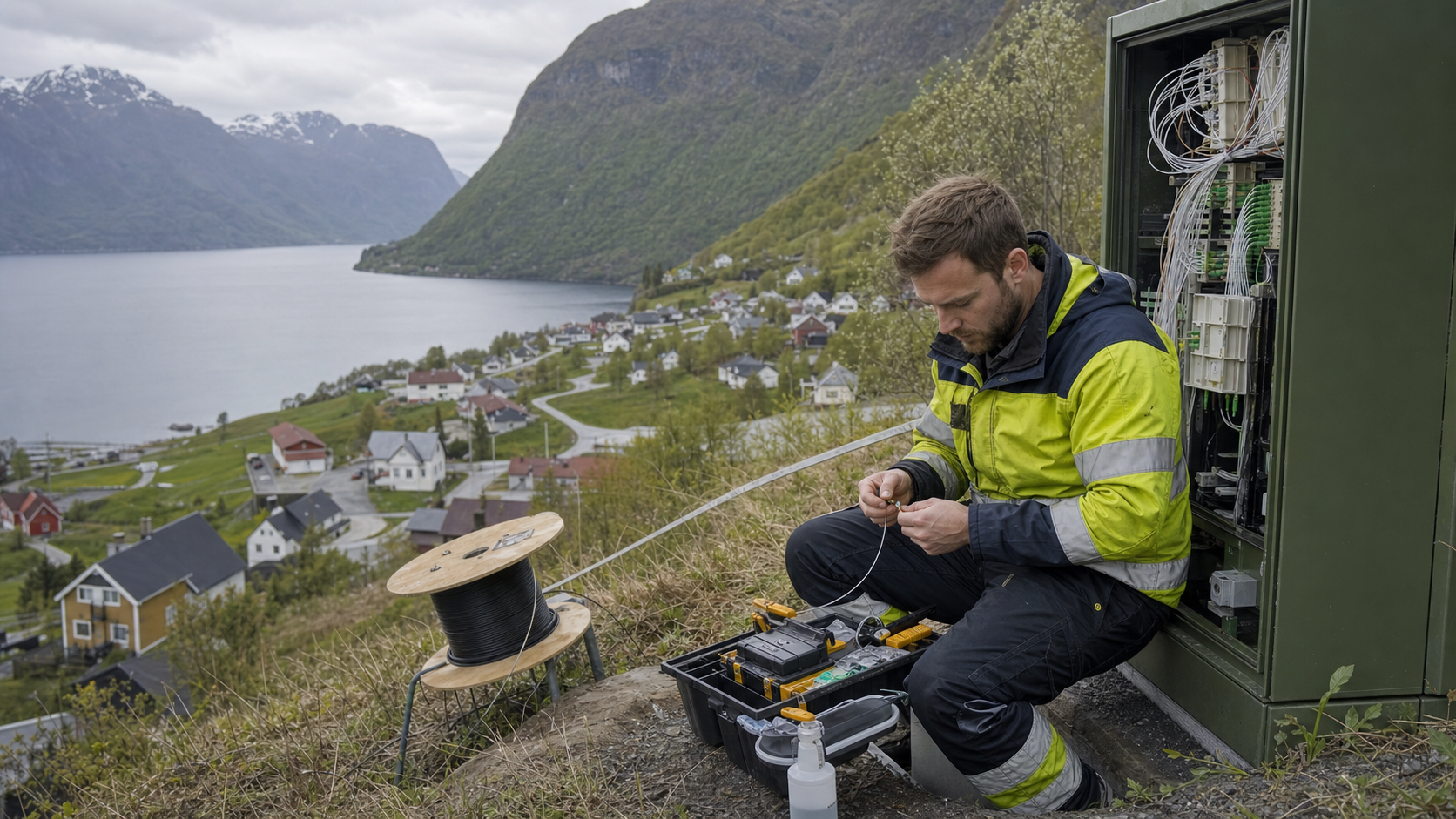
The most important decision in Kvinnherad Breiband's market is not made in a boardroom alone. It is made when a household, cabin owner, local business, municipality and network operator decide who should pay for the final expensive connection. In a compact urban block, the cost of one more customer can be spread across ducts, cabinets and labour that already serve many neighbours. In Kvinnherad, the same connection may run through fjord geography, islands, dispersed farms, holiday properties and small settlement pockets.
The company can pass a high share of premises and still face poor economics if the addresses that remain unconnected require a lot of civil work for limited recurring revenue.
That is why the company's own public position has two sides. Kvinnherad Breiband says it has delivered fibre for more than 20 years and offers internet, TV from Telia and telephony over fibre. It also says it has more than 5,650 customers across Kvinnherad, an internet-services market share of about 90%, and a build-out level of about 99.5%, with Snilstveitøy planned for 2026-2027 and some small pockets still left. Those claims describe a strong local footprint. They also imply that the next increment of growth will be harder than the first broad build. The company is no longer primarily proving that fibre can be built.
It is proving that a local access network can earn enough from take-up, speed upgrades, support services and business service levels to renew what it has already built.
The assignment for management is therefore specific. Premises passed are not the same as paying customers. Coverage is not the same as revenue density. A municipal owner may accept a broader public-service return than a private consolidator would, but even a public-service network has to replace electronics, repair cuts, maintain standby capability, buy upstream capacity, absorb supplier shocks and support customers who expect national-grade uptime from a local team. The last connection is where public value and private bill-paying meet.
Kvinnherad Breiband's advantage is that its market is legible. It is not chasing anonymous national demand. It knows the roads, cabins, local institutions and businesses. Its disadvantage is the same: the service area is finite. Once the easy houses are connected, growth has to come from higher utilisation per premise, lower churn, business products, TV and Wi-Fi add-ons, or carefully selected expansion beyond the core. The company must make rural fibre density pay because there is little evidence that scale will arrive from outside the municipality fast enough to rescue a weak local model.
The Company Is Local Utility Infrastructure, Not Just A Retail ISP
The Bronnoysund Register Centre records Kvinnherad Breiband AS under organisation number 986 419 497, with a Husnes business address, the corporate form of an aksjeselskap, and NACE code 61.100 for cable-based, satellite-based and wireless telecommunications. The registry says the company was founded in December 2003 and registered in January 2004. It also records 16 employees, NOK 4 million in share capital, VAT registration, a municipal-owned institutional-sector code, and 2024 as the latest submitted annual accounts year. This is not a shell with a telecom label.
It is a local operating company with staff, premises, customer contact and statutory purpose.
The company's registered purpose is telling. It is to own and operate broadband infrastructure and broadband networks, operate or mediate broadband services, cooperate with businesses with similar purposes, and own or operate activity naturally connected with those purposes. Its registered activity is to own and operate broadband infrastructure and broadband networks, and to operate or mediate broadband services. That legal language gives the business wider latitude than simple retail resale. It can own ducts, fibre and equipment; it can sell or mediate service; it can cooperate with neighbouring infrastructure holders.
But the same language also confirms that the economic centre is access infrastructure, not software, advertising, content creation or unrelated managed services.
Ownership reinforces the utility interpretation. Kvinnherad Breiband says it is wholly owned by Kvinnherad Energi. A municipal ownership report from 2020 described Kvinnherad Breiband as a subsidiary of Kvinnherad Energi and noted that the broadband company accounted for a large part of the value left in the energy company after network-business changes. That report was written when ownership was still described as split between Kvinnherad municipality and Fjelberg Kraftlag. Local press later reported that Kvinnherad Energi had become the full owner.
The current company page aligns with that later position by stating 100% Kvinnherad Energi ownership.
This ownership matters because it changes the downside calculation. A private buyer might focus mainly on enterprise value, free cash flow and consolidation options. A municipal energy owner also has to consider local resilience, jobs, service quality, digital inclusion and political accountability. That can justify more patient capital. It cannot justify ignoring economics. If local ownership keeps prices too low, defers renewal or funds uneconomic extensions without clear public support, the cost still lands somewhere: on the energy owner, the municipality, customers through future price rises, or service quality through underinvestment.
The company is therefore best understood as a municipal-utility broadband platform with a retail front end. That is attractive if the network is already built, customers are loyal and take-up is high. It is fragile if customer revenue cannot keep up with the maintenance curve of a near-universal rural network.
Coverage Has Been Built Before Utilisation Is Fully Proven
Kvinnherad Breiband's strongest claim is coverage. Its own internet page says it can deliver internet, TV, fixed telephony and payment services to about 99% of households and businesses in Kvinnherad. Its fact and history material says the build-out level is around 99.5%, with the remaining work concentrated in Snilstveitøy and a few small pockets. Its local-news posts repeat that message while saying the company has more than 5,650 customers across the municipality.
Those numbers should be read with discipline. They are company claims, not audited penetration metrics. Still, they fit the public economics of the market. Statistics Norway's municipal facts and Statbank material put Kvinnherad at roughly 13,200 residents in 2026 and a land area of about 1,042 square kilometres. Even if household size, cabin demand and business lines mean a customer is not equivalent to a resident, the arithmetic shows the density challenge. More than 5,650 customers across that geography is a strong local franchise, but it is still only a few customers per square kilometre of land.
The network must earn urban-like reliability expectations from rural-like density.
This distinction between passed premises and active customers is the central investment test. A network that passes nearly every address has already incurred a large part of its fixed cost. If a household declines installation, delays conversion from an older product, takes only a low-speed plan, suspends service at a cabin, or switches to mobile broadband, the stranded portion of the capital cost remains. The marginal address may be important for public inclusion, but it does not automatically create private returns.
The company's 2026 note about high demand is encouraging but not decisive. Kvinnherad Breiband said the start of 2026 was busy, with strong demand for new fibre installations, expansion of existing connections and high activity across the business. It also said handwritten letters to several areas drew responses from residents and cabin owners, including people living elsewhere who have a connection to Kvinnherad. That is a useful unofficial signal from the company itself: latent demand still exists, especially among holiday-property users and people with family ties.
But the same note said the company had longer delivery times for some new installations. Demand, labour capacity and service quality have to stay in balance.
The economics of the remaining premises are probably worse than average. Earlier company material on Baugstranda, Skorpo and Snilstveitøy said it needed as many orders as possible before starting, and that more orders made it easier to get a green light. That is the language of demand-threshold build economics. The company can make the final edge work only if enough households, cabins and businesses commit before the shovel cost is locked in.
The Published Price Ladder Points To A Narrow ARPU Problem
The public price list gives the clearest view of Kvinnherad Breiband's revenue mechanics. Ordinary consumer broadband is listed at NOK 699 per month for Fiber 100, NOK 799 for Fiber 200, NOK 899 for Fiber 500, and NOK 1,099 for Fiber 1 gig. The price list also shows a Fiber 500 campaign price at NOK 699 with a 12-month commitment, a year-round leisure-home Fiber 200 product at NOK 500, and a sponsored organisation product at NOK 300. Wi-Fi rental is listed with an upfront charge and NOK 99 per month. TV from Telia, boxes, premium content, fixed IP and technician services sit on top.
The ladder matters because the business needs customers to move beyond the lowest useful product without feeling exploited. The difference between Fiber 100 and Fiber 1 gig is NOK 400 per month, or NOK 4,800 per year before any bundle effects. If a meaningful share of households accepts higher speeds, the same physical drop can produce better return without new trenching. If most customers cluster around campaign pricing or low tiers, then broad coverage turns into a thinner annuity.
Public financial mirrors based on submitted accounts report 2024 operating revenue of about NOK 50.5 million and operating profit of about NOK 3.8 million, a margin around 7.5%. Those figures should not be treated as a full audited model here, but they are useful as a sanity check against the customer count. Dividing NOK 50.5 million by 5,650 customers gives roughly NOK 8,940 per customer per year, or about NOK 745 per month before adjusting for VAT, business accounts, TV, installation, support, telephony and non-recurring work. That rough average sits close to the lower-middle consumer broadband range.
It suggests the company cannot rely on a huge surplus per connection unless business and add-on revenue are materially stronger than visible retail pricing implies.
This is why price discounting has to be selective. A NOK 699 Fiber 500 campaign can defend share and push customers into a faster product, but if it becomes the expected price across the base, it compresses the same cash flow needed to fund maintenance. Free installation can remove friction for unconnected premises, but it also shifts upfront cost from the customer to the company unless recovered through the commitment period. A customer who takes free installation, a discounted plan and no add-ons is not the same economic asset as a customer who pays standard price, adds Wi-Fi support, keeps TV and renews after the first year.
The company has some room to segment. Cabin owners may value a stable year-round or seasonal product differently from full-time residents. Voluntary organisations can be subsidised openly as local social value. Business customers can pay for service levels. But the core problem remains: rural fibre economics depend on recurring gross margin per active line, not just on a proud coverage map.
Installation Discounts Show Why Take-Up Matters More Than Headline Coverage
Kvinnherad Breiband's 2025 free-installation offer is one of the best clues to the market's remaining friction. The company said it would offer free installation in built-out areas through 2025 and put the value of a new installation at NOK 3,950. It also promoted three free months of Telia TV for customers ordering by a deadline, while noting a 12-month commitment for new subscriptions. The message was friendly, but the economics are hard-nosed: remove the upfront barrier, get the premise active, then earn the subsidy back through recurring revenue.
That can be a rational tactic late in a coverage cycle. Once fibre is near an address, an inactive premise is wasted option value. A free drop that converts a household into a long-term subscriber may beat waiting for the customer to pay an upfront fee. But the tactic works only if the customer stays long enough and takes enough monthly value. On a NOK 699 broadband plan, the NOK 3,950 installation value is more than five months of gross billings before service costs, support, depreciation and upstream capacity. If the customer also receives TV concessions, the payback period stretches.
This is why the company should measure take-up by cohort, not by headline customer count alone. A customer acquired through a handwritten local campaign, a free installation, a cabin-owner appeal or a speed-upgrade promotion may have a different churn, support and add-on profile. The best customer is not necessarily the newest one. It may be the household that keeps service after the commitment period, upgrades speed as devices multiply, rents managed Wi-Fi, keeps Telia TV, and calls local support before considering a substitute.
Installation economics also expose the public-private boundary. Nkom describes broadband public support as a tool for areas where it is not commercially profitable to build digital infrastructure, with counties administering funds and rules around state aid, procurement, third-party access and open documentation. That logic fits the last-address problem. If a build is socially valuable but commercially weak, public support can share the cost. It should not hide the utilisation question after the project is finished. A supported fibre route still needs active customers, maintenance funding and upgrade capital.
The 2021 company note on Baugstranda, Skorpo and Snilstveitøy was blunt: more orders made it easier to start. That is the right test. If the local community wants fibre, enough households and cabin owners should prove demand early, and any subsidy should be linked to clear public benefit. The worst result would be a network extension that satisfies a coverage target but leaves too few paying lines to fund its life-cycle costs.
Business Service Levels Add Margin Only If The Base Stays Local
The business product surface gives Kvinnherad Breiband a possible way to improve revenue per metre of fibre. Its business page presents service-level choices: a standard level with 24/7 fault-reporting, fault repair during ordinary business hours, 99.5% availability, two-hour response and a target resolution time inside working days; a Silver level at NOK 399 per month with longer service hours, 99.7% availability and one-hour response; and a Gold level at NOK 599 per month with 24/7 service time, 99.8% availability and immediate fault work with a shorter target resolution window.
That is economically important because local businesses can pay for certainty. A small municipal network cannot become much larger by waiting for population growth, but it can earn more from premises that treat connectivity as operational infrastructure. Shops, offices, small manufacturers, tourism operators, farms, public services and home-office professionals can rationally pay for lower outage risk, faster response and support from technicians who know the area.
The public price list also shows lower hourly rates for technician or fitter work under Silver and Gold SLA conditions, which gives larger customers an incentive to buy the support wrapper rather than treat every incident as ad hoc labour.
The constraint is that business service levels consume real capacity. A promise of better response is not just a marketing line. It requires staffing, monitoring, spare equipment, work scheduling and a willingness to prioritise fault restoration. Kvinnherad Breiband publishes local service windows, customer-centre hours and standby arrangements. The fact and history page lists named employees across management, fibre project leadership, technical leadership, finance, business customer advice, customer advice, planning, fibre fitting and apprenticeship roles. A local team is a competitive advantage, but it is also a fixed cost.
Business terms also keep the operating boundary tight. The company says business subscriptions are for businesses within its network area, even if a legal customer has activity in several geographic areas. That protects the model from support obligations it cannot scale, but it also means the business segment is bounded by the local economy. Kvinnherad's industrial, public-service, tourism and small-enterprise base can produce valuable accounts. It cannot by itself create the demand of a metropolitan fibre market.
The company should therefore treat business SLA penetration as a core metric. If a large share of business customers remains on standard service, the network carries business-critical expectations without business-grade revenue. If Silver and Gold adoption rises, the company can better justify staff, spares and standby. The economic value of local proximity is highest when customers explicitly pay for it.
Network-Resource Evidence Shows Dependence As Well As Control
Kvinnherad Breiband appears in the RIPE NCC member directory with a Husnes address, phone number, email contact and Norway as its service area. That confirms a resource-governance footprint in the RIPE region. It does not, by itself, prove that the company sells transit, operates a national backbone or has independent upstream diversity. The right inference is narrower: Kvinnherad Breiband participates in the number-resource environment expected of a serious access-network operator.
Public routing evidence should be handled with the same caution. BGP.tools lists AS216374 as Hardanger Breiband AS, registered in August 2023, active under RIPE, with an eyeball network type and one observed upstream, GlobalConnect AS2116. The same page shows five IPv4 prefixes and one IPv6 prefix originated, including 83.242.0.0/19 and 185.221.0.0/22 described as Kvinnherad Breiband AS. Hurricane Electric's BGP Toolkit similarly shows AS216374 originating those Kvinnherad-described prefixes and observing GlobalConnect as the IPv4 and IPv6 peer.
IPinfo also presents AS216374 as Hardanger Breiband AS with one upstream, no downstreams and a consumer ISP activity profile.
This is useful evidence, but it is not a licence to overstate the business. The presence of Kvinnherad-described address blocks under AS216374 suggests shared or coordinated routing with Hardanger Breiband, a neighbouring regional broadband operator in which public company-data mirrors indicate Kvinnherad Breiband has held a minority share. It also points to GlobalConnect as an important upstream dependency. That means the network has real internet-routing exposure and local address resources, but its external connectivity is not visibly diversified in the way a major carrier's would be.
The economic reading is mixed. On the positive side, local address resources and participation in a regional AS arrangement can reduce dependence on pure white-label retail and support data-sovereignty and locality arguments. Local customers may prefer a provider whose physical support, customer contact and resource records are rooted in the region. On the negative side, reliance on upstream and partner networks limits bargaining power. Wholesale backhaul, IP transit, peering arrangements, core-router renewal and security controls still matter, and the public data does not show a large independent wholesale platform.
Kvinnherad Breiband should therefore be valued as a strong local access owner with regional network-resource cooperation, not as a broad carrier. Its fibre drops, customer relationships, local repair capability and municipal accountability are the assets. The routing layer supports those assets; it does not replace the need for paid household and business utilisation.
Telia, GlobalConnect And Service Partners Set The Outer Boundary
Kvinnherad Breiband's business model includes supplier leverage that can help margins but also imports risk. The company's consumer material says it delivers TV from Telia, and the price list shows Telia TV packages, Telia boxes, Apple TV rental and premium content options. The business and SLA material also points customers back to current price lists and accepted offers. That structure lets the company sell a broader home-service bundle without building its own TV platform, but it makes part of the customer experience dependent on a national supplier.
The Telia data incident in 2026 illustrates the point. Telia said customer data was stolen in a breach affecting private customers with TV or broadband from Telia, including partner customers, and that exposed data could include names, addresses, email addresses, phone numbers, dates of birth and IP addresses. Kvinnherad Breiband told its own customers that because Telia supplies TV services to the company, some customers could be affected, while also saying this was not verified at that moment. The commercial lesson is clear: even when the local fibre plant works, supplier trust can affect the local brand.
GlobalConnect is another boundary. The BGP evidence shows AS216374 using AS2116 GlobalConnect as upstream and peer. For a small access network, buying upstream capacity from a larger network is normal. It can provide reach, resilience and commercial simplicity. It also means the customer's experience is partly tied to wholesale terms, capacity planning and upstream outages outside the local company's direct control. If bandwidth prices fall and upstream resilience improves, Kvinnherad Breiband benefits. If wholesale costs, security requirements or route-quality issues move against it, the company has limited visible bargaining scale.
Equipment and labour suppliers are less visible but just as important. Fibre access networks need customer-premises equipment, routers, optical network terminals, splicing gear, cabinets, backup power, monitoring tools, vehicles and skilled technicians. The public price list shows fitter and technician hourly rates of NOK 1,200 and NOK 1,800, with lower rates for some SLA customers. Those prices reveal the cost base behind the friendly local support promise. Every fault visit is skilled labour. Every customer-caused fibre break has a repair cost. Every Wi-Fi complaint can consume time even if the outside plant is healthy.
The company can manage these boundaries, but it cannot wish them away. A local provider wins when it makes national services feel local and accountable. It loses when national supplier problems, upstream dependence or equipment renewal costs arrive faster than the rural revenue base can absorb.
Competition Is Increasingly About Substitutes, Not Just Fibre Overbuild
The obvious competitive threat is another fibre network. In practice, Kvinnherad Breiband's near-universal coverage and claimed local share suggest that direct fixed overbuild may not be the main pressure in every area. The sharper threat is substitution. A household that once needed local fibre for modern connectivity may now compare fibre with 5G fixed wireless, mobile broadband, satellite and national bundles. The substitute does not need to be superior. It only needs to be good enough for the customer's use case at a tolerable price and installation burden.
Nkom's national data frames the problem. At the end of 2024, 99.1% of Norwegian households were offered at least 100 Mbit/s internet access, 96.2% were offered at least 1 Gbit/s, and basic 5G household coverage was estimated at 99.7%. Nkom also said 96% of households were offered alternative connections, including fixed wireless in addition to fibre and HFC. National averages do not prove coverage at every address in Kvinnherad, especially in fjord and island terrain, but they show why the fallback options are becoming credible.
Telenor markets 5G-ready wireless broadband as a way to get fast and stable broadband without digging and says it expects nationwide 5G in 2026. Telia markets mobile broadband with 5G and a coverage guarantee, and Telia Company has said its Norwegian 5G network reached 99% population coverage in December 2024. Starlink's availability map presents Norway as covered for satellite service, while its residential material offers unlimited home internet in markets where available. None of these products is a perfect substitute for a symmetrical local fibre line with low latency and local repair.
But for a cabin, a renter, a light user or a household unwilling to wait for construction, they create bargaining pressure.
The competitive response cannot be only "fibre is better." Fibre often is better for capacity, latency, upload performance and reliability. The Nkom annual report notes that mobile technologies have much lower upload speeds than WLAN measurements, partly because many fibre subscriptions have symmetrical properties. That supports Kvinnherad Breiband's technical case. But customers do not buy abstract superiority. They buy the connection that fits their home, budget, work and patience.
Kvinnherad Breiband's best defence is local completeness: reliable fibre, fair speed choices, clear installation promises, good Wi-Fi support, fast fault communication and service that national substitutes cannot personalise. Its weakest defence would be a price ladder that assumes customers have no alternative.
Public Support Changes The Risk Sharing, Not The Need For Demand
Norway's broadband policy recognises that some areas are not commercially profitable to serve without support. Nkom describes public broadband support as a state-budget tool, administered by county authorities, for areas where it is not commercially profitable to build digital infrastructure. Its 2026 guidance says Vestland had NOK 17.85 million in broadband-support allocation, within a national total of NOK 159.11 million. It also describes rules around state aid, procurement, third-party access, data registration and minimum wholesale-access periods for supported projects.
That framework matters for a company like Kvinnherad Breiband because the final address problem is exactly where public and commercial logic diverge. If Snilstveitøy or another pocket cannot produce enough private take-up to fund construction, public support may be the right answer. The social benefits of connectivity can exceed the operator's billable revenue. Remote work, emergency communication, education, cabin use, small business, local inclusion and property value may all matter to the municipality.
But public support should not be confused with commercial success. A subsidy can lower construction risk; it cannot make a dormant premise pay the monthly bill. A supported extension still needs clear demand, active customers, maintenance reserves and enough future upgrade path to avoid becoming a stranded public asset. Nkom's rules around wholesale access also mean that support can come with obligations. If a project receives aid, the company may have to expose parts of the infrastructure to other access seekers under defined conditions.
That can be economically fair, but it reduces the operator's ability to treat the supported area as an exclusive local annuity.
This is where municipal ownership can either help or harm. It helps if the owner can distinguish between a public-service project and a commercial growth project, fund each transparently, and avoid pretending that every connection must meet the same private return threshold. It harms if political pride pushes construction without customer commitments, or if the company cross-subsidises edge builds so heavily that existing paying customers carry future price increases.
The right test is not whether broadband support is available. It is whether each supported or unsupported build has a believable take-up plan, clear operating cost, and a responsible answer to who funds renewal ten years later. The municipality can help pay for public value. The company still has to make the active network earn.
Customer Concentration Is The Hidden Constraint
Kvinnherad Breiband's claimed 90% local share sounds like a victory. It is also a concentration risk. When a company has already won most of its natural market, it has less room to grow by taking customers from rivals. Retention becomes as important as acquisition. Each household that downgrades, pauses, switches to mobile broadband, or declines a renewal offer matters more than it would in a larger addressable market.
The company also depends on the demographic and economic shape of Kvinnherad. A municipality of about 13,200 residents cannot generate unlimited household growth. It can generate seasonal demand from cabins, higher usage from home offices, business continuity needs, local public-service demand and industrial connectivity. But the finite nature of the market means management must be careful with fixed cost. A larger national operator can average call-centre, security, procurement and engineering costs across millions of subscriptions. Kvinnherad Breiband has to carry much of the local service promise on a small staff.
There are positive signs. The company says residents, existing customers and cabin owners responded to direct outreach in 2026. It says technicians are out connecting new customers, expanding links, fixing faults, planning and preparing new installations. Comparison sites show only a small number of user reviews, which is too thin for a reliable satisfaction conclusion, but that thin review footprint itself suggests the public unofficial signal is limited rather than broadly negative.
The company's Facebook and local-news posture emphasises local jobs, local competence and local service, which can reduce churn if customers believe the alternative is a distant national help desk.
Still, concentration cuts both ways. If local customers strongly identify with the provider, the company can defend pricing and bundle adoption. If they come to see it as a utility that should be cheap because it is locally owned, price increases become politically harder. The 2026 price-adjustment and product-change communication thanks customers and says "you need us and we need you." That sentence captures the mutual dependency well. It is honest, but it is also a warning. The company needs enough willingness to pay, not only goodwill.
The healthiest customer base would include many standard and high-speed households, a growing set of managed Wi-Fi users, business SLA accounts, cabin products that do not require excessive seasonal support, and public or enterprise accounts that value resilience. A base dominated by low-price promotions and high-cost support would weaken the local advantage.
What Would Change The Judgment
The current evidence supports a cautious positive view: Kvinnherad Breiband has built a valuable local fibre franchise, but its economics depend on utilisation and disciplined renewal capital rather than coverage pride. The company appears stronger than a marginal rural reseller because it has local infrastructure, a large claimed share, named staff, municipal utility ownership, RIPE membership, local customer relationships and published business service levels.
It appears weaker than a scalable telecom growth story because the market is small, the remaining build is hard, supplier dependencies are real, and public information does not show broad wholesale or transit revenue beyond the access franchise.
The judgment would improve with five facts. First, a verified premises-passed count by household, business and cabin category, matched to active subscriptions, would show whether 99.5% build-out is translating into billable utilisation. Second, cohort-level churn and upgrade data would show whether free installation and campaign pricing create durable customers or short-term movement. Third, segment revenue, especially business SLA adoption and TV attachment, would show whether average revenue per connection is rising enough to fund renewal.
Fourth, capital expenditure and maintenance data, including fibre-break frequency, electronics refresh cycles and upstream costs, would show whether the 2024 operating margin is enough for the next decade. Fifth, a clear Snilstveitøy and residual-pocket plan, including customer commitments and any public support, would show whether the last expensive addresses are being handled transparently.
The judgment would worsen if the company were relying on municipal patience to cover weak take-up, if customers were clustering around promotional tariffs without add-ons, if business SLA adoption stayed low, if supplier costs rose faster than prices, or if fixed wireless and satellite substitutes began taking the cabin and light-user segments. It would also worsen if the regional AS arrangement or upstream dependency created resilience problems the local company could not solve quickly.
The position, then, is direct. Kvinnherad Breiband should not be judged by whether fibre in rural Kvinnherad is good. It is good. The company should be judged by whether it can convert municipal proximity, high local coverage and trust into enough paid utilisation to fund the network's next life. On the public evidence available, it has a defensible local moat, but not a free one. The moat holds only if customers keep paying for more than the minimum connection and if the owner treats the final connections as explicit public-service investments where private demand is not enough.