
Summary
- Kursktelecom is not an empty shell around an access brand. Its own website, registry profiles and routing records point to a real Kursk communications operator with local telephony, data-transfer, telematics, cable-TV and leased-channel permissions, a consumer-facing KurskOnline service, corporate connectivity offers, public IPv4 space and AS42277 routing presence. That gives it a defensible local surface, but the same evidence shows why the economics are unforgiving: the revenue pool is regional, the plant is fixed, and many tariff points are low enough that one avoidable support visit can consume more than a month of residential subscription revenue.
- The investment case turns less on a generic "ISP in Russia" label than on density by neighbourhood and building. If Kursktelecom owns a fibre or cable path into a building where enough households take 340 to 740 rouble internet-and-TV bundles, or where an office circuit, telephone trunk, dark fibre lease or public-sector link adds higher-margin demand, the local segment can earn its keep. If take-up falls, churn rises, bad debt increases or a national carrier prices a comparable bundle into the same entrance, the same segment becomes a maintenance liability.
- Public records do not support confident subscriber, churn, traffic-volume or capex claims. The strongest usable facts are narrower: 2024 and 2025 financial snapshots reported by business registries, company-published service and licence material, observed routing and peering records, tariff pages, procurement traces, labour and vacancy signals, review surfaces and regional population/income context. They support a cautious thesis: Kursktelecom can remain economically relevant where its local operating knowledge and installed plant lower acquisition and service costs, but it needs pricing discipline and dense recurring revenue because its network cannot be allowed to age for free.
The access segment is the right unit of analysis
The central question for Kursktelecom is best asked at the scale of one neighbourhood access segment, not at the scale of a corporate biography. A regional ISP can appear large when described through licences, autonomous-system records and years of service, yet the cash result is often decided by a few streets, a block of apartment entrances, a private-sector cluster, a small business district, or a public institution linked by a dedicated fibre path.
In that unit, the useful variables are concrete: how many homes are passed, how many actually subscribe, what they pay each month, how often they call support, whether installation was subsidised, whether the same cable route can carry a school, clinic, store or municipal buyer, and how quickly mobile or national fixed-line alternatives can step into the same customer relationship.
The public record around Kursktelecom points toward exactly that economics. Its own website describes a broad menu of services: office internet over dedicated lines, local telephone access, IP telephony, regional 8-800 numbers, last-mile construction, data-channel organisation, local networks for corporate customers, remote office interconnection, design and construction of communications systems, fibre leasing, colocation in a local communications room, equipment placement across company facilities, public Wi-Fi, domain registration and hosting.
The same page frames Kursktelecom as a large alternative communications operator in Kursk, built around a fibre-optic network and a history dating back to 1999. Those are not just marketing categories. They describe the revenue stacking that a regional network needs. A residential line alone may not pay for civil works, electronics refresh, support desks and upstream redundancy. A segment that can also sell an office channel, a telephone service, a dark-fibre lease, or a public-sector connection has a different payback profile.
That distinction matters because published residential tariffs are not rich enough to absorb many mistakes. Public tariff surfaces for KurskOnline show apartment offers at low monthly price points, with packages in the 200 to 740 rouble range for common internet-and-TV bundles and higher offers for faster or richer bundles. Other public pages list a 500 Mbit/s apartment package and private-sector offers with day and night speed differences.
Even if those pages are third-party or local catalogue surfaces rather than audited company accounts, they are useful market evidence: residential broadband in Kursk is sold as an affordable utility, not a premium enterprise service. The moment a field visit, a missed payment, a damaged drop cable or a free installation is attached to one subscriber, the operator needs either long customer life or many neighbouring subscribers to recover the cost.
The density problem is harsher because most network costs do not fall in proportion when one household leaves. A fibre strand, switch port, optical node, route permit, battery, technician, billing platform and support team cannot be resized one apartment at a time. The local segment either has enough paying users to make those fixed and semi-fixed costs feel small, or it becomes an ageing asset carried by the remaining subscribers. Kursktelecom's public position is therefore not simply "small regional ISP faces competition." It is a local-capital recovery problem.
The company must keep enough revenue tied to each built area for long enough that the initial build, the ongoing transit, the repair labour and the eventual replacement cycle are paid before cheaper alternatives weaken the installed base.
Identity and control boundaries are not cosmetic
The company boundary has to be drawn carefully. The directory entity is Limited liability company Kursktelecom. The public-facing materials, however, sit inside a wider Kursktelecom group presentation that also names Limited Liability Company Kursk Telephone Company and the KurskOnline home network. The company website describes an association of communications enterprises and assigns business services to the telephone company while presenting KurskOnline for individuals.
Registry and routing records identify Limited liability company Kursktelecom through OGRN 1144632005539, INN 4632190410, a Kursk address on Karl Marx Street, AS42277, and telecom licences tied to the Kursktelecom legal entity. The economic analysis should not collapse every related brand, sister company or catalogue entry into one consolidated operating statement unless a source clearly does that.
That boundary is important because local communications businesses often share addresses, managers, technical staff, brands, fibres, service pages and customer-facing phone numbers while remaining different legal persons. A consumer may experience "KurskOnline" as the service and a business customer may see "Kursktelecom" on a page, but creditors, regulators and counterparties look at legal entities and licences. The public company page lists Kursktelecom's own OGRN, INN, bank details, address, contact information and licence numbers.
The same page separately lists details and licences for Limited Liability Company Kursk Telephone Company. That means the correct public conclusion is narrower than a sweeping group claim: Kursktelecom appears to be part of a local communications group and is tied to the KurskOnline brand surface, but its standalone finances, licences and network records should be treated on their own terms where the source names only Kursktelecom.
The registry evidence reinforces both existence and caution. RBC Companies reports Kursktelecom as registered on 20 May 2014, with 75,000 roubles of charter capital, 63 average employees in its reported 2024 profile, 2024 revenue of 149.696 million roubles, net profit of 16.347 million roubles, 2024 cost of sales of 125.54 million roubles, and ownership split equally between Svetlana Matyushina and Marina Donskaya.
Companium, drawing on later public-reporting surfaces, reports 2025 revenue of 102.7 million roubles, net profit of 2.3 million roubles, fixed assets of 52.5 million roubles, 72 average employees, 7.1 million roubles of taxes and 11.7 million roubles of insurance contributions. These are meaningful indicators, but not audited analysis in the article itself. They show scale and direction, not the exact structure of broadband margins by product line.
The reported swing from a strong 2024 profit snapshot to a much thinner 2025 result is economically important if the later figure is accurate. It would suggest either revenue pressure, cost pressure, mix change, timing effects, or some combination of these. It would not by itself prove subscriber loss, tariff cuts, traffic growth, equipment cost inflation or poor execution. The public data does not identify those drivers. The right inference is that Kursktelecom is small enough for local operational changes to matter.
A few large contracts, a procurement renewal, a route rebuild, wage inflation, equipment replacement, bad debt, or a change in related-party allocation could move visible profit sharply. That makes the company's control boundary and product mix central to any serious view of durability.
The network has real evidence, but not limitless scale
Kursktelecom's routing profile is one of the strongest pieces of public evidence that there is a material network behind the name. IPinfo lists AS42277 as an ISP in Russia with 71,680 IPv4 addresses, no IPv6 addresses in its own summary, a RIPE registry basis, allocation dating to January 2007, and a consumer-ISP activity pattern. Hurricane Electric's BGP page shows AS42277 originating eight IPv4 prefixes and one IPv6 prefix, all RPKI-originated valid in its view, with 71,680 originated IPv4 addresses and observed peers including Rostelecom, MTS and IP-Max.
Other routing surfaces, including 2IP, IPIP, IPXO, Cloudflare Radar, CIDR Report and Qrator Radar, broadly support the same picture of an active regional autonomous system with multiple prefixes and transit or peering relationships.
This does not prove subscriber count. Address space is not the same as paying households. Some addresses may support residential pools, business customers, infrastructure, hosting, equipment management, reserves or historical allocation. Cloudflare's estimated customer-population surfaces are useful only as directional measurement signals, and the public snippets visible from different captures show different estimated figures. That variability is itself a warning against using third-party internet measurements as a subscriber ledger.
What the routing evidence does show is that Kursktelecom controls a meaningful public IP footprint and participates in the interconnection system as more than a mere reseller.
The details are economically revealing. Public BGP pages show upstream or peer relationships involving Rostelecom, MTS, MSK-IX route servers, and additional networks. The RIPE-style aut-num text visible through several sources names upstream imports from MTS and Rostelecom, peering with MSK-IX, and customer announcements to several smaller networks. Hurricane Electric shows observed IPv4 peers and a large set of peer names, while bgp.tools pages for other networks show reciprocal relationships in which AS42277 appears as upstream or peer. The MSK-IX page shows an AS42277 presence on the Moscow exchange fabric.
These records imply a network that has to buy, manage or exchange upstream reachability and route policy, not simply purchase a generic internet line under someone else's brand.
For the local economics, that cuts both ways. Interconnection can lower marginal traffic cost and improve performance when properly managed. It can also create fixed technical obligations: router capacity, route filtering, DDoS hygiene, RPKI maintenance, monitoring, engineering knowledge, abuse handling and contractual exposure to upstream price changes. In a national carrier, those functions are spread across millions of users and large enterprise accounts. In Kursktelecom's case, the address base and observed routing are sizable for a regional operator but modest relative to the large Russian carriers.
The company has enough scale to need serious network operations, but not enough public evidence to assume that upstream and engineering costs disappear into vast national volume.
The IPv6 evidence is a good example of why precision matters. IPinfo's summary states that there are no known IPv6 addresses belonging to the network. Hurricane Electric, IPIP and Qrator-related surfaces point to an IPv6 prefix or at least IPv6 routing information. The safe interpretation is not that one source is wholly useless; it is that public measurement surfaces classify and expose address resources differently. A business conclusion should not turn on whether the live commercial base is IPv6-heavy.
The conclusion can be narrower: Kursktelecom's public profile is still dominated by IPv4 address space and IPv4 broadband economics, while the open routing data indicates at least some IPv6 registration or routing surface.
Published pricing shows a two-sided monetisation problem
Kursktelecom's pricing evidence splits into household mass-market offers and negotiated or semi-negotiated business infrastructure services. On the household side, third-party tariff pages for KurskOnline show low monthly prices for internet and TV packages, including offers around 200 roubles for a lower-speed bundle, 340 roubles for 100 Mbit/s plus a TV package, 430 roubles for another 100 Mbit/s bundle, 740 roubles for a higher-content 100 Mbit/s bundle, and higher figures for faster or premium bundles.
A local catalogue page lists additional apartment packages such as 90 to 500 Mbit/s internet offers and private-sector plans with different day and night speeds. These surfaces should be treated as market displays rather than contractual proof for every address, but they are directly relevant to the competitive price ladder visible to Kursk households.
On the business and infrastructure side, the official tariff PDF for Limited Liability Company Kursk Telephone Company shows the type of price architecture that matters to the shared operating system around Kursktelecom.
Fixed telephone access is priced with connection charges, E1 access includes a 30,000 rouble one-time charge and a 6,000 rouble monthly fee, SIP trunk access has one-time and line-based fees, local telephone plans have monthly components, virtual PBX functions have one-time and recurring charges, technician visits are priced, regional 8-800 numbers have allocation and monthly components, city data channels are contractual, dark fibre leasing is contractual, fibre maintenance and emergency restoration are contractual, and technical conditions for operators or developers carry published fees.
Even where the named legal entity is the telephone company rather than Kursktelecom, the menu describes the broader local infrastructure economics available around the same communications group.
That split is the heart of the thesis. Residential broadband produces recurring cash, but at low price points it is sensitive to support intensity. Business and wholesale-style services can raise the average revenue attached to a route, but they are less automatic. They require sales, technical design, reliability, documentation, and often negotiated installation. A regional operator that already owns fibre in the right place can monetise it several times: one apartment building, one retail tenant, one municipal service point, one 8-800 number, one leased channel, one public Wi-Fi site, one colocation rack or one fibre pair.
A route with only a handful of households on the cheapest plan cannot carry the same cost burden.
The public procurement traces support this view. Tender mirrors and official procurement links show Kursktelecom named as winner or supplier on small internet-access, direct fibre or data-transfer contracts for public-sector customers in the Kursk area. Aggregators report roughly one hundred public contracts over time, with total value below ten million roubles in the visible summaries. That is not enough to call public procurement the core business. It is enough to show that public institutions can be part of the revenue stack and that Kursktelecom's network is relevant to more than retail households.
The procurement amounts also underline scale: these are useful local contracts, not a transformational national backlog.
Unit economics are ruled by support labour as much as bandwidth
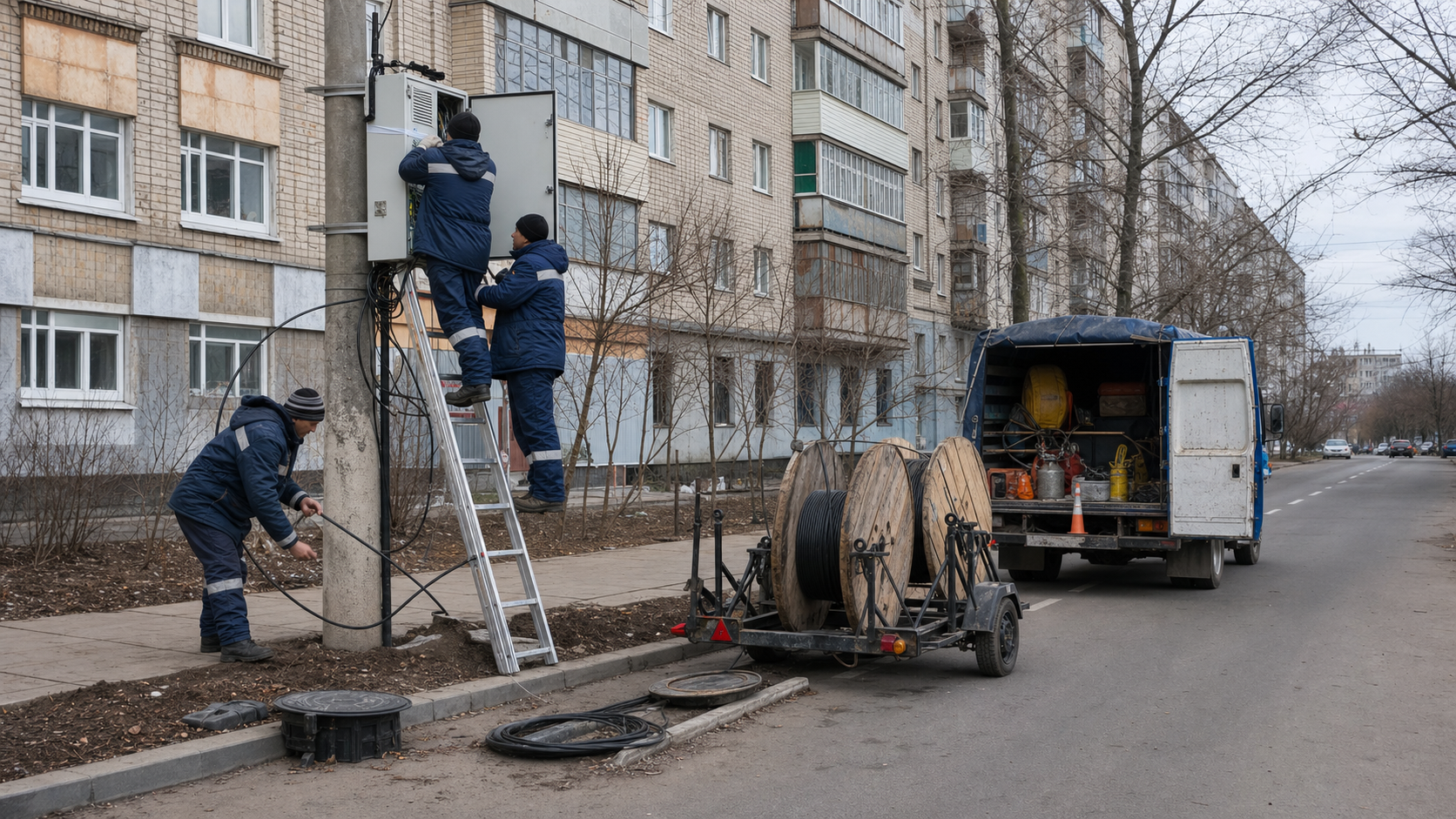
In broadband, it is tempting to think the unit cost is traffic. For a small regional access provider, the more immediate cost often sits in labour, truck rolls, installation work, repair time, customer support and failed collection. Kursktelecom's public pages repeatedly point to field-heavy work: last-mile construction, design and construction of communications systems, technical maintenance, emergency restoration, equipment placement, cable work, public Wi-Fi organisation and custom technical conditions.
The local catalogue pages also advertise electrical installation and cabling services, which may be adjacent to the telecom business rather than pure ISP revenue. The common theme is physical work in real buildings. That work can be a differentiator when customers value local response, but it also means ageing infrastructure creates cash demands that cannot be solved by marketing alone.
The price comparison is stark. If an apartment customer pays 340 or 430 roubles per month, a single published 600 rouble technician call in the business tariff context is already greater than one monthly household bill. A free or discounted installation, a damaged drop, a repeated support visit, or a tariff-change administrative burden can erase months of contribution from a low-ARPU subscriber. That does not make the customer unprofitable by definition, because many subscribers need little support and remain for years. It does mean the company must guard against avoidable service friction.
The cheapest customer is not the one with the lowest package price; it is the one who stays long enough, pays on time, uses standard equipment, does not require repeated visits, and lives near many other paying customers.
The labour evidence shows why this is not abstract. Companium reports 72 average employees for 2025, and a public vacancy signal for a service-engineer assistant offered a salary from 50,000 roubles in 2025. The company website lists many services that require technical staff rather than only billing software. If 2025 revenue was around 102.7 million roubles and average headcount around 72, the simple revenue-per-employee ratio is roughly 1.43 million roubles per year. That is not a broadband margin calculation, because the figure includes all product lines, accounting choices and non-wage costs. It is still a useful scale marker.
A small team has to operate a local network, support residential and business customers, handle regulatory obligations, sell services, maintain routing, and conduct field work.
Wage pressure therefore has second-order effects. A national carrier can absorb a specialist team across many regions. A local operator may need the same categories of skill but cannot divide them across the same revenue base. If wages rise because skilled telecom labour is scarce, if military and security conditions in border regions make field work harder, if equipment import constraints raise replacement costs, or if customers expect faster response without paying more, the margin moves quickly. The public accounts do not tell which of these pressures hit Kursktelecom in 2025.
They do show that the company is small enough for any one of them to matter.
Customer concentration cuts both ways
The public record does not identify Kursktelecom's largest customers, and it would be unsafe to invent them. The evidence does show customer categories: households using KurskOnline, legal entities buying office internet or telephone services, public institutions appearing in procurement traces, other operators or developers needing technical conditions, and networks visible in routing records as customers or peers. That mix is helpful because it reduces dependence on a single retail product. It is also risky because each category has different failure modes.
Residential customers are numerous but price-sensitive. The reviews and tariff-comparison pages show consumers thinking in terms of speed, price, TV channels, convenience and support. One old review complains about actual speed versus advertised speed; another complains that tariff changes required an office visit and that 100 Mbit/s offers were available at low price points. These are anecdotal and dated, and they should not be treated as a current service-quality audit.
They are useful because they reveal what churn conversations sound like in the market: customers compare speed promises, administrative ease, price and the availability of alternatives. A local ISP that makes plan changes difficult or lets support friction accumulate can lose the very long customer life needed to make low monthly ARPU work.
Business customers are fewer and potentially more valuable, but they demand reliability and service clarity. A small office internet line, SIP trunk or local channel may be less price-sensitive than a home bundle, yet a business outage can trigger urgent support and reputational damage. Public-sector customers offer visible contracts and payment discipline, but procurement is episodic, price-competitive and sometimes small. A data channel or fibre lease can make a route more valuable, but it may also require technical performance commitments and documentation.
Other networks visible in routing records may bring transit or peering complexity rather than simple retail revenue.
The fact that business registries report public contracts worth under ten million roubles over the full visible period is a useful scale check. Those contracts are evidence of institutional relevance, not proof of a protected annuity. If one hospital, agency or regional office renews, the company may have a stable local circuit. If it retenders and a national carrier bids aggressively, the same revenue may move. The stronger position is where procurement customers are attached to routes that also serve households and commercial tenants; then even a lost contract does not leave the route empty.
The weaker position is a bespoke build whose economics depend on one institutional buyer.
The customer-concentration question therefore remains unresolved. Kursktelecom may have thousands of households, dozens of business customers, a few public accounts and some network customers. Or the split may be more concentrated than the public surface suggests. The public record cannot settle that. What it can say is that the company needs more than subscriber count. It needs diversity by product and density by route. A thousand scattered low-price homes are not equal to a thousand homes concentrated in buildings where the company already has plant, low support cost and nearby business customers.
Competition is not only another fibre provider
Kursktelecom's substitutes include at least three categories: national fixed-line carriers, other regional and cable operators, and mobile broadband or bundled mobile-fixed offers. The visible tariff market in Kursk is crowded enough to constrain price. Beeline pages show mobile data offers for devices and home internet offers with promotional pricing, including 100 Mbit/s and 600 Mbit/s plans on public comparison pages. Dom.ru pages show 300 Mbit/s to gigabit-style home-internet offers with prices in the hundreds to low thousands of roubles per month.
MTS pages visible in search results show home internet and TV bundles with promotional discounts and speeds up to gigabit settings. Rostelecom regional pages emphasise xPON, Wi-Fi 6, bundles, security services and address-availability checks across Kursk region localities.
The exact price at a given address can differ from the web page. Promotional prices expire, routers cost extra, installation may be free or charged, and building availability is decisive. The competitive message is still clear: Kursk households are shown alternatives that combine speed, TV, mobile minutes, mobile data, router offers, online-cinema features and national-brand support. If those alternatives reach a building where Kursktelecom once had a local advantage, the company has to defend not only price but convenience and trust.
A national carrier can cross-subsidise acquisition with mobile bundles; a local ISP may answer with local support, lower prices, known technicians, TV content, or faster building-specific response.
Mobile broadband is a special threat because it does not have to beat fibre on every metric to create churn. For some households, a cheap SIM, a router data plan, or a mobile bundle may be "good enough" during a move, renovation, short rental, student stay or dispute with a fixed-line provider. Beeline's public device-tariff page, for example, advertises mobile data packages for routers and modems. Those products are not perfect substitutes for heavy home fibre usage, especially under congestion or data-cap constraints, but they raise the customer's outside option.
If a fixed-line provider asks for paperwork, delays repair or makes plan changes painful, a mobile workaround can become permanent.
Kursktelecom also faces a harder national-carrier cost problem. Rostelecom and MTS appear not only as competitors but also as upstreams or adjacent networks in routing evidence. That does not imply abusive pricing or dependency beyond the recorded relationships. It does mean Kursktelecom operates in an ecosystem where large carriers may be both suppliers of reachability and retail rivals. A regional ISP can survive that arrangement when it owns local access, controls support quality and extracts value from routes that national carriers neglect.
It is exposed when the large carrier decides the same building or public customer is worth a promotional campaign.
The regulatory and geopolitical surface is real but indirect
Telecom regulation appears throughout the evidence. Kursktelecom's own website lists multiple communications licences: data transmission, telematics, data transmission for voice purposes, local telephone services, payphone-related local services, leased channels, intra-zone telephone service, cable broadcasting and other local telephone categories. Companium states that eight active licences are visible through EGRUL and federal communications sources. A 2016 communications-ministry letter includes both Kursk Telephone Company and Kursktelecom among Kursk-region communications entities subject to statistical reporting.
The regional government page on children's internet mentions Kursktelecom as offering a free "Children's Internet" service through a proxy-server white-list arrangement and parental-control services.
These facts matter because a local ISP is not only a commercial subscription business. It is part of a regulated communications system that must handle licences, reporting, personal-data rules, lawful requests, content rules, abuse contact obligations and technical reliability expectations. The company-published app privacy policy for KurskOnline identifies Kursktelecom as the operator of a user-facing application and states that Russian law applies. The company's privacy and personal-data documents are not evidence of superior compliance, but they show that data-handling and user-service obligations are part of the operating surface.
The geopolitical context is harder to quantify from public company-specific sources. Kursk region borders Ukraine, and the Federation Council page places the region in the Central Federal District, gives its area and population, and notes the border. That location can affect risk perception, labour availability, repair logistics and public-sector communications priorities. But the public sources reviewed here do not prove that Kursktelecom has suffered a particular outage, capex delay, damage event or supply disruption due to the border environment. The correct treatment is to recognise regional exposure without inventing operational events.
Equipment and replacement capital also require caution. It is plausible that Russian telecom operators face equipment sourcing, currency and vendor constraints, and that older access networks need periodic electronics replacement. But Kursktelecom-specific public documents do not disclose capex plans, vendor contracts, spare-part inventories or debt facilities. The official business tariff page does mention construction, modernisation, maintenance and emergency restoration. Registry surfaces report fixed assets and financial statements. Routing pages show ongoing public internet operations.
Those facts support the conclusion that replacement capital matters. They do not support a claim that the company is underfunding its network or facing a named vendor shortage.
The regulatory risk is therefore less dramatic and more persistent. Kursktelecom has to keep licences current, satisfy reporting and communications rules, protect user data, handle children's internet and filtering expectations, maintain abuse contacts, and keep network-routing hygiene visible to peers and upstreams. None of those tasks creates high ARPU. They are the fixed obligations of being an operator. They become economically heavier when revenue density weakens.
Public finance signals show resilience and fragility at the same time
The financial snapshots create a mixed picture. RBC reports 2024 revenue near 149.7 million roubles and net profit near 16.3 million roubles, implying a visible net margin around 10.9% on that snapshot. Companium reports 2025 revenue near 102.7 million roubles and net profit near 2.3 million roubles, implying a much thinner margin around 2.2%. The same Companium page reports fixed assets of 52.5 million roubles, equity capital around 63 million roubles, 72 average employees and 18.8 million roubles of taxes and insurance contributions in 2025. Another business-checking surface reports 2025 revenue at the same rough level.
These figures are public-registry-derived and may be restated or displayed differently across services, but the direction is hard to ignore.
If the 2025 numbers are correct, Kursktelecom had a revenue drop of roughly 31% to 32% from the 2024 registry snapshot and a far larger drop in profit. That is not automatically a crisis. Small communications companies can show year-to-year volatility from accounting timing, contract mix, related-party arrangements, one-off work, equipment purchases, depreciation, tax treatment or revenue recognition. But it changes the tone of the economic question. A company with consistent double-digit net margin could fund modest replacement capital from retained earnings.
A company with a low-single-digit net margin has less room for mistakes, especially if it must keep skilled labour, support customers and refresh network electronics.
The public accounts also suggest that Kursktelecom is not a venture-style high-growth network chasing losses. It is a small private regional operator with charter capital of 75,000 roubles, an SME status signal, reported taxes and contributions, no bankruptcy messages in one registry surface, and no direct sanction-list hit in Companium's display. That can be a strength. A locally controlled operator may have lower bureaucracy, long relationships, practical building knowledge and disciplined spending. It can also be a constraint. It may lack cheap capital for a large fibre rebuild, marketing subsidies or bundle wars.
The procurement and court signals are modest but relevant. RBC reports 17 arbitration cases over a recent three-year window and 104 public contracts worth 9.86 million roubles over time, while Companium reports a larger lifetime arbitration count and similar public-contract scale. These are not alarming on their face for an operating local utility with many small accounts. They do indicate administrative friction, collections or contract enforcement as normal parts of the business. For a low-ARPU ISP, bad debt and legal recovery matter because the cost of chasing small balances can exceed the margin recovered.
The article cannot say that Kursktelecom's bad debt is high; it can say that the unit economics leave little room for late payment, repeated disputes or low-value collection work.
Unofficial market signals point to the customer promise
Unofficial signals have to be treated as signals, not facts about the whole customer base. Yandex-hosted profile pages and review surfaces show a KurskOnline office, contact numbers, hundreds of reviews and recent positive comments about stable service, support and rare price increases. Older 2IP reviews include complaints about speed, tariff changes and administrative friction. Provider-comparison pages list KurskOnline tariffs alongside other providers. Local catalogue pages show promotions, events, services and plan names. None of this is audited, and reviews can be biased, stale, duplicated or unrepresentative.
But together they show the contours of market perception.
The positive signal is that KurskOnline appears to have local brand recognition. Customers can find an office, leave reviews, compare plans, discuss service stability and refer to specific plan names. A local provider without brand memory has to buy every new subscriber. A provider with a known name can rely more on word of mouth and building-level familiarity. The company website's claim that thousands of Kursk residents, enterprises and organisations have become customers is not independently quantified, but it fits the visible consumer footprint.
The negative signal is that the customer promise is easy to damage. Broadband customers forgive neither slow repair nor confusing plan changes. If a household believes the advertised speed is not delivered, or if a simple tariff change requires an inconvenient office visit, the low monthly price stops feeling cheap. National carriers and mobile offers then become escape valves.
Reviews from many years ago should not be used to judge current operations, but they identify the exact operational categories that matter: speed consistency, support access, plan administration, and whether the operator behaves like a neighbourhood utility or a paperwork-heavy incumbent.
The market-signal layer also helps explain why TV bundles and local services still matter. Some KurskOnline offers include TV channels, video services, entertainment packages and community-facing promotions. For a pure bandwidth analyst, these may look secondary. For a local ISP, they can reduce churn and make a household less likely to compare only megabits per rouble. The danger is that content and bundle extras also add vendor, support and licensing complexity. They help if they lengthen customer life without adding heavy cost. They hurt if they create more support contacts than revenue.
The signal to monitor is not whether one review is good or bad. It is whether the visible market conversation shifts from "local provider with adequate price and familiar support" to "same price as national carriers but harder to deal with." Kursktelecom's advantage lives in the first description and weakens quickly in the second.
What would change the judgment
The public evidence supports a cautious but not dismissive view. Kursktelecom has licences, a local brand surface, public network infrastructure, registry-visible revenue, staff, public customers, and a plausible business/residential mix. It is not just a name attached to a dormant allocation. Yet the economics are not comfortable. Low residential price points, fixed support labour, possible revenue volatility, national-carrier competition and regional constraints mean that Kursktelecom must keep density high and capital discipline tight.
The first fact that would change the judgment is connected-homes and take-up data by area. If Kursktelecom has high penetration in apartment buildings where it already owns in-building plant, the low advertised prices can still be rational because acquisition, maintenance and support costs are spread across many users. If its customers are scattered or if many buildings now have national-carrier overbuild, the same prices look exposed. Homes passed, active subscribers, active ports and churn by building would matter more than any headline address-space number.
The second fact is true ARPU by segment. A 340 rouble public plan does not mean the blended household ARPU is 340 roubles. Customers may buy TV packages, higher-speed tiers, static IPs, private-sector plans, equipment, installation services or related offerings. Business customers may lift route economics. Conversely, promotions, arrears, free months and discounts may pull realised ARPU below the public price. Without that information, the article can only infer price pressure from visible tariff pages.
The third fact is support intensity. How many installation visits, repair calls, repeat contacts, unpaid balances and tariff-change interactions does each cohort require? The public tariff evidence shows why this matters, but it does not measure Kursktelecom's current performance. A local operator with excellent first-time installation, durable in-building wiring and simple plan administration can make low tariffs work. One with frequent return visits cannot.
The fourth fact is capital backlog. The official service menu references construction, maintenance, modernisation and emergency restoration, while routing records show ongoing network operations. But no public source discloses equipment age, fibre-route condition, spare capacity, battery status, vendor exposure or planned replacement spending. If the network is mostly modernised and densely loaded, Kursktelecom has optionality. If large portions require replacement while revenue is falling, the apparent resilience weakens.
The fifth fact is wholesale and public-sector renewal quality. Procurement traces show institutional demand, but visible totals are modest. If Kursktelecom has durable, high-margin leased-channel, fibre, colocation or business internet relationships near its residential routes, it has a defensible economics. If procurement is mostly small, one-off and price-led, it is helpful but not a moat.
The final judgment is therefore conditional. Kursktelecom's strongest economic role is as a practical local infrastructure operator in Kursk, monetising installed plant through households, offices, public circuits and network relationships. Its weakest position would be a commodity low-price ISP trying to match national carriers on speed and bundles while carrying local support costs. The public evidence leans toward the first role being real, but it also shows why management cannot allow the network to drift. Ageing plant has no pause button. Every year of under-recovery turns today's local advantage into tomorrow's repair bill.
Sources
- https://www.kursktelecom.ru/
- https://www.kursktelecom.ru/document/deystv_tarif_ooo_ktk_s_16112022.pdf
- https://kursktelecom.ru/policy.html
- https://kurskonline-kursktelekom.clients.site/
- https://vash-kurskonline.orgs.biz/
- https://provayder.net/kursk/providers/kurskonline/
- https://provayder.net/kursk/tarifs/dve-zvezdy/
- https://provayder.net/kursk/tarifs/tri-zvezdy/
- https://provayder.net/kursk/tarifs/chetyre-zvezdy/
- https://2ip.ru/isp-reviews/KurskOnline%2B%28%D0%9A%D1%83%D1%80%D1%81%D0%BA%D0%B0%D1%8F%2B%D1%82%D0%B5%D0%BB%D0%B5%D1%84%D0%BE%D0%BD%D0%BD%D0%B0%D1%8F%2B%D0%BA%D0%BE%D0%BC%D0%BF%D0%B0%D0%BD%D0%B8%D1%8F%29/?itemPerPage=10&orderBy=id&pageId=4
- https://2ip.ru/isp-reviews/99635/JSC%2BKursktelecom/
- https://2ip.ru/isp-reviews/246231/JSC%2BKursktelecom/
- https://kursk.ru/region/other/page327546/
- https://www.ripe.net/membership/member-support/list-of-members/ru/kursktelecom/
- https://ipinfo.io/AS42277
- https://bgp.he.net/AS42277
- https://2ip.ru/as/42277/
- https://whois.ipip.net/AS42277
- https://www.ipxo.com/asn/AS42277/
- https://radar.qrator.net/as/42277
- https://radar.cloudflare.com/as42277/
- https://radar.cloudflare.com/security/network-layer/as42277?dateRange=12w
- https://radar.cloudflare.com/routing/as42277
- https://www.cidr-report.org/cgi-bin/as-report?as=AS42277&view=2.0
- https://www.pdflibr.com/AS42277
- https://bgp.tools/as/34033
- https://bgp.tools/as/44011
- https://bgp.tools/as/44276
- https://bgp.tools/as/8359
- https://bgp.tools/as/8631
- https://bgp.tools/ixp/MSK-IX%20Moscow
- https://companies.rbc.ru/id/1144632005539-ooo-kursktelekom/
- https://companies.rbc.ru/amp/ogrn/1144632005539/
- https://companium.ru/id/1144632005539-kursktelekom
- https://synapsenet.ru/organizacii/1144632005539-ooo-kursktelekom
- https://reputation.ru/ogrn/1144632005539
- https://zachestnyibiznes.ru/company/ul/1144632005539_4632190410_OOO-KURSKTELEKOM
- https://spark-interfax.ru/kurskaya-oblast-kursk/ooo-kursktelekom-inn-4632190410-ogrn-1144632005539-23bcc36c08fd48bf89570d59f45ab70d
- https://www1.fips.ru/fips_servl/fips_servlet?DB=RUTM&DocNumber=1030789
- https://trudvsem.ru/vacancy/card/1144632005539/d45d3180-403f-11f0-b9d8-d549be31d974
- https://kad.arbitr.ru/Card/9973c764-820e-44d0-b1e9-e610c99ceca1
- https://fedresurs.ru/
- https://poisktenderov.ru/item/0844200001419000069/
- https://poisktenderov.ru/item/0344300102219000037/
- https://poisktenderov.ru/item/0344200010719000059/
- http://zakupki.gov.ru/epz/order/notice/ea44/view/common-info.html?regNumber=0844200001419000069
- http://zakupki.gov.ru/epz/order/notice/ea44/view/common-info.html?regNumber=0344300102219000037
- http://zakupki.gov.ru/epz/order/notice/ep44/view/common-info.html?regNumber=0344200010719000059
- https://kursk.beeline.ru/customers/products/mobile/data-tariffs/
- https://beelinefiber.ru/kursk/
- https://kursk.internet-domru.ru/
- https://tarify-dom.ru/kursk
- https://kursk.mtsru.ru/internet
- https://kursk.rt.ru/-kshenskij-/homeinternet
- https://46.rosstat.gov.ru/main_indicators
- https://46.rosstat.gov.ru/?ysclid=m1t20z9zu9419221503
- https://rosstat.gov.ru/folder/13397
- https://regionstat.ru/region/46/19/301
- https://www.council.gov.ru/en/structure/regions/KRS/
- https://www.nalog.gov.ru/rn46/news/activities_fts/16596766/
Member Briefing
Deeper Profile Context
Sign in with the right membership level to unlock the full briefing and source notes.
Only for Strategic Circle
Strategic Circle
Open to all readers. Unlock profile briefings after joining and signing in.
Join Strategic CircleOnly for Leadership Alliance
Leadership Alliance
For qualified IP-asset owners and management; sign in to unlock alliance briefings.
Join Leadership Alliance