
Summary
- Kirzhachtelecom LLC is a small Kirzhach-based fixed-line operator whose public evidence points to a real local access network, a licensed service perimeter, AS201285 routing, district tariff segmentation, and a business model that depends on converting local service density into repair speed and cash discipline rather than on national scale.
- The main investment and monitoring question is not whether the company has a website, tariffs or a registered ASN; it is whether each connected building and settlement cluster leaves enough monthly cash after wholesale connectivity, customer support, field labour, pole and fibre work, CPE replacement, TV resale costs, taxes and churn to fund the next repair before customers defect to mobile, a national carrier or a local alternative.
The Premise Inside One Building
Start with one building in Kirzhach rather than with the company name. A multi-dwelling block on a city street has a different economic profile from a private house on the edge of the town, and both are different from a settlement or garden association in the district. The public tariff grid makes that distinction visible. Apartment tariffs in Kirzhach show promotional monthly levels at 400 rubles for up to 55 Mbit/s, 500 rubles for up to 100 Mbit/s and 1,250 rubles for a higher-speed plan bundled with television, with ordinary prices shown above the promotional level.
Private-house tariffs are higher: 800 rubles for up to 50 Mbit/s, 850 rubles for up to 100 Mbit/s, 1,000 rubles for up to 250 Mbit/s and 1,750 rubles for the 450 Mbit/s plus TV tier. District tariffs are higher again, running from 900 rubles for a 70 Mbit/s plan to 2,000 rubles for the high-speed TV bundle.
That stepped schedule says more than a generic provider profile would. It suggests that Kirzhachtelecom prices around build density, drop length, support friction and repair difficulty. A city apartment connection can spread the feeder, switch, splice and call-centre cost across many doors. A private house may require a separate optical drop, more outdoor work, more failed appointment risk and more home networking support. A village or garden-area connection adds distance and, often, overhead plant exposed to weather, third-party work and tree or vehicle damage.
The price ladder is therefore not just a marketing table; it is a rough map of where the cost is supposed to sit.
The company’s own terms also matter because they show how it tries to pull cash forward. The public tariff notes say the discounted plans are available subject to six months of advance payment for the chosen plan. A six-month prepayment is economically important for a small operator. It lowers collection risk, gives working capital before the next repair season and reduces the number of subscribers who connect for a brief period, consume installation labour, and leave before the operator has recovered its local build cost.
The discipline has a price: customers who view the operator as expensive or unavoidable may resent paying in advance, and public reviews show some of that tension. But the mechanism is rational for a company whose operating problem is not just demand; it is the timing mismatch between recurring revenue and lumpy local maintenance.
This is the right frame for Kirzhachtelecom. The useful question is not whether a subscriber wants broadband. The useful question is whether each connected premise, after upstream transit, access electronics, power, customer support, billing, taxes, line repair and eventual replacement, leaves a sufficient contribution to defend the network. A small broadband company can look healthy at the revenue line while being fragile at the repair line. If a cluster of connected buildings creates predictable cash and a concentrated field route, it compounds.
If the same revenue is spread across long rural drops with high fault rates, the apparent tariff can still be too low.
Identity, Boundary and Control
Kirzhachtelecom LLC is publicly presented as a Kirzhach operator with an office at Privokzalnaya Street 59 and contact channels that include a toll-free number and the company domain email. Its own documents page lists telecom licences for data transmission, telematic services and channels, and its privacy policy identifies the legal entity, tax and registration numbers, addresses, website, and personal-data register reference.
Russian company-record mirrors identify the same registration number and tax number, a 2010 registration date, a small-business profile, and wireline communications as the main activity in more recent classification data. The public corporate pages also identify Dmitry Marshanov as general director and show a shareholder structure made up of individual participants rather than a national carrier group.
That boundary is important because small regional operators are often misread as brands, franchises or sales agents. Kirzhachtelecom’s public footprint is deeper than a reseller page. It has its own access tariffs, customer account links, payment channels, service documents, municipal-service language, local outage notices, video surveillance tariffs, TV resale packages and an autonomous system. Those are not sufficient to prove every element of network ownership, but they do establish that the operating surface is local, direct and customer-facing.
The company has to manage not just sales but field service, regulatory documents, customer data, notices of planned works and routing visibility.
The control boundary also contains risk. Public court records describe a dispute with Rostelecom in which courts considered evidence of unauthorized connection to Rostelecom fibre facilities in local settlements. The details matter because they go to the discipline of network build, rights of way and use of third-party infrastructure. The cases are not a generic complaint about service quality; they involve fibre lines, protected zones, alleged splices, active signal, the company name appearing on a coupling label in court-described evidence, and monetary awards for unjust enrichment.
For an operator whose economics depend on local fibre reach, that history is material. It raises the question of whether growth was always matched by clean infrastructure rights, documentation and defensible capital allocation.
The prudent reading is neither to reduce the whole company to the litigation nor to ignore it. Kirzhachtelecom has a continuing public business, current tariffs and current notices. But the court record is evidence that network access rights and construction discipline are not peripheral details. For a large national operator, a local claim may be one more legal file. For a district provider, it can affect supplier trust, future pole or duct negotiations, insurance-like caution in field work and the cost of documenting every extension.
If Kirzhachtelecom wants local repair speed to be an advantage, the same field culture must be controlled enough to avoid creating new legal or infrastructure liabilities.
The Product Mix Shows a Local Operator, Not Just an Internet Pipe
Kirzhachtelecom’s offer is broader than plain internet access. The public site presents residential internet, business internet, municipal-organization solutions, interactive television, video surveillance and online cameras. The municipal page is particularly revealing because it pitches high-speed internet, local networks and video surveillance for schools and educational organisations. The TV pages show Smotreshka interactive television, applications across smart TVs, mobile devices and computers, and separate TV package prices.
Video surveillance tariffs price online viewing and archived storage by camera, with longer archive periods priced higher.
This product mix has two opposite economic effects. On the positive side, adjacent services can raise average revenue per customer and deepen local stickiness. A household that buys internet and television, a municipal customer that uses connectivity plus surveillance, or a small organisation that needs a local network is harder to displace than a household buying a single low-speed plan. A camera archive product also converts support trust into recurring revenue.
A district operator that already sends technicians, understands local addresses and has fibre in the area can sell surveillance or school connectivity with a credible local-service story.
On the negative side, each added service introduces dependency. Smotreshka notices show that the television layer depends on LifeStream’s platform and that maintenance or emergency works on that platform can affect TV channels and traffic routing. Television is therefore not pure owned-margin revenue. It is a resale or partner-service layer whose reliability and wholesale economics Kirzhachtelecom must manage but does not fully control. Video surveillance can also create storage, privacy, installation and support obligations.
A single camera archive may look like easy monthly revenue until someone has to climb, replace power, troubleshoot recording gaps, explain retention periods, or respond to customer complaints after a local incident.
The strategic question is whether the product bundle improves contribution margin after labour. If the company adds services to the same connected premises and the same field route, the economics can be strong. A private-house subscriber who pays a higher broadband tariff, takes TV, and later adds a camera can amortise the original drop. A school or municipal customer can anchor a local build if the operator also gains households along the route. But if the bundle multiplies support calls without lifting gross margin, it can make a small staff busier while leaving less cash for replacement capital.
Kirzhachtelecom’s published service pages imply that the company is trying to be the practical local communications utility for Kirzhach and surrounding settlements. That can work if the operator keeps its promise local and concrete: connect the premise, keep it working, answer the phone, repair the break, and offer useful add-ons that national operators or mobile substitutes cannot support with the same local intimacy. The danger is promising national-platform breadth while carrying district-operator resources.
The wider the product set, the more valuable discipline becomes: clear service-level expectations, clean partner contracts, standard equipment, documented fibre maps, and a hard choice about which remote builds really pay back.
Pricing and the Cash Left After the Bill
A subscriber tariff is not margin. The apartment plan at 500 rubles for up to 100 Mbit/s, the private-house plan at 850 rubles for the same headline speed, and the district plan at 1,000 rubles for up to 150 Mbit/s do not tell us what Kirzhachtelecom earns unless we estimate what must be paid and maintained behind them. The company buys or otherwise secures upstream connectivity, operates AS201285, maintains access electronics, pays staff, handles office and billing overhead, installs or replaces customer equipment, and absorbs bad debt, downtime calls and repair truck rolls.
The public financial data from RBC’s company page show 2025 revenue of 82.546 million rubles, net profit of 4.116 million rubles and cost of sales of 75.3 million rubles. On that data, net profit is roughly 5 percent of revenue and cost of sales is a little over 91 percent of revenue.
Those ratios do not prove poor economics; small operators can be intentionally low-margin while owner-managed, tax-efficient or investment-heavy. But they show that there is not much room for sloppy expansion. A few large repairs, a wrong-footed wholesale contract, an underpriced rural build or a wave of unpaid accounts can absorb the annual profit cushion quickly. The same RBC data also show revenue growing from 65.696 million rubles at the beginning of 2025 to 82.546 million rubles by the end of the year. Growth helps only if incremental connections use existing infrastructure efficiently.
If revenue growth comes from longer rural drops that require more crews and more capital, higher turnover can coexist with tighter cash.
The six-month prepayment condition should be read against that margin structure. Advance payment is not merely a sales gimmick. It gives the company cash before it performs months of service, and it makes customer acquisition more selective. The operator is effectively saying: if you want the discounted price, fund the relationship upfront. In a dense city building that may be a reasonable trade. In rural and dacha markets it can be more controversial, because customers may feel they are paying before the quality risk is proven. Reviews mention both satisfaction with speed and frustration with prices, staff interactions or waiting times.
That blend is exactly what one would expect from a provider trying to recover local build costs where the customer’s fallback options are imperfect.
The contribution test is therefore local, not averaged. A building with twenty active subscribers on a short drop can carry a low headline tariff because the shared access cost is diluted. A road segment with two active households and a long exposed fibre route may be uneconomic even at a higher monthly price unless connection fees or prepayment cover a large share of build cost. A school or municipal site can be profitable if it anchors service density; it can be weak if it demands bespoke support without household spillover.
A TV bundle can be attractive if wholesale platform fees are modest and support low; it can be dilutive if customers blame the local operator for upstream platform outages.
What would make Kirzhachtelecom more valuable is not simply higher posted tariffs. It would be better evidence that tariff segmentation maps to actual cost: installation fees that cover drops, prepayment that funds builds, clear upgrade paths, standardised ONTs and routers, fewer repeat visits, and disciplined rejection of lines that look politically attractive but operationally unrecoverable. The danger sign would be the opposite: revenue growth bought by extending plant into low-density territory while reviews increasingly mention long waits, recurring breaks, or expensive service that feels unavoidable rather than excellent.
Routing Evidence and Wholesale Dependence
AS201285 is the technical identifier that turns Kirzhachtelecom from a website into a network visible in public routing datasets. Routing sources identify the autonomous system as Kirzhachtelecom LLC, KIRZHACHTELECOM-AS, registered through RIPE, with no IPv6 visibility in the common views and several IPv4 prefixes. Different routing mirrors disagree on the precise total. Hurricane Electric shows six originated IPv4 prefixes and 2,048 IPv4 addresses. IPinfo and IPLocate show 1,536 IPv4 addresses across five ranges. IPIP and some whois mirrors show a smaller or different set depending on the snapshot.
That discrepancy is not unusual across BGP collectors and commercial mirrors, but it is analytically useful: the visible network is small enough that a single prefix change, upstream adjustment or address accounting difference moves the apparent total materially.
The upstream picture is clearer. Public routing views show Kirzhachtelecom connected to large Russian networks such as VimpelCom, Rostelecom, TransTeleCom and MegaFon, though the observed set differs by source and date. IPinfo lists four upstreams; Hurricane Electric shows four observed IPv4 peers; CIDR Report’s route collector observed two upstream adjacent ASNs in its view. This tells us the company is not running an isolated local network, but it is also not an interconnection-heavy operator with a broad peering strategy.
Its economics likely depend on wholesale connectivity from national or major regional carriers, plus whatever local cache, route selection and redundancy it can afford.
For customers, upstream diversity is good only if it is engineered and purchased in a way that survives failures. Having four names in a routing table does not automatically mean equal capacity, clean failover or low cost. One upstream may carry most traffic; another may be present for backup or specific routes; another may appear because of historical arrangements. For a small operator, the wholesale bill is a negotiation problem as much as a technical problem. Too little upstream diversity creates outage risk. Too much poorly used upstream diversity can raise fixed cost.
The right answer is probably enough redundancy to protect the local brand, not a prestige routing table.
The absence of visible IPv6 in common routing views is also a signal. It may not hurt many local households today, and Russian regional ISPs often continue to run IPv4-centric access networks. But it points to a future replacement problem. Carrier-grade NAT, scarce IPv4 space, device compatibility and customer expectations all become more burdensome as the network ages. IPinfo’s hosted-domain and address data suggest the ASN is not a hosting platform; it is primarily an access ISP. That means the pressure is less about serving internet businesses and more about giving ordinary subscribers reliable reachability through a limited address pool.
Routing evidence also intersects with brand trust. Customers do not care whether AS201285 has six originated prefixes or five. They care whether video calls work, whether game latency is stable, whether TV recovers after a platform event, and whether the network keeps operating when a national upstream has problems. The operator’s own notices about planned work on backbone lines, local nodes and the Smotreshka platform show that maintenance windows are a normal part of service. The economic question is whether Kirzhachtelecom can turn those maintenance windows into proof of operational control rather than evidence of fragility.
Repair Labour Is the Economic Core
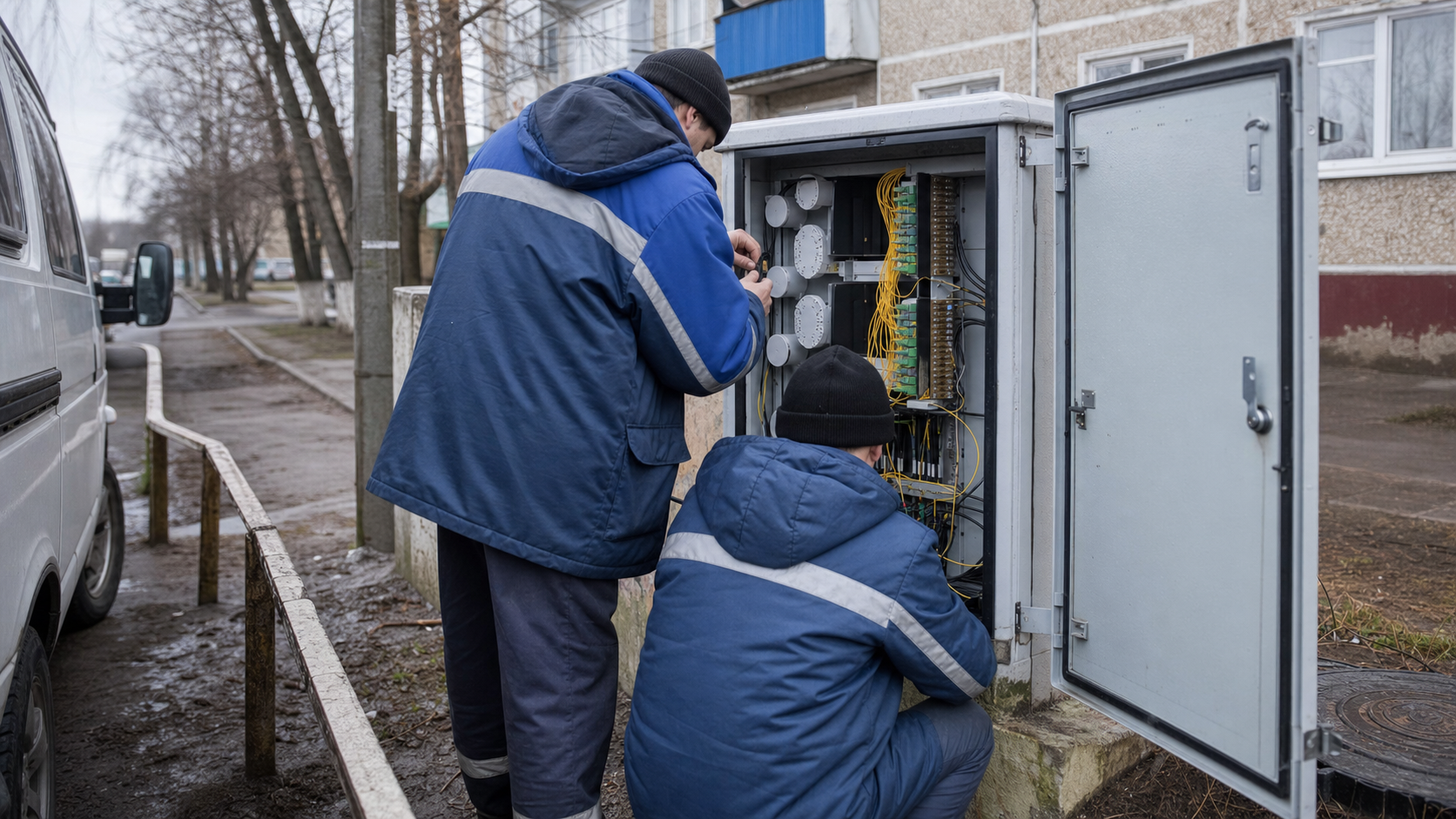
The company’s news archive is unusually useful because it repeatedly talks about planned technical works, backbone-line works, node works, fibre repairs and specific affected settlements. Notices mention places such as Filipovskoye, Dvorishchi, Dvoriki, Buyany, Melezha, Zakharovo, Rozhkovo, Pershino, Fineevo, Polutino, Barsovo and garden or settlement areas. Older notices refer to fibre breaks from weather, vandalism, line work and upstream-channel problems. Recent front-page notices describe a water leak damaging distribution panels and a communications node at a Barsovo address. These are not abstract risks.
They are the operating calendar of a small physical network.
That calendar explains why repair speed matters more than brand polish. A national mobile carrier can lose some indoor throughput and still keep a customer because the service is portable and bundled. A local fibre operator wins by being the company that knows which pole, which cabinet, which splice, which settlement and which technician can fix the problem. If Kirzhachtelecom repairs faster than substitutes, it can defend a higher rural tariff. If it repairs slowly, the same tariff becomes a grievance.
The field-labour requirement also gives meaning to the public staff figures. RBC shows 21 employees in its 2025 company page, while Checkspot shows 25 average employees in 2024. Those numbers are small against the range of territory, services and support obligations. A staff base of that size has to cover office work, technical support, installation scheduling, field construction, repairs, billing and management. It may use contractors, and the public records do not show the full labour model. But the visible headcount is enough to say that every repeated truck roll matters.
A bad router batch, an unclear installation standard or a storm week can consume attention that should have been used for new connections or preventive maintenance.
The strongest local-operator advantage is that the same technician may recognise the route, customer and failure pattern. The weakest local-operator trap is that knowledge remains in people’s heads. If maps, splice records, pole permissions, customer equipment inventories and upstream configurations are informal, the company becomes fragile as soon as a key technician leaves, a contractor is unavailable or a legal dispute demands documentation. The court record involving fibre access reinforces this point.
Operational agility without documentation can look like speed until someone asks who had rights to which line, what was connected, when it was connected, and who authorised it.
Kirzhachtelecom’s public notices suggest a company that communicates planned and emergency works with some regularity. That is positive. Customers tolerate maintenance better when they know what is happening, when the window is finite and when repairs finish. But the next level is predictive discipline: replacing vulnerable spans before repeated failures, clustering work to avoid multiple outages, and tracking whether high-priced rural tariffs actually correspond to stronger repair economics. In a district network, the difference between good and bad management is often not visible in the tariff table.
It is visible after snow, water ingress, road work, wind, vandalism or a third-party contractor touches an aerial line.
Competition and the Substitute Threat
The market signal is mixed. Review platforms show generally positive ratings, with Yandex and T-Bank pages around 4.4, but comments include both praise for fast connection and complaints about price, support, delays and monopolistic local conditions. These reviews are not audited operating data. They are uneven, emotional and sometimes contradictory. Still, they are useful because local telecom markets are lived through service anecdotes. Several positive comments describe quick installation, optical connection into a private home, stable service and staff competence.
Negative comments mention expensive dacha tariffs, connection delays, poor support interactions, a lack of alternatives or recurring issues.
The word "monopoly" appears as a customer perception in several public review snippets. That does not mean legal monopoly. It means that in some settlement or dacha contexts, a household feels that Kirzhachtelecom is the only practical wired option. That perception can support pricing in the short term, but it is dangerous if the company mistakes captive demand for loyalty. Mobile broadband, fixed wireless, satellite alternatives and national-carrier extension can erode a local operator’s pricing umbrella over time.
In Russia, mobile networks from large carriers are a permanent substitute for some households, especially when the fixed operator asks for prepayment, connection fees or higher rural tariffs.
The substitute test varies by use case. A light user who checks messages at a dacha may choose mobile if the fixed-line tariff feels expensive. A remote worker, gamer, camera user or household with television and multiple devices is harder to satisfy over mobile, especially where signal quality changes seasonally. Kirzhachtelecom’s private-house and district proposition should therefore be strongest for users who need predictable fixed access and value local support. It is weakest for low-usage customers who view broadband as occasional and resent paying year-round or in advance.
National carriers are both suppliers and competitors. Rostelecom appears in Kirzhachtelecom’s routing and in the court record. VimpelCom, MegaFon and TransTeleCom appear as upstream or peer names in routing views. That dual role is common in telecom economics. A small operator may buy capacity from companies that can also sell directly or indirectly into its territory. The small operator’s defence is not buying power; it is local execution. It can answer faster, install where national sales teams are slow, recognise local addresses, maintain community presence and bundle practical services such as cameras.
But if the local operator’s reputation shifts from fast and competent to expensive and difficult, national carriers and mobile substitutes do not need to be perfect; they only need to be good enough.
The best evidence to monitor is not generic market share, which is not publicly visible here. It is connection waiting time, complaint language, pricing changes, maintenance frequency, and whether the operator continues to publish transparent outage notices. If reviews increasingly mention 30- or 60-day delays, prepayment disputes or repeated fibre breaks, the business is losing the repair-speed premium. If reviews continue to emphasise quick field response, stable optical access and better support than alternatives, the higher private-house and district tariffs can remain defensible.
Suppliers, Partners and Platform Risk
Kirzhachtelecom’s partner risk is visible in two places: upstream connectivity and television. The routing table points to dependence on large carriers for internet reach. The TV pages and notices point to Smotreshka and LifeStream as the interactive television platform. In both cases, Kirzhachtelecom’s customer relationship is local, but part of the service quality depends on counterparties outside its control.
This is normal for a small ISP, but it matters for unit economics. Wholesale transit and platform fees are paid before the local operator retains its margin. If a subscriber pays a discounted city tariff, there is limited room for upstream cost inflation. If a rural household buys a high-speed TV bundle, the operator has more revenue, but it must also support television expectations. When the TV platform has planned software updates or emergency backbone works, customers see an interruption in a service sold through the local provider.
Kirzhachtelecom can publish the notice and reroute where possible, but it cannot make the platform fully local.
Supplier bargaining also affects repair quality. Access electronics, ONTs, routers, fibre cable, splitters, cabinets and power supplies are not free, and import or supply constraints can raise replacement cost. The company’s own tariff notes for speeds above 100 Mbit/s specify customer-side requirements such as four-pair Category 5e cable, gigabit ports and appropriate Wi-Fi standards. That note is economically revealing. It shifts some performance responsibility to the customer premises and limits support exposure for speed complaints caused by old routers, bad internal cabling or underpowered devices.
Without that boundary, every speed tier above 100 Mbit/s can become a support liability.
The company’s payment and account infrastructure is another supplier surface. The website points to personal account and online payment services. These are convenient, and review comments mention easy payment channels. But billing availability, data handling, privacy compliance and customer communication become part of the telecom product. The privacy policy’s reference to Yandex Metrica, personal-data localization and no cross-border transfer statement shows that even a small district ISP must manage the regulatory and vendor complexity of a modern customer-facing website.
The correct strategic stance is modest platform ambition. Kirzhachtelecom does not need to build every service itself. It needs to choose partners whose economics and failure modes fit a small access network. A TV platform that causes frequent support calls can consume local goodwill. An upstream contract that looks cheap but performs badly at peak time can poison the broadband brand. A camera storage product that requires too much manual support can turn a high-margin add-on into a technician drain. Supplier selection is therefore not back-office procurement; it is central to whether each connected premise leaves enough cash.
Regulatory and Legal Risk Is Operational, Not Abstract
The company operates in a regulated communications sector and presents public licences and personal-data documentation. Its documents page lists licences for data transmission excluding voice-data purposes, telematic services and channel services. Its privacy policy states personal-data handling purposes, local storage commitments, register information, user rights and incident notification obligations. These documents do not prove compliance in every detail, but they show that the public legal surface is not empty.
The more concrete legal risk is infrastructure access. The Garant court pages record two related disputes with Rostelecom. In one, the claim was for 739,200 rubles and the appeal court left the lower court’s decision in force. In the later case, the appeal record describes a 682,165 ruble unjust-enrichment claim for a period from July 2020 to June 2021 and notes that the lower court awarded the amount plus state duty. The records describe alleged unauthorized connection to Rostelecom fibre in settlements and court reliance on materials that included inspection acts and police-related materials.
The company contested the claims, but the public appeal records are adverse.
For investors, partners and large customers, that history matters because local telecom infrastructure is permission-heavy. Poles, ducts, fibres, couplings, rights of way, protection zones and interconnection agreements all require documentation. A small operator can grow rapidly if it uses existing routes creatively, but the same creativity can create liabilities if rights are unclear. The legal lesson is not that Kirzhachtelecom cannot operate; it is that future growth should be measured by clean builds, documented access, and a maintenance culture that treats infrastructure ownership as seriously as customer acquisition.
Geopolitical and regulatory risk sits on top of that. Russian telecom operators face domestic regulatory obligations, sanctions-linked equipment constraints, payment-system and vendor changes, and a market environment in which state-linked or national carriers can have structural advantages. A small operator’s defence is local indispensability. But local indispensability does not remove regulatory cost. It may even increase it if public institutions, schools or municipal-camera deployments become important customers and require stricter documentation.
The operator’s personal-data policy includes commitments around domestic storage and incident notification. That is positive as a public statement, but it also highlights exposure. Broadband and camera services collect addresses, contact details, traffic-related technical data, account records and sometimes video-surveillance metadata. A small staff must manage those obligations with the same seriousness as a larger operator, but without the same compliance bench.
A data incident, billing failure or disputed installation record can consume management attention and damage trust faster in a local market because customers know the office, the staff and the settlement.
The legal and regulatory conclusion is therefore practical: Kirzhachtelecom’s value increases if management can show that local agility is now paired with disciplined records. The company should be judged by whether every extension has a documented right, every partner service has a clear responsibility boundary, every high-speed sale has a customer-equipment boundary, and every repair notice reflects controlled operations rather than emergency improvisation. In a small ISP, governance is not a boardroom abstraction. It is whether the splice map, contract file and technician instruction match the network in the field.
Capital Renewal and the Ageing Network Problem
Kirzhachtelecom’s public story begins around a company registered in 2010 and an ASN allocated in 2014. That means the business has had enough time for early fibre, electronics, customer-premises devices and installation practices to age. A small network can run for years on accumulated local knowledge, but eventually active equipment, power systems, aerial routes, cabinets, fibre joints, customer routers and software platforms need replacement. The tariff schedule and financial margins have to fund that cycle.
High-speed tiers create a particular renewal obligation. The public note about gigabit-capable cabling and equipment for speeds above 100 Mbit/s is not decorative. It shows that the bottleneck can move from backbone to drop, from drop to ONT, from ONT to router, or from router to customer device. Upgrading customers from 55 or 100 Mbit/s into 250, 300, 450 Mbit/s and TV bundles can raise revenue, but it also exposes every weak link in the access chain. If the operator has to replace equipment without charging enough, the upgrade can destroy margin.
If the customer must pay for or maintain part of the upgrade, the operator must communicate clearly enough to avoid complaints.
Rural expansion has a slower but heavier renewal problem. A long line to a settlement may be justified when many households connect. But if take-up is lower than expected, the operator still owns the exposed route and repair obligation. Weather, vandalism, road work, pole changes and water ingress do not care how many subscribers are paying. The news archive’s repeated references to fibre and backbone works are a reminder that plant is not a one-time cost. It is a living asset that demands attention.
Financially, the 2025 numbers leave little room for romantic build-out. A 5 percent net profit margin on public RBC data can support investment only if capex is targeted and cash collection is disciplined. The six-month prepayment model helps, but it is not a substitute for capital planning. A company can collect six months from a household and still lose money if the drop requires repeated visits, the customer churns after the prepaid period, or the route later requires expensive repair. Conversely, a well-designed dense cluster can become a cash machine even at moderate tariffs if support calls are low.
The best evidence of healthy renewal would be fewer emergency notices over time, more planned windows, stable or improving review language about reliability, and tariffs that rise with clear service improvements rather than with desperation.
The warning sign would be frequent unplanned outages, sudden tariff increases without obvious upgrades, longer installation queues, and reviews that shift from "expensive but works" to "expensive and unreliable." For a small network, the economics of renewal are brutally simple: old plant either produces cash for replacement before it fails, or it becomes a claim on future cash after customers are already angry.
What Would Change the Judgment
The base judgment is cautious but not dismissive. Kirzhachtelecom appears to be a real local fixed-line operator with active tariffs, licences, routing assets, local notices, customer reviews, and a product set that fits the Kirzhach district. The company’s public economics are plausible if it maintains high local take-up in dense areas, prices rural connections to reflect field cost, uses prepayment to reduce working-capital strain, and keeps repair speed ahead of customer frustration. Its risk is that a small staff, narrow margin, partner dependencies and past infrastructure litigation leave little tolerance for poor build discipline.
Several facts would improve the judgment materially. First, proof of household and business subscriber counts by geography would allow real revenue-per-route analysis. A small operator with high take-up on short fibre routes is a different business from one with scattered low-density subscribers. Second, a current split of revenue between apartment, private-house, district, business, municipal, TV and surveillance services would show whether add-ons deepen margin or merely add support load. Third, evidence of upstream capacity, contract diversity and failover performance would separate cosmetic routing diversity from genuine resilience.
Fourth, capex and maintenance data would show whether the company is replacing plant ahead of failure or living off old build decisions.
Facts could also worsen the view. If a large share of revenue depends on disputed infrastructure, undocumented routes or high-churn dacha customers, the business is less durable than the tariff table suggests. If support queues are lengthening because installations outrun field capacity, the growth story is really a backlog story. If rural tariffs are high because repair costs are high rather than because customers buy richer bundles, margin may be weaker than revenue implies. If partner TV or upstream issues repeatedly hit customers, the company may carry brand damage for services it cannot fully control.
The most important test is whether local repair speed pays. Kirzhachtelecom does not need to beat national carriers on capital scale. It needs to beat them on the economics of knowing Kirzhach: where the line runs, who is connected, which settlements justify a build, which customers need fixed reliability, which repairs can be prevented, and which offers recover their true cost. A small network can be a strong business when it is geographically dense, operationally documented and trusted by customers who need fixed access. It can become fragile when it mistakes local scarcity for permanent pricing power.
For now, the public record points to a company with real assets and real constraints. It has a visible ASN, a local tariff architecture, service documents, municipal and surveillance ambitions, generally positive but uneven customer sentiment, and an adverse court history that should keep any analyst focused on infrastructure rights. The company’s future economics will not be decided by a national broadband narrative.
They will be decided premise by premise: whether the next connected building creates enough monthly cash to pay for the upstream bill, the next field repair, the next customer call, the next equipment replacement, and the legal cleanliness of the line that brings the service home.
Sources
- https://kirzhachtelecom.ru/
- https://kirzhachtelecom.ru/fizicheskim-liczam/
- https://kirzhachtelecom.ru/municzipalnym-organizacziyam/
- https://kirzhachtelecom.ru/smotryoshka-besprovodnoe-interaktivnoe-televidenie/
- https://kirzhachtelecom.ru/televidenie/tarify/
- https://kirzhachtelecom.ru/videonablyudenie/tarify/
- https://kirzhachtelecom.ru/dokumenty-2/
- https://kirzhachtelecom.ru/rekvizity-kompanii/
- https://kirzhachtelecom.ru/politika-v-otnoshenii-obrabotki-personalnyh-dannyh-ooo-kirzhachtelekom/
- https://kirzhachtelecom.ru/category/novosti/
- https://kirzhachtelecom.ru/category/novosti/page/20/
- https://kirzhachtelecom.ru/page/9/
- https://kirzhachtelecom.ru/page/13/
- https://kirzhachtelecom.ru/page/15/
- https://kirzhachtelecom.ru/novosti/planovye-remontnye-raboty-na-magistralnoj-linii-svyazi-4/
- https://kirzhachtelecom.ru/novosti/planovyh-rabotah-po-obnovleniyu-programmnogo-obespecheniya/
- https://kirzhachtelecom.ru/novosti/avarijnye-raboty-na-magistralnoj-setevoj-infrastrukture-servisa-smotreshka/
- https://kirzhachtelecom.ru/novosti/izmeneniya-v-stoimost-tv-paketov-smotreshka-2/
- https://companies.rbc.ru/id/1103316001414-ooo-kirzhachtelekom/
- https://companies.rbc.ru/amp/ogrn/1103316001414/
- https://checkspot.ru/company/1103316001414
- https://check.tochka.com/company/1103316001414/
- https://kontragent.skrin.ru/issuers/1103316001414
- https://companies.rbc.ru/okved/61.1/
- https://kirzhachtelekom.clients.site/
- https://yandex.com/maps/org/kirzhachtelekom/108053800143/reviews/
- https://www.tbank.ru/reviews/company/kirzhachtelekom/118873/
- https://2ip.ru/isp/KirjachTelekom/
- https://bgp.he.net/AS201285
- https://ipinfo.io/AS201285
- https://www.iplocate.io/AS201285
- https://asnlookup.com/asn/AS201285
- https://whois.ipip.net/AS201285
- https://2ip.ru/as/201285/
- https://www.cidr-report.org/cgi-bin/as-report?as=AS201285&view=2.0
- https://whoisrequest.com/ip/AS201285
- https://ipinfo.io/ips/195.208.183.0/24
- https://ipinfo.io/AS201285/195.208.183.0/24
- https://lite.ip2location.com/sv/as201285
- https://www.abuseipdb.com/check/185.196.31.234
- https://www.ipaddress.com/ipdb/ipv4-public/185.68.145.56/29/
- https://base.garant.ru/63005614/
- https://base.garant.ru/65588795/
- https://www.kirzhach.su/
- https://33.rosstat.gov.ru/demograf
Member Briefing
Deeper Profile Context
Sign in with the right membership level to unlock the full briefing and source notes.
Only for Strategic Circle
Strategic Circle
Open to all readers. Unlock profile briefings after joining and signing in.
Join Strategic CircleOnly for Leadership Alliance
Leadership Alliance
For qualified IP-asset owners and management; sign in to unlock alliance briefings.
Join Leadership Alliance