
Summary
- From 1990 to 1997, Karen Banks maintained GreenNet’s GnFido gateway, where FidoNet and UUCP let partner hosts queue and compress mail, make short scheduled calls and forward messages without a permanent international connection.
- The mechanism became politically useful only because operators, autonomous partner networks, training and user support completed the route. The 1995 Beijing communication centres made that hidden service layer measurable through accounts, messages, machine allocation and support work.
- Retrospective reach figures describe different dates and units. They support a history of widening access, not claims of universal service, guaranteed delivery or outcomes caused by one person.
The bundle waiting beside the modem
Before the call, there was a bundle.
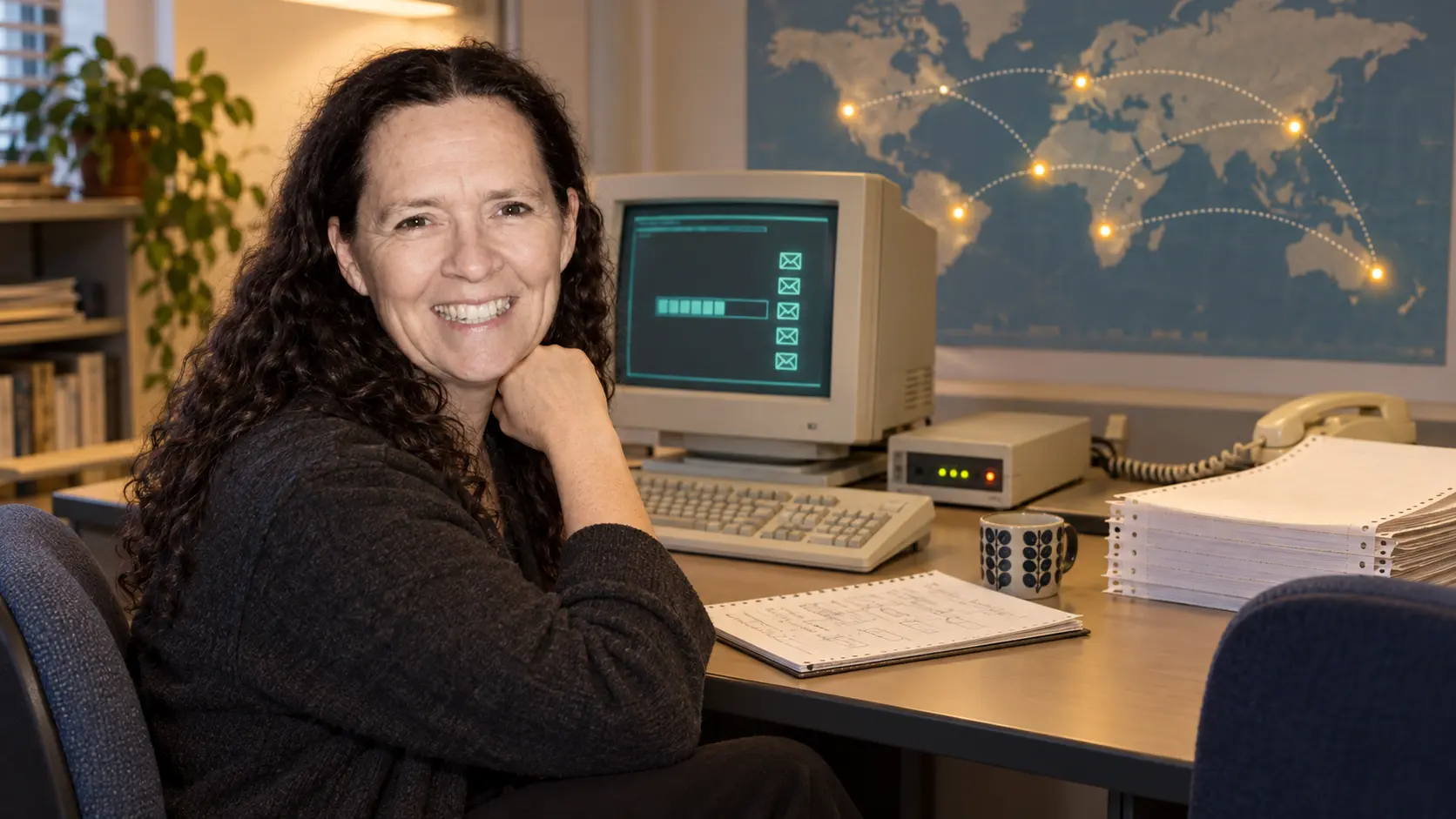
In Karen Banks’s account of her first encounter with GreenNet’s experiments, a message was composed with DOS-based FidoNet software and packed with other messages. Compression reduced the bundle to roughly one twentieth of its original size. Only then did a modem call move it to another computer. The expensive moment—the telephone connection—could be short because writing, reading and most local handling happened before or after the line was open.
That sequence matters more than the nostalgia of a dial tone. A permanent circuit makes connection look like a state: up or down. Store-and-forward turns it into a process. A message can be locally accepted, queued, compressed, transmitted, relayed and eventually delivered at different times. Each step has a different custodian and a different failure condition. A user does not need to occupy an international line while composing a note; a local organisation does not need every reader to call London; a remote partner can operate its own host and exchange accumulated traffic when the link is available.
The London communications hub became known as GnFido, for GreenNet Fido. Banks wrote that, within six months of discovering the work, she had become its system operator. Her retrospective describes daily telephone connections with more than 40 hubs in Africa, Southeast Asia, and Central and Eastern Europe. The Internet Hall of Fame gives a broader 1990–1997 account: more than 60 partners and thousands of users in civil-society organisations, universities and public bodies. GreenNet’s own history records 52 networks in Africa and Asia and says more than 50 small hosts were receiving gateway service by 1994.
Those are not three independent measurements of one population. “Hub,” “network,” “host” and “partner” are not interchangeable, and the records cover different dates and regional scopes. Their value is not an artificial grand total. Together they show a service expanding through many locally operated endpoints while its documentary perimeter changed.
Intermittent was an architecture, not an apology
Store-and-forward was sometimes the practical answer to weak telephone lines and prohibitive international costs. An APC history explains that a FidoNet host could behave like a network post office: it gathered messages, connected briefly, handed the bundle onward and disconnected. The short online interval reduced cost and made poor lines more tolerable. UUCP provided another handoff between systems.
That did not make the service weightless. A queue could age. A scheduled call could fail. Compression and routing software had to agree at both ends. Addresses and conferences had to map across systems. Someone had to notice that a transfer had stopped, decide whether to retry, and explain to a user why a message that had left the local outbox had not yet reached its destination.
Nor was GnFido the work of a solitary inventor. APC’s history credits Mike Jensen and other technicians with adapting software, travelling with disks and hardware, installing systems and working beside local operators. GreenNet itself had been founded before Banks arrived. The wider Association for Progressive Communications emerged in 1990 from seven peer networks across several countries. Banks’s documented role was operationally specific: she maintained the international gateway, and she later helped organise a programme that connected technical access with women’s participation.
Specificity makes the achievement larger, not smaller. Infrastructure history often rewards the moment a cable is lit or a protocol is named. GnFido’s importance lay in sustained mediation between unlike systems. The gateway was useful because it kept working after the demonstration, because partners did not have to become branch offices of a London host, and because operators on both sides could fit the exchange into local costs and conditions.
A peer network instead of a distant terminal
GreenNet began in 1985 as a bulletin-board service for environmental organisations. Its early London system worked for domestic users who could dial a local number. International users faced a different economy. A central service that required every partner to place a costly international call would turn reach into dependency.
The APC model aimed at another topology: peer organisations ran services for their own communities and exchanged traffic with one another. Gatewaying gave smaller FidoNet systems access to APC mail and electronic conferences without pretending that every site had the same hardware, connectivity or budget. The centre still mattered, but it was a handoff point rather than the only place where participation could occur.
This distinction separates access from mere terminal exposure. A modem on a desk proves that a call might be attempted. A functioning partner network adds accounts, local support, an addressable community and responsibility for the queue. An international gateway adds translation between systems and onward routes. An APC conference adds a public to receive and answer the message. Only the chain produces a usable communication service.
Some official retrospectives say the gateway was, for certain partners, their only cheap and effective electronic channel. That claim should remain attributed. It does not mean postal mail, fax, telephone or commercial services literally disappeared, nor does it establish equal access inside every country. It identifies a comparative constraint: other electronic routes could be absent or unaffordable, while a short scheduled transfer made cross-border exchange possible.
Beijing exposed the human layer
In 1993, Banks and women colleagues within APC formed the Women’s Networking Support Programme. The Internet Hall of Fame records that she coordinated the programme from 1996 to 2004. Its preparation for the Fourth World Conference on Women and the parallel NGO Forum in 1995 turned a distributed networking practice into a crowded, visible service operation.
The programme’s research report describes more than 30,000 women attending the combined events. That number defines the environment in which the service operated; it is not a count of unique network users. The primary project team included 40 women and one volunteer man in China, three women in London and three men providing remote support, with further help from APC nodes. The China team represented 25 countries, spoke 18 languages and drew on 12 APC member networks and seven partner networks.
The operating model was divided into user support, information facilitation, political-diplomatic work and training. A core support group of 17 women, reinforced by volunteers, ran two centres at the NGO Forum and one at the UN conference. They staffed reception desks, registered users, allocated computers and accounts, helped with word processing, diagnosed network problems and encouraged people to use the available services. At busy times there were too few machines and sessions were limited to 15 minutes.
That 15-minute rule belongs in Internet history. It shows that installed connectivity did not abolish scarcity; it moved the control point. The operational question became who received a machine, an account, assistance and enough time to finish a task. Training and troubleshooting were not decorative additions after “the network” had been built. They determined whether the network could be used at all.
The project report recorded 1,700 free email accounts at the NGO Forum, 62,000 messages sent and received, 33,000 visits to a local web page and 100,000 visits to an international page. A separate Internet Hall of Fame account says email and web access was provided to more than 10,000 delegates. These are different counters. Accounts are not people; messages are not outcomes; page visits are not informed participation. Yet the counters are valuable because they locate work that a ceremonial story could hide: registering, allocating, sending, receiving, publishing and assisting.
What crossed the gateway
The obvious answer is mail. The better answer is a set of commitments.
A local host promised to hold the message until it could make a call. The gateway promised to accept a bundle from a different technical environment and place its contents on an onward route. A conference system promised a shared destination rather than a private dead end. Operators promised to keep enough state to diagnose failure. At Beijing, support teams promised that scarce equipment would be allocated and that a first-time user would not be left alone with an unfamiliar interface.
None of those promises was absolute. The sources do not provide audited delivery times, uptime, error rates or security guarantees. They do not prove that a particular message changed a negotiating position, that every woman felt safe using the centres, or that access was distributed evenly. The record does show how to ask a harder question than “Was there Internet?” One can ask where a message waited, which connection moved it, who could retry the transfer, who could open an account, and what evidence remained after the exchange.
That is the durable contribution of Banks’s operating history. Continuous connectivity is one way to reduce waiting; it is not the definition of communication. A network can be temporally sparse and still institutionally real if its queues, handoffs, responsibilities and audience are designed as a service. Conversely, an always-on line can remain socially empty if no one owns support, no partner can act locally, and no recipient is prepared to answer.
Sources
- https://www.apc.org/en/about/history/enabling-civil-society-policy-making
- https://www.apc.org/en/about/history/mike-jensen-pre-internet-days
- https://www.apc.org/en/news/greennet-celebrates-40-years-pioneering-internet-service-provider-still-building-digital
- https://www.apc.org/en/partner/international-development-research-centre-idrc
- https://www.apc.org/sites/default/files/WomenInSync_1.pdf
- https://www.apc.org/sites/default/files/WomenInSync_2.pdf
- https://www.greennet.org.uk/about/history
- https://www.internethalloffame.org/inductee/karen-banks/
- https://www.internethalloffame.org/press_release/internet-hall-fame-announces-2013-inductees/
Member Briefing
Deeper Profile Context
Sign in with the right membership level to unlock the full briefing and source notes.
Only for Strategic Circle
Strategic Circle
Open to all readers. Unlock profile briefings after joining and signing in.
Join Strategic CircleOnly for Leadership Alliance
Leadership Alliance
For qualified IP-asset owners and management; sign in to unlock alliance briefings.
Join Leadership Alliance