
Summary
- K-telekom looks economically stronger as a dense regional access network than as a thin legal-entity profile. Public evidence ties the customer-facing brand to Ural and Volga fixed-broadband operations, a self-described base above 150,000 subscribers, a wide settlement footprint, and the AS48642 routing ecosystem; the registry accounts for the named LLC alone are too small to explain that operating scale.
- The investment case is not "more subscribers" in the abstract. It is whether every new apartment block, private-house cluster, office node, intercom deployment, or video-surveillance account adds enough recurring contribution to repay the drop, support work, power, CPE, backbone, and renewal costs before churn or complaints consume the margin.
- Public tariffs and marketplace listings show a low-to-mid-price broadband offer in apartment buildings and a higher-priced private-house offer. That spread is rational: multi-dwelling buildings can amortize shared equipment and local labour over many subscribers, while private-sector fibre and radio-like edge work make each connected premise more expensive.
- The company has a real network footprint, but the control boundary is messy. BGP and PeeringDB data point to AS48642, regional peering, multiple upstreams, and roughly forty originated prefixes, yet RIPEstat names the holder as Joint Stock Company "For" while RIPE objects and third-party databases also expose K Telecom Ltd., KTEL-MNT, and the k-telecom.org domain. The right judgment is to analyse the operating network, while keeping legal-entity attribution conservative.
- The decisive risks are not exotic. They are repair backlogs, installer availability, local-weather damage, price pressure from national carriers, support quality, and the cost of keeping an ageing access network aligned with GPON, routing, power-backup, app-billing, and customer-service expectations.
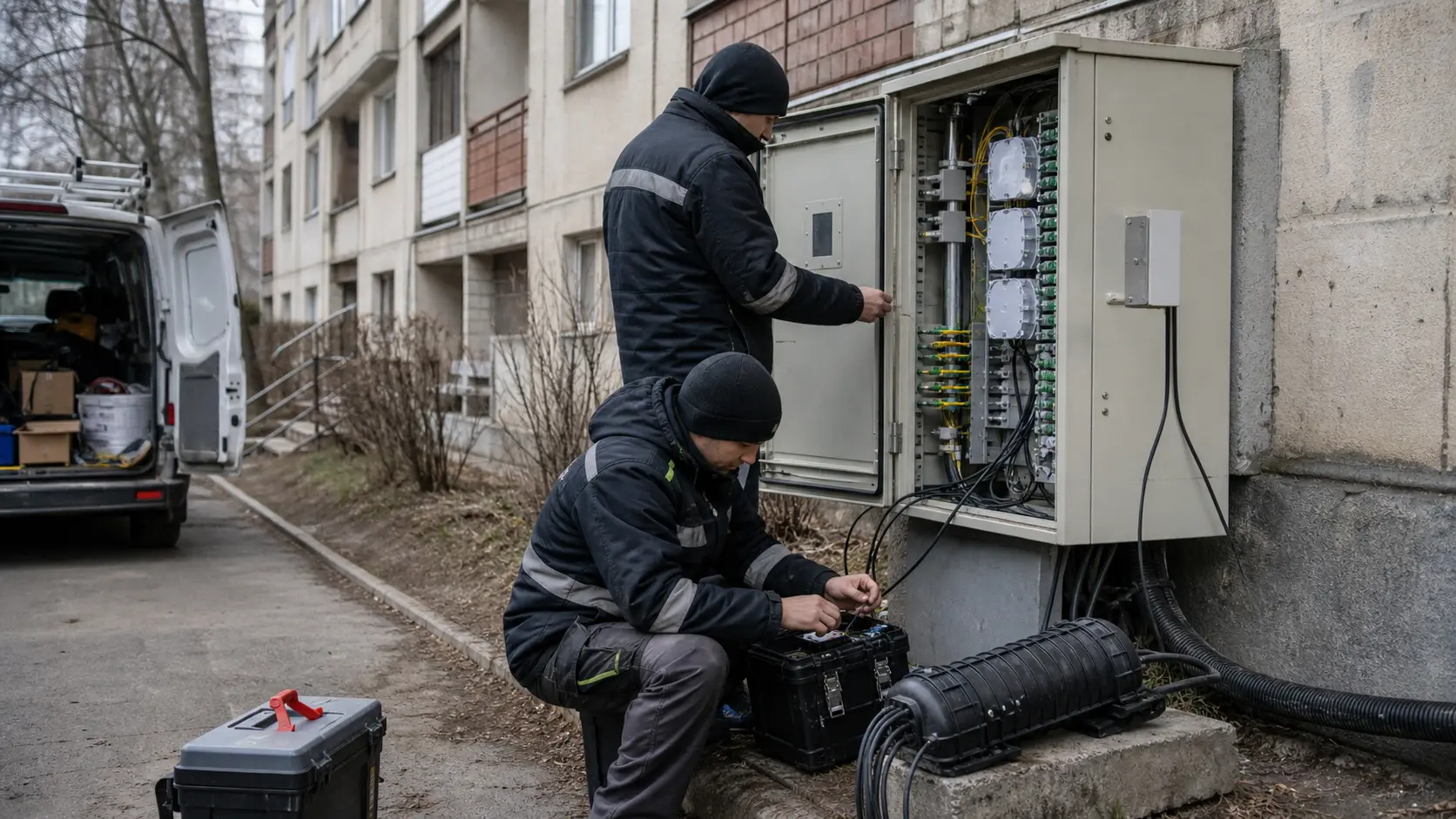
Start with one connected building. Suppose K-telekom has already pulled fibre near a residential block and can light service without a long civil build. The commercial question is then brutally local. How many flats take service? How many choose a basic plan rather than a richer internet-plus-TV package? How many calls does the building create after the first storm, after a power incident, after a tenant swaps a router, or after a neighbour complains that video conferencing drops at night?
If the building has one hundred potential premises and thirty to forty become paying customers, the monthly gross billings at publicly advertised apartment-market prices may be enough to justify the small node. If only ten connect, the same cabinet, switch port, address space, billing account, support queue and installer route become a drag.
That is why K-telekom should not be read like a software platform. The company cannot sell one more subscription at near-zero marginal cost. Every incremental customer sits at the end of something physical: a drop cable, a port, a router, an optical splitter, a building riser, a pole route, a help-desk script, a field technician's day, and an upstream path. Regional broadband economics are about density before they are about brand. A national carrier can absorb a thin district as part of a broad portfolio.
A regional operator survives by knowing which entrances, streets, private-home clusters and small-business courtyards will produce durable contribution.
The public evidence supports that frame. The customer-facing K Telecom app describes a multiservice operator serving Yekaterinburg and other Ural Federal District cities. The company's recruitment pages describe a large regional multiservice telecom operator, years of operating history, more than one hundred Ural and Volga cities, more than 150,000 connected subscribers, a team above 700 employees, and a product set extending beyond home broadband into television, video surveillance, IP telephony, virtual PBX, colocation and M2M or smart-home services.
The company website's indexed pages go further, claiming more than 185,000 subscribers, 410 settlements and an eighteen-year operating history. Those are not audited financial figures, but they are operating-scale claims, and they fit the shape of a local-access network rather than a pure reseller.
The first important caution is identity. There is another Russian K-Telekom name associated with Crimea and mobile brands, and some automated English-language routing searches mix the two. The assigned company here is the Ural fixed-broadband entity connected to k-telecom.org, the Yekaterinburg address at Kulibina Street, and RIPE/BGP evidence around AS48642. The Crimea mobile operator's evidence should not be imported into this judgment. Even inside the Ural case, the boundary is not perfectly clean.
Public company registries for LLC "K Telecom" with INN 6670230988 show a small legal entity registered in 2008 at Kulibina Street, a 10,000-ruble charter capital, a current director, a 100 percent individual founder, telecommunications-by-wire as the main OKVED, multiple communications licences, and official activity. But the same registry surfaces show 2024 revenue of only a few million rubles and small headcount. A separate database reports 2025 income and expense figures that still do not reconcile with a brand claiming more than 150,000 subscribers.
That mismatch matters. It is not a reason to dismiss the operating footprint, because routing data, job postings, tariff marketplaces, customer reviews, app-store evidence and local office records all point to a real broadband business. It is a reason to avoid overconfident ownership and cash-flow statements. The public record may be showing a licence holder, a legacy legal shell, a group participant, a brand-facing entity, or a company that uses related infrastructure and commercial partners.
The sound conclusion is narrower: there is a K-telekom fixed-broadband operation in the Urals with visible customers, field labour, local offices, tariffs, app infrastructure, licences and routing exposure; the exact allocation of subscribers, revenue, debt, vendors and assets among legal entities is unresolved.
The economics begin with price. Public tariff listings in Yekaterinburg show apartment-market K Telecom offers around 299 rubles a month for a low-speed "My Click" type internet tariff, roughly 349 rubles for a 20 Mbps internet-plus-TV package with 106 channels, around 449 rubles for an 80 Mbps internet-only offer, about 499 rubles for the 80 Mbps internet-plus-TV package, and around 499 to 549 rubles for 100 Mbps internet or internet-plus-TV.
Other listings for private-house style products show higher monthly prices, from roughly 999 rubles for a lower-speed country-home offer to 1,499 rubles for a 300 Mbps country-home tier, with TV bundles adding more. A separate archived Krasnoufimsk tariff page shows earlier low-priced plans, router purchase or rental economics, TV set-top rental, and individually calculated connection charges for some cases. The picture is consistent: apartment access is a low-ARPU density game; private-home access is a higher-ARPU but higher-installation-risk game.
That split is not merely pricing strategy. It reflects physics and labour. In an apartment block, the operator can amortize shared fibre, an access switch or GPON splitter, power, enclosure, and repeated technician visits over many doors. The incremental customer may be one drop, one router, one activation, one account and one support risk. In a private house, the same customer may require aerial or buried fibre, pole agreements, a longer truck roll, optical power testing, weather exposure and a future repair path that cannot be handled while the installer is already inside the same entrance.
The public review trail makes this difference visible. Customers praise stable service and local offices, but complaints describe weeks or months of waiting for connection, uncertainty around field crews, and cases where private-house or village connections depended on a nearby cabinet, aerial spans, or a technician's ability to schedule the work.
The right financial test is contribution per premise after direct service costs, not headline subscriber count. A building with fifty paying apartment customers at an average of 450 to 550 rubles a month produces only 22,500 to 27,500 rubles of gross monthly billing before VAT, payment fees, equipment amortization, support time, backbone, content and office overhead. If that building needed a modest extension, used existing fibre, and shares maintenance with nearby buildings, the payback can be attractive.
If the same fifty customers generate repeated outages, router replacements, night support, and truck rolls across a wide service area, the gross revenue is quickly consumed. If only twenty customers take the service, monthly gross is nearer 9,000 to 11,000 rubles; one expensive repair can wipe out several months of contribution.
That is why the self-reported settlement footprint cuts both ways. A 410-settlement claim sounds impressive, and it may signal deep local coverage that national carriers have not optimized. But settlements are not subscribers. A dispersed footprint can create bad economics if it contains too many short streets, low take-up villages, storm-prone aerial routes, or legacy networks with too few paying customers per cabinet. Conversely, a smaller number of dense towns can be excellent if K-telekom owns building relationships, local brand trust, and enough routes to cluster technician work. The economic unit is not the region.
It is the connected node, with its churn, repair history and average revenue.
Recruiting evidence is useful because it reveals what the network really needs. Public postings for communication installers describe connecting subscribers to the internet, eliminating network accidents, replacing and configuring equipment, and repair-and-recovery work. The listed salary for one field installer role in Sverdlovsk region starts at 90,000 rubles, and the job description welcomes candidates without experience but requires transport of ladders, tools and materials, physical stamina, stress tolerance and customer communication. That is not a back-office cost. It is the operating core.
The operator's economics depend on how many gross additions and repairs a technician can complete per day, how far the technician must drive between jobs, and how often work is re-opened because the first visit did not solve the problem.
The app and personal-account system are attempts to lower that service burden. Google Play describes a free "My K Telecom" app for account management, balances, monthly bills, payment history, service changes, contract hold during vacation, promotions, deferred payment, in-app payment and chat. The app has more than 50,000 Google Play downloads, and Apple-market data show an iOS version updated in July 2026. That matters because low-ARPU broadband cannot afford expensive support interactions for routine account actions.
Every payment, tariff change, temporary hold or support question handled in the app protects the margin from call-centre labour. But app adoption only helps if the back end resolves issues. Review signals show customers value chat and quick tariff changes when they work; they also punish the company when outages or connection delays remain unresolved.
The routing evidence adds a second layer to the economics. AS48642 is presented by bgp.tools as K TELECOM LLC with k-telecom.org, an eyeball network, eight upstreams, more than one hundred peers, and a meaningful originated-prefix base. PeeringDB describes K Telecom Ldt. on ASN 48642 as a regional NSP with a balanced traffic ratio, open peering policy, IPv4 and IPv6 support, and operational presence at GNM-IX, MSK-IX Ekaterinburg, MSK-IX Moscow, MSK-IX Saint Petersburg and PITER-IX locations.
BGP.he.net reports seven internet exchanges, forty originated IPv4 prefixes, two originated IPv6 prefixes, no invalid RPKI-originated routes in its snapshot, and roughly 89,856 originated IPv4 addresses. IPinfo labels the network a consumer ISP with Russia geography and a pronounced daily rhythm.
This is significant for two reasons. First, it suggests the operator is not simply white-labelling another broadband service. A multihomed regional network with peering and its own route set has real engineering and capital requirements. It must manage upstream diversity, routing hygiene, IP resources, peering sessions, traffic ratios, abuse handling, and the economics of transit versus local exchange. Second, the network-resource evidence does not eliminate the legal boundary problem. RIPEstat's AS overview names the holder as FOR-AS, Joint Stock Company "For".
RIPE whois and route objects expose AS-KT-RU, KTEL-MNT, K Telecom Ltd. records, and k-telecom.org contacts. The practical reading is that K-telekom's customer-facing service is economically tied to an AS48642 ecosystem, but legal ownership and infrastructure stewardship may sit across more than one entity. That is an uncertainty to monitor, not a detail to smooth away.
For a regional ISP, peering can be a competitive advantage if it lowers transit cost and improves performance to popular destinations. Local and national exchange presence can keep video, cloud, gaming, search, messaging and domestic traffic closer to users. It can also reduce exposure to a single national carrier. BGP evidence shows upstreams including Rostelecom, MegaFon, VimpelCom, ER-Telecom, RETN, Arelion, iHome and route-server relationships. That is a more diversified posture than a small one-uplink ISP. But it is not free.
Routers, optics, ports, remote-hands, traffic engineering, qualified engineers and 24-hour incident processes cost money. A badly priced access plan can still lose money even if packets flow through a sophisticated interconnection mix.
Competition is also not only another regional ISP. In Yekaterinburg and nearby cities, the substitute set includes Rostelecom, ER-Telecom/Dom.ru, MTS, Beeline/VimpelCom, MegaFon, t2 and other local operators. Marketplace pages show customers comparing K Telecom against national and regional offers, and some K Telecom tariffs are inexpensive enough to compete directly on monthly price. National carriers have stronger bundled economics: mobile, TV, fixed broadband, device offers, payment apps, national call centres and procurement scale. They can discount home broadband as part of a converged household relationship.
K-telekom's counter is locality: presence in smaller settlements, specific building access, faster local response when it works, intercom or surveillance adjacency, and willingness to connect edge areas that large carriers may ignore.
The danger is that national carriers can convert K-telekom's support failures into churn. A cheap regional ISP can tolerate some service imperfections if customers have no real alternative or if local technicians respond quickly. It cannot tolerate a reputation for uncertain repair dates where a national substitute is present. Review data should be read as market signals, not audited performance. The Yandex listing for the Kulibina Street office shows a middling score with hundreds of reviews. Positive reviews mention stable speed, low ping, local offices, responsive chat, adequate prices, and free replacement of house-side equipment.
Negative reviews mention repeated outages, support frustration, delayed callbacks, unclear repair times, and private-house connection delays. A Novouralsk listing shows a higher rating but also complaints about packet loss and inability to reach operators. These are not statistical samples, but they indicate exactly where the contribution model breaks: support quality and field capacity.
K-telekom's product adjacencies are economically sensible. Television adds modest ARPU and reduces household churn if the content bundle is satisfactory. Smart intercom service can improve building-level lock-in, because it moves the operator from a replaceable internet pipe toward entrance infrastructure and resident identity. Video surveillance and IP telephony create small-business and residential-complex use cases. Virtual PBX and colocation, if delivered through existing network assets, can raise enterprise revenue without pulling a new residential drop for every ruble. The problem is operational focus.
Each added product creates a support surface. Intercoms create access-control incidents. Cameras create storage and privacy expectations. PBX creates business-critical availability expectations. Colocation creates power, cooling, security and SLA demands. Product breadth only helps if it rides on the same route density and support teams without multiplying complexity faster than revenue.
The registry and licence evidence points to a legitimate regulated operator, but also to financial opacity. RKN records and contractor databases show multiple active communications licences associated with LLC "K Telecom" and INN 6670230988. RBC and other registries show state-contract history and participation in procurement or tenders, though exact counts vary by database.
Saby reports operational indicators including tender participation, wins and Sberbank as a major customer; RBC reports hundreds of government contracts by value; other registries show active status, founder and director changes, and negative profitability in 2024. These facts do not let a reader calculate consolidated EBITDA. They do show that the legal entity is not merely a dormant name. They also warn that public financial statements for the named LLC may not represent the whole operating business.
The most plausible economic explanation is a layered structure: a customer-facing regional brand, a licensed LLC, related infrastructure entities or LIR relationships, and possibly local operating arrangements that do not all flow through the same reported revenue line. That structure may be harmless in practice, but it raises lender and buyer questions. Who owns the fibre? Who controls the AS route objects? Who employs the 700-plus staff referenced in recruiting material? Which entity signs building access agreements? Which entity takes customer receivables? Which entity funds replacement capital?
Which entity is liable for licence compliance? A regional ISP can be operationally healthy while remaining hard to value if the asset perimeter is unclear.
The unit economics can still be analysed by thresholds. For an apartment block, K-telekom needs a high enough take-up rate that monthly contribution covers the local port, shared equipment, installation labour, CPE subsidy or rental friction, billing, customer support, bad debt, and periodic repairs. The business improves materially when the same technician route serves several nearby buildings, when the same building adds intercom or TV, and when customers use self-service instead of calling.
It worsens when a building has low penetration, a hostile management company, repeated line damage, low-cost promotions, and a high share of price-sensitive customers who churn after one outage.
The practical management tool is a local contribution map. Each building or cluster should carry a simple score: homes passed, active customers, monthly billings, service mix, historical truck rolls, average time to repair, unresolved complaint rate, age of local equipment, power-backup status, spare port count, and distance from the nearest technician base. A building with forty low-price customers, no recent faults and a connected intercom may rank above a private lane with ten higher-price customers if the private lane absorbs two long repair visits every winter. That is the core discipline for a regional ISP.
The operator should not ask only whether a settlement is covered. It should ask whether each covered pocket is creating cash after the real work of keeping people online.
The settlement-footprint claim makes that map even more important. Four hundred plus settlements could mean the operator has found neglected pockets where demand is loyal and competition is weak. It could also mean the company has inherited or built many thin routes that look good in marketing but are expensive to maintain. A national market share number would miss this completely. A regional operator can win one street, lose the next, and still report the same subscriber total. The strongest possible version of K-telekom would show that most subscribers sit in clusters where repair crews, cabinets, fibre routes and customer offices overlap.
The weakest version would show a long tail of small places where field support is too far away from monthly revenue.
Building access is therefore an asset class. In a multi-dwelling market, the operator is not only selling to tenants. It is negotiating with building managers, homeowners' associations, developers, local contractors and sometimes municipal or quasi-municipal bodies that influence roof, basement, riser and entrance equipment. Smart intercom makes this more valuable but also more sensitive. Once an operator controls or serves entrance access, switching is no longer as simple as changing a router. But the support obligation becomes more visible: when a door app fails, residents may blame the same brand that sells broadband.
K-telekom's advantage grows if it can combine broadband, TV and intercom into one trusted building relationship; it shrinks if every extra feature becomes another reason residents contact support.
The tariff ladder also shows how delicate product design is. A 20 Mbps internet-plus-TV plan around 349 rubles may be a defensive price for price-sensitive households or buildings where K-telekom wants presence. An 80 to 100 Mbps plan around 449 to 549 rubles looks like the core apartment broadband offer. The higher country-house products, above 999 rubles a month, are not automatically richer business. They probably reflect a different cost structure. If the operator sells a private-house plan as a premium product but then cannot schedule the build, the customer sees a broken promise rather than a disciplined capital decision.
The correct commercial posture is transparent scarcity: quote the true connection cost, explain the queue, cluster neighbours where possible, and avoid pretending that every technically feasible address is economically ready.
This is where the review evidence is especially useful. Positive comments often describe the operator as local, reachable, stable and reasonably priced. Negative comments describe the opposite: not just that the internet failed, but that the customer could not get a clear answer about when it would be fixed or installed. That distinction is economically important. Outages are unavoidable in access networks. Uncertainty is what destroys trust. A customer may tolerate a storm failure if the provider gives a credible repair window and then meets it. A customer with no repair date starts shopping, warning neighbours and using mobile fallback.
For a regional ISP, service certainty is not soft reputation capital. It is churn control.
Field labour is the hinge between marketing and cash. The installer vacancy's task list is an operating summary of the company: connect subscribers, eliminate accidents, replace and configure equipment, carry tools and ladders, and deal with customers under stress. If management adds subscribers without adding enough field capacity, reported growth can produce worse economics. If it hires ahead of demand, wages hit cash before new connections repay installation cost. The right metric is not headcount.
It is completed jobs per technician day, repeat visit rate, repair backlog by settlement, installations delayed for lack of crews, and the share of work that can be solved remotely through customer education or app support. A 90,000-ruble monthly salary is not excessive for skilled field work, but it forces discipline in routing, scheduling and first-time fix quality.
Self-service is the other labour lever. The mobile app's balance, bill, service-change, contract-hold, deferred-payment and chat functions all attack small support costs. A low-ARPU operator needs this. A call about a tariff change or vacation hold can cost more than the margin on a cheap monthly plan if handled manually too often. But the app must not become a screen between the company and unresolved physical work. The most valuable self-service function would be a reliable repair or installation status: appointment window, crew assignment, cause category, expected completion and escalation path.
If customers can see that the operator knows the problem and is moving, the app reduces call pressure. If it gives only generic text, customers still call and the cost returns.
The procurement and institutional signals should be interpreted with restraint. Registry platforms show government contracts, tenders, a main customer reference and litigation indicators, but the public record does not show whether these contracts are material to consolidated revenue. Institutional work can help a regional ISP by providing anchor revenue, local legitimacy and traffic demand. It can also distract management if each contract requires bespoke service levels, documentation, special equipment or delayed payment. For K-telekom, the better version is institutional work that sits on existing local network assets and improves density.
The worse version is contract revenue that pulls technicians and engineers away from residential repair while adding little durable network advantage.
Routing depth changes the competitive game but does not remove local execution risk. AS48642's upstream and peering profile means K-telekom can potentially avoid some performance dependence on any single national backbone. It can place traffic at regional and national exchanges, reach content and networks through peers, and present a more professional network posture than a tiny access reseller. That helps with latency-sensitive uses such as video calls, games, business remote access and cloud tools. But retail customers rarely reward routing architecture directly.
They reward it only when the evening video stream works and the game does not lag. If local Wi-Fi, CPE, overloaded access nodes or bad support undermine the experience, upstream diversity remains invisible to the household.
The AS48642 boundary also creates a governance question. BGP sources show K TELECOM LLC, K Telecom Ldt., K Telecom Ltd., Joint Stock Company "For", AS-KT-RU and KTEL-MNT in overlapping ways. There may be a straightforward explanation in local history, LIR sponsorship, acquisitions or operational practice. Public sources do not prove a problem. They do prove that a serious buyer, lender or partner should ask for the network-control documents before assigning value to the route footprint.
The commercial question is who can change route policy, who holds resource contacts, who pays for upstream and exchange ports, who owns the routers, and who carries liability when abuse, outage or regulatory issues arise. A regional ISP's route set is not an accessory. It is part of the operating asset.
Capital renewal should be measured before expansion applause. Access networks can look better than they are because old copper, fibre, cabinets, batteries, routers and CPE continue working until they do not. The operator then faces a bunching of replacement needs: optical splitters, SFPs, ONTs, access switches, power units, batteries, cabinets, app integrations and billing systems. Public sources show the categories of work and equipment implied by the business, but not K-telekom's renewal schedule. A conservative operator would reserve cash at the cluster level, not only at the company level.
Each area should show whether its recurring contribution can pay for its next hardware cycle. If that answer is no, expansion there is borrowing from the future.
This is also why average revenue per user is an insufficient target. A private-house customer at 1,199 rubles a month can look better than two apartment customers at 499 rubles each. But if the private customer needs a custom connection, weather-exposed drop and a future aerial repair while the apartment customers share a stable building node, the apartment pair may be superior. Likewise, a TV bundle may lift ARPU but require set-top support and content costs. A smart intercom may lock in a building but create urgent access-control incidents.
The right measure is risk-adjusted contribution per served location over the expected retention period. K-telekom's public evidence makes that measure more important than any headline subscriber claim.
The operator's local advantage is real only if it can turn knowledge into faster decisions. A national carrier may not know which courtyard management company approves work quickly, which village route fails after storms, which old apartment riser causes repeated complaints, or which office manager can coordinate resident access. K-telekom should know those facts. That knowledge is an intangible asset if it is captured in scheduling, pricing and capex approvals. It is wasted if it sits only with individual technicians or salespeople.
The professional implication is that K-telekom's best system is not merely a billing platform or an app; it is a local operating database that links customers, physical network elements, support history and renewal needs.
For private homes, the hurdle is higher. Public tariffs above 999 rubles a month are not evidence of pricing power by themselves; they may simply reflect longer drops and lower density. The decisive number is connection payback. If a private-home customer pays a higher monthly fee but requires a long custom build, two truck rolls, pole work, a router subsidy and future weather repairs, the payback can still be worse than a cheaper apartment customer. Customer reviews about individually calculated connection costs and delayed field work should therefore be read as economic signals.
They show that the company is rationing scarce field capacity and trying not to promise uneconomic connections, but they also show churn risk before the customer even activates.
Upstream and peering costs are the next pressure point. A regional eyeball network's traffic is lumpy. Evening demand is video-heavy; app-store and game updates spike; outage recovery triggers call volumes; large events concentrate streaming. IPinfo's daily-rhythm signal is what one expects from consumer access. If peering is good, the marginal traffic cost is lower and customer experience is better. If upstream links congest or if traffic shifts to destinations not well-peered locally, the operator must buy capacity before revenue rises.
That is why the combination of low apartment ARPU and multihomed routing is both reassuring and concerning. It shows technical seriousness, but it also means the company has real renewal obligations.
Replacement capital is the slow risk. Access networks often look cash-generative after the initial build, until cabinets, optics, batteries, CPE, poles, risers, billing systems and routers age together. Job and procurement signals around GPON, passive optical components, cabinets, power units, batteries and SFP modules, including similarly named but legally distinct entities in the wider market, are reminders of the categories that operators must keep buying. For the Ural K-telekom case, direct sources show installer labour, repairs, equipment replacement, app maintenance, routing resources and licences. They do not disclose capex.
The judgment must therefore stay conditional: the network is attractive only if maintenance capex per active subscriber stays below the recurring contribution created by dense local clusters.
Regulatory risk is ordinary but material. Communications licences, Russian data and telecom rules, lawful-interception obligations, numbering, local telephone rights, channel provision and consumer-protection rules create fixed compliance costs. For a national carrier those costs spread across millions of accounts. For a regional operator, they are overhead that must be recovered from smaller clusters. The K-telekom evidence includes active licences and local telephone-type permissions, which is positive.
The question is whether licence renewal, reporting, security requirements and potential inspections require staff and systems that are invisible in simple tariff comparisons.
Geopolitical and supply-chain risk should be treated practically. Russian telecom operators have had to navigate equipment sourcing, software maintenance, payment systems and routing relationships under a different post-2022 environment. K-telekom's observed mix of fibre access, GPON-like service, routers, app infrastructure, peering, route objects, and field equipment creates exposure to optics, switches, CPE, batteries, cabinets, tower or pole hardware, and qualified engineers. The risk is not that the network stops overnight. It is that replacement cycles become slower, more expensive or more dependent on a narrow supplier base.
A low-price regional operator has less room to absorb such cost inflation than a national bundle provider.
Customer concentration is harder to read. The business appears mostly residential, but Saby and RBC point to procurement participation and government or institutional contracts. Routing data shows downstream or connected organizations in the AS-KT-RU set, including local institutional names and regional entities in BGP views. Such relationships can be valuable because they add stickier revenue and traffic scale, but they can also introduce dependence. If one bank, municipality, management company or large building manager accounts for too much local revenue, the operator's economics can change with one procurement loss.
Public evidence does not identify a dangerous concentration level. It does justify monitoring whether growth comes from dispersed residential density or from a few institutional accounts.
The best argument for K-telekom is that it may own the awkward middle. National operators often prefer scalable urban and bundled economics; very small local ISPs may lack route diversity, support systems and capital. K-telekom appears to sit between them: local enough to pursue smaller settlements and building-specific relationships, large enough to run app self-service, wide recruiting, multiple services and a visible AS48642 network. If management can keep support quality above the local tolerance threshold, this middle position can produce a defensible franchise.
Customers do not necessarily want to switch providers every time a national promotion appears if their current service is stable, local and easy to pay.
The strongest argument against K-telekom is that the middle is unforgiving. The company is too physical to enjoy software margins, too local to enjoy national procurement scale, and too broad in product set to remain operationally simple. Public complaints do not prove systemic failure, but they point to bottlenecks that can destroy local trust. Low monthly prices leave little room for repeated repairs. Higher private-house prices invite scrutiny if connection dates slip. Legal and routing-boundary ambiguity complicates external financing or acquisition.
If the operator cannot translate its route and settlement footprint into dense, maintainable clusters, size becomes a burden.
The change-of-view facts are clear. The judgment improves if audited or otherwise credible consolidated data show that the operating group behind the brand has positive cash generation, stable capex per active customer, low churn, and clear asset ownership. It improves if K-telekom demonstrates shorter repair times, predictable private-house connection scheduling, rising app usage, higher take-up per connected building, and profitable adoption of intercom, surveillance and business services. It also improves if routing data continues to show diversified upstreams, valid RPKI, no persistent congestion and useful local exchange presence.
The judgment worsens if the legal-entity financial weakness is not a perimeter issue but a sign that the operating business itself cannot earn adequate returns. It worsens if subscriber claims are inflated or counted across loosely related entities without corresponding control. It worsens if customer reviews trend toward unresolved outages and slow field work, if national carriers undercut with converged bundles, if private-house expansion absorbs capital without payback, or if route stewardship remains dependent on a partner whose incentives diverge from the retail brand.
My base case is therefore cautious-positive on the network position and cautious-negative on disclosure. K-telekom has enough public operating evidence to be taken seriously as a regional ISP. It has local brand presence, app infrastructure, a wide claimed footprint, visible field operations, tariffs that match the access-density thesis, and routing evidence that suggests a real backbone and peering posture. But the investment or strategic conclusion depends on facts not visible in public sources: consolidated revenue, subscriber churn, capex, debt, supplier terms, route ownership and field-service productivity.
Until those facts are known, the right economic sentence is not "K-telekom is a large regional operator." It is this: K-telekom can be a valuable regional access business only where local density outruns the recurring cost of repair, support and renewal.
Sources
- https://k-telecom.org/
- https://k-telecom.org/o-kompanii/
- https://k-telecom.org/home/internet-tv/
- https://k-telecom.org/house/
- https://k-telecom.org/internet-domofon/
- https://k-telecom.org/support/
- https://k-telecom.org/pay/
- https://k-telecom.org/addresses/
- https://k-telecom.org/docs/
- https://k-telecom.org/mobilnoe-prilozhenie/
- https://cabinet.k-telecom.org/
- https://play.google.com/store/apps/details?hl=en_US&id=com.k_telecom.k_telecom
- https://foxdata.com/en/app-marketing-analytics/6477857533/as/US/
- https://ekaterinburg.hh.ru/employer/664709
- https://dreamjob.ru/employers/37199/vakansii/130559625
- https://pawetta.ru/company/k-telekom-ooo/
- https://provayder.net/ekaterinburg/providers/k-telekom/
- https://provayder.net/ekaterinburg/tarifs/rezvyy-klik-ekaterinbrug/
- https://provayder.net/ekaterinburg/podklyuchenie-po-adresu/1555/23776/
- https://isp-vrn.ru/krasnoufimsk/provider/k_telecom/tariffs
- https://yandex.ru/maps/org/k_telekom/1175709080/
- https://yandex.ru/maps/org/k_telekom/1175709080/reviews/
- https://yandex.ru/maps/org/k_telekom/85589038645/reviews/
- https://2gis.ru/ekaterinburg/firm/1267165676507504
- https://2gis.ru/ekaterinburg/firm/1267165676507504/tab/reviews
- https://101internet.ru/ekaterinburg/rating/k-telecom
- https://101internet.ru/ekaterinburg/orders/sat
- https://companies.rbc.ru/id/1086670034494-ooo-k-telekom/
- https://spark-interfax.ru/sverdlovskaya-oblast-ekaterinburg/ooo-k-telekom-inn-6670230988-ogrn-1086670034494-4c16cf9b994645ffa7a84cd38b8f95ae
- https://saby.ru/profile/6670230988-667001001
- https://kontragent.vbr.ru/company/ooo-k-telekom-1086670034494/
- https://www.tbank.ru/business/contractor/legal/1086670034494/
- https://rkn.gov.ru/activity/connection/register/license/?id=%D0%9B030-00114-77%2F00069287
- https://rkn.gov.ru/activity/connection/register/license/p8100/?id=%D0%9B030-00114-77%2F00069389
- https://rkn.gov.ru/activity/connection/register/license/p9600/?id=%D0%9B030-00114-77%2F00069390
- https://rkn.gov.ru/activity/connection/register/license/p9800/?id=%D0%9B030-00114-77%2F00072314
- https://stat.ripe.net/data/whois/data.json?resource=AS48642
- https://stat.ripe.net/data/announced-prefixes/data.json?resource=AS48642
- https://stat.ripe.net/data/as-overview/data.json?resource=AS48642
- https://bgp.tools/as/48642
- https://www.peeringdb.com/net/8926
- https://bgp.he.net/AS48642
- https://bgp.he.net/irr/as-set/AS-KT-RU
- https://ipinfo.io/AS48642
- https://www.browserscan.net/ip-range/AS48642/195.206.226.0/23
- https://whois.ipip.net/AS48642/91.223.170.0/24
- https://www.ip2location.com/5.43.155.5
- https://www.forbes.ru/tekhnologii/543601-scastlivo-ostavat-sa-na-svyazi-spros-na-podklucenie-domasnego-interneta-vyros-na-20
- https://tmt-consulting.ru/wp-content/uploads/2025/04/%D0%A2%D0%9C%D0%A2-%D0%BE%D0%B1%D0%B7%D0%BE%D1%80-%D0%A8%D0%9F%D0%94-2023.pdf
- https://tradingeconomics.com/russia/fixed-broadband-internet-subscribers-wb-data.html
- https://www.company.rt.ru/about/lic_and_cert/
- https://www.justmedia.ru/news/russiaandworld/top10-luchshikh-internetprovayderov-yekaterinburga
- https://ekaterinburg.justconnect.ru/s/private/
Member Briefing
Deeper Profile Context
Sign in with the right membership level to unlock the full briefing and source notes.
Only for Strategic Circle
Strategic Circle
Open to all readers. Unlock profile briefings after joining and signing in.
Join Strategic CircleOnly for Leadership Alliance
Leadership Alliance
For qualified IP-asset owners and management; sign in to unlock alliance briefings.
Join Leadership Alliance