Summary
- Journey North’s 1998 garden instructions standardised the bulbs and their planting conditions so distant classrooms could compare the arrival of spring.
- A February 1999 web table turned local observations into dated, located reports. Teachers and pupils supplied the preparation and repeated attention that made those rows useful.
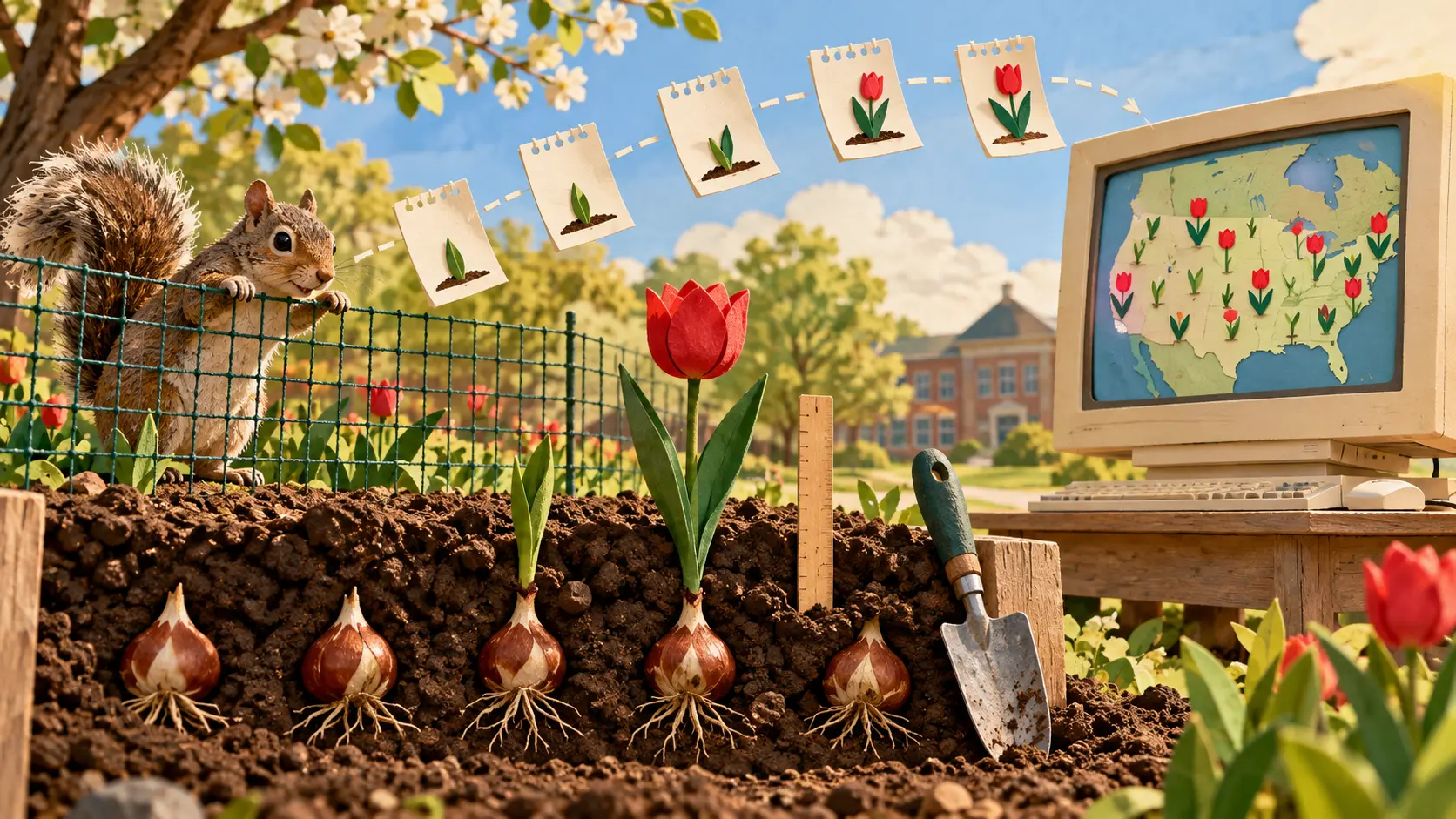
Chicken wire had a role in the early web. Journey North’s tulip experiment recommended it for protecting freshly planted bulbs from squirrels, with cut wire hangers bent into stakes to secure the edges. A school could prepare its contribution to a continental science project and find that a small, well-fed mammal had other plans for it.
The advice survives in the project’s official reproduction of its 1998 planting guide. That guide put the base of each bulb seven inches below ground and specified four-inch spacing. Gardens were to avoid building foundations, heavy shade and steep slopes. A warmer patch beside a building could bring spring forward on the chart before the wider neighbourhood had caught up.
The participants were growing Red Emperor tulips. Using the same variety and similar planting conditions gave scattered gardens something worth comparing. The website could collect dates quickly; it depended on people with trowels to make those dates answer roughly the same question.
The autumn 1998 invitation asked schools to plant gardens for tracking the following spring across North America. The page offered a way to report sightings and a route to teaching material. It connected the coming season’s work to a public destination: other classrooms would be following along.
By 12 February 1999, a published table listed the first 28 gardens reporting emergence. Orlando’s entry gave 12 January. Delta, in British Columbia, recorded 1 February. Newport-on-Tay appeared with 8 February, extending this particular list across the Atlantic. The columns supplied a date and place, coordinates and a contact address. A green tip breaking through one school’s soil had become a row another school could read.
There is a pleasing mismatch of speeds here. The network could carry a report while its next subject remained underground. Children had something to check beyond the classroom window, and then something beyond their own garden to compare it with. The web gave a local act of looking a much larger audience.
The educational use appears in Elizabeth Donnelly’s Journey North paper in the 1999 proceedings of a 1997 conference, on pages 347–348. She describes a third-grade class comparing monarch-butterfly and tulip-garden patterns. In the 1997 observations, monarchs appeared on the US East Coast five to six weeks before they appeared at similar latitudes in the Midwest. The pupils noticed a corresponding regional pattern in the garden results and considered the butterflies’ dependence on milkweed. Their own project had given them evidence to think with.
Donnelly describes several hundred gardens across the United States and Canada, alongside web-based weather resources. The useful action was the comparison: field observations from distant places could meet in a classroom discussion. A map of other people’s spring made the children’s own patch of ground more interesting.
The planting guide also imposed an annual expense. Official observations were to come from new bulbs each year, because second-year growth introduced too many variables. Previous bulbs could remain useful for separate experiments. Keeping the shared study comparable meant buying, planting and watching again.
That is where this piece of internet history gets its dirt under the fingernails. The attractive shared view rested on a common routine performed in many places: prepare a garden, protect it, notice a change and report when it happened. The screen brought the dates together. Someone still had to go outside and see whether spring had turned up.
Member Briefing
Deeper Profile Context
Sign in with the right membership level to unlock the full briefing and source notes.
Only for Strategic Circle
Strategic Circle
Open to all readers. Unlock profile briefings after joining and signing in.
Join Strategic CircleOnly for Leadership Alliance
Leadership Alliance
For qualified IP-asset owners and management; sign in to unlock alliance briefings.
Join Leadership Alliance