
Summary
- Joint stock company "For" is the RIPE-listed holder behind AS48642, a routed Russian network with visible prefixes, peering records and upstream diversity. This is not a thin directory entry pretending to be infrastructure.
- The economic problem is that the observable K Telecom retail and business surface must convert that infrastructure into enough recurring gross margin to cover local field labour, IX and transit costs, replacement capex and compliance burdens in a market where national operators can discipline prices.
- The main uncertainty is corporate boundary. Public data links AS48642, Joint stock company "For" and K Telecom in operationally meaningful ways, but it does not disclose a consolidated ownership or profit picture. The network can be analysed; the profit pool cannot be assumed.
The first incentive is to turn routed scale into local pricing power
The cleanest way to understand Joint stock company "For" is to start with the incentive created by its network assets. A regional broadband operator does not carry an autonomous system, LIR status, dozens of visible prefixes and multiple public exchange points as decoration. Those assets exist because someone expects to earn recurring revenue from connectivity, reduce dependence on a single upstream, sell enough capacity to amortise routing and access costs, and make the local customer relationship sticky enough that national competitors do not take the account away with a cheaper bundle.
That is the economic case. It is also the weakness in the case. AS48642 has real scale for a regional operator. RIPEstat identifies the AS as announced and held by Joint stock company "For". The RIPE organisation object names Joint stock company "For" as a Russian LIR with registration number 1169658138440 and an Ekaterinburg address. PeeringDB ties ASN 48642 to a K Telecom network profile, regional scope, open peering and several Russian exchange points. DB-IP counts more than ninety thousand IPv4 addresses and dozens of prefixes. Those are not claims in a brochure.
They are routing and registry artefacts that outside networks must observe for traffic to move.
But network mass alone is not value creation. It is a claim on future margin. The operator has to sell household access, business internet, private connectivity, telephony, video, Wi-Fi, support and adjacent services at prices high enough to offset a cost base that is partly fixed and partly stubborn. Local broadband looks simple to the customer: a monthly bill, a router, a support number, a technician if the cable breaks. Underneath that bill sits backhaul, transit, peering ports, switches, optical equipment, customer premises equipment, licence administration, abuse handling, billing, field crews and a queue of replacement capex.
If the bill is too low, subscriber growth merely expands the surface over which losses can travel.
The public evidence makes Joint stock company "For" more interesting than a standard small ISP. The AS is not a single-town access network hanging off one upstream. RIPE route policy lists multiple upstream import/export relationships, and RIPEstat's neighbour view shows a broad set of adjacent networks. PeeringDB lists public interconnection points across MSK-IX, PITER-IX and GNM-IX, with public IX-LAN speeds that add up to roughly 119 Gbit/s of listed port capacity. That number is not utilization, and it should not be mistaken for revenue. Still, it shows an operator building to avoid being a pure paid-transit taker.
The judgment that follows is deliberately narrow. Joint stock company "For" appears economically real because the network surface is real. It does not yet appear economically proven because the public record does not show subscriber density, ARPU, churn, gross margin, capex intensity or consolidated profit across the AO FOR and K Telecom surfaces. In broadband economics, those missing facts are not footnotes. They decide whether the network is an asset or a long-lived obligation.
The operating boundary is visible but not cleanly disclosed
The directory entity is Joint stock company "For". The network evidence points to that entity as the RIPE organisation and AS holder. The retail surface, however, is K Telecom. PeeringDB names the AS48642 network as K Telecom Ldt. and links to the k-telecom.org website. K Telecom pages and subdomains show residential internet, digital television, telephony, cloud video surveillance, office connectivity, VPN and virtual PBX services across Ekaterinburg and smaller localities in Sverdlovsk, Chelyabinsk and Perm-linked service areas.
Russian registry pages separately identify OOO "K TELEKOM" with OGRN 1086670034494 and INN 6670230988.
That split matters because the economic rights may not sit exactly where the network resources sit. A network-holding joint stock company may own or administer numbering and routing resources while a limited liability company signs retail contracts, manages support, handles offices or books operating revenue. It may also be that one entity controls the other, or that the brand and network have evolved through acquisitions and local ISP integrations. The public record available here does not prove the consolidated control chain. Treating everything under one brand as one audited economic unit would be too generous.
Still, the boundary is not so opaque that analysis has to stop. The public records form a coherent operating surface. RIPE names Joint stock company "For" as the AS holder. PeeringDB ties ASN 48642 to K Telecom. K Telecom's public service pages are consistent with the geography suggested by DB-IP prefix labels: Ekaterinburg, other Sverdlovsk towns, Perm-linked localities and a wider regional footprint. Third-party listings and 2GIS branch records show K Telecom offices, support channels and local ratings. RKN licence search results identify OOO K TELEKOM as a licensed communications provider.
The reasonable reading is that Joint stock company "For" sits in the infrastructure and routing layer of a K Telecom operating surface. The unreasonable reading would be to infer consolidated profitability without accounts.
This distinction is more than legal hygiene. It affects who pays and who benefits. If the AS holder bears LIR fees, routing administration and upstream relationships, while another entity captures subscriber revenue, transfer pricing and service agreements decide the economics. If the same owners control both entities, the internal split may be administrative. If they do not, the AS holder's return may be a wholesale fee, not the full retail margin. The public article can judge the network's economic burden, but it cannot allocate the full income statement with precision.
The cold conclusion is that the network footprint is credible and the corporate reporting is not sufficient. Investors, lenders, suppliers or large customers looking at this operator should not be satisfied by the existence of AS48642. They should ask where revenue is booked, who owns the access network, who signs customer contracts, who pays for field crews, and who is liable for regulatory and routing obligations.
The network is broader than a single local ISP, but it is not a national platform
AS48642 has a footprint that looks regional in the operational sense and distributed in the routing sense. RIPEstat's announced-prefixes data lists 42 visible prefixes during the July 2026 observation window. DB-IP reports 90,368 IPv4 addresses and 42 prefixes for the AS. PeeringDB describes the network scope as regional and the traffic ratio as balanced. The public IX records show presence at MSK-IX Ekaterinburg, PITER-IX Moscow, PITER-IX Saint Petersburg, MSK-IX Moscow, MSK-IX Saint Petersburg and GNM-IX entries. The route-policy object includes several upstreams and peers.
For unit economics, this tells two stories at once. The favourable story is that traffic scale and peering diversity can reduce the marginal cost of heavy consumer usage. A residential customer watching video is expensive if every byte leaves through paid transit. The same customer is less expensive if popular Russian and global content is reached through peering or cached routes. An open peering policy is not a guarantee of low cost, but it signals an operator trying to buy down per-bit expense.
The unfavourable story is that public interconnection is not free. IX ports, cross-connects, router capacity, operations staff and monitoring all cost money. A 10G or 20G port is a fixed commitment that only creates value when enough traffic moves over it, when the alternative paid-transit cost is meaningful, and when reliability improves customer retention. If utilization is low, port diversity becomes a vanity fixed cost. If utilization is high but retail prices are capped by competition, the savings are captured by customers rather than shareholders.
The upstream list also shows dependence rather than independence. RIPE route policy references large Russian and international transit or network names around Rostelecom, ER-Telecom, MegaFon, RETN-like topology in CIDR's view and other adjacent networks. This is normal. Regional ISPs buy resilience and reach from larger networks. But it means the small operator's gross margin is partly a negotiation with bigger suppliers.
If upstream prices rise, if traffic patterns shift, if sanctions change available equipment or if a major route becomes unreliable, the regional operator absorbs much of the practical pain before it can reprice households.
The geography reinforces the same point. DB-IP's prefix labels and geolocation samples scatter across Ekaterinburg, Moscow, Perm, Berezniki, Istok, Verkhnyaya Salda, Verkhoturye, Artyomovskiy, Dzerzhinsk and other places. Geolocation data is imperfect and should not be treated as a map of owned fibre. But the labels are consistent with an access/backbone surface assembled across several local markets and smaller settlement networks. That can be attractive if the operator has local density and weak competition in those settlements. It can be punishing if every locality needs trucks, offices, repair inventory and low-density drops.
The network, then, is more substantial than a household reseller and less strategically protected than a national platform. It has enough routing surface to lower traffic costs and sell business connectivity. It does not have obvious monopoly power. Its value depends on local density, customer mix and the discipline with which capital is allocated to settlements that can pay back.
Retail broadband revenue is a thin margin unless bundled services change the mix
The K Telecom service surface points to a classic regional fixed-access model. Residential pages advertise internet and digital television, sometimes smart intercom features, and locality-specific offers. Search-visible official snippets show up-to-200 Mbps or up-to-250 Mbps offers in several towns and 200-ruble TV-package references in local pages. The official site was slow from command-line access, and full current tariff tables could not be fetched directly. That limitation matters: the tariff evidence is sufficient to show product type, not enough to calculate full ARPU.
Third-party aggregators fill part of the gap, but they introduce their own signal. 101 Internet lists K Telecom as an Ekaterinburg provider while saying that no available K Telecom tariffs are present in its current regional dataset. Its Sverdlovsk-region rates page similarly says no available tariffs in that aggregator view, even as it lists contact and support numbers. That does not mean K Telecom has no retail customers or no current tariffs. It means distribution through that aggregator is incomplete, stale or not prioritised.
In a market where consumers compare price by address, weak aggregator visibility can be a customer acquisition cost even when the local brand is known.
The retail economics are harsh. Ekaterinburg competitor pages list national and large regional alternatives: Beeline, Dom.ru, Insis, MegaFon, MTS, Rostelecom, t2 and TTK. Tarifnik's local market page reports many tariffs, seven providers, prices from 299 rubles per month and speeds up to 1000 Mbps. Rostelecom and MTS pages show bundled home internet, TV and mobile offers. That competitive set sets a ceiling on household pricing.
If a national operator can bundle mobile data, TV channels, installation promotions and discounts, a local ISP has to win on local availability, support, faster installation, better service in neglected buildings or private-house reach. It cannot simply charge a premium because it owns an AS.
The natural response is bundling. K Telecom's public pages show television, IP telephony, smart intercom, online payment and mobile self-care. Business pages show office internet, VPN, Wi-Fi access points, virtual PBX and cloud video surveillance. These are not cosmetic add-ons. They are attempts to raise revenue per access line and reduce churn. A household with broadband plus TV or smart intercom is harder to lose than a broadband-only account. A small business with internet, VPN, PBX and camera service is more valuable than a household and may tolerate a support premium if uptime matters.
The risk is that every add-on has a cost structure. TV content packages require rights or wholesale relationships. Cloud video surveillance needs storage, cameras or installation work, support and liability around reliability. Virtual PBX needs voice infrastructure, numbering, call quality and regulatory compliance. A service that raises ARPU but adds support tickets can be less profitable than it appears. The question is not whether the product catalogue is broader than access; it is whether those products share enough infrastructure and support to improve contribution margin.
On the public evidence, the right judgement is cautious. K Telecom's product set is exactly what a regional ISP should try to sell if it wants to escape pure broadband commoditisation. But there is no disclosed proof that the mix is large enough to change the economics. The article's base case should therefore treat value-added services as potential margin support, not as proven margin expansion.
Field labour is the cost line that marketing usually hides
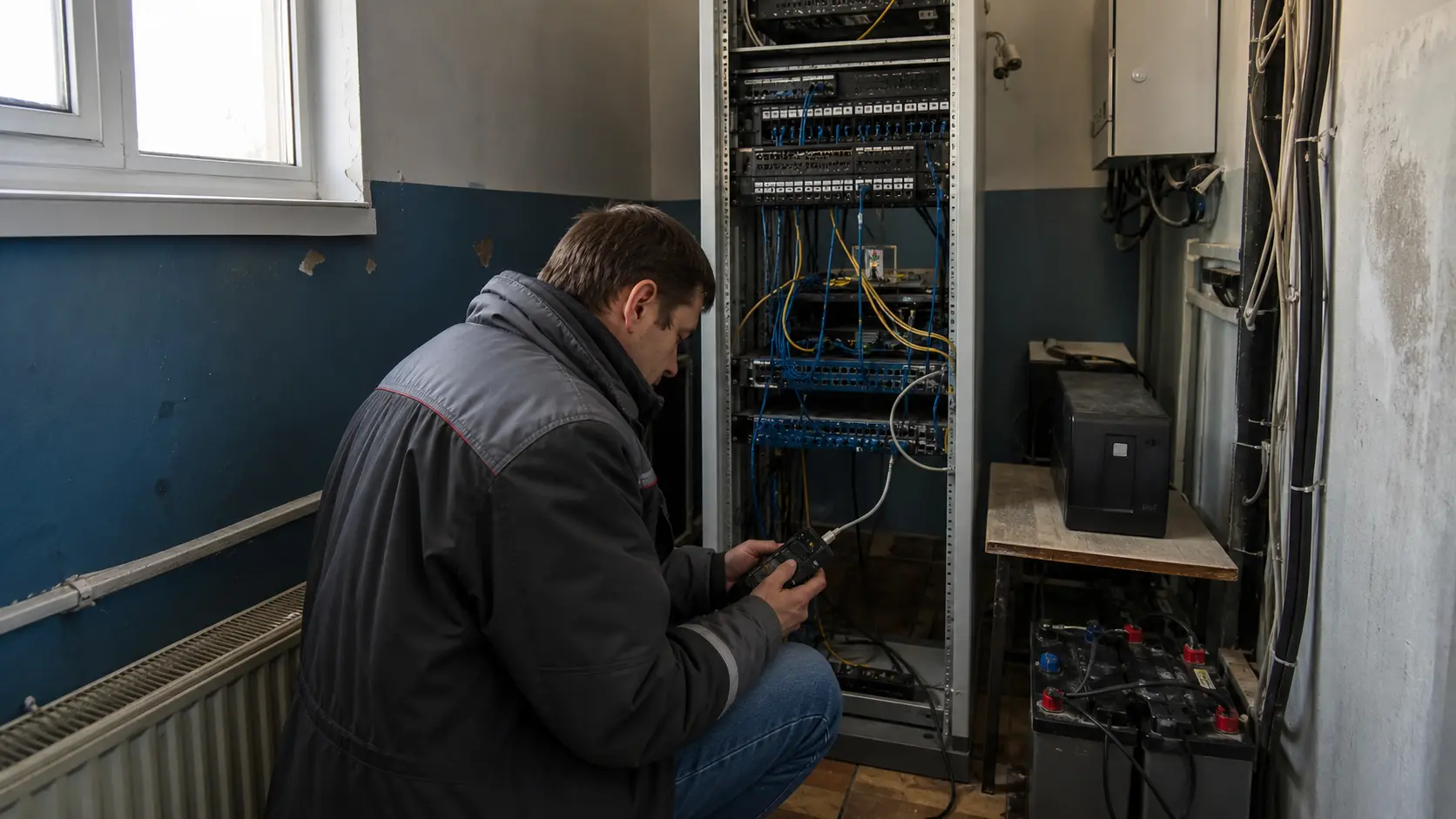
Regional broadband networks are not only routers and exchange ports. They are installers, support staff and repair obligations spread over streets, apartment blocks, private houses and smaller towns. The public labour signals around K Telecom are unusually useful because they reveal the operating cost that tariff pages prefer to ignore.
Job listings in 2026 show K Telecom seeking communications installers in Revda, Ekaterinburg, Svobodny and other towns, with salary references ranging roughly from 50,000 to 100,000 rubles depending on locality and role. Hotwork listings show multiple installer vacancies across towns, with origins from hh.ru and other job sources. Careerist, Employment Center and Dream Job pages all point to the same basic requirement: the operator needs people in the field to connect, repair and expand the network.
That labour cost changes the unit economics. A new subscriber is not just monthly revenue. It is a sales event, a technical feasibility check, a visit or dispatch, a cable run, equipment configuration, possible router support, later fault handling and eventual churn risk. If the operator provides free or subsidised installation, the first months of revenue may be consumed before the customer becomes profitable. If the household leaves after a promotion, the payback fails. If the customer is in a private house or lower-density settlement, the drop cost can be materially higher than in a dense apartment building.
The operator can shift some of this burden to customers through installation fees, equipment charges, deposits, prepaid balances or long-term contracts. But competitive markets limit how aggressively that can be done. Aggregator pages for Ekaterinburg show that many popular providers advertise free or low-cost connection, with promotions and address-based offers. The customer rarely cares that a regional ISP has real capex; the customer compares monthly price, speed, connection date and whether the line works.
Support labour is another margin leak. K Telecom's public support pages show a phone number, support email, subscriber account guidance and a recurring emphasis on payment, account numbers and technical support. This is normal for an ISP, but it should be read economically. Every billing problem, router issue, outage and connection question costs time. Operators can reduce support cost with mobile apps and online payment, and K Telecom advertises a mobile application. But in smaller markets, high-touch service can also be the reason customers stay.
The company may need to spend more on support precisely because that is its differentiator against national operators.
This is where the apparent contradiction sits. Good local support is a competitive advantage and a cost centre. If customers pay a premium for it or churn less, it creates value. If they expect it at commodity prices, it transfers downside to the operator. The public reviews are mixed enough to show both sides. Some customer comments praise stability and support contact. 2GIS branch ratings vary by location, with some low scores. 101 Internet's review page shows a large review count but also administrator checks questioning authenticity on some comments. The signal is not that service is good or bad in a simple sense.
The signal is that local support quality is central to the brand's economics and cannot be assumed from the network map.
Peering lowers traffic cost, but it does not eliminate supplier dependence
PeeringDB is the strongest public evidence that AS48642 is trying to manage its traffic economics. The network profile reports regional scope, open peering, balanced traffic ratio, IPv6 support, and multiple IX presences. Public entries show several 10G and 20G ports and GNM-IX entries at 8G, 20G and 11G. For a regional operator, this is a rational strategy. Video-heavy broadband demand increases traffic faster than monthly willingness to pay. The operator must either lower unit traffic cost or accept margin compression.
The value of peering is not that it makes the internet free. It changes who gets paid. Instead of buying all bits from transit suppliers, the operator pays for exchange access, ports, transport into peering locations and routing operations. Popular traffic can move through settlement-free or lower-cost paths; local content performance can improve; support complaints about latency may fall. The benefit is shared between cost savings and customer retention.
But supplier power remains. The RIPE route-policy object lists several upstreams. RIPEstat and CIDR Report show larger networks adjacent to AS48642. This is a classic regional-operator position: enough scale to negotiate and peer, not enough scale to stop depending on larger carriers. The company's downside is concentrated in inputs it does not fully control. Transit rates, equipment costs, optical component availability, router replacement cycles, cross-border technology constraints and regulatory network-security obligations can all move against it.
Capital cycles are the hidden trap. Broadband customers buy speed as if speed is a software setting. It is not. Higher speeds require access equipment, aggregation capacity, backbone headroom, CPE upgrades and sometimes fresh fibre or better in-building wiring. A network that was economically adequate at 100 Mbps may need new investment to compete at 500 Mbps or 1 Gbps. The customer may not pay proportionally more for that upgrade. Global telecom analysis repeatedly points to a familiar problem: traffic rises faster than ARPU. Regional Russian operators face the same arithmetic, with an additional supply-chain and policy overlay.
This is why the AS48642 footprint is best viewed as optionality with obligations attached. The peering footprint gives Joint stock company "For" and the K Telecom surface a way to control unit traffic costs. It also commits them to technical operations that a small reseller would not carry. The company benefits if the subscriber and business-services base is large enough to fill the network and pay for upgrades. It carries the downside if the traffic grows but pricing does not.
The customer base is probably more fragmented than concentrated, but proof is missing
No public source found here discloses K Telecom or Joint stock company "For" subscriber counts, household penetration, enterprise revenue share or customer concentration. That absence changes how the risk should be framed. A regional ISP can have dangerous customer concentration in two different ways. It can depend on one or two anchor corporate or municipal clients, or it can depend on many low-ARPU households in a few buildings or towns where a competitor can overbuild. Both are forms of concentration, but they behave differently.
The network evidence suggests the customer base is not merely one enterprise contract. The retail site, support pages, address pages, mobile app, consumer reviews and multiple local subdomains point to a household and small-business access business. 2GIS branch listings across several towns support the same view. Public route data also shows downstream or specific subnet labels associated with smaller operators or local networks. This looks like a distributed regional connectivity surface rather than a single private network.
Distributed does not mean safe. If the residential base is broad but low priced, revenue is exposed to churn, promotions and installation payback. If the business base is meaningful, revenue may be more stable but support expectations rise. If local government, education, energy or industrial customers are part of the downstream mix, the operator may gain anchor stability while assuming procurement, SLA and compliance burdens. CIDR Report lists downstream-adjacent ASNs including public-sector and industrial-sounding networks, but topology labels do not disclose contracts.
They are evidence of routing relationship, not proof of revenue concentration.
The company's best economic scenario would be a layered base: dense residential clusters for cash flow, business products for ARPU lift, and a manageable number of institutional customers that justify network depth without dictating prices. Its worst scenario would be fragmented low-ARPU households spread across too many towns, with business services too small to cover field labour and with bigger operators discounting in the most profitable buildings.
The public data leans toward real operating breadth, but not toward proven pricing power. That is the distinction that matters. Many regional ISPs can grow revenue by connecting more households. Fewer create value after labour, capex and churn.
Regulation is not an externality; it is part of the cost structure
Russian telecom regulation is not a distant policy risk for an ISP. It shapes licences, lawful intercept, blocking obligations, data handling, network security equipment and operating compliance. RKN search results identify multiple OOO K TELEKOM communications licence references, including local telephone and other communications-service licences. OONI reported AS48642 among Russian networks where BBC blocking was confirmed in 2022. GitHub user discussions around K-Telecom in Sverdlovsk mention Discord/YouTube circumvention configurations. IStories has reported concern from small regional operators about proposed ISP market reforms.
None of this proves misconduct by the operator. It does prove that the operator works in a policy environment where network compliance is operational work. Blocking orders, deep-packet inspection requirements, registry coordination, lawful intercept systems and changing licence expectations can require equipment, staff time and legal attention. For a national carrier, those costs are spread over millions of accounts. For a regional operator, they are more concentrated. Regulation therefore acts like a fixed cost that favours scale.
The unofficial signals deserve careful handling. A GitHub issue about Discord not working on K-Telecom is not a network audit. A discussion thread about circumvention settings is not proof of operator policy. But these signals have market value because they show user behaviour under perceived network constraints. When users discuss workarounds, they are revealing friction. That friction can increase support calls, reputational pressure and churn among technically sensitive customers. It can also be unavoidable if the operator is complying with national rules.
This is one of the ways risk is transferred. The state sets obligations. The operator installs, configures, supports and absorbs customer anger. The customer experiences failure or friction. The larger upstream and equipment ecosystem may benefit from compliance spending. The regional ISP carries the most awkward middle position: it is visible enough to be regulated, small enough for compliance to hurt, and local enough that angry customers know where the office is.
The policy risk is not just censorship. Proposed market reforms affecting small regional ISPs could change licensing burdens, ownership requirements, security obligations or consolidation pressure. If the state pushes the market toward fewer, larger operators, the value of Joint stock company "For" may lie in its local footprint as an acquisition or integration target. If regulation remains manageable, the same footprint may support an independent niche.
The facts that would change the judgement are concrete: new licence conditions, forced equipment requirements, consolidation rules or public statements from small-operator associations with direct applicability to K Telecom's regions.
Alternatives are good enough to cap the upside
A regional ISP creates value when it can do something the larger operator does not do well enough: connect a building faster, serve a village ignored by national carriers, answer support calls locally, provide a custom business circuit, maintain local offices, or bundle niche services around intercoms, CCTV and telephony. The public evidence suggests K Telecom is trying to compete on precisely those dimensions. The service subdomains, support pages, office listings and field vacancies all point to local execution rather than national brand leverage.
The problem is that the alternatives are strong enough to cap pricing. Rostelecom has scale, regional reach and government-linked weight. MTS can bundle mobile, fixed internet and TV. Beeline, MegaFon, Dom.ru, TTK and other operators appear in local provider lists. Address-based aggregators let consumers compare speed and price. Some competitor pages show 500 Mbps to 1000 Mbps options and promotional pricing. Even if a customer prefers a local operator, the available alternative sets a reference price.
That means K Telecom's moat is likely operational rather than structural. Operational moats are fragile. They depend on service quality, installation speed, local knowledge, in-building access, relationships with housing managers and the ability to repair faults before customers switch. They are real moats when executed well. They are also labour-intensive and hard to scale without diluting the very local service that made them valuable.
For business customers, the alternatives are different but still credible. A small enterprise may choose K Telecom for a local leased line, VPN, virtual PBX or camera service if the operator can provide fast local response. Larger enterprises may prefer national carriers for procurement, redundancy and compliance comfort. The regional operator can win where the problem is practical and local. It struggles where the buyer values balance sheet, national SLAs or integrated mobile/fixed contracts.
This competitive setting produces a clear conclusion. Joint stock company "For" and the K Telecom surface can earn acceptable returns if they are disciplined about where they build and if business services attach to the access footprint. They are unlikely to earn exceptional returns from broadband access alone. The market has too many substitutes and too much price visibility.
The balance-sheet test is whether local density beats renewal drag
The decisive financial question is not whether the operator can add another settlement, another subdomain or another peering session. It is whether every added operating surface improves the return on capital. Regional ISPs often confuse footprint expansion with value creation because the first metric is visible and the second is uncomfortable. More towns, more prefixes, more offices and more services can all make a company look larger while making the business less attractive if density is poor and renewal capex keeps arriving before earlier investment has paid back.
Joint stock company "For" has a network that already carries the burden of a grown-up operator. It must administer number resources, keep route objects accurate, maintain upstream and peering relationships, run support, handle abuse, manage licences and keep customer-facing systems working. Those functions do not scale down elegantly. A small operator with this architecture needs enough revenue over the platform to justify the fixed layer. If the platform supports high-density residential clusters and business accounts, the fixed layer becomes leverage.
If it supports scattered low-price households, the same fixed layer becomes a tax on growth.
The local service pages imply an operator willing to meet customers locality by locality. That is commercially sensible in towns where national carriers are slow, where apartment-building access is relationship-driven, or where local technical response has value. It is less attractive where the operator has to maintain small pools of equipment and field labour for thin demand. A connection in a dense Ekaterinburg building may be cheap to install and maintain. A private-house connection in a smaller settlement may require more cable, more truck time and more fault exposure.
The monthly broadband price may not differ enough to reflect that cost gap.
Equipment renewal sharpens the test. Access switches, optical line terminals, aggregation routers, batteries, cabinets, CPE and monitoring systems age whether the customer pays a premium or not. Customer expectations move faster than depreciation schedules. A provider advertising 200 Mbps or 250 Mbps in several towns may soon be compared against 500 Mbps and 1 Gbps offers from national operators. Matching those headline speeds can require capital spending that protects existing revenue rather than creates new revenue. In accounting terms it may look like investment. In economic terms it may be defensive maintenance.
This is why the network's peering sophistication should not be read as automatic advantage. Public IX capacity is useful if it protects gross margin on a sufficiently large base. It is less useful if it supports traffic that customers will not pay more for. The same is true of business services. VPN, virtual PBX and video surveillance are better products than commodity access only if they attach to customers who value reliability and support enough to pay for them. Otherwise the operator merely adds complexity to defend accounts that might otherwise churn.
There is also a working-capital angle. Regional ISPs can shift some risk to customers through prepayment, payment portals, mobile apps and temporary disconnection for non-payment. K Telecom's payment and subscriber-account surface suggests that cash collection is operationally important. Prepaid balances can help working capital, but they do not solve capex. A customer may pay this month before the operator must pay a technician or supplier, but equipment replacement and network expansion still require cash before future revenue is certain.
The balance-sheet evidence is incomplete, so the judgement must be inferential. Public registry pages give identity and some financial hints for the legal entities, but not the consolidated economics of the AS holder plus retail/service surface. The existence of installer vacancies, support offices and many local pages makes the cost base tangible. The existence of peering, prefixes and business products makes the revenue opportunity tangible. What is missing is the bridge: how much contribution margin each locality and product line actually produces after renewal, support and supplier costs.
The company should therefore be evaluated as a network with credible operating leverage and credible operating drag. The same assets that make it more defensible than a simple reseller also make it more exposed to poor capital allocation. If management adds only dense, repayable footprints and attaches business services, the AS48642 platform can create durable local value. If management adds low-density coverage because coverage looks strategically impressive, the network will transfer downside from customers to the operator's balance sheet.
What would prove value creation
The bullish case needs evidence that the network is full enough, dense enough and monetised well enough to justify its fixed costs. The first missing fact is subscriber density by locality. A thousand subscribers in one dense cluster are more valuable than a thousand spread across small settlements requiring separate crews and spares. The second is ARPU by product bundle. Broadband-only households at commodity prices do not have the same economics as households with TV, intercom and recurring service add-ons, or businesses with VPN and PBX.
The third missing fact is churn and payback period. If installation cost is recovered in six months and customers stay for years, subsidised connection can be rational. If customers switch after promotions, growth destroys cash. The fourth is traffic cost: paid transit spend, peering utilization, cache arrangements and IX port utilization. Public peering capacity is useful evidence, but the real question is whether it is filled with traffic that would otherwise have been expensive.
The fifth is capex. The operator's network may be mostly leased, partly owned, acquired through local integrations or built with a mix of fibre, in-building Ethernet and aggregation. Each structure has different economics. Owned fibre creates long-lived advantage but demands upfront capital and maintenance. Leased access lowers capex but exposes margins to suppliers. Acquired local networks may bring customers but also technical debt.
The sixth is corporate consolidation. If AO FOR and OOO K TELEKOM publish or otherwise disclose consolidated economics, the analysis becomes much sharper. Without that, the public record can identify the operating surface but not fully assign profit. The seventh is regulatory burden. Any new security equipment, licence reform or compliance requirement that falls disproportionately on small regional operators would change the investment case quickly.
Until those facts appear, the base judgment should stay disciplined. Joint stock company "For" is a real network operator with a credible regional footprint. It is not yet a proven compounder of economic value. The company has built the infrastructure needed to lower traffic costs and sell local services. It still has to show that customers, not the operator, will pay enough for the risk and capital tied up in that infrastructure.
The final judgement is operational credibility without disclosed economic proof
Joint stock company "For" deserves more seriousness than many obscure directory companies because the public internet can see its network. AS48642 is live. The RIPE objects are coherent. The PeeringDB profile is developed. The prefixes are numerous. The K Telecom service surface has offices, support channels, local pages, business products, reviews and job postings. There is a business here.
What the public record does not show is whether the business earns its cost of capital. That is the question Elias Ward should care about. The operator has built or assembled the pieces that a regional ISP needs: resource control, transit diversity, peering, retail support, local sales, business services and field labour. Those pieces create value only if local density and service mix turn them into margin. Otherwise they become a permanent obligation to keep upgrading a network whose customers can leave for national bundles.
The clearest economic reading is this: Joint stock company "For" has infrastructure credibility and uncertain pricing power. Its upside is the ability to use regional knowledge and public interconnection to serve places and customers that larger operators underserve. Its downside is that every advantage costs labour, compliance, equipment and capital, while competitors keep the headline price low. The network may be worth owning. It is not yet publicly proven to be worth as much as it costs to keep competitive.
Sources
- https://stat.ripe.net/data/as-overview/data.json?resource=AS48642
- https://rest.db.ripe.net/search.json?query-string=AS48642&source=ripe
- https://rest.db.ripe.net/ripe/organisation/ORG-JSC13-RIPE.json
- https://rest.db.ripe.net/ripe/aut-num/AS48642.json
- https://stat.ripe.net/data/announced-prefixes/data.json?resource=AS48642
- https://stat.ripe.net/data/asn-neighbours/data.json?resource=AS48642
- https://www.peeringdb.com/api/net/8926
- https://www.peeringdb.com/net/8926
- https://db-ip.com/as48642-joint-stock-company-for
- https://www.cidr-report.org/cgi-bin/as-report?as=48642&view=2.0
- https://bgp.he.net/AS48642
- https://bgp.tools/as/48642
- https://apps.db.ripe.net/db-web-ui/query?searchtext=AS48642
- https://apps.db.ripe.net/db-web-ui/lookup?source=ripe&key=AS48642&type=aut-num
- https://apps.db.ripe.net/db-web-ui/lookup?source=ripe&key=ORG-JSC13-RIPE&type=organisation
- https://ipgeolocation.io/browse/asn/AS48642
- https://ipinfo.io/AS48642
- https://www.cidr-report.org/as6447/bgp-originas.html
- https://www.checko.ru/company/for-1169658138440
- https://www.rusprofile.ru/id/10697970
- https://companies.rbc.ru/id/1169658138440-ao-for/
- https://spark-interfax.ru/sverdlovskaya-oblast-ekaterinburg/ao-for-inn-6670445246-ogrn-1169658138440-53375b0e7286416193f8f8af410bd142
- https://www.checko.ru/company/k-telekom-1086670034494
- https://www.rusprofile.ru/id/3557704
- https://companies.rbc.ru/id/1086670034494-ooo-k-telekom/
- https://spark-interfax.ru/sverdlovskaya-oblast-ekaterinburg/ooo-k-telekom-inn-6670230988-ogrn-1086670034494-4c16cf9b994645ffa7a84cd38b8f95ae
- https://kontragent.vbr.ru/company/ooo-k-telekom-1086670034494/
- https://www.tbank.ru/business/contractor/legal/1086670034494/
- https://www.audit-it.ru/contragent/1086670034494_ooo-k-telekom
- https://rkn.gov.ru/activity/connection/register/license/?id=%D0%9B030-00114-77%2F00069287
- https://rkn.gov.ru/activity/connection/register/license/p9600/?id=%D0%9B030-00114-77%2F00069388
- https://rkn.gov.ru/activity/connection/register/license/p8000/
- https://rkn.gov.ru/docs/lic_tcom_order/annex_762737352.docx
- https://k-telecom.org/
- https://k-telecom.org/addresses/
- https://k-telecom.org/support/
- https://k-telecom.org/pay/
- https://k-telecom.org/mobilnoe-prilozhenie/
- https://k-telecom.org/home/internet-tv/
- https://bistok.k-telecom.org/home/internet-tv/
- https://zarechny.k-telecom.org/home/internet-tv/
- https://vtagil.k-telecom.org/home/internet-tv/
- https://sysert.k-telecom.org/home/internet-tv/
- https://severouralsk.k-telecom.org/
- https://k-telecom.org/b2b/
- https://k-telecom.org/b2b/internet-dlya-biznesa/
- https://k-telecom.org/b2b/vpn/
- https://k-telecom.org/b2b/virtualnaya-ats-dlya-biznesa/
- https://k-telecom.org/b2b/b2b-ovn/
- https://101internet.ru/ekaterinburg/providers/k-telecom
- https://101internet.ru/ekaterinburg/rating/k-telecom
- https://101internet.ru/sverdlovskaya-oblast/providers/k-telecom/rates
- https://2gis.ru/ekaterinburg/branches/1267174266111605
- https://2gis.ru/ekaterinburg/firm/1267165676507504
- https://2gis.ru/ekaterinburg/firm/70000001051641481/tab/reviews
- https://101internet.ru/ekaterinburg/providers
- https://101internet.ru/ekaterinburg/orders/tohome
- https://101internet.ru/ekaterinburg/providers/rostelecom/rates
- https://tarifnik.ru/ekaterinburg/vse-tarify
- https://ekaterinburg.mtsru.ru/internet-i-televidenie-mts
- https://www.company.rt.ru/en/ir/results_and_presentations/AnnualReports/
- https://tadviser.com/index.php/Article%3AInternet_access_%28Russian_market%29
- https://tradingeconomics.com/russia/fixed-broadband-internet-subscribers-wb-data.html
- https://datareportal.com/reports/digital-2025-russian-federation
- https://www.pwc.com/gx/en/1/industries/technology-media-telecom/telecom-outlook-perspectives.html
- https://istories.media/en/stories/2026/04/14/new-reforms-will-leave-some-areas-of-russia-without-internet/
- https://ooni.org/post/2022-russia-blocks-amid-ru-ua-conflict/
- https://github.com/Flowseal/zapret-discord-youtube/issues/3512
- https://github.com/remittor/zapret-openwrt/discussions/168
- https://k-telecom.org/vakansii/
- https://revda.careerist.ru/vakansii/montazhnik-revda-83180988.html
- https://ekaterinburg.employmentcenter.ru/vacancy/?action=read2&id=30054343
- https://dreamjob.ru/employers/37199/vakansii/130559625
- https://hotwork.ru/jobs/russia/montazhnik-svyazi-spayshchik-vols?company=%D0%BA+%D1%82%D0%B5%D0%BB%D0%B5%D0%BA%D0%BE%D0%BC%2C%D0%BE%D0%BE%D0%BE
- https://dreamjob.ru/employers/37199
- https://www.101internet.ru/ekaterinburg/address/%D0%BA%D0%B8%D1%80%D0%BE%D0%B2%D1%81%D0%BA%D0%B8%D0%B9-id1306/%D1%83%D0%BB-%D1%80%D0%B0%D0%B5%D0%B2%D1%81%D0%BA%D0%BE%D0%B3%D0%BE-id296829
- https://bistok.k-telecom.org/support/
- https://ntura.k-telecom.org/home/
- https://baikalovo.k-telecom.org/home/
- https://krutoylog.k-telecom.org/