Summary
- ISC can document upstream stewardship through source repositories, release artifacts, security advisories and administrator guidance; those records establish available control mechanisms, not control of every deployed service.
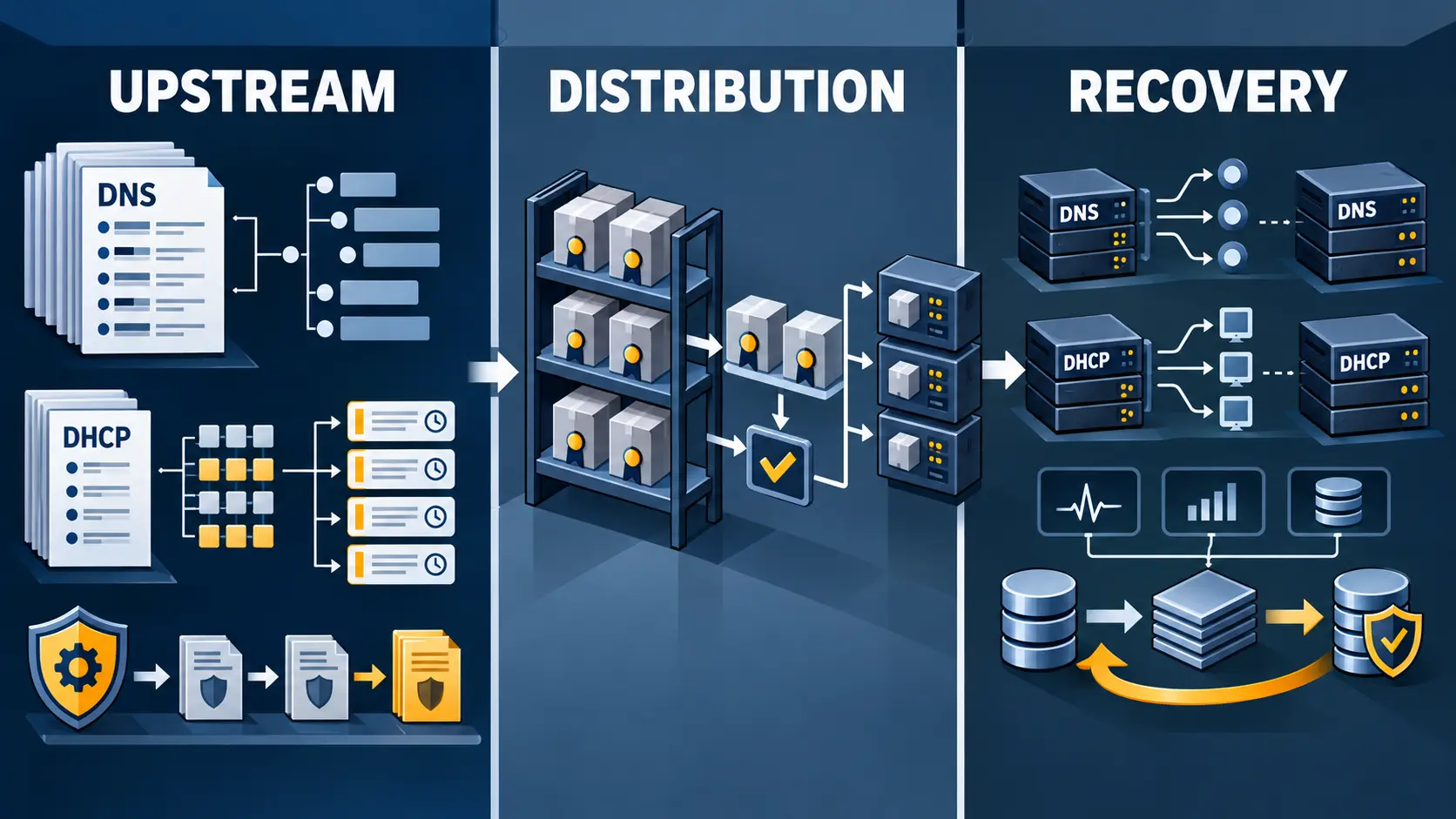
- The durable-remedy test is a chain: identify the affected version, obtain and validate the right artifact, pass through distribution and change-control layers, deploy it, observe the service, and test recovery under credible failure conditions.
Internet Systems Consortium’s public record makes an important distinction visible. ISC maintains BIND 9 and Kea, publishes documentation and security advisories, and provides downloadable software and source repositories. Its administrator documentation describes configuration, logging, statistics, control interfaces, troubleshooting, monitoring and, for Kea, high-availability mechanisms. These are real stewardship functions. They are not the same as operating every resolver, authoritative server or DHCP service that uses the software.
The distinction matters because a software repair becomes an infrastructure repair only after it crosses several control boundaries. ISC’s security-advisory process can identify affected versions and provide remediation information. Its download infrastructure can make an upstream artifact available. The BIND administrator documentation describes operational controls and evidence surfaces, while the BIND source repository supports traceability of upstream development. None of those records, by themselves, proves that a particular operator found its exposure, selected the correct branch, installed the fix or confirmed that service behaviour improved.
Kea presents the same boundary in a different form. Its administrator documentation describes control channels, logging, monitoring, databases, operational procedures and high availability. The Kea project page and public repository show an upstream software and development base. They establish mechanisms that an operator may use. They do not establish that those mechanisms are enabled, correctly integrated or monitored in a named production environment.
The distribution layer makes the accountability chain longer. Operators may obtain BIND through ISC’s direct releases, through a Linux distribution or through another platform that packages and integrates the software. Debian’s package tracker exposes package versions, release relationships and maintainer activity. Ubuntu’s package listings show another route through which an operator may receive BIND. A distribution package can lag, diverge from or add patches to an upstream release. Package availability therefore proves an available route to remediation, not installation or recovery.
That is the central evidence boundary for ISC-AGP1. Public records can show that ISC maintains software, publishes fixes and documents controls. They cannot, without deployment-specific records, show how many operators run a given version, how quickly they apply a security release, whether configurations preserve the intended protection, or whether failover and restoration work under pressure. The ISC Knowledge Base may add version-specific operational guidance, while ISC’s BIND software page provides additional product context; guidance remains different from evidence about a particular service.
A fair accountability test should therefore assign responsibility by control point rather than by reputation. ISC controls upstream code maintenance, release engineering, advisory publication and much of the technical guidance. Distributors control packaging, update timing and sometimes downstream patches. Operators control inventory, change approval, configuration, deployment, monitoring, backups and recovery exercises. An incident can cross all three layers without proving that one actor alone caused it.
For boards and public-service operators, the practical question is not whether ISC promises continuity. It is whether the operator can produce a dated chain of evidence: the affected asset and installed version; the advisory or release that governed the decision; the package or artifact hash; approval and deployment records; post-change service metrics; and a recovery test showing that data, keys, configuration and dependencies were restored. Without that chain, a published fix remains a credible input to repair, not proof that repair occurred.
The same test applies to high availability. Documentation can show that software supports cooperating servers, control APIs or runtime configuration. It cannot establish that a deployment has independent failure domains, synchronized state, tested promotion rules, usable monitoring and an operator who can intervene when automation fails. “Supported” describes a capability. “Recovered” requires an observed event or a controlled exercise.
This is not an argument against ISC’s role, nor a claim that ISC directly controls downstream outages. It is an argument for precision. Institutional legitimacy in infrastructure depends on stating what an organization can change, what it can observe, what it can only recommend, and what evidence would close the remaining gap. For ISC and its users, the durable remedy is a documented handoff from upstream stewardship to downstream proof.
Member Briefing
Deeper Profile Context
Sign in with the right membership level to unlock the full briefing and source notes.
Only for Strategic Circle
Strategic Circle
Open to all readers. Unlock profile briefings after joining and signing in.
Join Strategic CircleOnly for Leadership Alliance
Leadership Alliance
For qualified IP-asset owners and management; sign in to unlock alliance briefings.
Join Leadership Alliance