
Summary
- ISC’s influence is strongest at the upstream end of a dependency chain: it maintains software, publishes releases and security information, and exposes documentation and distribution paths. That is stewardship of available remedies, not proof of control over every deployed system.
- BIND and Kea create different operational dependency maps. Continuity can require configuration, zone data, DNSSEC material, leases, databases, hooks, APIs, peer communication and monitoring in addition to the principal daemon.
- The public record can show whether a release, advisory, package or container exists. It cannot, without operator-specific records, prove deployment scale, universal patch adoption, measured failover time or durable recovery after an incident.
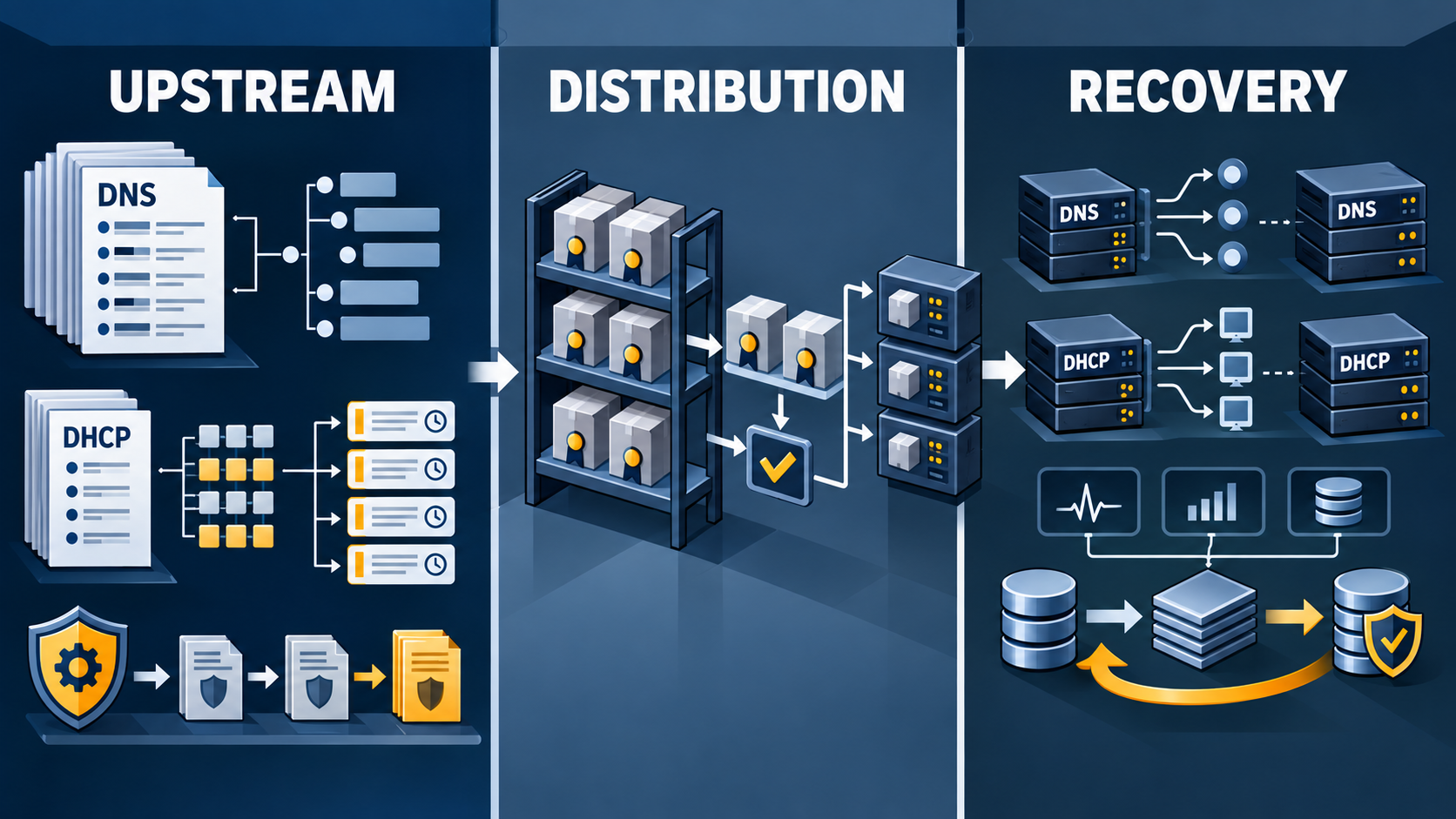
Internet Systems Consortium is often discussed as though its influence were located inside a single product. The more useful unit of analysis is a chain: ISC maintains upstream software; it publishes source releases, documentation, advisories and support information; distributors package or backport that software; operators select versions, configure services, protect state and test restoration. Each link changes what the next participant can do, but no link automatically transfers operational authority to ISC.
That distinction matters because BIND and Kea sit close to the control plane of ordinary network operation. BIND can provide authoritative or recursive DNS service. Kea can provide DHCPv4 and DHCPv6 functions, with surrounding components for management, lease storage, high availability and Dynamic DNS. A defect, an unavailable dependency or an untested recovery path can therefore affect more than a software process. It can affect name resolution, address assignment, service discovery and the ability of administrators to reach or reconfigure systems.
The evidence reviewed here supports a narrower and more defensible conclusion. ISC demonstrably maintains an upstream software and information infrastructure. Its product pages identify BIND and Kea, while its download, support and security channels connect users to releases, assistance and vulnerability information (BIND; Kea; ISC downloads; ISC support; ISC security advisories). These channels create the conditions for remediation and adoption. They do not establish how a particular operator’s system is configured or whether a fix has been deployed and validated.
From maintained code to an operational dependency
The first link is upstream stewardship. ISC presents BIND 9 as open-source DNS software and Kea as an actively developed open-source DHCPv4 and DHCPv6 platform. Their public documentation describes not only the central services but also the surrounding control surfaces. BIND’s administrator material covers authoritative and recursive operation, configuration, zone data, dynamic updates, DNSSEC, logging and administrative controls (BIND Administrator Reference Manual). Kea’s manual describes DHCP daemons, a Control Agent, Dynamic DNS, hook libraries, lease storage and high-availability functions (Kea Administrator Reference Manual; RFC 2131).
This is the mechanism by which software becomes infrastructure. The user does not depend only on a binary called named or a DHCP daemon. The user depends on a set of versioned components, configuration assumptions, stored state and administrative interfaces that must continue to work together. In BIND, the recovery object may include zone files, update journals, trust material, keys, logs and monitoring. In Kea, it may include lease databases, peer state, hook-library compatibility, API credentials and the communication path between cooperating servers.
The manuals document what those components do; they do not provide a production operator’s recovery record. The difference is important. A documented high-availability state machine is evidence that a mechanism exists. It is not a measurement of the time needed to move traffic or leases during an outage. A documented configuration reload is evidence of an administrative capability. It is not proof that a change was safe in a named production environment.
The second link is release and advisory distribution. ISC’s download and security channels provide a public route to releases and information about affected and corrected software lines. Its support material describes assistance and escalation as part of the wider operating model. The BIND and Kea vulnerability matrices are candidate records for comparing affected branches with fixed releases, while individual advisories provide the event-specific context (BIND vulnerability matrix; Kea vulnerability matrix; support policy and version numbering).
That channel changes the remediation problem, but it does not close it. A published correction answers an upstream question: which source or release contains a remedy for a defined issue? It does not answer the downstream questions: which package is installed, whether a distributor backported the fix, whether the vulnerable component is enabled, whether the operator found every affected instance, whether configuration changes are also required, and whether service recovered under realistic load.
Why version numbers do not settle responsibility
Upstream BIND and Kea repositories provide source-level release tags. Those tags are useful evidence of published versions and release timing (BIND tags; Kea tags). But a tag does not establish that a branch remains supported, that a downstream package has adopted it or that an operator has installed it.
The distribution layer introduces a necessary translation. ISC exposes package repositories and container images, while operating-system distributors maintain their own package and security records (ISC package repositories; ISC BIND container; ISC container profile). Debian’s package and security trackers provide another view of BIND and Kea packaging and vulnerability status (Debian BIND package; Debian BIND security tracker; Debian Kea package; Debian Kea security tracker).
These records can disagree without any one of them being defective. An upstream release may appear before a distributor’s package. A distributor may backport a fix while retaining an older-looking package version. A container may follow a different update cadence from a host operating-system package. A downstream maintainer may classify exposure differently from ISC or the National Vulnerability Database (NVD BIND results; NVD Kea results).
The practical consequence is that “the fix exists” and “the system is fixed” are different claims. A responsible inventory must identify the actual artifact, its source, its patch state and the enabled features. It must then connect those facts to the service’s data and recovery procedure. A version comparison that stops at the upstream tag can miss the distributor’s backport. A package comparison that stops at the installed version can miss an unprotected key, a stale database or a second instance running in a container.
BIND’s dependency map is larger than named
BIND’s continuity requirements illustrate the gap between a software release and an operating service. The BIND documentation describes authoritative and recursive service, configuration, zone transfers, dynamic updates, DNSSEC, logging and administration. Standards material also treats authoritative DNS operation as a matter of coordinated servers, data and operational practice rather than a single isolated process (RFC 2182; BIND release notes).
For an authoritative service, recovery may depend on the availability and correctness of zone data, transfer relationships, update journals and signing material. For a recursive service, it may depend on configuration, trust anchors, cache behavior, logging and the ability to validate responses. The documentation establishes these technical surfaces. It does not establish that every operator backs them up, monitors them or has tested restoration.
The distinction becomes sharper during a security event. ISC can publish an advisory and a corrected release. A distributor can package or backport it. An operator can deploy it. Yet the resolver may still be exposed if a second installation was missed, if a required configuration mitigation was not applied, or if the operator did not test service behavior after the change. The public existence of the advisory is therefore evidence of an available remedy, not evidence of completed recovery.
DNS standards reinforce the importance of operational design. RFC 6781 addresses DNSSEC operational practices, while NIST’s Secure Domain Name System Deployment Guide frames deployment as a security and configuration process. Neither source identifies how ISC’s downstream users implement those practices. They help define the evidence an operator would need to show: asset inventory, key custody, change records, monitoring and restoration tests.
Kea’s dependency map adds state and coordination
Kea makes the same point through a different protocol. Its documentation describes DHCPv4 and DHCPv6 services, the Control Agent, Dynamic DNS, hooks, lease storage and high-availability coordination. DHCP service can therefore depend on more than the daemon responding to a request. It can depend on the lease database, the persistence model, the peer relationship, the hook libraries loaded into the process, API access controls and the DNS update path (Kea introduction; Kea quickstart; Kea high availability; Kea lease database).
The adoption mechanism is visible even when the outcome is not. A platform can integrate Kea, expose its controls and make the software easier to deploy. The component model can lower the cost of automation for an operator that already has suitable databases, monitoring and configuration management. It can also create additional failure surfaces: an incompatible hook, an inaccessible lease store, a broken peer link or an exposed management interface can change the operational result.
This is why the public record should not be read as either a product endorsement or a failure finding. It shows a technically credible path from maintained software to downstream use. It does not reveal the denominator: how many installations use each component, how many run high availability, how often operators test failover or how many recovery exercises succeed. The absence of those measurements is an evidence boundary, not proof that the deployments fail.
What ISC controls, and what it does not
ISC’s demonstrated role is upstream stewardship. It can influence the code, release artifacts, documentation, advisories and support channels it maintains. It can make a remedy available and explain the conditions under which a component is expected to operate. It cannot, on the evidence reviewed, be treated as the operator of every BIND or Kea deployment, the owner of every distributor’s package policy or the party that controls each local recovery decision.
That boundary matters for both accountability and resilience. If a vulnerability is disclosed, ISC’s responsibility includes communicating the issue and publishing an appropriate correction or mitigation through its upstream channels. A distributor’s responsibility may include packaging, backporting, updating its tracker and communicating support status. An operator’s responsibility includes identifying affected systems, selecting and testing the artifact, protecting configuration and state, deploying the change, monitoring the service and validating recovery.
The roles can overlap. Operators may compile from source. Distributors may alter patches. Commercial support may provide escalation without taking over local testing or restoration. A container image may be maintained by one party and orchestrated by another. The chain is therefore not a simple transfer of liability. It is a set of handoffs where evidence must travel with the remedy.
The most decision-relevant test is consequently procedural rather than rhetorical. Can the operator identify the applicable release and all instances? Can it obtain and authenticate the remedy? Can it determine whether a distributor backport changes the version comparison? Can it deploy across the complete dependency chain, including data, keys, databases, hooks and peer state? Can it verify that DNS or DHCP service recovered under realistic conditions, and retain a record of that verification?
The public sources reviewed can define those questions and locate many of the inputs. They cannot answer them for an unnamed operator. Nor can the visible association between ISC and an internet number resource answer them. Software stewardship, network identity and operational authority are separate claims.
The missing ledger
A durable resilience assessment would connect five records: the affected asset and installed artifact; the upstream advisory or release; the distributor’s package or container state; the operator’s deployment and configuration change; and the post-change observation or recovery test. The sequence should include dates, versions, responsible parties, exceptions and evidence of validation.
For BIND, that ledger should include the resolver or authoritative role, zone and trust-material dependencies, update and transfer state, and the test showing that service remains correct after remediation. For Kea, it should include DHCP version and mode, lease storage, high-availability state, hook libraries, Control Agent exposure, Dynamic DNS relationships and measured failover or restoration behavior. A status page or release note can be one entry in the ledger; it cannot substitute for the operator’s result.
This requirement is not an argument that ISC must publish private customer data. It is an argument for separating what upstream public records can establish from what only downstream operators can establish. Public evidence can show that the remedy exists and that the architecture has defined control surfaces. Operator evidence must show whether the remedy reached the system and whether the system recovered.
The resulting conclusion is bounded. ISC demonstrably shapes the available software, information and support pathways for BIND and Kea. Those pathways create operational dependencies because network operators and distributors must translate upstream releases into configured, stateful and monitored services. The evidence reviewed does not prove universal deployment, direct control of downstream infrastructure, measured recovery performance or durable repair after a named incident.
For technical leaders, the practical lesson is straightforward: treat the upstream release as the beginning of a recovery workflow, not its completion. The decisive record is the chain from advisory to artifact, from artifact to deployed dependency set, and from deployment to a tested service outcome. Until that chain is visible, software influence is real but operational resilience remains an open question.
Member Briefing
Deeper Profile Context
Sign in with the right membership level to unlock the full briefing and source notes.
Only for Strategic Circle
Strategic Circle
Open to all readers. Unlock profile briefings after joining and signing in.
Join Strategic CircleOnly for Leadership Alliance
Leadership Alliance
For qualified IP-asset owners and management; sign in to unlock alliance briefings.
Join Leadership Alliance