
Summary
- Incomsvyaz is best read as a narrow regional access operator around Shchelkovo, not as a scaled national carrier: its public web pages, company registry records and AS41639 routing evidence all point to a local fixed-line business whose economics depend on keeping monthly access payments ahead of bought capacity, field support and renewal costs.
- The headline residential tariff spread is real but fragile. Apartment plans published by the company run from RUB 671 for up to 50 Mbps to RUB 1,220 for up to 500 Mbps, while private-house plans run from RUB 1,100 for up to 100 Mbps to RUB 1,403 for up to 500 Mbps. The higher-speed tiers sharply reduce price per advertised megabit, so profit depends on contention, utilisation and low avoidable repair labour rather than on selling raw speed at face value.
- Routing evidence shows operational autonomy but limited upstream depth. AS41639 is registered to Limited Liability Company Incomsvyaz, with roughly 3,072 IPv4 addresses and a large IPv6 allocation visible in public routing sources. IPinfo and CIDR Report identify two upstream adjacencies, JSC Mediasoft ekspert and LLC Svyaz Invest, and no downstream networks, which supports the view of a retail access operator rather than a transit platform.
- Market signals are mixed and must be treated as signals, not measurements. Public reviews include long-tenure praise for support and stability, complaints about price increases, outages and speed, and address-level comments that alternatives are not always available. Competitor and aggregator pages show that Shchelkovo households can see national bundles and local substitutes, but actual substitution is address-specific.
- The main judgment is conditional: Incomsvyaz can finance a replacement cycle if it preserves a paid local-service premium, shifts enough users toward higher-retained-contribution plans, limits repeat truck rolls and maintains carrier redundancy. The judgment would weaken if payment delay, churn, upstream concentration, support labour or equipment replacement costs rise faster than tariff resets.
Begin with one customer invoice. A household taking Incomsvyaz's published "Optimal" apartment plan pays RUB 915 per month for access advertised at up to 100 Mbps. That invoice is not revenue that can all be kept by the operator. It contains tax, card or payment-channel friction, support promises, the cost of any upstream transport used when the customer actually moves traffic, the maintenance of the building access link, the work of keeping account credentials and static network settings straight, and the latent cost of replacing old switches, optical nodes, patch cords, power supplies and routers when they age out.
The economic question is whether enough of the RUB 915 remains after those obligations to fund the next cycle of access plant without relying on one-off promotions, unpaid labour or a gradual decline in service quality.
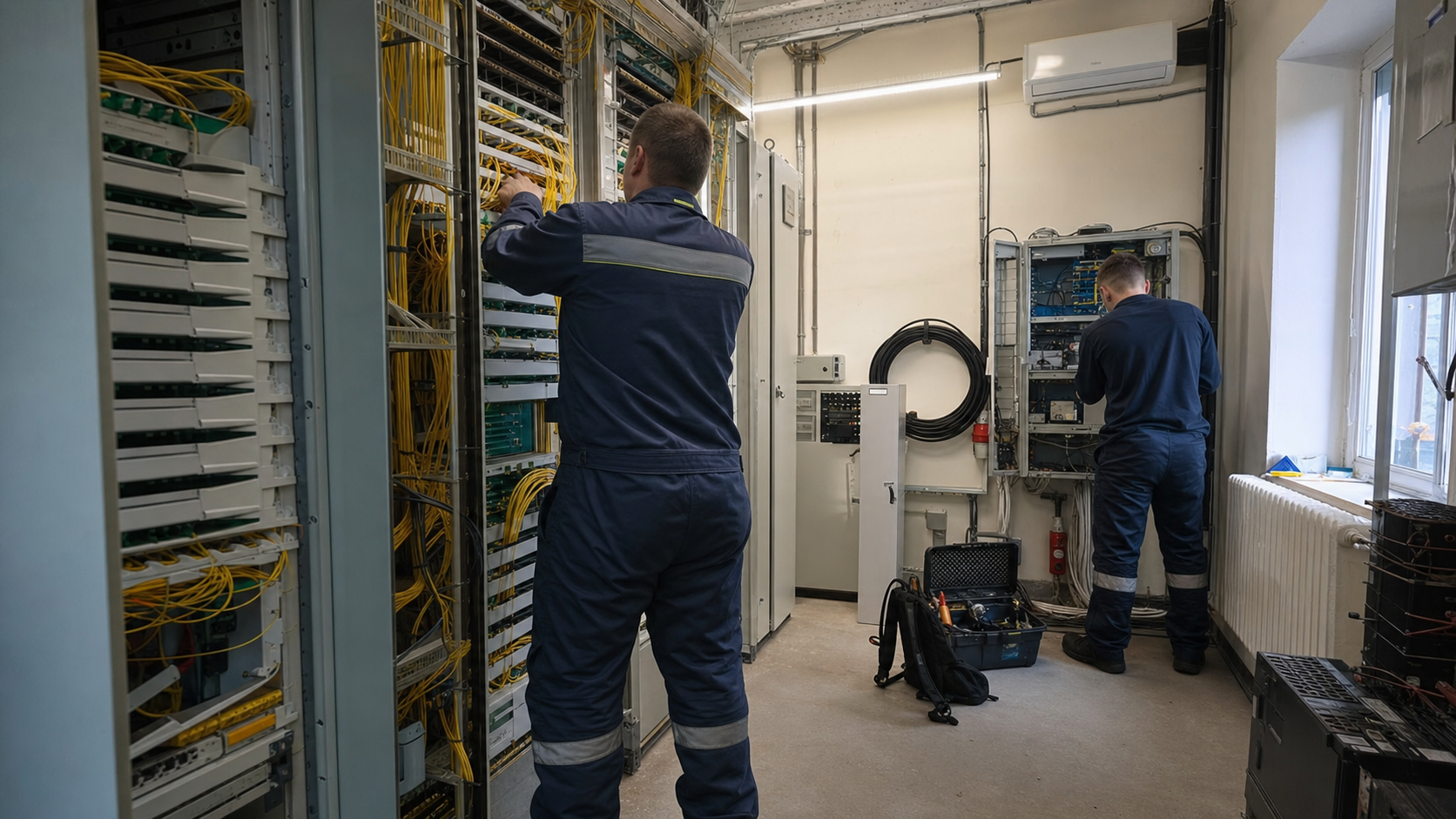
That framing matters because Incomsvyaz's public evidence looks like a local fixed-line operator with practical, labour-heavy economics. The company site places the office at Oktyabrskaya Street in Shchelkovo and lists office hours, support hours and mounting-work hours. The internet service page describes dedicated lines to homes, optical cable to each building, Category 5 or 5e twisted-pair cable to the customer's computer, local network resources, and a VPN connection to the company's server for internet access.
The same page tells prospective residential customers to submit an application, sign a contract, pay the first monthly fee, provide access to risers and utility areas, and wait for installers to arrange a line within fourteen calendar days. For business customers it describes a technical assignment, an estimate, payment to the company's account and a fourteen-working-day connection timeline after receipt of funds.
Those details define the control boundary. Incomsvyaz controls the customer relationship, local access instructions, pricing, account portal, support desk and at least one autonomous system. It does not control the whole internet path. Public routing evidence identifies AS41639 as Incomsvyaz's autonomous system, but shows upstream adjacency rather than a broad transit business. The margin is therefore made between the retail invoice and a stack of wholesale, maintenance, licensing and support costs. If upstream costs, customer calls, truck rolls and equipment failures stay contained, the local access network can have a defendable spread.
If those costs consume the invoice, the company becomes a collector of small payments on behalf of suppliers, tax authorities, labour and replacement vendors.
The pricing table is the first hard test of that spread. Incomsvyaz publishes apartment internet plans at RUB 671 for up to 50 Mbps, RUB 915 for up to 100 Mbps, RUB 1,037 for up to 200 Mbps and RUB 1,220 for up to 500 Mbps. The price per advertised megabit falls from about RUB 13.42 on the lowest apartment plan to about RUB 2.44 on the 500 Mbps plan. Private-house plans are higher in absolute price, at RUB 1,100 for up to 100 Mbps, RUB 1,220 for up to 200 Mbps and RUB 1,403 for up to 500 Mbps, but their price per advertised megabit also falls sharply as speed rises.
The company can tolerate that compression only if the average customer does not use the headline speed continuously and if higher-speed plans reduce churn, support disputes or competitive loss.
The private-house plans hint at another margin structure. Serving a detached house or a garden settlement is different from serving a dense apartment riser. There is less natural sharing of entry work across apartments, and the line may be longer, more exposed and more expensive to repair. Incomsvyaz prices those plans above the apartment equivalents, which is economically sensible, but the difference is not enormous at the upper end: the private-house 500 Mbps plan is RUB 1,403, only RUB 183 above the apartment 500 Mbps plan. That gap may be enough if the house plant has already been built and faults are rare.
It looks much less generous if the operator must repeatedly dispatch staff, replace outdoor segments, fight seasonal damage or maintain low-density optical routes.
The invoice also includes a support option value that can be more important than the posted speed. Incomsvyaz's own price list charges for customer-side work: the internet page lists a specialist call or penalty for refusing repair work at RUB 500, external IP support at RUB 200 per month for individuals and RUB 400 for legal entities, cable at RUB 40 per metre without apartment laying, and a business specialist visit at RUB 2,000 per hour excluding materials. The separate service price page lists PC diagnosis, router setup, Wi-Fi setup, software work, printer and scanner setup, cable preparation and other labour-heavy tasks.
Some services are free when the fault is the provider's own line; many customer-side or discretionary services are chargeable. This is not incidental. For a small access operator, a good month is one in which subscribers pay for access and do not consume unpaid labour. A bad month is one in which the support desk and installers spend hours proving that a router, cable, device or Wi-Fi environment is outside the provider's fault domain.
That is why the company's old technical instructions are economically relevant. Router setup pages for TP-Link and D-Link devices tell customers to use static IP settings and to call support for IP address, gateway and mask details. The same instructions refer to binding an IP address to a hardware address and tell customers to ask technical support to change the binding when a new router is installed. Windows and Linux VPN pages document PPTP-style setup, internal DNS addresses and server IPs from the company's network. These pages do not prove how every current customer connects, and they should not be read as live telemetry.
They do show a support model in which customer access is not fully abstracted away by modern retail equipment. When a subscriber changes a router, forgets credentials, misconfigures a static setting or suffers Wi-Fi interference, the support burden can become a direct cost against the monthly invoice.
The account portal evidence points to payment timing as a second margin issue. The Incomsvyaz cabinet page describes the personal account as the interface for balance, traffic reports, payments and service status. It explains that if payment through terminals lands in the electronic account, internet access may not switch on automatically; the subscriber may need to enter the cabinet and enable service. It also states that if funds are not added by the reporting-period date, access is blocked and the account balance becomes negative. This is a practical credit-control mechanism.
It reduces unpaid usage, but it also creates support calls, confusion and customer frustration whenever payment status and service status diverge. For a company whose public financial scale is small, fast collection and clean activation matter.
Registry and business-information sources support the picture of a small company rather than a large carrier. RBC Companies, TBank and other Russian company profiles identify the legal company by OGRN 1045010209716 and INN 5050048938, with registration in August 2004, a Shchelkovo legal address, RUB 10,000 charter capital and Oleg Sobolev as general director in several records. TBank lists two founders with a 51 percent and 49 percent capital split. The sources differ in some financial presentation, but all point to modest scale.
TBank reports 2025 revenue of RUB 25.13 million and profit of RUB 2.54 million; VBR's profile presents 2025 income of RUB 37.356 million and expenses of RUB 34.046 million. Those are not identical line definitions, and they should not be forced into one reconciled statement without primary financial files. But both imply a company whose annual financial room is measured in tens of millions of roubles, not hundreds.
That scale changes how to read every operational choice. A margin of roughly RUB 2.5 million on RUB 25 million of revenue, if TBank's presentation is taken as a broad guide, is enough to fund some replacement and contingency work, but not enough to absorb a large technology refresh, a serious cable event, a sustained increase in wholesale prices, or a wave of underpriced high-speed customers without tariff action. VBR's income and expense presentation implies a similar small surplus.
Because the public record does not separate residential access, business access, telephony, static IP fees, installation fees, equipment sales and public contracts, the safer conclusion is not that Incomsvyaz has a precise margin, but that the margin of safety is narrow.
Public-contract data adds a second but limited revenue signal. TBank lists four 44-FZ government contracts, including internet access services, with three completed and one in execution; B2B.house describes one customer and total contract value of about RUB 2.69 million for access to the information and communications network. Public contracts can improve cash quality because institutions often need continuity and may accept bespoke service. They can also concentrate operational duty if one small company must maintain public-sector service levels with a lean staff.
The record is useful evidence that Incomsvyaz has sold beyond pure household access, but it is not enough to infer customer concentration or recurring contract renewal.
The routing evidence clarifies what infrastructure Incomsvyaz brings to the invoice. IPinfo identifies AS41639 as Limited Liability Company Incomsvyaz, country Russia, ASN type ISP, RIPE registry, with an allocation date in September 2006 and a visible address footprint of about 3,072 IPv4 addresses plus a very large IPv6 allocation. IP2Location Lite lists the same AS number, domain and fixed-line ISP classification. IPIP's WHOIS page lists AS41639, AS name INCOMSV-AS, the organization, RIPE registry, six IPv4 prefixes, one IPv6 prefix, 3,072 IPv4 addresses and the IPv6 /29.
Cloudflare Radar's routing page counts seven prefixes, with six IPv4 and one IPv6, and shows RPKI unknown for all seven at the time captured. These facts support a real network identity. They do not prove subscriber count, traffic volume or network quality.
Address scale is an important but easily abused number. A 3,072-address IPv4 footprint can support far more than 3,072 retail subscribers if private addressing, translation and dynamic allocation are used; it can also support fewer active revenue lines if addresses are reserved, assigned to infrastructure, used by business customers or left underutilised. The right conclusion is that Incomsvyaz has enough public address space to be more than a purely virtual reseller, but not enough to resemble a national broadband footprint. IPv6 capacity is not the constraint.
The actual constraint is whether the local access plant, customer equipment, upstream links and support team can turn the address and routing assets into reliable paid service.
Upstream structure is the most direct wholesale-risk evidence. IPinfo lists two upstreams for AS41639: JSC Mediasoft ekspert and LLC Svyaz Invest. CIDR Report also shows two upstream adjacencies and zero downstream. BGP.Tools pages for AS48347 and AS205460 show Incomsvyaz as a downstream or connected network in their public routing context. This suggests Incomsvyaz has more than one visible upstream relationship, which is useful, but not deep redundancy.
If one upstream changes terms, suffers quality issues, loses routes or raises price, the retail operator's ability to protect its contribution depends on contract flexibility, capacity planning and customer tolerance. Public evidence does not reveal the commercial contracts behind those adjacencies, so the risk is structural rather than proven imminent.
The interconnection record adds nuance. Hurricane Electric's SVAO-IX exchange page lists AS41639 with an exchange address, and Hurricane Electric's IRR AS-SET page for AS-INCOMSV lists AS41639 and AS51579 as set members. BGP.Tools identifies Korporatvniy partner Ltd as a member of the as-incomsv set and shows exchange presence for that related network. None of this establishes ownership links beyond what the routing registries display. It does show that Incomsvyaz is present in the technical vocabulary of peering, route sets and exchange membership rather than appearing only as a name in a retail directory.
For customers, however, the economic benefit comes only if that interconnection lowers bought-transit cost or improves quality enough to reduce churn and support burden.
Cloudflare Radar and IPinfo activity views are tempting, but they must be handled carefully. IPinfo classifies the network as a consumer ISP and notes day-night activity rhythm. Cloudflare Radar gives traffic and protocol views for AS41639 and an estimated customer-population framing based on its measurement methods. These are useful market signals that the AS behaves like an eyeball network, not like a data-centre backbone. They are not invoices, subscriber counts or capacity commitments. The safest inference is behavioral: the network is consistent with retail users who generate daily access patterns.
It would be wrong to infer exact customer numbers, oversubscription ratios or traffic cost from those public measurement pages.
The company itself sells a wider bundle than pure broadband. Its site lists internet, television and UDP cable offerings in the navigation, while the telephone page describes VoIP-based telephone connection for subscribers on the local network. Telephony pricing includes connection fees for different number ranges, monthly fees and per-minute rates for Moscow, Russian long-distance and international zones. The television page visible through the Smotreshka channel list shows package structure and channel availability, while the news archive records changes in Smotreshka package costs.
These services can diversify revenue, but they also add supplier dependence and customer-care complexity. If television packages are supplied by a partner platform, the operator collects and supports a bundle whose content economics are partly outside its control.
Supplier dependence appears in pricing announcements as well as routing. The company news archive includes an announcement about changes in Smotreshka package prices and a later notice about tariff changes after tax-related changes, with old tariffs moved to archive and customers told to contact support to choose a plan. A local competitor, Shchelkovo.net, posted its own price-increase notices for internet, telephone, cable TV and external IP services, and a separate notice about Smotreshka interactive television prices. These are not proof of Incomsvyaz's supplier contracts.
They do show a local market where providers publicly explain price rises through external cost and tax pressure. For Incomsvyaz, the question is whether price resets are accepted before the cost increase reaches the bottom line.
Competition is visible and address-specific. Tarifnik's Shchelkovo provider page says the city has ten providers and seventy-one tariffs, with MTS, Rostelecom, Ufanet, Beeline and MegaFon among listed providers. Rostelecom's Shchelkovo page on the same aggregator shows home internet offers up to 1,000 Mbps from RUB 450 per month. Beeline's Shchelkovo bundle page lists seven plans with home internet, TV and mobile from RUB 800 per month and up to 500 Mbps.
MTS's official Shchelkovo page presents a bundled "MTS Home Super" proposition with home internet, TV, mobile services, KION and options such as ad blocking and parental control. These offers are not always available at every building, and aggregator pricing can include promotions. But they set customer expectations. A local provider asking RUB 915 for 100 Mbps or RUB 1,220 for 500 Mbps must defend its service through availability, reliability, support, static options or lack of address-level alternatives.
The strongest competitor signal may not be national advertising; it may be the next local operator with comparable field knowledge. Shchelkovo.net's own site says it has operated for twenty years, sells apartment and private-house internet, offers free router setup and free master visits in some cases, and publishes private-sector plans that begin with a RUB 10,000 connection fee and monthly prices. Its apartment page includes a social 30 Mbps plan and bundled internet-TV offerings. Its support price list shows many free services for individuals and lower prices on some cable and support items than Incomsvyaz's published price list.
This is a direct local benchmark: if a neighbouring operator can bundle support into price and still renew its plant, Incomsvyaz must either match that service expectation or explain why its footprint, stability or availability is better.
Unofficial review signals reinforce the same tension. The 2ip provider page gives Incomsvyaz a modest rating and includes complaints about price increases, slow speed, repeated connection problems and support explanations, alongside older positive comments from users saying the service worked well for years. Yandex Maps reviews are similarly mixed: some reviewers praise long service tenure, support and low tariffs; others complain about outages, router resets, high prices compared with Shchelkovo.net, and lack of alternatives in certain settlements. These comments cannot be treated as a representative survey.
They can be treated as real market language: customers experience the service as a combination of price, uptime, support response and available substitutes, not as a neutral Mbps table.
The review evidence also shows why Incomsvyaz's margin cannot be analysed only by wholesale capacity. A dissatisfied customer often consumes more support before leaving, and a satisfied long-tenure customer may be cheap to serve if the line is stable and payment is automatic. One loyal customer can be more valuable than a newly acquired promotional subscriber who needs installation work, router setup and repeated calls. Because the company has been registered since 2004 and public reviews mention long tenure, the installed base may include customers who value continuity. But the same age can mean older equipment and legacy configurations.
The replacement cycle is therefore both a cost risk and a retention opportunity: modernising plant can reduce faults and support hours, but it requires cash before the benefits are certain.
Regulation adds obligations that do not appear in a customer tariff table. TBank and B2B.house list three active communication-service licences for Incomsvyaz, while public regulatory guidance from Roskomnadzor points communications licensees toward rules for telephone, telematic, data-transfer and broadcasting-related services. Russian communications law includes subscriber-data protection duties, and legal commentary on the so-called Yarovaya data-retention framework discusses content and metadata retention burdens on operators.
The article does not need to assume Incomsvyaz's precise implementation cost to see the economic point: a local operator must carry compliance obligations that are not proportional to its marketing budget. The smaller the revenue base, the more each fixed duty matters.
Geopolitical and supply-chain risk is harder to quantify but impossible to ignore. Russian fixed-line operators have faced a hardware environment shaped by sanctions, exchange rates, domestic procurement constraints and vendor substitution. Public pages show Incomsvyaz's customer-end support around commodity routers, cables and PC setup; they do not disclose backbone equipment, optical line terminals, spares or vendor contracts. A replacement cycle can become expensive if imported parts are harder to source, if domestic alternatives require retraining, or if the operator must hold more inventory to avoid outages.
Again, the evidence supports a risk category, not a precise cost number.
One useful way to judge Incomsvyaz is to separate pass-through revenue from retained contribution. On an internet-TV bundle, TV platform costs and channel package changes can absorb much of the package price. On telephony, number resources, voice interconnection and support may reduce the retained share. On static external IP support, the incremental monthly fee may carry high contribution if address management and support are efficient, but it becomes labour-consuming if every router change triggers a call.
On business connections, a bespoke technical assignment and estimate can protect margin, but only if the customer pays for the true cost of installation and service levels. The company's survival question is not whether it can sell many products; it is which products keep enough cash after the supplier and support layers are paid.
The private-sector segment deserves special attention. Detached homes and garden settlements often have weaker alternatives than apartment blocks, which gives a local provider more pricing power. But they also impose a harsher cost curve. Incomsvyaz's own news archive references outage work in named settlements and streets, and the internet page makes new-house connection dependent on location, number of applications and technical possibility. That language is economically disciplined: it acknowledges that a line extension is viable only where enough demand covers the fixed build cost.
A provider that connects every low-density request at apartment economics will destroy its replacement reserve. A provider that waits for clusters of demand may frustrate customers but protect capital.
The published price table creates a second operational challenge: moving customers to newer tariffs without causing churn. The company homepage and news archive state that tariffs created before December 2025 were moved to archive and customers could choose a convenient plan by contacting support. In the short run, tariff migration can raise average revenue per user and repair tax or cost pressure. In the medium run, it creates a comparison moment. Customers who had ignored alternatives may check MTS, Rostelecom, Beeline, Shchelkovo.net, mobile fixed-wireless options or address aggregators.
The migration works only if the new price feels matched by reliability, or if the address has no serious alternative.
The support-hours evidence is a practical constraint on that transition. Incomsvyaz lists technical support from 09:00 to 21:00 every day, office hours on weekdays and mounting work on weekdays from 10:00 to 18:00. Those hours are respectable for a local operator, but they are not the same as a national operator's broad call-centre and field force. A customer who loses service outside mounting hours may judge the provider harshly, even if the formal support desk is available. Conversely, a local support team that knows buildings, risers and settlements can solve some problems faster than a national call centre.
The margin depends on turning locality into lower fault resolution cost, not simply into a familiar brand name.
Customer concentration is unresolved. The partner page names corporate clients and institutions, including banks, an insurer, a private security company, a political party branch, a college and various companies and individual entrepreneurs. The public-contract records show internet access contracts. But the available sources do not disclose revenue share by customer, settlement, apartment block, corporate account or public institution. It would be unsafe to claim that Incomsvyaz is dependent on one customer or one building.
The risk is different: because the company is small, any cluster of customers that generates high trouble tickets, delayed payments or competitive loss could matter more than it would for a national operator.
The absence of downstream networks in public routing reports also says something about strategic options. A company with no visible downstreams is not obviously monetising its AS through transit resale to smaller networks. It earns primarily from access customers and related services. That is simpler and may reduce wholesale credit risk, but it also limits upside. Incomsvyaz cannot count on a growing carrier-customer base to subsidise household churn unless it develops one. Its durable spread must come from local access density, efficient support, public and business accounts, or add-on services.
RPKI and route hygiene are part of the same financial story because routing quality affects trust. Cloudflare Radar's routing page showed all seven AS41639 prefixes as RPKI unknown at the time captured, while IPIP showed a mix of IRR-valid and parent-route-origin-mismatch labels across listed prefixes. These are public routing-data observations, not proof of an outage or security breach. But if an operator is asking customers to trust it for work, payment, telephony and daily access, route hygiene is a low-cost way to reduce avoidable risk.
Better routing hygiene does not create new revenue by itself; it protects revenue from avoidable incidents and makes the network easier to defend in wholesale conversations.
There is also a capital-allocation choice in IPv6. Incomsvyaz has a large IPv6 allocation visible in IPinfo, IP2Location and IPIP. IPv6 does not solve ageing switches, damaged cables or weak Wi-Fi, but it can reduce pressure on scarce IPv4 addresses and improve future readiness. If customer equipment and support processes remain tied to legacy configurations, the IPv6 allocation becomes an unused asset. If the company gradually modernises access, customer premises guidance and support scripts, IPv6 can reduce address scarcity and make future services easier.
The public record shows the resource; it does not show how fully the company has activated it.
The tariff architecture also creates a quiet contract with the customer about what is being bought. The words "up to" before a speed number shift part of the utilisation risk away from the operator, but only to a point. A household paying for up to 500 Mbps will not forgive a line that behaves like a low-tier product during the hours when the household is home. At the same time, the operator cannot economically reserve 500 Mbps of dedicated upstream and access capacity for every residential customer at RUB 1,220 or RUB 1,403 per month.
The business is therefore a managed promise: sell peak capability, rely on statistical sharing, and spend enough on local plant and wholesale headroom that the promise feels honest. If that balance fails, reviews turn the "up to" language into an accusation.
Business customers change the equation because their willingness to pay is tied to downtime cost rather than entertainment speed alone. Incomsvyaz's business connection language mentions a technical assignment, an estimate, individual documents and payment before work begins. That is the right economic posture. A business office, bank branch, college or security company can be a high-quality account if the quote includes construction, response expectations and any special routing or address needs.
It can be a poor account if the operator prices it like a household line and then absorbs business-hour disruption, paperwork and urgent visits. The public partner list and public-contract pages show that Incomsvyaz has touched this segment; they do not show whether the accounts are priced to protect replacement capital.
The customer cabinet deserves more weight than it first appears to deserve. A clean billing and status system can lower support expense because customers can see balances, payment dates, reports and blocking status without calling. A confusing system can do the opposite. Incomsvyaz's own description that terminal payment does not automatically switch service back on in every case is an example of a small operational rule with large customer-emotion risk. From the operator's side, manual reactivation discipline protects against unpaid usage and keeps credit risk low. From the household side, the customer has paid and sees no service.
The retained contribution is preserved only when these rules are both financially strict and easy to understand.
Installation timing is another hidden capital test. The internet page's fourteen-calendar-day residential timeline and fourteen-working-day business timeline after payment set an expectation that work is scheduled, not instant. In dense apartment buildings that timeline can be acceptable if the operator already has riser access and spare ports. In a private-house cluster, it may mask the need to wait for enough demand or plan a more complicated line. The economic danger is promising a connection window that satisfies sales but forces uneconomic field work.
The opposite danger is moving too slowly and losing a customer to a mobile or national fixed-line substitute. A regional operator has to let technical possibility and density govern build decisions, even when that disappoints individual prospects.
This is why replacement-cycle finance is the central issue rather than an afterthought. The next cycle is not one purchase. It is many small outlays that arrive unevenly: access switches fail, optical segments are damaged, power supplies age, customer routers become unsupported, old instructions stop matching customer devices, upstream links need more capacity, and support staff must keep learning the messy mix of legacy and current configurations. None of those costs waits politely for a single capital budget. They arrive through tickets, outages, complaints and supplier invoices.
A company with Incomsvyaz's public scale can manage that cycle if it steadily saves contribution from routine months. It cannot manage it if every routine month is consumed by free support, promotional pricing and reactive repairs.
What would make the company more robust? First, evidence of stable multi-year positive cash flow after maintenance capex, not merely accounting profit. Second, lower paid support burden per line, shown by fewer repeated calls and fewer customer-side router disputes. Third, diversified upstream capacity with clear failover, not just two names in public routing. Fourth, tariff design that prices private-house service, external IP support and business custom work at real cost. Fifth, local market positioning that makes customers believe Incomsvyaz is the reliable option when national bundles are promotional or unavailable at the building.
These are ordinary telecom disciplines, but at this scale they decide whether the company accumulates replacement cash or consumes it.
What would change the judgment in the other direction? A public financial record showing declining revenue or a collapse in profit after 2025 would weaken the case. So would evidence that high-speed plan adoption is rising without corresponding upstream and access investment, because a falling price per advertised megabit can pressure capacity. A material increase in negative reviews tied to outages or unresolved support would suggest that customer-side labour is eroding the margin. Loss of one upstream, deterioration in route visibility, or a failure to renew licences would raise risk.
So would address-level competitor gains in Incomsvyaz's strongest settlements, especially if national providers or Shchelkovo.net can offer similar reliability at lower effective price.
The most likely base case is not dramatic. Incomsvyaz appears to be a long-running, modest, locally embedded operator with real network resources, visible public contracts, a published tariff reset and a mixed customer reputation. That combination can be viable. It can also be brittle. The company does not need national scale to succeed; it needs a disciplined local spread.
It must charge enough for private-house and apartment access, recover paid labour when faults are outside its control, avoid underpricing bundled services, keep customers from using every tariff migration as a reason to shop, and ensure that wholesale and equipment costs do not outrun the invoice.
The economic verdict is therefore conditional but clear. Incomsvyaz can finance the next replacement cycle only if the customer invoice remains more than a pass-through. The retained contribution has to cover invisible obligations: upstream capacity headroom, route hygiene, customer authentication, support hours, field labour, spare equipment, regulatory duties and the slow replacement of old access plant. The company has evidence of a real access business, not just a name on a directory page. But the public facts do not justify confidence that the spread is permanently protected.
The spread has to be earned every month, one invoice at a time, by keeping support intensity, churn and supplier pressure below the price customers are willing to pay.
Sources
- https://incomsv.ru/
- https://incomsv.ru/internet.html
- https://incomsv.ru/internet_job.html
- https://incomsv.ru/phone.html
- https://incomsv.ru/contacts.html
- https://www.incomsv.ru/cabinet.html
- https://www.incomsv.ru/cgi-bin/news.pl
- https://incomsv.ru/partners.html
- https://www.incomsv.ru/abonent_smotreirf.html
- https://incomsv.ru/instructions/router/2543nd_setup.html
- https://incomsv.ru/instructions/router/dir300c1_setup.html
- https://incomsv.ru/instructions/vpn_linux.html
- https://incomsv.ru/instructions/vpn_xp.html
- https://www.incomsv.ru/instructions/win7/local/local_win7.html
- https://ipinfo.io/AS41639
- https://whois.ipip.net/AS41639
- https://lite.ip2location.com/as41639
- https://www.abuseipdb.com/check/AS41639
- https://radar.cloudflare.com/as41639/
- https://radar.cloudflare.com/routing/as41639/
- https://radar.qrator.net/as/41639/graph
- https://www.cidr-report.org/cgi-bin/as-report?as=AS41639&view=2.0
- https://ipinfo.io/AS41639/89.31.80.0/21
- https://ipinfo.io/AS41639/89.31.80.0/22
- https://ipinfo.io/AS41639/185.146.72.0/22
- https://bgp.he.net/irr/as-set/AS-INCOMSV
- https://bgp.he.net/exchange/SVAO-IX
- https://bgp.tools/as/48347
- https://bgp.tools/as/205460
- https://www.ip2location.com/as205460
- https://companies.rbc.ru/id/1045010209716-ooo-inkomsvyaz/
- https://www.tbank.ru/business/contractor/legal/1045010209716/
- https://kontragent.vbr.ru/company/ooo-inkomsvyaz-1045010209716/
- https://check.tochka.com/company/1045010209716/
- https://b2b.house/company/OOO-INKOMSVYAZ_0fbfb664-6123-41bc-bb03-a0e15029f04a/
- https://contragent.org/5050048938-ooo-inkomsvyaz-schelkovo
- https://2ip.ru/isp/Limited%2BLiability%2BCompany%2BIncomsvyaz/
- https://yandex.com/maps/org/inkomsvyaz/1016415090/reviews/
- https://2gis.ru/shchelkovo/search/%D0%98%D0%BD%D1%82%D0%B5%D1%80%D0%BD%D0%B5%D1%82-%D0%BF%D1%80%D0%BE%D0%B2%D0%B0%D0%B9%D0%B4%D0%B5%D1%80%D1%8B/rubricId/176
- https://tarifnik.ru/shchyolkovo/provaydery
- https://tarifnik.ru/shchyolkovo/provaydery/rostelekom/tarify-domashniy-internet
- https://moskva.mts.ru/personal/mobilnaya-svyaz/tarifi/vse-tarifi/mts-doma-super-mo-mts-home/shhelkovo
- https://tarifnik.ru/shchyolkovo/provaydery/beeline/tarify-internet-televidenie-mobilnaya-svyaz
- https://www.schelkovo-net.ru/
- https://www.schelkovo-net.ru/internet-dlya-doma/
- https://www.schelkovo-net.ru/internet-v-chasnyj-sektor/
- https://www.schelkovo-net.ru/conditions/
- https://www.schelkovo-net.ru/prajs-list-na-uslugi-sluzhby-tehnicheskoj-podderzhki/
- https://www.schelkovo-net.ru/povyshenie-tsen/
- https://82.rkn.gov.ru/directions/kontrol_nadzor/p17811/
- https://base.garant.ru/186117/9d6506b7354f91b33cd5839dca900db1/
- https://www.sciencedirect.com/science/article/pii/S0267364917303369
- https://www.398-fz.rkn.gov.ru/en/tooperators/
- https://rg.ru/documents/2024/07/17/document-nalogovyj-kodeks.html
Member Briefing
Deeper Profile Context
Sign in with the right membership level to unlock the full briefing and source notes.
Only for Strategic Circle
Strategic Circle
Open to all readers. Unlock profile briefings after joining and signing in.
Join Strategic CircleOnly for Leadership Alliance
Leadership Alliance
For qualified IP-asset owners and management; sign in to unlock alliance briefings.
Join Leadership Alliance