
Summary
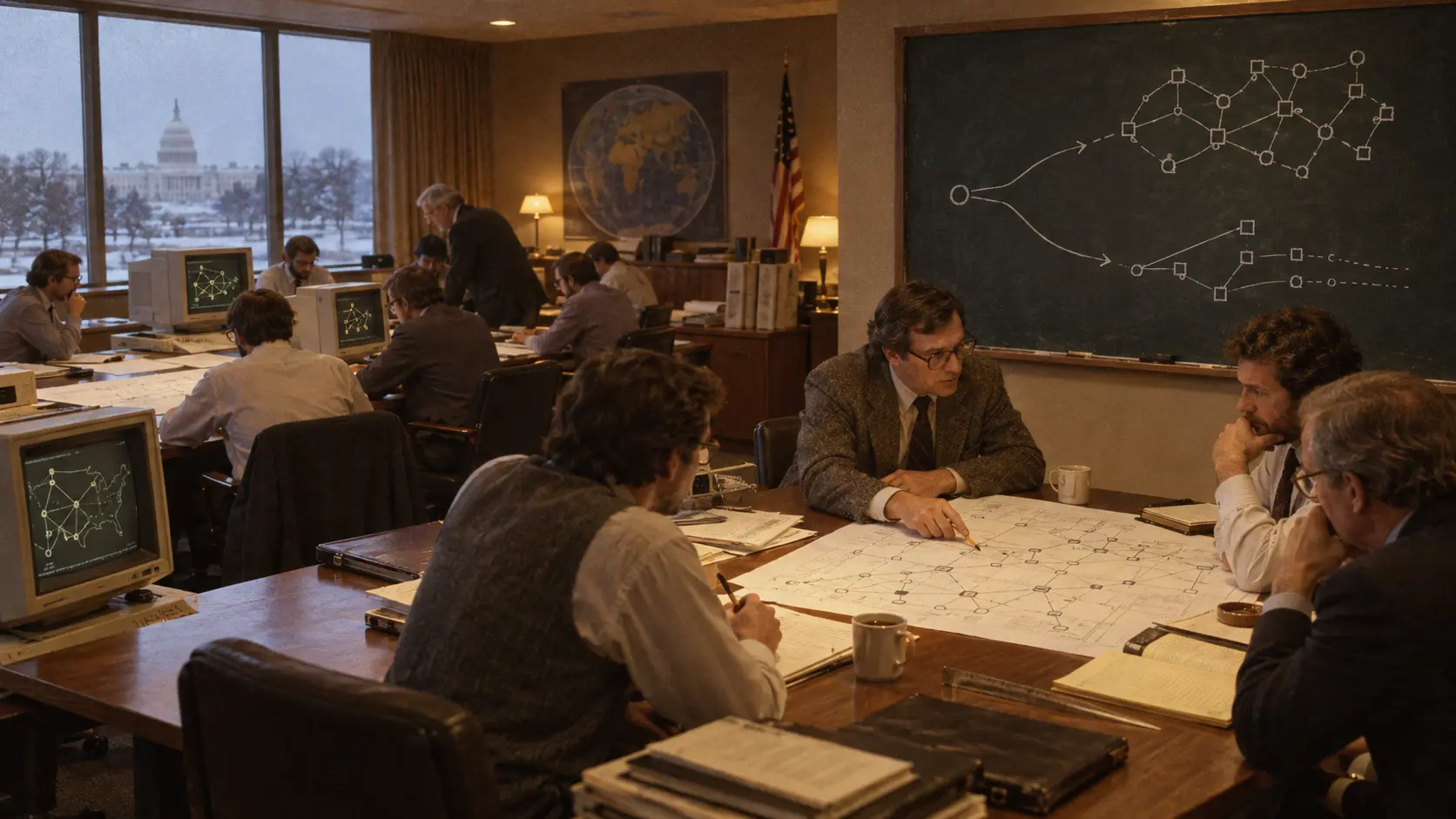
- The January 1986 gathering now known as IETF 1 was contemporaneously documented as the fourth meeting of DARPA’s Gateway Algorithms and Data Structures Task Force, or GADS.
- Its minutes describe an initial IETF session convened on the afternoon of 16 January as GADS was expected to give way to separate engineering and architecture groups.
The familiar label “the first IETF meeting” compresses two events into one. The official IETF history page lists a 1st IETF in San Diego on 16–17 January 1986, with 21 attendees. The contemporary proceedings, however, are titled for the fourth meeting of the DARPA Gateway Algorithms and Data Structures Task Force. Their introduction dates that two-day gathering to 16–17 January and says it was hosted by David Mills at M/A Com Government Systems. The minutes then place what they call the initial IETF meeting inside its first afternoon.
That distinction is not a correction to the IETF’s anniversary. It is a way to read the record at the scale at which it was made. The gathering had a morning of GADS business and status reports, an overlapping National Science Foundation gateway subcommittee meeting, and a separately chaired IETF session. “IETF 1” is a useful retrospective name for the start of a continuing series. It is not the title on the contemporary minutes, nor does it tell us that every hour or every attendee belonged to a single new organization.
The change of agenda was explicit. At the opening, the chair said recent events had substantially altered the meeting’s plan: GADS was nearing its end, and two successor task forces were being formed in its place. The minutes describe one group for longer-term architectural research and another for short-term engineering and operational problems. Their acronym expansions are inconsistent in the opening narrative; the proposed charter headings later in the same proceedings identify the Internet Architecture Task Force as INARC and the Internet Engineering Task Force as IETF.
For the distinction between them, those charter headings are the clearer part of the record.
The first IETF session was not a ceremonial launch. The minutes say Mike Corrigan chaired it while the GADS chair and several members attended the NSF gateway subcommittee. The opening discussion ranged over immediate operational concerns: subnets, routing in the host IP layer, the Exterior Gateway Protocol, and switching ISO datagrams. The minutes then list areas of concern: protocol development and stabilization, protocol conformance, support for implementers, Internet performance measurement, and ISO conversion. The next day’s technical presentations remained part of the broader GADS proceedings.
The proposed IETF charter explains what kind of engineering forum its organizers had in mind. Its mission was to identify and resolve engineering issues in near-term planning and operation of the Department of Defense Internet. It called for growth forecasts, problem identification, solution specifications, advice to contractors, and review of performance. The text expected operational agencies and users to shape much of the agenda. It also said the task force was not intended to discuss policy questions about administration or procurement.
Those are words in a proposed charter, not proof that every later IETF activity followed that boundary or that the charter became a complete constitution for Internet governance.
A separate proposed architecture charter assigned a different horizon. It focused on research, architecture, and engineering models that could support services being developed by other task forces. Its expected products included technical memoranda, planning material, advice, and coordination for network experiments. This division matters because later histories can make “the IETF” sound like a single group that immediately inherited every kind of Internet work.
The January record instead shows organizers trying to split near-term operational engineering from longer-range architectural research, while the new labels and responsibilities were still being written down.
The attendee count also changed across the institutional memory. The contemporary proceedings list 16 members in attendance and five additional attendees: 21 names in all. RFC 1718, a 1994 guide to the IETF, says the first meeting at Linkabit in San Diego had 15 attendees. The 2005 IETF plenary notes, the 2016 anniversary post, and the current past-meetings page use 21. No explanation in those records reconciles the figure of 15 with the proceedings’ two attendance categories.
The sound conclusion is that one contemporary roster records 21 people and one later account records 15—not that the missing six can be assigned a role, excluded from a session, or treated as evidence of a particular membership rule.
The place name is similarly unsettled in the sources reviewed here. RFC 1718 and the current IETF meeting page say Linkabit; the proceedings introduction says M/A Com Government Systems. This article does not assume that the names refer to an identical site, a corporate succession, or a different room. A historical account should preserve the discrepancy until a source establishes the relationship.
These distinctions give the founding episode its real significance. The record documents an operational engineering group emerging within an existing task-force meeting, with its short-term remit placed beside a separate architecture group. It records a proposed boundary around the work and named agency, user, and contractor roles. It does not show that 21 people represented everyone affected by Internet operations, that the initial meeting could bind absent networks, or that a two-day gathering created today’s global standards process in finished form.
That limit does not diminish what happened. It makes the historical claim more precise. IETF 1 was the first meeting in a series later recognized as the IETF’s own. Its surviving proceedings also show that its first session was nested in GADS’s fourth meeting, and that the engineering institution was being distinguished from architecture research while operational needs still set the frame. Both descriptions belong in the history. One names the series that endured; the other shows the organizational transition underway on its first day.
The record leaves practical questions open: whether later minutes settled the charter wording, how the new groups divided actual work, and why one 1994 count differs from the attendance list. Those gaps are not invitations to invent a tidy origin story. They are reasons to keep event labels, proposed authority, attendance, and subsequent institutional practice as separate claims.
The primary record is the January 1986 GADS proceedings. The later count and venue wording appear in RFC 1718; later IETF retrospectives are the 2005 plenary notes, the 30-year anniversary account, and the current past meetings list.
Member Briefing
Deeper Profile Context
Sign in with the right membership level to unlock the full briefing and source notes.
Only for Strategic Circle
Strategic Circle
Open to all readers. Unlock profile briefings after joining and signing in.
Join Strategic CircleOnly for Leadership Alliance
Leadership Alliance
For qualified IP-asset owners and management; sign in to unlock alliance briefings.
Join Leadership Alliance