Summary
- ICANN's Board authorised a new enterprise resource planning contract on 22 October 2026. The public resolution obscures the supplier, contract description and maximum value, though it says the FY27 budget already anticipated the expense.
- In 2023 the Board said it was renewing Oracle Cloud ERP at the seven-year mark and argued that switching systems would be costly and premature. The 2026 record does not identify the vendor, so continuity with Oracle remains unproved in the public document.
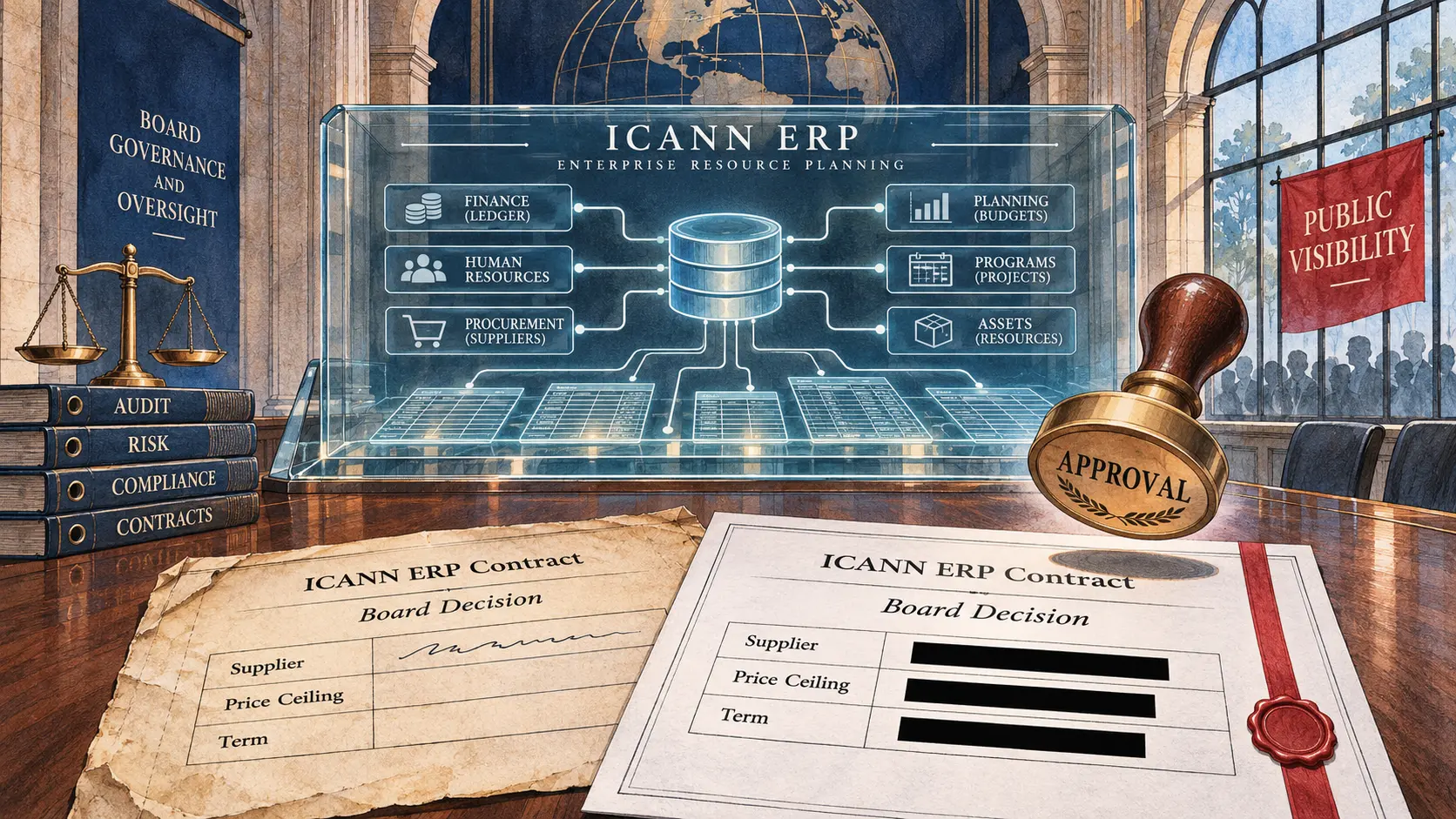
The people entrusted with ICANN's internal system of record can see the price. The people whose fees finance the institution cannot. In its 22 October Board resolution, the Board authorised the president and chief executive to enter into a new ERP contract and make the related payments. The supplier's name, the contract description and the value ceiling are replaced by negotiation redactions. The Board Finance Committee reviewed the financial implications and recommended approval. The public receives its conclusion, not the inputs needed to price it.
ERP is the machinery beneath an organisation's accounting, purchasing, staffing and reporting. ICANN describes its platform as an integrated single system of record that improves global reporting and internal controls. That makes the purchase more than an office-software licence. Changing the system can force the institution to rebuild workflows, data connections and controls. Keeping it can give the incumbent supplier leverage as those dependencies accumulate. The Board's 2026 rationale says the cost was anticipated in the FY27 Operating Plan and Budget. It does not publish the cap against which that assertion could be checked.
The previous October 2023 Board decision offers a useful baseline. ICANN then said its ERP was Oracle Cloud ERP, that it was seven years into the relationship, and that an ERP normally needed around ten years to yield optimal value. The Board said a new implementation would be costly and premature, and that licence numbers had been adjusted in negotiating the renewal. It still redacted the total price. Three years later the ten-year horizon has arrived, and the new resolution withholds even the supplier's identity. The old document establishes Oracle's 2023 role; it does not establish who won the 2026 contract.
ICANN's contracting and disbursement policy makes the formal control visible. One officer may approve up to US$150,000, two up to US$300,000, three up to US$750,000, and the Board approves obligations above US$750,000. It requires review of budget impact, risk, legal questions, procurement practice and internal controls; the chief financial officer reports significant spending to the Board Finance Committee. The October resolution is evidence that this internal approval route was used. It is not a public cost test when the amount and counterparty are hidden.
The redaction is said to protect negotiations until the chief executive determines release is possible. That gives management, rather than a dated public milestone, the release switch. A signed contract, published price range, vendor identity and comparison of renewal with migration would let members test whether the Board bought continuity at a fair price. Today the only defensible cost number in the public record is the policy's approval threshold, not the contract's cost.
Member Briefing
Deeper Profile Context
Sign in with the right membership level to unlock the full briefing and source notes.
Only for Strategic Circle
Strategic Circle
Open to all readers. Unlock profile briefings after joining and signing in.
Join Strategic CircleOnly for Leadership Alliance
Leadership Alliance
For qualified IP-asset owners and management; sign in to unlock alliance briefings.
Join Leadership Alliance