
Summary
A current registry view renders AS208183, AS208974, AS205154 and AS202539 with holder strings ending in the same Internetmanufaktur Karlsruhe legal-company name. Each record still has its own AS number, holder prefix and operational history. The shared legal suffix does not prove one network, one route policy, common ownership of every asset or a single service.
The useful public inquiry is therefore an evidence-control exercise. Legal records, number-resource ledgers, route observers, exchange directories and measurements answer different questions. Readers can obtain a detailed picture by preserving dates and attribution, while refusing to turn origins into property deeds, adjacencies into contracts, locations into facilities or a generated image into documentary evidence.
One company name does not answer every network question
Public infrastructure records often look more unified than the systems they describe. A repeated company name can appear beside several autonomous-system numbers, and a reader may naturally compress them into a single organization chart. That shortcut removes the distinctions needed to understand routing responsibility, resource records, interconnection metadata and the limits of public observation.
The reviewed register-derived material identifies a Karlsruhe legal entity in a 2022 record and describes its stated corporate purpose. That is useful company chronology. It does not retroactively date every route, prove that all technical activity began together or establish ownership of every prefix, cabinet, facility, cable or service associated with a similar name.
The current RIPEstat view reviewed on 12 August 2026 presents four announced autonomous-system records whose holder strings share the legal-company suffix. Their prefixes are ROOTUNDGUESTIG, OGELPRE, internetmanufaktur and Schuh. Those words are part of distinct holder labels, not decorative aliases that can be dropped when evidence is assigned.
This briefing keeps the four records separate from the first sentence to the final checklist. It asks what each source can establish, what remains observer-relative and what direct evidence a customer, peer or investigator would still need. The aim is neither promotion nor suspicion. It is a reliable method for reading a small multi-AS public record.
Freeze the four identities before interpreting them
AS208183 appears in the frozen current snapshot with the holder label ROOTUNDGUESTIG Internetmanufaktur Karlsruhe UG (haftungsbeschraenkt). The record was observed as announced on 12 August 2026. Any route, prefix or measurement discussed for AS208183 must stay attached to that exact number, holder string, source and observation date.
AS208974 appears separately with the holder label OGELPRE Internetmanufaktur Karlsruhe UG (haftungsbeschraenkt). The common legal suffix does not let an analyst transfer an AS208183 measurement to AS208974. It also does not show that their policies, external relationships, address resources, operational teams or service roles are identical.
AS205154 appears with the holder label internetmanufaktur Internetmanufaktur Karlsruhe UG (haftungsbeschraenkt). The repeated word may look awkward in prose, but editing it into a smoother brand narrative would change the evidence. A careful article preserves the registry surface and then explains what the record does and does not mean.
AS202539 appears with the holder label Schuh Internetmanufaktur Karlsruhe UG (haftungsbeschraenkt). It remains its own autonomous-system record. Evidence about its announcement, route history, prefixes or security metadata cannot be filled from one of the other three merely because the current holder strings share a company suffix.
Treat legal identity as chronology, not topology
A legal-company record can identify a registered person, registration timing and stated purpose within the authority of that record. It can help a reader distinguish a current legal label from an informal brand. It cannot describe BGP configuration, physical path layout, live equipment, customer assignments or the engineering choices behind an autonomous system.
Chronology matters because public sources update at different times. The reviewed 2022 company record belongs to one historical point. The four-AS snapshot belongs to 12 August 2026. A route observer may capture another point, while an exchange page or measurement may refresh on its own schedule. One date cannot silently govern all layers.
The correct construction is modest: register-derived records identify the legal entity and stated corporate purpose at the date represented by those records. Current registry and routing surfaces can then be described with their own dates. If a reader needs a continuous history between them, additional dated documents and route archives are required.
This prevents two opposite mistakes. A current technical observation should not be projected backward into the company's formation story. An older legal record should not be used to certify today's topology or service. Keeping chronology explicit makes change visible and leaves space for a later record to update the analysis without rewriting history.
A registry holder string is a ledger entry
Number-resource registries make identifiers, contacts and recorded relationships legible. That function is operationally important. Accurate records reduce ambiguity during routing changes, abuse handling, transfers and incident response. Their value comes from maintaining a dependable ledger, not from providing sovereign proof of every adjacent commercial or physical fact.
The shared legal-company suffix in the four holder strings supports a narrow statement about how the current registry view renders them. It does not prove that the company owns every address originated by the four ASNs. It does not identify every customer, supplier, facility, router, fibre path or contract visible around those numbers.
Registration, route origin and property are different propositions. A registry can record a holder or administrative relationship. BGP can propagate reachability from an origin. A contract can authorize service or resource use. Title to equipment or facilities requires its own evidence. A sentence that moves between these layers needs a source for every step.
This boundary is not an argument against registries. It is a reason to use them precisely. A ledger entry can be compared with running observations and direct documents. Agreement increases coherence; disagreement identifies a question. Neither result allows an analyst to invent the legal or operational explanation that the public record does not contain.
An autonomous-system number is not a brand container
An autonomous-system number is a coordination identifier used in interdomain routing. It gives networks a stable reference for routing policy, origin observations, security objects and troubleshooting. It is not a brand licence, a company valuation, a certificate of service quality or a deed to every resource that appears near it.
The four numbers therefore deserve four evidence rows. Each row should include its exact holder label, dated registry state, observed originated prefixes, relevant route objects, RPKI material, public adjacencies and unresolved questions. Combining the rows too early destroys the ability to see which fact belongs to which control surface.
The rows may later reveal shared administration or coordinated operations. That conclusion still requires evidence suited to the claim. A common contact, suffix or website can be a lead, but it does not establish identical configuration, one change process, shared failure domains or a uniform response to incidents across all four ASNs.
Separation also improves practical communication. A peer can name the exact ASN whose policy needs clarification. A resource holder can identify the exact prefix and authorization. A customer can ask which ASN carries a contracted service. An incident team can avoid sending a route question to a contact whose record belongs to another surface.
Running code is strong evidence with a narrow scope
Route observers can show what their collectors saw from defined vantage points. That evidence is closer to operating behavior than a static description, and it can reveal a state that a directory does not capture. It is still an observation, not a complete view of configuration, intent, authority or every path available to every user.
The frozen source set presents the four ASNs as separately observed announced records. That supports treating them as active routing surfaces in the stated observation window. It does not prove perpetual activity, uninterrupted reachability, a shared backbone or common route policy. A future observation may differ because routing is mutable.
Running-code primacy means that actual behavior must be investigated when it conflicts with paperwork. It does not mean behavior supplies its own legal explanation. A visible route cannot tell a reader whether the address space is directly held, used for a customer, temporarily migrated or operated under another documented arrangement.
The strongest account records the observation exactly and asks an accountable operator to reconcile it with intended state. That approach respects both technical reality and the limits of outside visibility. It avoids permission theatre while also avoiding the equally weak claim that a route collector can answer ownership, contract and cause by itself.
Keep route evidence attached to its exact ASN
Cross-AS substitution is the central technical risk in this case. A route or prefix visible for AS208183 cannot establish the state of AS208974, AS205154 or AS202539. Even if the records share a legal-company suffix, BGP treats the numbers as distinct policy identifiers and public observers report them separately.
Every material route statement should therefore name the exact ASN, observer and capture date. If a prefix is discussed, the statement should name the prefix and observed origin. If an adjacency is discussed, it should identify the source that displayed it. Broad phrases such as the company's routes hide the attribution needed for verification.
A responsible comparison can still look across the four rows. It may ask whether registered contacts are consistent, whether security objects cover expected origins or whether public policy descriptions appear coherent. The comparison must preserve missing data. Evidence present for one row is not evidence present for all four.
This discipline makes later updates cheaper. A changed origin or new authorization can be inserted into the affected row without rewriting a supposed unified network story. Reviewers can distinguish genuine change from a source refresh. Operators can answer a precise discrepancy instead of defending a vague claim about an entire company network.
Origin is not ownership, authority or service
A BGP origin observation says that a route was propagated with a particular autonomous system at the origin of the visible AS path. That is an important operational fact. It does not, by itself, prove title to the address space, authority under every applicable agreement or responsibility for every service reachable within the prefix.
Networks may originate directly held resources, customer resources, leased space or addresses used under other documented arrangements. More-specific routes may appear for engineering, security or migration reasons. Public observation alone cannot select among those explanations. Registry records, route authorizations and direct contractual evidence must be reconciled for a control conclusion.
The language should reflect this boundary. Use observed origin rather than owned prefix unless ownership is directly established. Use address space visible through the observer rather than customer network unless customer status is sourced. Use routing association rather than service provision unless an accountable first-party or contract identifies the service.
For diligence, build a resource-control table. Record prefix, registry holder, observed origin, relevant authorization object, observation date and evidence owner. Flag differences without accusing. Then obtain a current explanation from the party responsible for route policy. The table turns public routing data into a question set instead of a property claim.
Route policy cannot be inferred from a common holder
Route policy includes decisions about what is originated, accepted, preferred, filtered and exported. The existence of four ASNs under holder strings sharing a legal-company suffix does not show that those decisions are uniform. Separate numbers may serve different roles, histories, environments or relationships even when administration overlaps.
Public route visibility can reveal effects of policy at a moment, but not the complete policy itself. Private sessions, filters and backup paths may be outside a collector's view. A visible preference may arise from remote policy rather than the origin operator's intent. A missing path may be filtered or simply unobserved.
Writers should therefore avoid phrases such as one routing strategy or the company's unified policy. A defensible sentence names the exact ASN and describes a dated observation. If the organization publishes policy objects or an interconnection statement, those materials can be attributed, but their declared intent still needs comparison with current behavior.
An engineering review should ask for a per-AS policy summary, critical prefix list, expected origins, filtering controls, RPKI maintenance owner and change process. It should identify which controls are shared and which remain separate. Only direct evidence can establish the relationship among the four policies; the holder suffix cannot do that work.
RPKI answers one validation question at a time
RPKI route-origin validation evaluates whether an observed prefix and origin combination is covered by a published route-origin authorization within a validation state. It is valuable security metadata. It does not prove legal ownership, path integrity, availability, correct service configuration or protection against every routing incident.
The exact ASN matters again. An authorization for AS208183 cannot be treated as authorization for AS208974, AS205154 or AS202539. Prefix length and maximum length matter. Validation data and route state can change independently. Any article statement must bind the object, prefix, origin and observation date it actually reviewed.
A valid result supports only the covered origin proposition. It does not certify all routes belonging to a holder string. An invalid or not-found result also needs investigation rather than instant attribution of fault. A stale object, planned migration, observer timing or configuration error can produce a discrepancy without revealing motive.
The practical control is a per-prefix authorization inventory with an accountable maintainer. Monitor expected origins, object expiry or change and unexpected validation states. Preserve alerts and repair records. Public indicators help test the inventory, but the operating process supplies the continuity and accountability that a coloured status badge cannot demonstrate.
Exchange metadata is a coordination surface
The frozen sources include a public view associated with KA-NIX. Exchange metadata can help identify where participants intend to coordinate and which interfaces or autonomous systems may be relevant. That makes it useful for contacting operators and planning a direct technical inquiry. It is not a contract or physical audit.
An exchange listing does not prove that a session is currently established, carries traffic or accepts every request. It does not disclose settlement terms, capacity, congestion, support obligations or failover behavior. A listed interface may change, and a public page may be updated on a schedule different from live configuration.
The listing also does not prove facility ownership. Participation can involve colocated equipment, remote transport, a reseller or another arrangement. The presence of an ASN at an exchange surface does not show who owns the building, rack, fibre, router or cross-connect. Those are separate physical and contractual facts.
Use exchange metadata as a reconciliation aid. Confirm the exact ASN, current contact, intended policy, interface details and technical acceptance requirements directly. If resilience matters, obtain a physical dependency map and test failover. Multiple public interfaces are not evidence of independent paths until shared-risk groups have been examined.
Adjacency labels are not commercial relationships
Routing observers often display neighbouring autonomous systems and may classify them with terms such as upstream, downstream or peer. These labels describe an observer's view or inference from visible paths. They do not establish signed provider, customer, settlement-free or paid-transit terms between the named organizations.
That distinction becomes critical when assessing concentration. Several visible neighbours do not prove several independent suppliers. Paths may share a facility, conduit, metro transport provider, management plane or contractual dependency. Conversely, private relationships may not be visible to the observer at all.
Commercial claims require a contract or authoritative statement from the parties. Physical-diversity claims require evidence about routes and shared risks. Current reachability requires measurements in the relevant window. A public adjacency can start all three inquiries, but it cannot complete any of them by being repeated in confident prose.
For each critical relationship, a reviewer should record the observed adjacency, source, time and intended operational role. Then request confirmation of the commercial and technical arrangement from an accountable owner. During an incident, compare expected and observed paths without treating the public label as the contract that governs escalation.
Registered address, exchange and router location are distinct
A registered company address identifies a legal or administrative location within the authority of the record. An exchange location describes an interconnection surface. An inferred router geography describes what a measurement or database associates with an observed hop. These locations answer different questions and must not be collapsed into a facility claim.
None of them, alone, proves where all equipment is installed. A company can register at one address and operate services elsewhere. Exchange access can be remote. Router geolocation can be approximate, stale or based on registration rather than physical observation. A facility name does not establish building or rack ownership.
The frozen IPinfo surface for AS208183 and 45.152.228.0/24 is therefore a bounded observation source, not a fleet map. Its result cannot be transferred to the other three ASNs. It cannot establish the location of every address, average latency, customer coverage, uptime or the physical path of a service.
A decision that depends on geography needs stronger evidence. Define the relevant service endpoint, collect measurements from representative customer locations, obtain facility and transport documentation and identify shared risks. Preserve timestamps and methodology. The result can then support the scoped decision without turning a convenient database label into documentary proof.
One measurement is a sample, not a network portrait
Traceroute-like and IP intelligence surfaces can expose a path, protocol response, latency sample or location estimate from a particular observer to a particular target. The result may be diagnostically useful. Its meaning depends on vantage, time, target, protocol, filtering and the route selected for that test.
One sample cannot establish fleet-wide topology or performance. It cannot show every path used by AS208183, much less by AS208974, AS205154 and AS202539. It does not measure customer experience across regions, service tiers or time. A successful response is not an uptime history, and silence is not proof of an outage.
Measurement claims should carry their scope in the sentence. Name the observer, target and date. Distinguish displayed geolocation from verified facility evidence. Do not average unrelated samples or present a visually appealing path as the operator's designed topology. Public tools report observations, not complete architecture diagrams.
The repair is a decision-specific measurement plan. Define endpoints, intervals, protocols, thresholds and excluded conditions. Retain raw output and configuration. Repeat from representative vantage points. Ask the operator to explain material differences. Broader conclusions become possible only when the sampling design and evidence justify the broader scope.
Hosting language needs direct attribution
The directory candidate and registry materials create a hosting and network-identity topic, but they do not independently prove every commercial capability a reader might associate with that topic. Statements about products, capacity, managed operations, support or customer outcomes require a source with authority over those exact claims.
First-party material can be authoritative for how a provider describes an offer, contact process or contractual responsibility. It should be labelled as a company statement. That attribution does not make it false; it prevents the statement from being mistaken for an independent performance measurement or an ownership record.
A customer can translate descriptions into evidence requests. Ask which legal entity contracts, which ASN or prefix supports the service, who maintains routing and RPKI, what facilities and dependencies are in scope, how incidents are escalated and what tests establish recovery. The answer should preserve the four-AS identity split.
This approach is more useful than repeating promotional language or rejecting it wholesale. Public descriptions frame the questions. Direct architecture records, test results and agreements establish whether the service meets the buyer's dependency. Where the frozen sources do not answer, the article should say unresolved rather than filling the gap with industry assumptions.
Continuity must be demonstrated at several layers
Operational continuity is not a synonym for route visibility. A visible route can coexist with an unavailable application, broken support process or failed dependency. Conversely, a route change may be part of planned recovery. Continuity needs evidence about the service, control plane, physical dependencies and accountable response process.
The four autonomous-system records may offer separate operating surfaces, but their number alone does not prove redundancy. They could share facilities, transport, upstreams, management systems, staff or change processes. They could also serve unrelated roles. The current holder strings do not reveal those dependencies.
A continuity review should map logical, physical, organizational and contractual layers. For each critical service, identify expected prefixes and origins, path dependencies, facilities, power domains, monitoring, escalation contacts, recovery objectives and test records. Mark which evidence is direct, company-attributed or publicly observed.
Failure exercises supply the missing behavioral evidence. Test a route change, unavailable upstream, stale authorization, failed facility dependency or unreachable contact in a controlled environment. Measure detection, decision and recovery. One successful exercise remains scoped to its scenario, but a repeatable program supports a stronger continuity conclusion than a static footprint.
Public scale signals do not reveal service quality
ASN count, visible prefixes, exchange listings, neighbours and route volume are not customer counts. They do not establish utilization, revenue, market share, support quality or technical leadership. A four-AS footprint may reflect history, segmentation or operating choices whose purpose is not stated in the reviewed public record.
The same caution applies to risk. A small visible footprint is not evidence of fragility, and a large one is not evidence of resilience. Reliability depends on architecture, process, maintenance and recovery evidence. Public metadata can identify where to ask, but it is a poor substitute for acceptance testing and incident history.
Writers should avoid superlatives and implied rankings. The frozen sources support a case study in identity and routing controls, not a league table. They do not support claims about fastest service, extensive coverage, market position or exceptional scale. Removing those claims makes the technical analysis more credible.
Readers making a purchase decision should request evidence matched to their workload. Define availability and recovery needs, measure representative paths, inspect dependencies and test escalation. Public records can verify identifiers and reveal discrepancies. They cannot predict the customer's outcome without evidence from the service being evaluated.
The generated image has zero factual weight
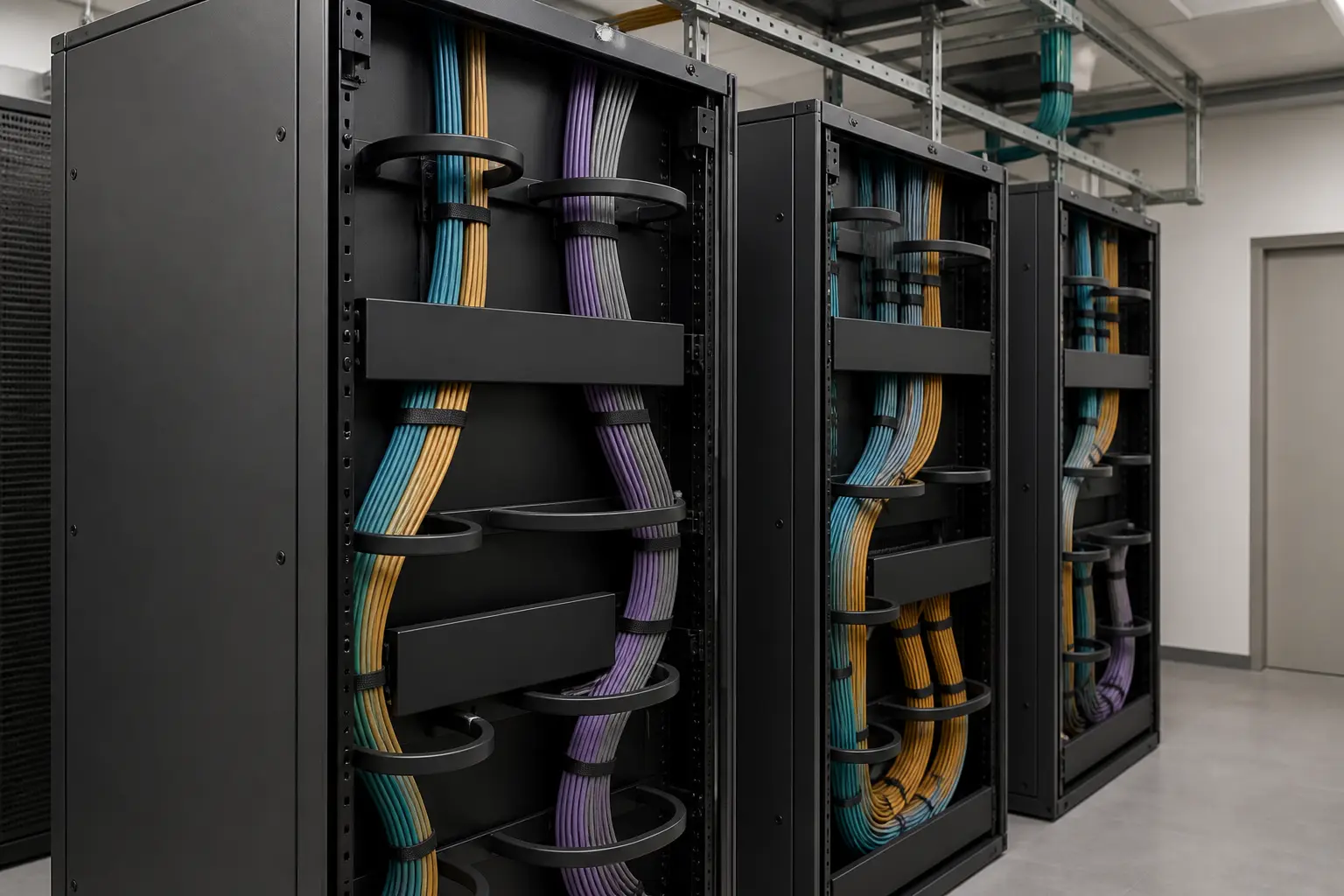
The accompanying image is generated realistic editorial context showing generic unmarked cabinet backs and organized fibre cabling. It does not depict Internetmanufaktur Karlsruhe, ROOTUNDGUESTIG, OGELPRE, any of the four ASNs, a real facility, staff member, device, topology, customer network, route, service state, incident or event.
The image carries no factual evidence about the company. No rack, cable colour, metal surface, room layout or apparent equipment arrangement supports a statement about the candidate. The image may help a reader recognize the general subject of physical network operations, but it is not documentary access and cannot resolve any uncertainty in the sources.
The exact image bytes passed a distinct review for realism, geometry and absence of logos, labels, readable text and pseudo-text. That review makes the visual suitable as generic context. It does not convert the scene into evidence, identify a company asset or prove that the operator uses the pictured cable-management method.
Public presentation should disclose that the image is generated and generic. Alt text should describe the visual rather than attribute it. A caption must not say inside an Internetmanufaktur facility or imply that a named ASN uses the hardware. The analysis remains grounded exclusively in the frozen public source set.
Registry accuracy supports coordination, not sovereignty
Reliable number-resource records matter because operators need unique identifiers, accurate contacts, transfer history and security metadata. When those records align with running systems, investigations move faster and route changes are easier to evaluate. When they diverge, the discrepancy can identify stale data or an operational question requiring an owner.
This function is practical rather than ceremonial. A registry entry does not grant permission to make claims beyond its scope. It does not override observed behavior, and observed behavior does not erase legal accountability. Each layer contributes a proposition that must be reconciled with the others.
For the four Internetmanufaktur holder strings, the ledger helps distinguish AS208183, AS208974, AS205154 and AS202539. It preserves their labels and gives analysts stable keys. It does not explain why four numbers exist, whether they share policy or which assets, customers and services sit behind each one.
The reality-layer method therefore values both records and running code without turning either into advocacy. Keep the ledger accurate. Test current behavior. Ask accountable people to explain mismatches. Preserve uncertainty where evidence is missing. That is stronger than treating formal registration or technical observation as an all-purpose source of legitimacy.
Build a four-row evidence ledger
The first practical deliverable is a ledger with one row per ASN. Record the exact number and holder label, source URL, capture time and proposition. Add columns for observed prefixes, origin state, RPKI material, public adjacencies, exchange metadata, direct operator confirmation and unresolved questions.
Do not populate empty cells from another row. If AS208183 has a public measurement and AS208974 does not, preserve the absence. If an authorization is visible for one prefix, do not generalize it to the holder's other resources. Missing evidence is a property of the current review, not a defect to be repaired with analogy.
Add a separate legal-entity row rather than turning the company record into a fifth network. That row can contain register chronology and stated purpose. Link it to the four holder strings only for the shared suffix actually observed. Leave asset ownership, route-policy unity and corporate-operational explanations as unresolved unless direct evidence supports them.
The ledger should have an owner and refresh date. Routing and security metadata change more quickly than legal records, while contacts and public directories can also become stale. A defined refresh policy helps readers distinguish a historical snapshot from a present operational decision and prevents old captures from becoming timeless claims.
Separate logical, physical and contractual maps
A logical map can represent ASNs, prefixes, origins, policies and observed adjacencies. A physical map can represent facilities, conduits, power domains, transport paths and equipment placement. A contractual map can represent counterparties, suppliers, customers, support duties and remedies. Each map answers a different class of question.
The four-AS snapshot belongs first on the logical evidence map. The legal-company record belongs on the identity ledger. KA-NIX metadata can identify a coordination surface but does not automatically place owned equipment on a physical map. A public adjacency does not automatically place a provider or peer on the contractual map.
Mappings between layers require evidence. A direct facility document can connect a service to a location. A contract can identify a supplier. A route-policy statement can connect an ASN to intended origins. An asset inventory can identify equipment ownership. Without those bridges, drawing one combined diagram creates certainty that the sources do not provide.
Review the maps together for hidden dependencies. Four logical control surfaces may share one physical risk. Several facilities may share one management plane. Multiple suppliers may depend on one exchange or conduit. A strong contract may lack observable monitoring. The purpose of separation is to test interfaces, not to keep teams in silos.
Design acceptance tests around the decision
A buyer should begin with the service dependency, not the most impressive public page. Identify which endpoint, application, prefix and support process matter. Define availability, latency, recovery, security and escalation requirements in measurable terms. Then select evidence that can answer those requirements.
Every test needs a vantage, target, interval, protocol and threshold. Preserve configuration and raw results. A route test should name the exact ASN and prefix. An RPKI check should name the authorization state and time. A failover exercise should define the failed dependency and expected recovery behavior.
Tests should include failure, not only nominal reachability. Exercise an upstream loss, withdrawn route, stale authorization, unavailable endpoint or unreachable contact in a controlled environment. Observe detection, escalation and restoration. Record which team owns each decision and which system supplies the evidence.
Results remain scoped. A successful test from one client proves that case, not all customers or future conditions. Representative sampling and repetition can support broader confidence when the method justifies it. Public observations can help design the plan, but they do not replace tests of the system the buyer will actually depend on.
Preserve uncertainty as actionable work
The public record leaves important questions unanswered. It does not explain why the four ASNs have their distinct holder prefixes, whether their route policies are coordinated, which prefixes are directly held or which physical and commercial dependencies sit behind the visible routing state.
These gaps should not become insinuations. Record each uncertainty, its decision impact, the evidence needed, an accountable owner and a review date. A low-consequence evaluation may accept some gaps. A critical deployment may require them resolved before acceptance. The response should follow risk rather than rhetoric.
Closure requires evidence that answers the question. A common company suffix does not resolve route-policy unity. A route screenshot does not resolve prefix ownership. An exchange listing does not resolve physical diversity. A generated image does not resolve facility layout. Collecting more material is not progress if it belongs to the wrong authority layer.
Preserve superseded captures when records change. A dated sequence can reveal an expected migration, stale metadata or a discrepancy requiring explanation. Historical comparison should describe the observed change, not invent a cause. The operator or documentary record must supply the explanation when the public evidence cannot.
Incident response should preserve all four identities
During a routing incident, vague references to the company network can delay diagnosis. The initial record should name the affected prefix, exact origin ASN, observation time, user impact and measurement vantage. If more than one of the four ASNs is involved, create separate timelines before looking for a common dependency.
Check whether registry and operational contacts are current for the affected surface. Compare intended and observed origins. Review relevant RPKI objects and policy changes. Examine exchange and adjacency observations within their limits. Preserve raw outputs so later analysis can distinguish the incident from observer or timing effects.
Escalation should identify the legal and operational counterparty without assuming they are interchangeable. A registry contact may help with resource coordination. A service contract may identify support duties. A network operator may explain configuration. Sending every question to a generic company identity can obscure ownership of the response.
After recovery, update each affected layer. Correct registry data if the ledger was stale. Correct route policy or configuration if running behavior was wrong. Update exchange metadata if coordination details changed. Clarify contracts if accountability failed. Verify the corrected state rather than closing the incident when traffic first returns.
What the frozen public sources establish
The reviewed source set supports a legal-company chronology tied to register-derived records. It supports a current registry rendering in which four distinct ASNs carry four distinct holder prefixes ending in the same company name. It supports treating those numbers as separately observed announced routing surfaces on 12 August 2026.
The set also supplies public route, exchange and measurement surfaces for bounded analysis. These sources can help identify visible origins, coordination metadata and a specific AS208183 measurement context. Their claims remain tied to source, vantage and date. They are not complete inventories of private configuration or contractual relationships.
The evidence supports the Heng.lu reality-layer framing used here: registries act as ledgers, running observations test current behavior and number resources require accuracy, unique identification, security metadata and operational continuity. No layer becomes sovereign proof, and the copy does not advocate for a company or governance position.
Finally, the public sources and the disclosed generated image support a generic editorial presentation with a strict truth boundary. The picture has zero factual weight. The article can explain how readers should audit a multi-AS identity surface, but it cannot claim internal access, ownership, performance, customer outcomes or an incident not established by the sources.
What remains unresolved
The reason for maintaining four ASNs remains unresolved in the reviewed material. Their internal division of roles, operational teams, change controls and route-policy relationships are not established. The common legal suffix is evidence of a registry naming relationship, not an explanation of engineering design.
Prefix ownership, authorization and service scope must be evaluated prefix by prefix. An observed origin does not answer all three questions. The source set does not establish that every visible prefix is owned by the legal entity, used for its own service or covered by one commercial model.
Physical topology and resilience also remain unresolved. Public exchange, facility, adjacency and location metadata cannot establish owned assets, path diversity, shared-risk groups, capacity or recovery behavior. Direct architecture material and tests are required for any service decision that depends on those properties.
The frozen metadata does not establish customer scale, utilization, quality or incident history. No conclusion should be inferred from ASN count or visible footprint. A buyer or peer can use the public record to prepare precise questions, but current direct evidence must answer the operational decision.
A final accountability checklist
First, name the exact object. Is the statement about Internetmanufaktur Karlsruhe as a legal entity, AS208183, AS208974, AS205154 or AS202539? Preserve ROOTUNDGUESTIG, OGELPRE, internetmanufaktur and Schuh where the holder labels matter. Never let a generic company reference erase the subject.
Second, name the authority and date. Is the evidence a register-derived record, registry view, route observer, exchange directory, measurement or direct document? What proposition can that source establish? What changed after the capture window? Present-tense claims need present-tense evidence.
Third, test every inference bridge. Origin is not ownership. Adjacency is not a contract. Exchange presence is not facility ownership. Multiple ASNs are not proven redundancy. A common holder is not a unified route policy. A measurement is not fleet-wide performance. A generated image is not documentary evidence.
Fourth, assign the unresolved question. Identify who can supply the legal, routing, physical, contractual or measurement evidence. Set a review date and preserve the result. Good infrastructure diligence does not eliminate uncertainty with confident language; it converts uncertainty into bounded, accountable work.
Member Briefing
Deeper Profile Context
Sign in with the right membership level to unlock the full briefing and source notes.
Only for Strategic Circle
Strategic Circle
Open to all readers. Unlock profile briefings after joining and signing in.
Join Strategic CircleOnly for Leadership Alliance
Leadership Alliance
For qualified IP-asset owners and management; sign in to unlock alliance briefings.
Join Leadership Alliance