Summary
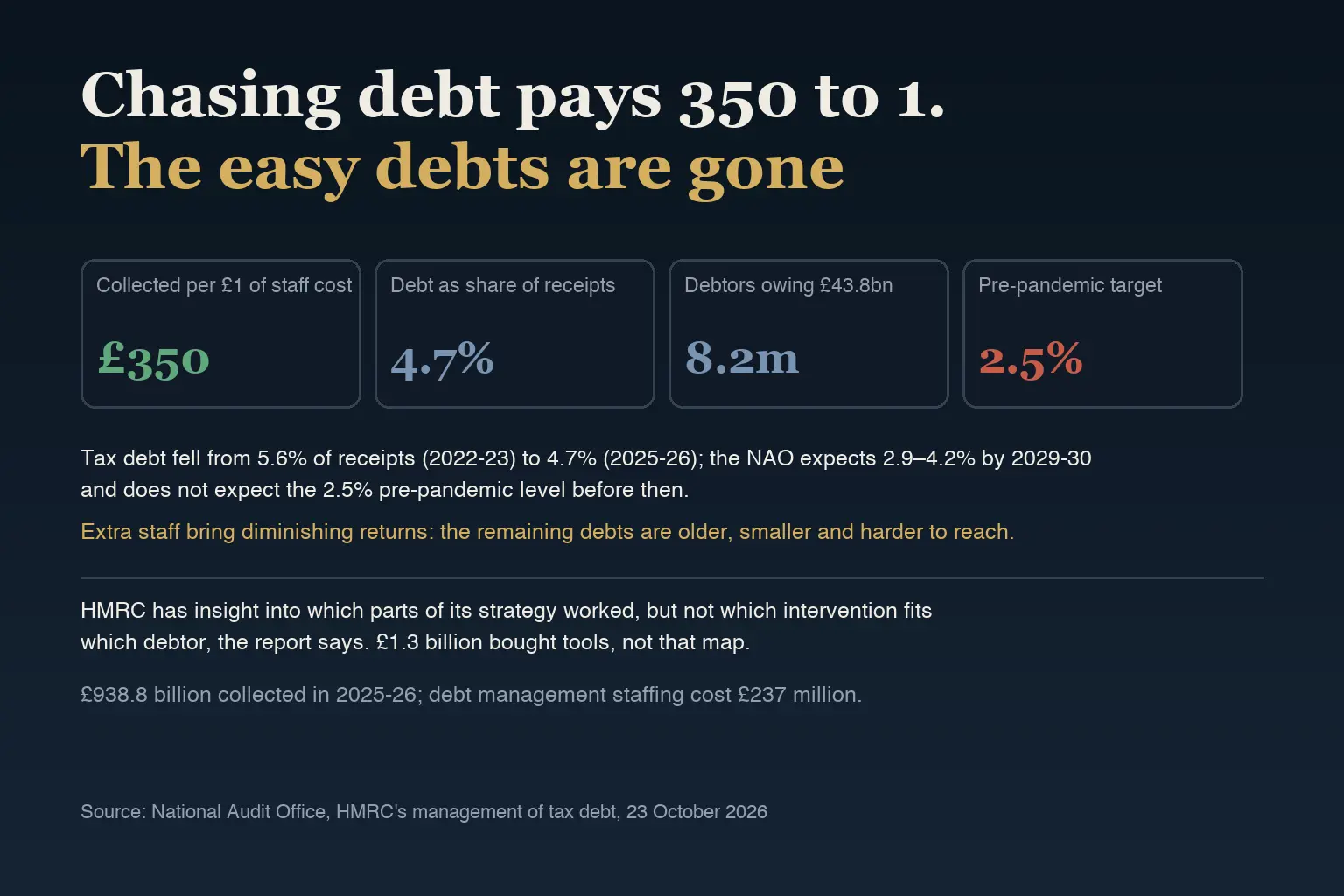
- The NAO's 23 October report finds HMRC reduced tax debt from 5.6 per cent of tax receipts in 2022–23 to 4.7 per cent in 2025–26, with 8.2 million taxpayers owing £43.8 billion at the end of 2025–26 against £938.8 billion collected.
- HMRC's debt management directorate employed about 5,600 full-time equivalent staff in 2025–26 at a staffing cost of £237 million, and collected £350 of debt for every £1 of staff cost.
- A 20 per cent staff increase between 2023–24 and 2025–26 was key to the improvement, and the measures introduced since 2021 have delivered an estimated £10.7 billion in additional revenue, but extra staff now bring diminishing returns on older, lower-value and harder-to-reach debts.
- The department expects tax debt to be between 2.9 and 4.2 per cent of receipts by 2029–30 and does not expect to reach the 2.5 per cent pre-pandemic target until after that date, and the NAO says it needs a better understanding of which interventions work in which circumstances.
The best ratio in the report is also the trap
Start with the number HMRC should be proud of. It collected £350 of debt for every £1 spent on debt-management staff in 2025–26. Staff numbers rose about 20 per cent between 2023–24 and 2025–26, the balance fell from 5.6 to 4.7 per cent of receipts, and the measures introduced since 2021 have brought in an estimated £10.7 billion of additional revenue. For a department chasing 8.2 million debtors owing £43.8 billion, that is a functioning operation.
Now the caveat that decides the next five years. The NAO says additional staff have brought diminishing returns, because they are dealing with lower-value and harder-to-reach debts. The easy cases — the taxpayer who pays when reminded, the business that responds to a letter — are precisely the ones the earlier investment already cleared. What remains is a population that ignores letters, moves, dissolves, or cannot pay in full.
That is why the ratio is a trap. A £350 return per £1 of staff cost invites the conclusion that more staff would produce proportionally more money. The audit's evidence says otherwise, and the department's own plan to reach 2.9 to 4.2 per cent by 2029–30 depends on productivity rather than headcount.
Prevention is the only route to 2.5 per cent
The target set by the then Exchequer Secretary in July 2025 was for debt to return to pre-pandemic levels, understood as 2.5 per cent of receipts, with no deadline attached. HMRC now expects to reach 2.9 to 4.2 per cent by 2029–30 and the 2.5 per cent figure only after that.
The gap matters because of what fills it. Chasing debt is a cost centre with diminishing returns; preventing debt is a design choice about how tax is paid. HMRC has proposed policy changes in what the NAO calls sensible areas, focused on preventing new debt and dealing with non-engaged debtors, and has consulted on direct debits to eliminate payment errors. Those changes attack the flow rather than the stock, which is the only way the balance falls sustainably.
£1.3 billion bought tools, not a theory of the debtor
Since the 2021 report HMRC has been given £1.3 billion to spend between 2021–22 and 2030–31 on more collection staff, private debt collection agencies, credit reference agency data to segment debtors, and a new case management system. The credit data use is the interesting part: it lets the department predict ability and propensity to pay, and target accordingly.
The NAO's judgement is that HMRC has some insight into which parts of its strategy had most impact, but needs a better understanding of which interventions are best in different circumstances. That is a mild sentence describing a real gap. Without that map, the department can scale what it has, but not reallocate it: every debtor gets a version of the same ladder, and the staff time that should go to the intractable goes everywhere.
Productivity, self-service, and the queue behind the queue
The audit points to three levers: a new case management system, self-serve payment plans that reduce demand on staff, and better targeting. Self-service is the most interesting, because it moves the cheapest cases out of the queue entirely — a taxpayer who can set up a plan online does not need an officer, and the officer's hour is then available for the debtor who will never use a portal.
The counter-argument is that the hardest debtors are also the least likely to self-serve. That is precisely why the segmentation data and the case management system have to be judged together: the portal reduces volume, the data decides who is left, and only both together raise output per hour.
What would change the judgement
Three things, all publishable. A segmentation map with outcomes: for each debtor segment, which intervention, what result, at what cost per pound collected. A published productivity series alongside the headcount series, so the next increase in staffing is justified by output rather than by volume of work. And a prevention ledger: how much new debt each policy change from the 2025 strategy prevented, measured against a control group.
The £350 figure will fall as the easy debts are exhausted. Whether that is a failure depends entirely on whether the department can say which pound bought the collection. HMRC has proved it can chase; the next phase is proving it knows whom to chase, with what, and when to stop.
Sources
Member Briefing
Read the full trend briefing
Members read the full briefing with the source notes behind every finding.
Strategic Circle
A daily briefing in your language, built from changes we have verified.
Join for USD 20/monthCancel anytime.
Members also get the full research library, a daily briefing on the networks they follow and the private forum.