Summary
- The Auditor General of Canada's report, tabled on 29 October 2026, examines Shared Services Canada's contracts for federal call centre technology, and finds procurement and administration that were not managed with due regard for economy, efficiency and effectiveness.
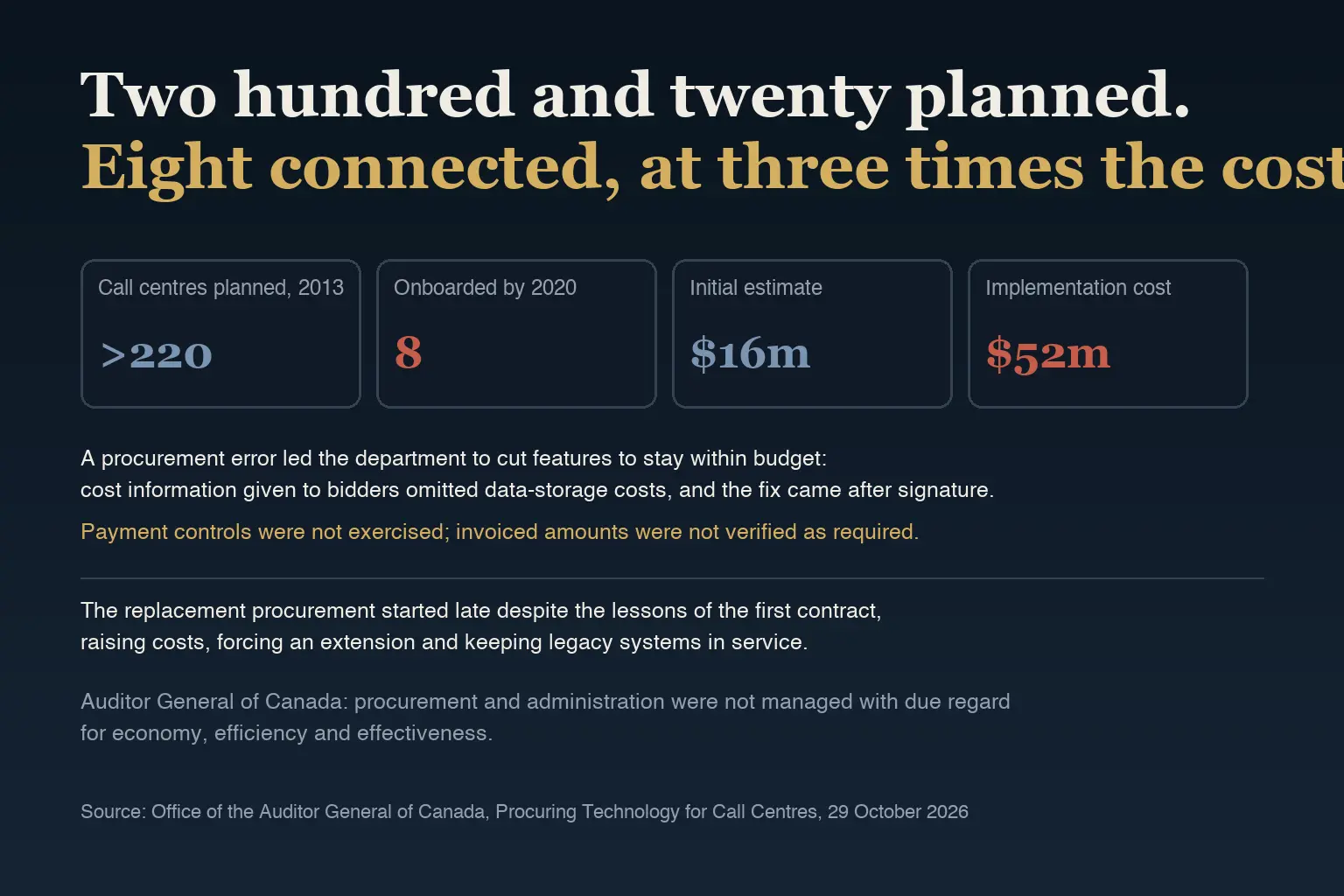
- In 2013 the department planned to modernise more than 220 federal call centres and awarded the Hosted Contact Centre Service contract in 2015. By 2020 it had onboarded eight call centres, and implementation costs had reached $52 million against an initial estimate of $16 million.
- A procurement error led the department to reduce some features and tools to remain within budget, so it did not obtain best value for money, and payment controls were not exercised as required: invoiced amounts were not verified.
- The procurement of replacements started late despite the lessons of the first contract, increasing costs and forcing an extension and continued dependence on legacy systems.
Two hundred and twenty in, eight out
The plan in 2013 was to modernise more than 220 federal call centres. The contract was awarded in 2015. By 2020, eight call centres had been onboarded.
That ratio is the report in one line, and the cost line makes it worse: implementation reached $52 million against an initial estimate of $16 million, three times the number the business case was built on. A project that delivers four per cent of its scope at three times the unit cost is not a project with a schedule problem. It is a project whose original plan was never tested against what the technology and the department could actually deliver.
The error was known and priced in, after signature
The audit's sharpest finding is about the procurement itself. The cost information that bidders had to supply was wrong: it did not account for all the data-storage costs across the call centres. Shared Services Canada knew about the problem and did not correct it. Instead it amended the contract after signature, changing how storage fees were calculated and removing some of the telephony features the system was supposed to include.
That sequence matters more than any single number. A correction before award is a procurement that discovers something. A correction after award, achieved by cutting scope to stay inside the budget, is a procurement that bought a cheaper system and called it the same product. The auditor's conclusion follows from the file: best value for money was not obtained.
Contract administration did not catch it either. Rigorous payment controls were not exercised and invoiced amounts were not verified as required. Invoice verification is the least glamorous control in government, and it is the one that turns a contract into a relationship with consequences. Without it, a department pays what it is billed and discovers later what it bought.
The replacement repeated the mistake
The second half of the report is the part that should worry a deputy minister. As the original contract and its optional extension approached their end, the department's process to plan and procure replacements showed weaknesses, and those procurements were launched late — despite the lessons learned from the first system.
Late procurement has a predictable price. Costs rise because there is less time to compete and negotiate, the old contract gets extended, and the department keeps depending on legacy systems it was trying to retire so that call centres stay online. The failure mode is not dramatic: a queue of federal call centres that keep working, on technology nobody planned to keep, at a cost nobody compared.
Why this is a governance story and not an IT story
Call centre technology is not exotic. The government's problem is not that the cloud is hard; it is that the same organisation managed the same category twice and reproduced the same pattern: an ambitious scope, a low estimate, a correction after signature, weak invoice control, and a replacement started after the deadline had become visible.
Those five steps are a governance signature. Each one is individually defensible and collectively expensive, and each is easiest to fix at the stage where nobody is looking. The audit's recommendations aim at contract and procurement management — the machinery that should have caught the storage-cost error before award and the invoice error before payment.
What would change the judgement
A published procurement plan with dates for the replacement, so "late" is measurable rather than retrospective. A verified invoice trail with the sample and the error rate. A scope-and-cost baseline filed at award, so any later reduction in features appears as a documented trade with a price rather than an amendment. And a single number, reported annually: how many of the 220 planned call centres are on the target platform, and what each one cost.
The eight call centres work, and that is the trap. A programme can keep answering the phone for a decade while its plan quietly stops describing reality. The auditor has now written down what the plan actually delivered; the next report should tell Parliament whether the replacement does better than three times.
Sources
Member Briefing
Read the full trend briefing
Members read the full briefing with the source notes behind every finding.
Strategic Circle
A daily briefing in your language, built from changes we have verified.
Join for USD 20/monthCancel anytime.
Members also get the full research library, a daily briefing on the networks they follow and the private forum.