Summary
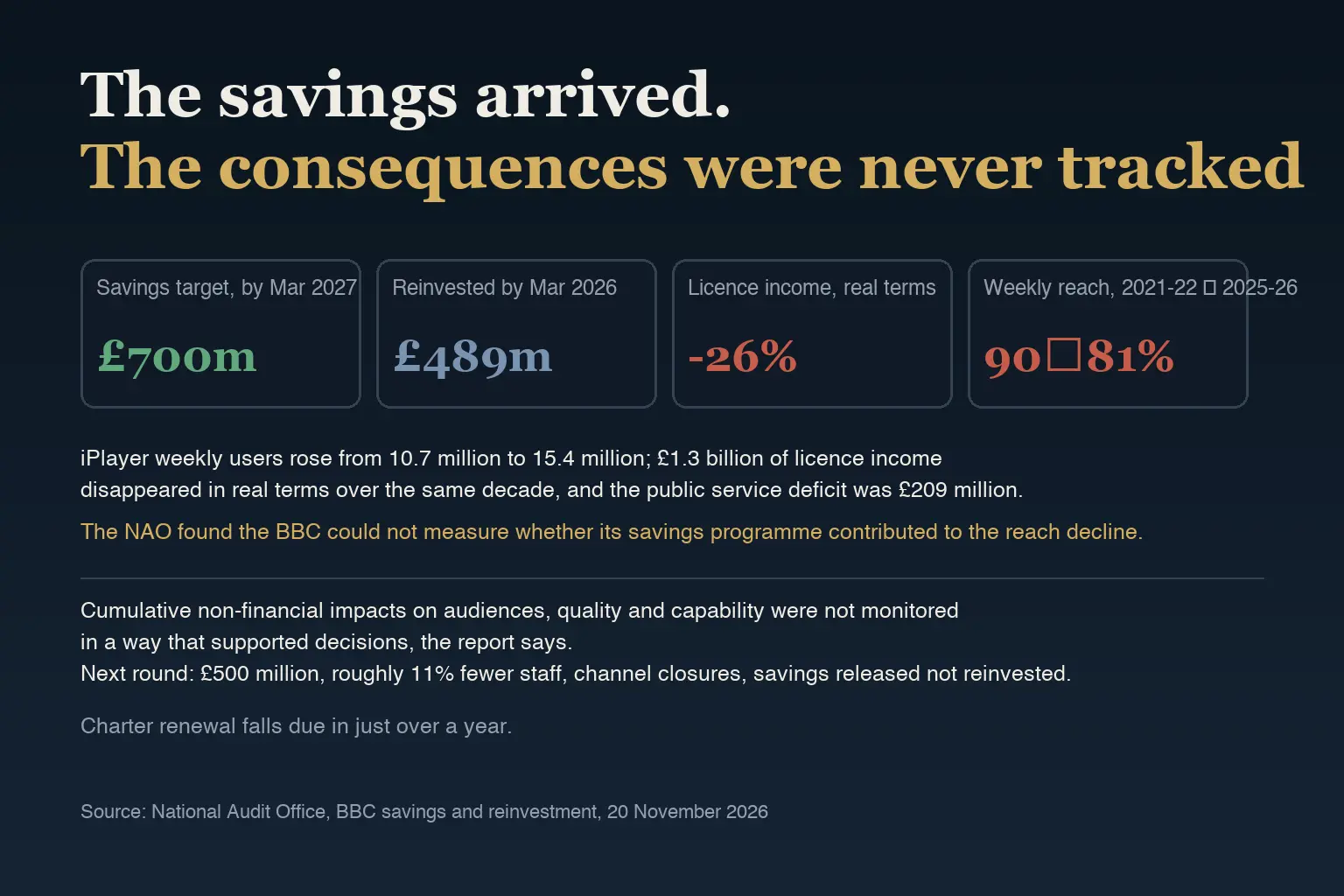
- The NAO's 20 November report finds that the BBC is delivering its £700 million programme of recurring annual savings ahead of schedule, and had reinvested £489 million of it by March 2026, including in digital-first priorities.
- Real-terms licence fee income fell 26 per cent, or £1.3 billion, between 2016-17 and 2025-26, and the public service broadcasting operating deficit was £209 million in 2025-26.
- Weekly reach fell from 90 per cent of UK adults in 2021-22 to 81 per cent in 2025-26, and the NAO found the BBC did not monitor its programme in a way that showed the cumulative non-financial effects on audiences, quality and capability, so it cannot say whether savings contributed.
- A new £500 million round runs to March 2029 with roughly an 11 per cent workforce reduction, programme and channel closures, and cash-releasing rather than reinvested savings, which the NAO says will require stronger governance and impact monitoring.
The number was met. The consequences were not tracked
Give the BBC its due. In May 2022 it set a target of £500 million of recurring annual savings by March 2028, raised it by £200 million in 2024, and now expects to land £700 million by March 2027 — a year early. It got there by reducing staffing, rationalising its estate, modernising technology, simplifying processes and changing the mix of content and services. By March 2026 it had reinvested £489 million, and the investment shows: weekly iPlayer users rose from 10.7 million in 2021-22 to 15.4 million in 2025-26.
Then read the other column. Real-terms licence fee income fell 26 per cent, £1.3 billion, over the same decade. The public service broadcasting operating deficit was £209 million in 2025-26. Weekly reach across TV, radio and online fell from 90 per cent of UK adults to 81 per cent. The NAO's finding is not that the cuts caused that decline; it is that the BBC did not monitor the programme in a way that let it know.
That distinction is the whole governance story. A savings programme is easy to score when the scoreboard is a cash number and a date. It becomes a different instrument when the board also has to show what the money bought, what it lost, and which audiences stopped turning up.
£489 million reinvested, and no ledger of what it displaced
The reinvestment is the part the BBC can defend: nearly half a billion pounds put back into digital products and news, with usage numbers to match. The part it cannot defend is the displacement. Savings of £700 million come out of activity somewhere — programmes not made, posts not filled, capability not maintained — and the report says the corporation did not track those cumulative effects in a way that supported decisions.
Cumulative is the word that matters. Individual cuts are approved one at a time by people who can explain each of them. The tenth cut to the same function is approved by people looking at the tenth business case, not at the sum of ten. The NAO's recommendation follows the arithmetic: build a consistent way to understand the wider consequences across initiatives, not just per initiative.
The next round is harder and less forgiving
In February 2026 the BBC added a further objective: reduce spending by around 10 per cent by March 2029 against a March 2026 baseline, with at least £500 million of recurring annual savings. The NAO is direct that this round will be harder. It includes roughly an 11 per cent reduction in the workforce from March 2026 and content changes audiences will notice; the BBC has already announced closures including programmes such as Celebrity Mastermind and Live at the Apollo, and channels including BBC Three and BBC Scotland.
There is one structural difference, and it makes the missing measurement more expensive. The £700 million programme reinvested part of its savings. The new round is cash releasing: the money goes to closing the funding gap rather than to new products. In the first round, a cut could be justified by what it funded. In the second, the justification is the gap itself.
Governance is the deliverable now
The NAO recommends that the BBC review whether its governance for delivering savings remains appropriate to the scale and pace of the new programme, and that it strengthen risk management. That is a polite way of saying the machinery that steered £700 million is not obviously sized for what comes next: more simultaneous cuts, deeper ones, more visible to audiences, at the same time as a Charter renewal in just over a year.
Charter renewal is the deadline that turns this from an efficiency question into a legitimacy question. A broadcaster asking for a new settlement needs to show not only that it spent less, but that it knows what spending less did to the service the settlement exists to fund.
What would change the judgement
Three things. A published impact framework that ties each savings initiative to the audience, quality and capability measures it is expected to move, reviewed as a portfolio rather than case by case. A cumulative impact report with each annual statement, so the tenth cut is decided with the sum of nine in view. And a reach-and-trust series published alongside the savings series, so the two curves are read together by the people who approve the next round.
Gareth Davies, the head of the NAO, put the lesson plainly: BBC leaders can take from the £700 million programme a stronger risk approach and a consistent way to understand the wider consequences of savings on audiences and services. The BBC has proved it can hit a number. The next target is proving it knows what the number cost.
Sources
Member Briefing
Read the full trend briefing
Members read the full briefing with the source notes behind every finding.
Strategic Circle
A daily briefing in your language, built from changes we have verified.
Join for USD 20/monthCancel anytime.
Members also get the full research library, a daily briefing on the networks they follow and the private forum.