
Summary
- The directory record for Hawaiki Submarine Cable LP, read as of 18 October 2026, carries no retained claim in any legal, control, service, network, people, contact or event section, and its entire distinct external evidence base is a single address describing a separate 50 km planned cable between Batam and Singapore.
- In that record the name appears only inside an owners field, alongside BW Digital and Telin. Three retained trade reports and one retained release on the same project name Telin, BW Digital and Nongsa Digital Park, and none of their retained excerpts names Hawaiki Submarine Cable LP.
- The trans-Pacific system that gives the name its meaning is described in the retained material by one verbatim passage: 15,000 km, three fibre pairs across the main segments, an initial design capacity of 43.8 Tbps, in service since July 2018.
- Design capacity is fixed when the cable is built. Who may use it, at what price, and who bears restoration cost are fixed later, by instruments the material reviewed here does not contain.
The figure and the instrument
Begin with what is manufactured, because that ordering is the argument.
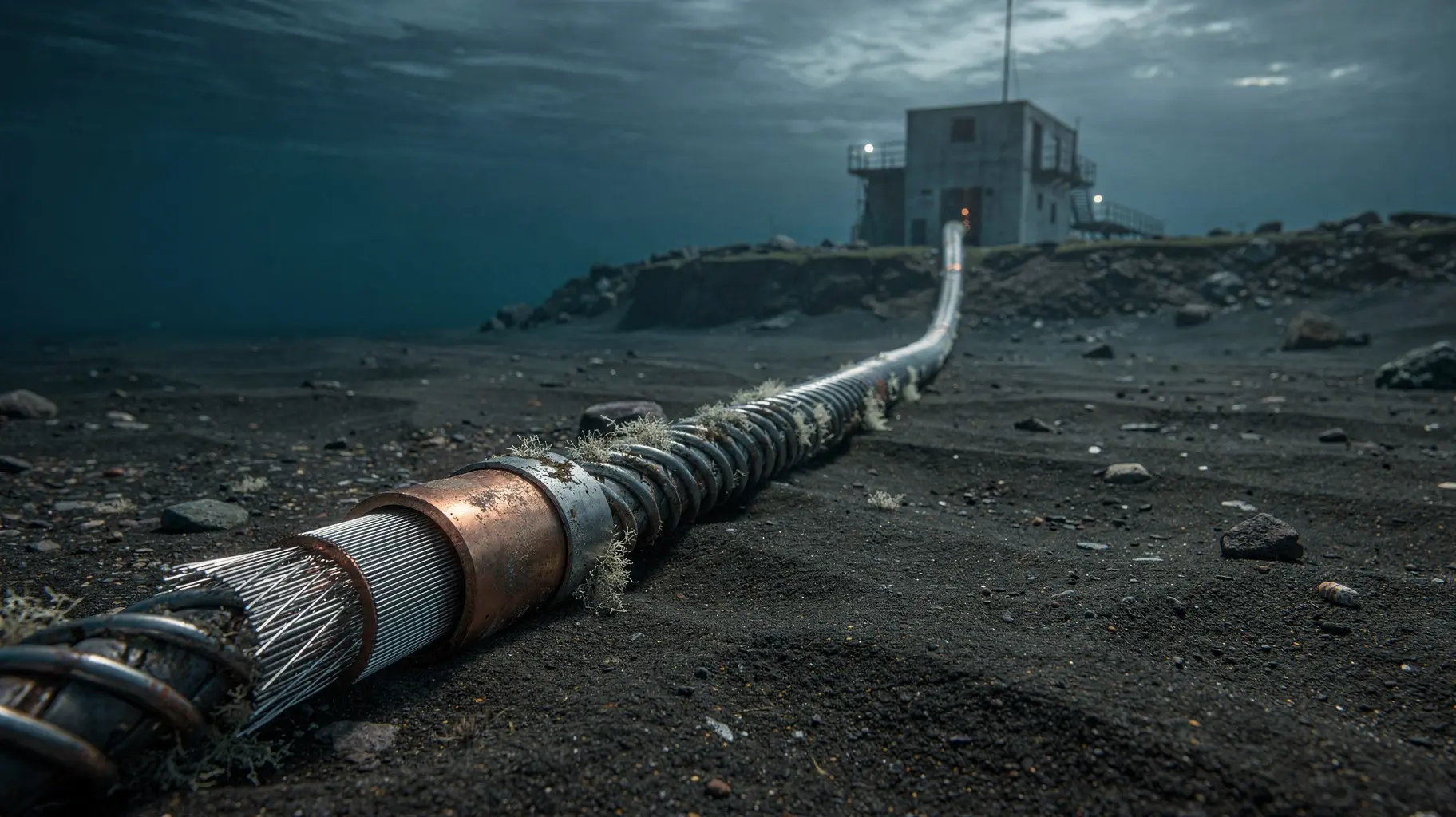
A submarine cable is an industrial object finished before it earns anything. Glass is drawn into a core, wrapped in steel and copper, armoured differently for deep water than for the shallows, and laid along a surveyed route chosen years before the first commercial wavelength lights up. The same holds at each end: landing stations, power-feed equipment, the branching units that let one trunk serve several countries. A trans-Pacific system is a decade-long construction project whose output cannot be adjusted afterwards — not its length, not its route, not the number of fibre pairs already on the seabed.
One public description of the Hawaiki system gives the physical parameters directly. It records a 15,000-kilometre fibre-optic submarine communications cable that entered service in July 2018, linking Australia, New Zealand and the United States with branches to American Samoa, New Caledonia and Tonga, carrying three fibre pairs across its main segments with an initial design capacity of 43.8 terabits per second. The passage is retained from an encyclopaedia entry read on 18 October 2026 (encyclopaedia entry on the Hawaiki cable).
Those numbers deserve separating, because they are not the same kind of number. Fifteen thousand kilometres is geography. Three fibre pairs is a manufacturing decision. Forty-three point eight terabits per second is a designed ceiling stated at the level of the whole system. Divide the ceiling by the pair count and you get roughly 14.6 terabits per second per pair — but that division is my arithmetic from the retained passage, not a published per-pair figure, and it assumes an even split the source does not itself assert.
Now the harder point. Design capacity is what the wet plant can carry in principle, under assumptions about terminal equipment and spectrum. It is not what is lit. Lit capacity is a commercial and engineering choice made with line-terminal equipment, and it can be raised later without touching the seabed — which is why a supplier announcement about optical networking equipment matters less as a capacity measurement than as a scheduling signal. One page on that subject was retained for this review, and it carries no quotable sentence: what survives is a one-line description stating that Hawaiki selected Ciena to provide coherent optical networking technology to upgrade the system (supplier press release as retained). That is description-strength only, and I treat it as such throughout.
Between the ceiling and the buyer sits the control surface. Who may use a given wavelength, on which route, for how many years, at what price, and with what priority when the cable needs a repair ship — none of that is manufactured. It is negotiated, and then it is fixed. A cable can be fully lit and almost entirely committed years ahead; it can be lightly used and impossible to buy into at short notice. Capacity here is not a market that clears continuously. It is a stock of rights, and the interesting question about any operator is what those rights say.
That is why a headline capacity figure is such poor equipment for a buyer, a lender or a regulator. It tells you what the pipe could do. It tells you nothing about whether the pipe is for sale.
What the registry actually holds
The directory entry for Hawaiki Submarine Cable LP is where the name meets the record, so it deserves a precise reading rather than a summary.
Read as of 18 October 2026, the projection is confident about identity and thin about everything else. Identity completeness is recorded as complete; geography is partial, with no country resolved. The confidence score sits at 0.72. There are no live claims at all in the legal, control, service, network, people, contact and event sections — not sparse claims, none. There is no autonomous system number, no announced prefix, no internet-exchange presence, no facility record, no website and no domain. Nine separate materialization gaps are logged. The entry was first seen on 17 June 2026.
For an object filed as a network operator in a global region, that combination is unusual in a precise way: the record knows what the thing is called and has nothing to say about what it does.
Then the evidence base. The projection lists two external references, labelled differently and carrying different confidence values — one as a cable-map source, one as public record evidence at 0.72. Both resolve to the same address. The entry's entire distinct external support is therefore one URL, and that URL is the cable-map record for the Nongsa–Changi system.
Read it directly, because it is short. The record identifies a cable called Nongsa-Changi, fifty kilometres long, with two landing points — Nongsa in Indonesia and Changi in Singapore. Its owners field reads "BW Digital, Hawaiki Submarine Cable LP, Telin". Its suppliers field is null. Its ready-for-service field reads "2026 September" with the year 2026, and its planned flag is true. No URL and no note are attached.
Every one of those fields is consistent with an ordinary community-maintained map entry for a short metro-regional link under construction. None of them is a title document. The owners field is a comma-separated string in a dataset. It records that three names are associated with the project, and it is silent on which legal person holds what share, on what instrument created that association, and on any capacity rights attaching to it.
So the honest statement of the record is narrow, and worth stating in exactly those terms: the external basis for this operator is a source describing a fifty-kilometre planned cable between Nongsa and Changi, in which the operator's name appears inside an owners field. A reader who treats that entry as evidence about a fifteen-thousand-kilometre system is making a leap the entry does not support.
The 15,000 km asset and its single retained description
It is worth being explicit about how much of the physical system rests on how little.
One verbatim passage supplies the route, the landing branches, the pair count and the design ceiling. Beyond that passage, the retained material offers two documents that name the system without quoting anything: the supplier page already mentioned, and an operator page (operator page as retained) whose surviving one-line description calls BW Digital the owner and operator of the Hawaiki system. That ownership statement is description-strength. It is not a corporate filing, not a partner register, not a deed, and it does not tell us how the name in the cable-map owners field relates to the name in that description.
The gap is easy to understate, so here it is in the form of questions the material cannot answer. How many fibre pairs does each segment carry, as opposed to the main segments collectively? What capacity was lit at the end of 2019, or 2021, or last year? Which upgrades were contracted, on what schedule, and did they require new terminal equipment at both ends? None of that appears in anything read for this article.
The same applies to time. The system entered service in July 2018 per the retained passage. Design life for plant of this class is conventionally counted in decades, which means the asset is now roughly a quarter of the way through a nominal life — but "design life" is a convention, not a document I read, and I will not dress it up as one.
And it applies to the land side. The retained passage names jurisdictions reached: Australia, New Zealand, the United States, American Samoa, New Caledonia, Tonga. Each of those jurisdictions has its own authorisation regime for a cable coming ashore, its own landing-station arrangements, and its own environmental and marine-survey permissions. Not one of those instruments was read for this article.
On 18 October 2026 I searched specifically for a United States cable-landing authorisation for this system. The search returned no sources at all, because the retrieval tool available to that request reported no document-retrieval capability. That is a gap in my own retrieval on a dated occasion. It is not a finding that no authorisation exists, and no reader should take it as one. The correct sentence is the narrow one: no landing licence, permit, consent or landing-station access agreement was inspected here.
Divergence: one name, two systems
The retained material contains a genuine divergence, and it is worth laying out precisely because the temptation to resolve it by inference is strong.
On one side: the cable-map owners field names Hawaiki Submarine Cable LP for a 50 km planned Indonesia–Singapore link. On the other: the trade coverage of that same project. One report says Telin and BW Digital are partnering on a subsea cable connecting Singapore to Indonesia's Batam, and that the two companies formed a strategic partnership to develop and construct the Nongsa-Changi cable (SDX Central report). A second reports that Telkom Indonesia has landed a new subsea cable in Batam, and that Telkom subsidiary Telin, BW Digital and Nongsa Digital Park announced the landing of the Nongsa Changi Cable at NDP (DatacenterDynamics report). A third, dated 21 July 2026 from Batam, names PT Telekomunikasi Indonesia International (Telin), an operating company of PT Telkom Indonesia (Persero) Tbk, together with BW Digital (Zawya / Media OutReach release).
Read the three together and the pattern is consistent: the public story of this project is carried by Telin, BW Digital and Nongsa Digital Park. Hawaiki Submarine Cable LP is not named in their retained excerpts. That is a fact about the retained excerpts, not a claim about the world — the releases are excerpts, and an unseen paragraph could name anyone.
There is also a status divergence inside the retained set, and it matters more than it first appears. The cable-map record still carries the planned flag as true and a ready-for-service field of September 2026. The DatacenterDynamics material says the cable landed at Nongsa in July 2026 — and that date appears in the summary attached to the source, not in the verbatim excerpt, so it is description-strength. Landing and ready-for-service are different events: a cable can be physically ashore and still not carrying commercial traffic.
As of 18 October 2026 no retained source states that the Nongsa–Changi system has entered service or reached its ready-for-service date. Both observations stand, dated, unreconciled.
Now the part that must not be overclaimed. Nothing retained shows whether the name in the owners field is the limited partnership itself, a related entity, a sponsor, or a placeholder in a community-maintained dataset. The connection between the registry name and the 15,000 km asset is unverified in this review. I am not going to characterise the operator's conduct, competence or good faith on the strength of a comma-separated string.
The finding is structural: a record whose external basis is one cable-map entry describing a different, much smaller system, and whose owners field is the only place the name appears, cannot carry the weight that a directory entry filed as a network operator implies.
Five instruments a cable operator cannot renegotiate after laying
If capacity is rationed by instrument rather than by pipe, then the useful way to read any cable operator is instrument by instrument. Here is the frame, applied honestly — which means showing which instruments are documented in the retained material and which are not.
One: the installed limit. This is the only instrument largely fixed in steel and glass. Route, landing points, fibre-pair count and design capacity are manufacturing and survey decisions. For Hawaiki the retained passage gives 15,000 km, three fibre pairs across the main segments, and 43.8 Tbps initial design capacity. What is missing is the rest of the same instrument: per-segment pair counts, lit capacity at any dated reference, and a dated upgrade path. The supplier page gestures at an upgrade and quotes nothing. So the installed limit is half-documented: the ceiling is public, the utilisation is not.
Two: the contract stack. Title, owner capacity, indefeasible rights of use, wavelength leases, minimum purchase commitments, contract tenors, and the split between capacity the owners keep and capacity they sell. This is the instrument that actually determines pricing power, and it is the one with no retained document at all behind either system. The owners field is not it. A name in a dataset tells you a name, not a tenure. Where rights of use run for the life of the cable — the normal structure in this industry for anchor buyers — the operator has sold forward years of capacity before a single competitor arrives. That structure is worth naming as a structure; it is not established here for Hawaiki.
Three: the landing surface. Each jurisdiction's cable-landing licence or equivalent, submarine permits, environmental consents, marine-survey approvals, and access to the landing station itself. These are the chokepoints that decide whether a second system can enter a country, and they are administrative rather than physical. For Hawaiki the retained material names the jurisdictions reached but contains no licence, permit or access agreement from any of them. My attempted retrieval of a United States authorisation failed for a tooling reason on 18 October 2026, which is a boundary on this review, not a finding about the regulator's files.
Four: the repair mechanism. Maintenance zone, vessel availability, response commitments, repair-cost allocation, and the record of faults and restoration intervals. This instrument determines what an outage actually costs and who pays it. It is also the instrument least likely to surface in trade coverage, because it is unglamorous and contractually private. A search on 18 October 2026 returned only provider-written summaries, one of which asserted that maintenance terms are not publicly disclosed. That assertion is an absence claim resting on a summary over two web pages, and I reject it as a finding. The narrower, defensible statement is the one I will stand behind: the material retained in this review on 18 October 2026 does not describe a maintenance zone, a vessel, a response commitment, a cost-allocation formula or a restoration interval for this system.
Five: ownership and financing. Dated owners, debt structure, transaction values, and what each implies for capacity pricing and residual risk. Two owners-field strings are all the retained material holds: the Nongsa–Changi entry listing BW Digital, Hawaiki Submarine Cable LP and Telin, and the summary-strength description calling BW Digital owner and operator of the Hawaiki system. No retained document states the legal form, the partners or the ownership instruments of Hawaiki Submarine Cable LP, and no debt, transaction value or financing term was read.
Set the five side by side and the picture is not a scandal. It is a coverage pattern. The instrument that is easiest to publish — the physical ceiling — is the one the record has. The four that decide commercial outcomes are the ones the record lacks. Any reader who substitutes the first for the other four is reading a specification as if it were a market.
What would make this record decision-grade
It is more useful to say what would close these gaps than to lament them.
The first thing is a legal-identity document. One filing that establishes which legal person holds the Nongsa–Changi owner share, and whether that person is the same entity that appears in descriptions of the trans-Pacific system, would settle the divergence in this article. Until then the divergence stays open, and every downstream claim about ownership inherits that uncertainty.
The second is a capacity-rights disclosure at any level of aggregation: how much of the design ceiling is committed under long-term rights, how much is sold on shorter terms, and how much the owners retain. Even a coarse split would convert the 43.8 Tbps figure from a specification into something a buyer could reason about.
The third is a landing instrument from any one jurisdiction — a licence, a permit, a landing-station agreement — because one real document establishes that the administrative layer exists in a way that a schematic of landing points does not.
The fourth is a maintenance arrangement: the zone, the vessel pool, the response commitment and the cost-sharing formula. This is the instrument that converts resilience from an adjective into a number, and it is the one whose absence most distorts how Pacific systems are compared with each other.
The fifth is a dated utilisation or upgrade reference: lit capacity at a stated date, so the ceiling and the reality can be told apart.
None of these is exotic. Operators hold all of it internally. The point is that a public record built from a cable map and an encyclopaedia entry cannot substitute for any of it, and no amount of careful reading will turn one into the other.
Bounded consequence
The consequence is bounded but real, and it runs in two directions.
For a buyer or a lender using this record as a starting point: the design ceiling is not a supply figure. A system can advertise tens of terabits per second and still have nothing available on the route you need at the tenor you want, because the capacity was committed before you arrived. The only way to know is to ask for the rights position, and the only honest thing a public record can do is tell you that the rights position is not in it.
For the record itself: an entity filed as a network operator, with complete identity and partial geography, zero claims across seven substantive sections, one distinct external evidence link and nine materialization gaps, is a name waiting for evidence rather than a description of a business. That is not a criticism of the operator. It is a description of the entry, dated 18 October 2026.
The wider point is about how cable capacity gets discussed. Announcements celebrate distance, pair counts and design capacity, because those are the numbers a project can publish without disclosing a single commercial term. The terms that decide who can buy, at what price, and who pays when the seabed moves are the ones that stay private. A reader who knows which numbers are manufactured and which are negotiated will not mistake the first for the second — and will notice that this particular record, read carefully, is mostly the first kind.
Member Briefing
Deeper Profile Context
Sign in with the right membership level to unlock the full briefing and source notes.
Only for Strategic Circle
Strategic Circle
Open to all readers. Unlock profile briefings after joining and signing in.
Join Strategic CircleOnly for Leadership Alliance
Leadership Alliance
For qualified IP-asset owners and management; sign in to unlock alliance briefings.
Join Leadership Alliance