
Summary
- The Great Renaming made Usenet’s growing group list easier to sort and filter at individual sites; it did not impose one feed policy on the whole network.
- Its organizer reported substantial discussion, but that participation did not amount to a recorded vote authorizing every site or reader.
Analysis
A name could help an operator choose
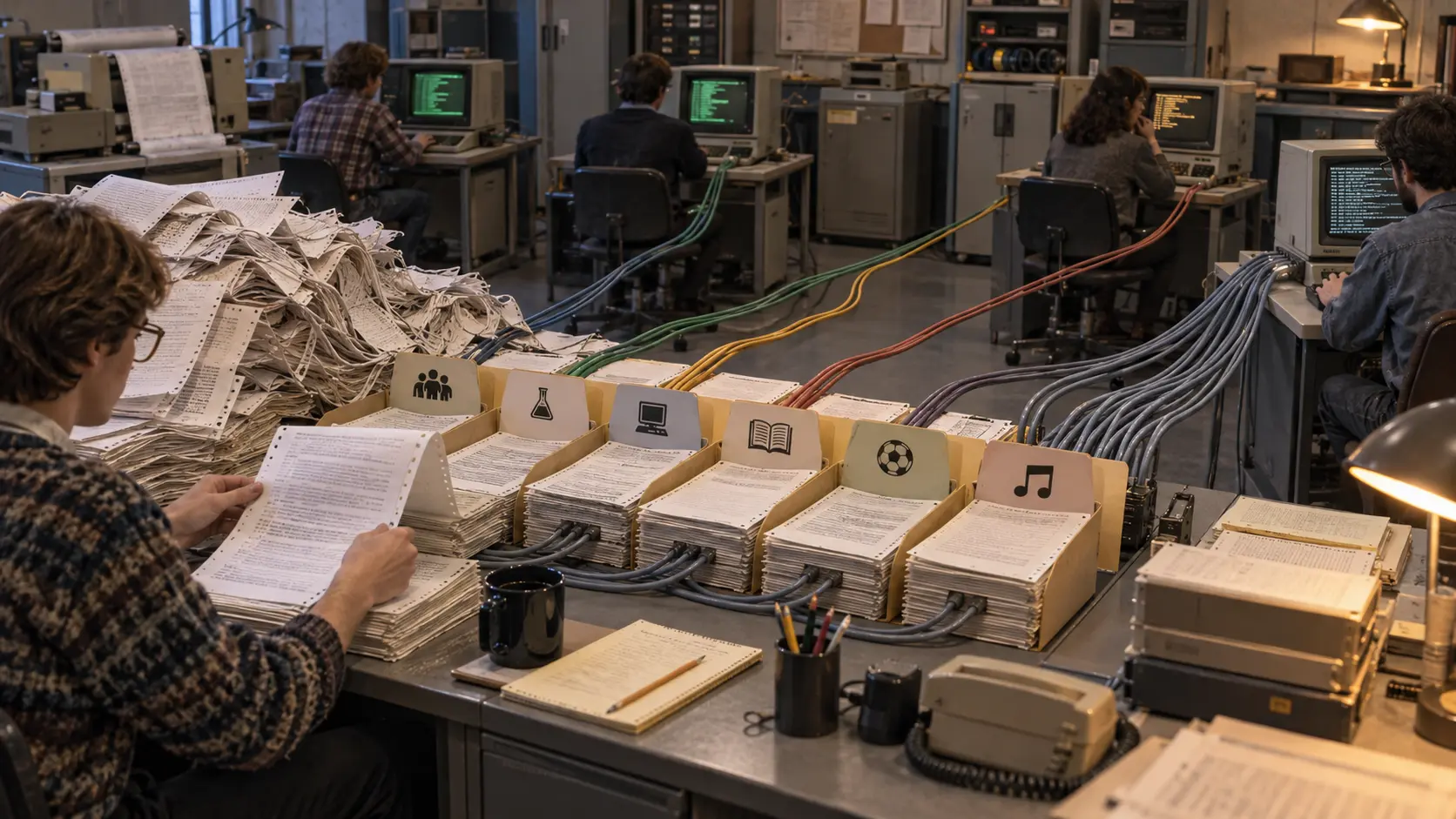
Before the reorganization, many discussions shared the broad net. prefix. That prefix said little about what a group contained, and it gave a site administrator limited help when deciding what to carry. By September 1986, some sites were already choosing among groups rather than taking everything.
In a contemporaneous post, Georgia Tech’s Gene Spafford said rising costs were only one pressure behind the change. He also pointed to the growing number of groups, the difficulty of knowing what they were for, selective carrying already practiced by sites, and the opportunity to make moderated discussions eligible for the Stargate satellite service. He argued that a better structure could help the network continue to grow.
The new hierarchy names turned a large, flat-looking list into topic families. That made the namespace useful as an administrative handle: a site could select a branch of groups without treating every group as one indivisible feed. The effect was practical, not automatic. A prefix could make filtering easier, but it did not force every host to use that filter.
Distribution still belonged to sites
The distinction is visible in Spafford’s account of talk groups. He said those groups were not being deleted; they were simply less likely to travel across the entire network. He reported that at least half of the backbone administrators polled at USENIX expected to keep carrying every group. The rest could make different choices as load and local circumstances changed.
That was not a central switch that removed talk from Usenet. It was a network of hosts whose administrators decided what their links would accept and forward. RFC 977, published in February 1986 for the ARPA-Internet community, describes news hosts using local site-dependent rules to choose groups and articles. It does not show that every Usenet site ran NNTP. RFC 1036 later described a sys file that specified, neighbor by neighbor, which group patterns a host sent onward. Together, the standards make the control surface legible: distribution depended on local configuration.
Consultation was not a network-wide mandate
Spafford reported that nearly 150 users had participated across three earlier mailing-list discussions, and that more than 50 people had reviewed eight iterations of the plan. Those figures matter: the redesign was discussed beyond a tiny drafting group. They do not identify who was represented, establish a binding vote, or show that every site delegated authority to the organizers.
Spafford was explicit that he was giving his own view, not speaking for the backbone administrators as a whole. He also acknowledged that the plan had been presented as a fait accompli to prevent discussion from continuing indefinitely, while saying it was not a final design. That combination is more revealing than a story of either pure consensus or a secret decree: consultation informed a practical redesign, but operators’ ability to configure feeds remained the decisive local authority.
What the record cannot establish
The surviving post explains the organizers’ reasons and their expectations. It is not a census of actual feeds. The sources reviewed here do not show which individual sites later dropped which groups, how long any gap lasted, or what every reader could access. A group’s appearance under a hierarchy may have made it easier to filter; it cannot, by itself, prove that a host filtered it.
The Great Renaming therefore matters as a change in the interface between names and operating choices. The network gained a more legible way to sort discussion, while no single naming decision could make every site carry the same collection. That left readers affected by propagation decisions, but it did not turn participation in the debate into authority over every operator.
Sources
Member Briefing
Deeper Profile Context
Sign in with the right membership level to unlock the full briefing and source notes.
Only for Strategic Circle
Strategic Circle
Open to all readers. Unlock profile briefings after joining and signing in.
Join Strategic CircleOnly for Leadership Alliance
Leadership Alliance
For qualified IP-asset owners and management; sign in to unlock alliance briefings.
Join Leadership Alliance