
Summary
- After Grace Hopper returned to Navy service in 1967, she helped turn compiler-standardization goals into a staffed testing and validation effort. Her 1980 oral history credits George Baird—not herself—with a crucial method for making shared COBOL and FORTRAN test routines run across different computers.
- The Navy’s tests made selected compiler features and outputs observable. They did not establish that every vendor implementation was correct, that every possible feature combination had been tried, or that any arbitrary application would run unchanged on another system.
- The enduring distinction is between a written standard, evidence that a compiler passes named tests, and proof that a particular program will behave portably in its full operating environment. Those are related claims, not interchangeable ones.
The standard was not the result
Imagine a government office that wants to move a payroll or logistics program between computers without buying the same vendor’s machine forever. A shared language standard appears to solve the problem: if both systems support COBOL, perhaps the program can move. But the standard is a target, not a measurement. A vendor can claim support while implementing a required feature incorrectly, omitting it, or handling a boundary case differently.
That gap became a practical concern as federal agencies acquired systems from multiple manufacturers. A procurement officer needed more than a promise that a compiler conformed. The buyer needed repeatable evidence: a program the compiler would accept, an expected result, an observed result, and a way to compare those results across machines.
This is the less familiar part of Grace Hopper’s career. Her public reputation often centers on early compiler work and FLOW-MATIC’s influence on COBOL. The episode here begins later, when she moved from advocating common programming languages to helping make their implementations testable. The shift matters because portable source code is not produced by readable syntax alone. It depends on what the standard requires, what a compiler actually implements, and what a test suite can demonstrate.
From feature lists to test runs
The technical lineage was already collective. In his 1972 account of the Department of Defense COBOL Compiler Validation System, George N. Baird described a standards-group effort that began in 1963. Its COBOL working group wrote programs to determine whether compilers made specified features available. The goal was not to debug every compiler or enumerate every possible combination. It was to select features, test them individually and in combinations, and report what happened.
That distinction is easy to miss. A language specification can contain many features and interactions. A test suite must choose a finite set of cases. The first Navy routines Baird described grew from existing work and added more useful reports: they could show the result produced by the computer alongside the expected result, and identify the procedure where a failure appeared. The preliminary set comprised 12 programs and about 5,000 lines of source.
Those details make the work concrete. “The compiler supports COBOL” is a broad assurance. “This compiler accepted these required constructs and produced these results under this test setup” is a bounded statement that another buyer can reproduce. The test did not eliminate judgment; it made part of the judgment visible.
Hopper’s assignment was to build a capability
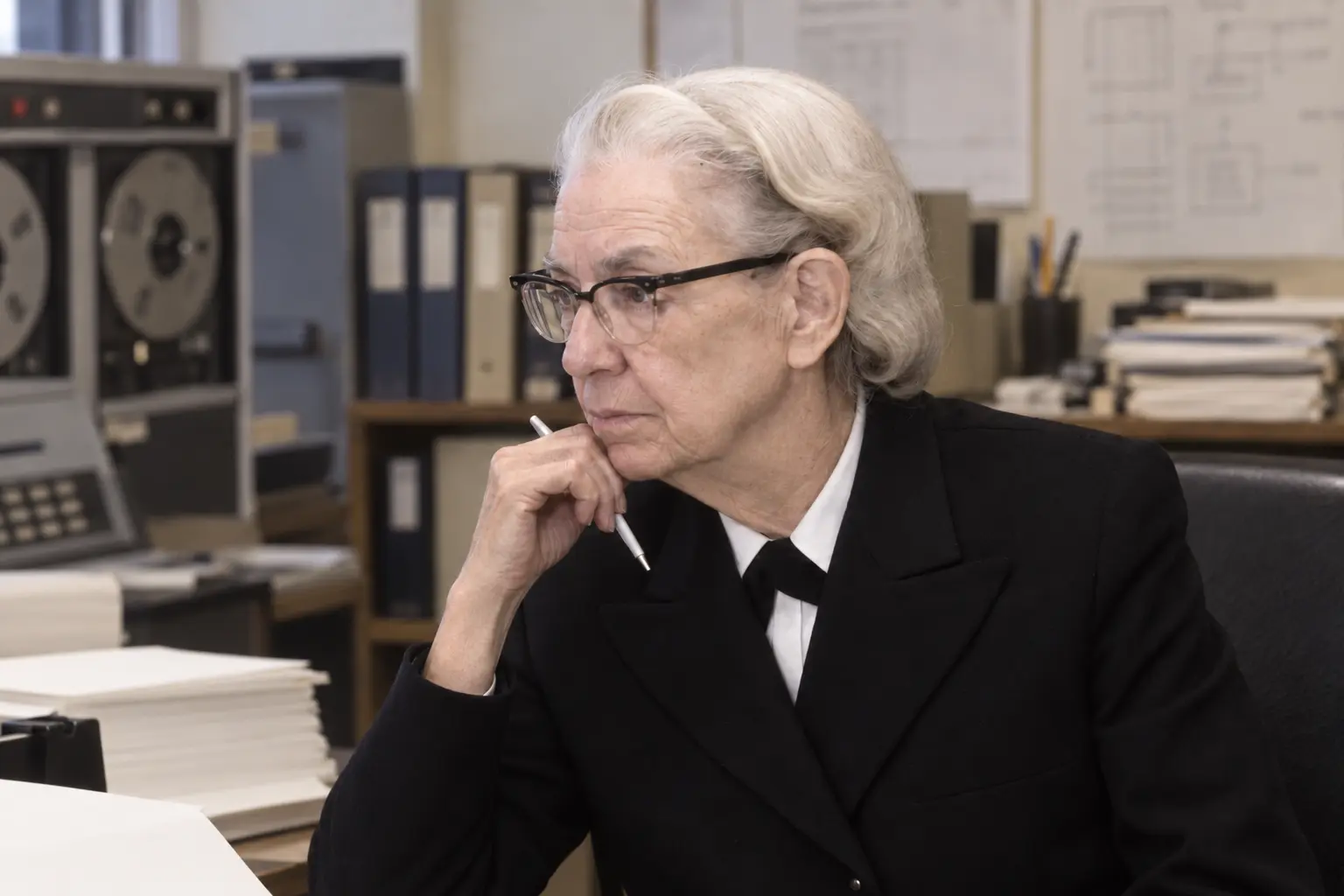
In a 1980 interview, Hopper recalled that Norman Ream, a Navy official responsible for automatic data processing, asked her to return to active duty in 1967. The assignment, as she remembered it, was to develop testing and validation procedures that could support language standards and make software more portable. She compared the need to product testing: a standard needs tests that show whether an implementation meets it.
Hopper said she asked for programmers rather than trying to do the work alone. She named civilian Ed Ford, one lieutenant and two sailors among the initial group, with George Baird as one of the sailors; Arnold Johnson joined later. The 1971 trade press described the Navy’s validation routine as developed by a staff headed by Captain Hopper. That contemporary report supports her leadership role, but it does not make the code a one-person creation.
The timeline also matters. By January 1971, Datamation reported that the Navy required COBOL compilers to be validated, while the Department of Defense and the National Bureau of Standards had agreed in principle to develop standardized routines against the ANSI language standard. “Agreed in principle” is not the same as a completed government-wide service. The report records an institutional direction at that moment, not a final outcome.
The part Hopper said belonged to Baird
The most revealing passage in Hopper’s oral history is not a claim of invention. It is an attribution. She said Baird devised the technique that let the test routines handle machine-specific special names and control-card details through separate configuration data. The common test logic could remain in standard COBOL; a small machine-specific file supplied the differences needed to run it on a particular computer.
That arrangement turned portability into a property of the test harness itself. If every test had to be rewritten for every compiler, comparisons would become harder to maintain and easier to bias. Separating common tests from machine-specific setup let the team reuse the same checks while still acknowledging that computers had different control conventions.
Hopper’s recollection is retrospective, so it should be read as her account of the team’s design and division of labor. Baird’s 1972 paper independently anchors the validation system and its technical structure. Together, the sources support a careful picture: Hopper helped establish the assignment and team; Baird supplied an important cross-machine technique; the wider standards and testing work had multiple contributors and predecessors.
What a passing suite could—and could not—say
The system’s value came from its limits being legible. A successful run showed that a compiler handled the tested language features and produced the expected results under the test conditions. It did not show that the test suite had covered every valid combination, every implementation defect, or every program an agency might later write.
This is not a defect unique to COBOL. NIST’s history of a separate FORTRAN test effort led by Betty Holberton and Elizabeth Parker explains why a finite test set cannot prove a compiler completely correct. That was a parallel National Bureau of Standards project, not Hopper’s Navy COBOL suite. The distinction matters both technically and historically: conformance testing was becoming an institutional practice across different teams and languages.
Compiler conformance and application portability are also different layers. A compiler may pass a selected standard test while a particular application still depends on a vendor extension, operating-system service, file layout, runtime behavior, or data representation. That is an inference from what the tests cover, not a claim that the Navy suite examined every such dependency. To move an application, teams still need application-level tests and a record of the environment in which they ran.
The practical lesson is not to distrust standards or tests. It is to name the evidence precisely. A standard defines expected behavior. A conformance suite checks a bounded sample of an implementation. An application migration test checks the system a buyer actually intends to move. Calling all three “portability” hides where risk remains.
A legacy of measurable claims
Hopper’s role in this episode is more interesting when it is not inflated. She helped turn a broad interoperability ambition into a staffed validation capability. She also described a management practice that is easy to overlook in stories about lone inventors: asking for collaborators and publicly assigning credit to the person whose idea made a technical mechanism work.
Baird’s contribution shows why that practice mattered. Portability was not just a feature promised by a language committee. It also depended on the mechanics of test design, configuration, output comparison and repeatable execution. A standard without observable tests left buyers with a claim. A test suite without careful attribution could obscure the people who built its mechanism. A passing suite without scope limits could become a new promise larger than its evidence.
For long-lived software, the receipt should therefore travel with the claim: which standard revision, which compiler build, which tests, which machine-specific configuration, and which results? Hopper’s Navy work did not abolish vendor differences. It gave institutions a way to expose some of them, compare implementations, and make procurement decisions on firmer ground. That is a more bounded achievement than “COBOL made software portable”—and a more durable one.
Sources
- Oral History of Captain Grace Hopper, Computer History Museum (1980)
- George N. Baird, “The DoD COBOL Compiler Validation System,” AFIPS Fall Joint Computer Conference (1972)
- “Standards Bearers Reach COBOL, OCR-B Accord,” Datamation, January 15, 1971
- John Cugini, “FORTRAN Test Programs,” NIST, pp. 258–259
- Naval History and Heritage Command, NH 96924: Captain Grace M. Hopper at her desk, August 1976
Member Briefing
Deeper Profile Context
Sign in with the right membership level to unlock the full briefing and source notes.
Only for Strategic Circle
Strategic Circle
Open to all readers. Unlock profile briefings after joining and signing in.
Join Strategic CircleOnly for Leadership Alliance
Leadership Alliance
For qualified IP-asset owners and management; sign in to unlock alliance briefings.
Join Leadership Alliance