
Policy continuity, legitimacy, and accountability signals across internet governance institutions.
Governance
Governance
Internet governance intelligence tracks institutions, policy processes, standards activity, registry operations, accountability disputes, and implementation signals that affect internet infrastructure. BTW.
RIR WatchdogCase FileNumber Resource SocietyICANNIETFHistory of InternetNOGs

RIR Watchdog, Case File, NRS, ICANN, IETF, History of Internet, and NOG sessions.
Coverage prioritizes implementation evidence and institutional behavior over declarative positions.
Latest Coverage
Latest from Governance
7,712 articles

History
TCP Was Reliable. One Channel Could Still Starve the Others: RFC 3081
RFC 3081 placed one BEEP session on one TCP connection, then confronted a consequence TCP could not solve for it. Reliable delivery for the connection did not guarantee progress for every application channel inside it. The mapping therefore added local credit, priority control…

History
The Notices Continued After the Directory Agent. New Services Could Still Be Missed: RFC 3082
RFC 3082 tried to replace wasteful polling with event-driven service discovery. Its recovery rules expose a more precise trade-off: a Directory Agent can lose subscription state while service agents already informed of that subscription keep announcing. A new service may enter…

IETF
The Tree Went Silent. The Alarm Came Back on a Different Road
A new BIER Working Group draft lets an active tail report multipoint BFD failure without waiting to be asked. The alarm returns by unicast on a path deliberately separated from the multicast tree—and that separation limits what the receipt can prove.

CASE FILE
The SID Selected the Lane. It Did Not Prove the Capacity Was There
A new Segment Routing identifier can tell every router which resource partition a packet is meant to use. The difficult part begins after that lookup succeeds: proving that the promised bandwidth, buffers and queues were actually committed at every hop, remained bound to the same…

History
One Connection Was Not One Conversation: RFC 3080
A BEEP connection could be healthy while no application conversation had yet been agreed. RFC 3080 began with channel zero, a deliberately thin management plane that advertised profiles and negotiated new channels. Only an accepted profile gave an application channel meaning.…

CASE FILE
Completed According to Whose Plan? Svea Bank's Self-Reported AML Remediation Meets the Regulator's Record
When Sweden's financial supervisor Finansinspektionen (FI) announced a sanction against Svea Bank AB on 17 December 2025, the operational part of the decision contained exactly two points: a formal remark (anmärkning) and an administrative fine of SEK 170 million. There was no…

IETF
The Link Agreed to Sleep. That Did Not Mean It Was Safe to Disappear
A new IETF draft proposes a bilateral procedure for powering down lightly used traffic-engineered resources. Its most important sentence is not a power-saving promise but an evidentiary limit: sending a sleep request is not successful completion.

Number Resource Society
The October 2025 RIPE NCC General Meeting Had No Executive Board Election — and the Record Proves It
The RIPE NCC's General Meeting of 22–24 October 2025 in Bucharest was billed alongside RIPE 91 as a major governance gathering, but the registry's own agenda, minutes and voting report show a meeting with a single resolution and no Executive Board election at all. The one…

History
The Master Key Never Encrypted a Packet: RFC 3079
RFC 3079 called one value a master key, then forbade it from touching traffic. Its job was to feed two role-aware branches, which in turn produced transient send and receive keys for separate cipher contexts. That hierarchy made a quiet point about interoperability: deriving…

CASE FILE
The Report Was Signed Before the Code Ran
An authenticated status report can be perfectly honest and still stop one step before the fact a governor wants. SUIT revision 22 names that boundary `invoke-pending`: the processor is about to hand control to code, but no one yet knows what the code will do.

CASE FILE
Three Names on One Netblock: How Custody of Svea's Legacy Abuse Contact Split Across a Merger
When a Swedish bank merges, its internet number resources do not disappear — they inherit. The RIPE Database record for 193.105.138.0/24 is a rare case where you can read the aftermath directly in a public registry entity: three distinct legal parties, one dissolved predecessor…

IETF
The Monitoring Option That Deletes the View
A new BMP draft tries to distinguish a quiet BGP feed from one that an operator has switched off. Its answer is useful—and more consequential than the name suggests. A Disable notification would instruct the collector to purge a scoped RIB view immediately, turning telemetry…
History
The Counter Detected the Lost Packet. It Could Not Decrypt the Next One: RFC 3078
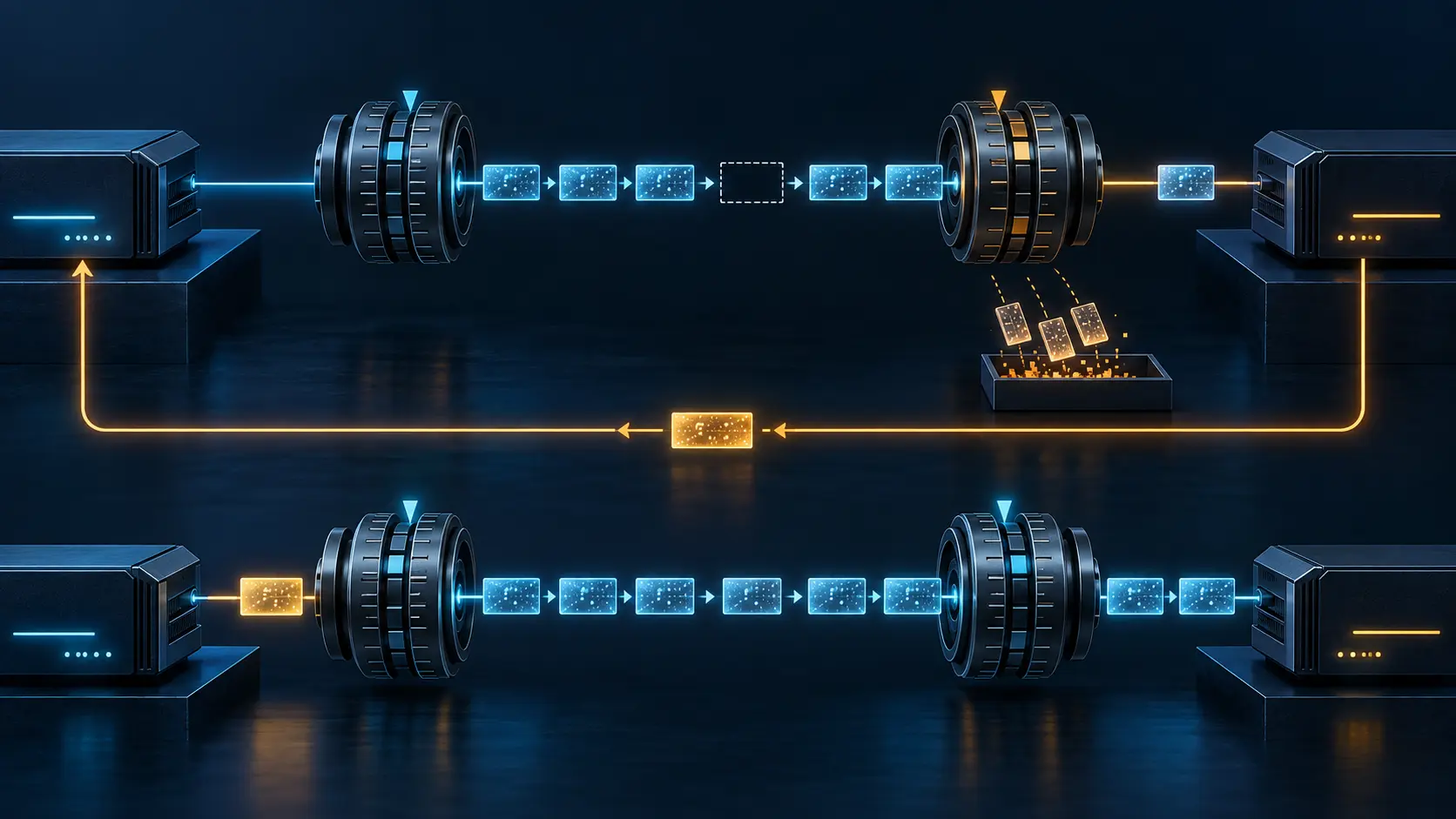
RFC 3078 placed a twelve-bit counter beside encrypted PPP traffic so a receiver could notice when the stream had jumped. In stateful mode, that knowledge arrived with an uncomfortable consequence: the packet that exposed the gap still had to be thrown away. Recovery needed a…

Story
The 2019 Excess-Contribution Redistribution: How the RIPE NCC's Own Instruments Authorised and Applied a Contested Remedy
When the RIPE NCC returned EUR 8,365,249 to its members in 2020, the money did not move by improvisation. It moved under Standard Service Agreement Article 7, a Clearing House Procedure that predates the decision, and a General Meeting vote that split hard enough to show how…

History
The Satellite Was One-Way. The Link-Layer Model Was Not: RFC 3077
In a satellite network, a receiver could hear a feed without being able to answer it on the same medium. RFC 3077 did not make that asymmetry disappear. It joined the broadcast path to a separate Internet backchannel, then tried to let ordinary link-layer protocols behave as…

CASE FILE
Three Months After the Fine: No Follow-Up, No Appeal, No Documented Remedy for Svea Bank
On 17 December 2025, Sweden's financial supervisor Finansinspektionen (FI) gave Svea Bank AB (org. no. 556158-7634) a formal remark (anmärkning) and a sanction fee of SEK 170 million for breaches of core anti-money-laundering rules…

IETF
The Configuration Succeeded. Its Trace Began Again
A device can accept a management change after rejecting the identifier meant to follow that change across the control stack. Two current IETF drafts make that split explicit—and force operators to decide how they will prove an action whose observability chain starts halfway…

IETF
The Old Mechanism Was Deprecated. The Link Had Not Migrated.
One sentence in a new Internet-Draft can change the preferred future of a protocol. It cannot change the packet a router will accept tonight. The first draft to deprecate IPsec AH for OSPFv3 exposes the gap between standards direction and a live link: every attached router must…

History
The Bytes Became Canonical Only After the Parser Had Already Changed the Document: RFC 3076
Canonical XML promised a stable byte stream, not a time machine. Before RFC 3076 could sort a single attribute, an XML processor had already normalized line endings, expanded entities, replaced CDATA and built an XPath node-set. The resulting octets could be repeated exactly.…

CASE FILE
DATAMATIX AS210973: what the live record proves about real operation
DATAMATIX AS210973: what the live record proves about real operation intelligence summary explains the development, the public evidence available to readers, the organisations involved, the regional context, market exposure, and the infrastructure consequences that may follow.…
Session Map
Governance Branch
RIR Watchdog
Five regional sessions tracking allocation policy, board legitimacy, and institutional continuity.
Open RIR WatchdogCase File
Long-cycle governance dossiers with legal, election, and institutional stress analysis.
Open Case FileNumber Resource Society
Membership, charter, and resource-governance intelligence from the NRS ecosystem.
Open NRS SessionICANN
DNS coordination, accountability frameworks, and global multi-stakeholder process dynamics.
Open ICANN SessionIETF
Protocol standardization trajectory and interoperability risk under fragmented policy conditions.
Open IETF SessionHistory of Internet
Long-cycle infrastructure history used for governance interpretation and structural forecasting.
Open History SessionNOGs
Operator-level implementation intelligence from APRICOT plus regional and national NOG ecosystems.
Open NOGs Session