
Policy continuity, legitimacy, and accountability signals across internet governance institutions.
Governance
Governance
Internet governance intelligence tracks institutions, policy processes, standards activity, registry operations, accountability disputes, and implementation signals that affect internet infrastructure. BTW.
RIR WatchdogCase FileNumber Resource SocietyICANNIETFHistory of InternetNOGs

RIR Watchdog, Case File, NRS, ICANN, IETF, History of Internet, and NOG sessions.
Coverage prioritizes implementation evidence and institutional behavior over declarative positions.
Latest Coverage
Latest from Governance
7,617 articles

IETF
The Nonce Repeated. The Failure Did Not Become Permission.
Misuse resistance is a promise about the shape of a cryptographic failure, not a waiver for the control that failed. RFC 5297's SIV construction keeps authenticity when a nonce repeats and confines the privacy loss to an equality signal. That is valuable precisely because nonce…

IETF
Both Routers Heard Hello. That Still Did Not Prove the Path.
The dangerous word in a network status is often “up.” RFC 5303 gave point-to-point IS-IS a stronger way to earn that word: not merely “I heard you,” but “I know you heard me, and this reply belongs to this system and this circuit.” It also left a crucial boundary intact.…

IETF
The Finish Was Authentic. The Key Was Not Yet in Use.
The peer verified a protected EAP-Finish/Re-auth and derived the expected re-authentication MSK. The ER server had already accepted the sequence number. Yet the authenticator had not installed that rMSK, and the lower-layer security association had not begun. A valid finish…

History
A Search Result Was Not an Identity: RFC 3744’s Canonical Principal
WebDAV’s access-control design had to solve a problem that a display name could hide: one person or software agent might be reachable through several URLs, while an access-control entry needed an unambiguous principal reference. RFC 3744 paired limited human-oriented discovery…

IETF
The Keys Were Different. The Boundary Still Collapsed.
An access system rotated its EMSK, derived a fresh root and produced exactly the bytes its specification expected. The downstream service kept using an older cache entry because the key name, lifetime and replacement event had not travelled with the secret. Cryptographic…

IETF
The Host Spoke PIM. The Network Mistook It for a Router.
A control plane fails before any packet is lost when it accepts the wrong class of speaker. RFC 5294 showed how a host-facing interface could hear a valid PIM Hello, Register, Assert, or election message and convert mere protocol fluency into routing responsibility. The decisive…

History
One IDN Registration Reserved a Package, Not Just a Label: RFC 3743
When a registry accepts a CJK domain label, the visible string may be only one member of a larger administrative family. RFC 3743’s Joint Engineering Team proposed treating selected character variants as one reservation package, while leaving each zone to decide which forms…

IETF
The Filter Edited One Message. It Did Not Create One Truth.
A compliance stamp appeared in the archived copy, disappeared from a delivery notice, and broke a signature check downstream. All three observations were compatible with RFC 5293. The failure was not that Sieve behaved inconsistently. It was that the institution called three…

IETF
The Premium Lane Could Not Replace the Road.
A network can sell priority, reserve capacity, or attach a price to congestion without answering the harder constitutional question: what remains usable by everyone who did not enter that arrangement? RFC 5290 treated simple best-effort traffic not as a primitive awaiting…

IETF
The Control Plane Was Alive. It Was the Wrong Witness.
Two indicators can describe the same TDM pseudowire and still disagree without either message being malformed. One arrives inside the emulated data stream; the other travels through the PWE3 control plane. RFC 5287 did not treat that duplication as automatic resilience. While the…

History
One Datagram Changed Its Route. The Other Socket Defaults Should Have Survived: RFC 3542
The most revealing API changes are sometimes changes in the blast radius of an exception. RFC 3542 let one IPv6 datagram depart from one socket default without making that packet an excuse to erase every other choice the application had already made.

IETF
The Label Stayed Specific. The Route Became an Aggregate.
The control plane still carried a label for one exact egress. The IP routing table no longer carried that egress at all; it carried only the larger prefix that contained it. RFC 5283 made that asymmetry useful. It did not make the aggregate a witness that every specific…

IETF
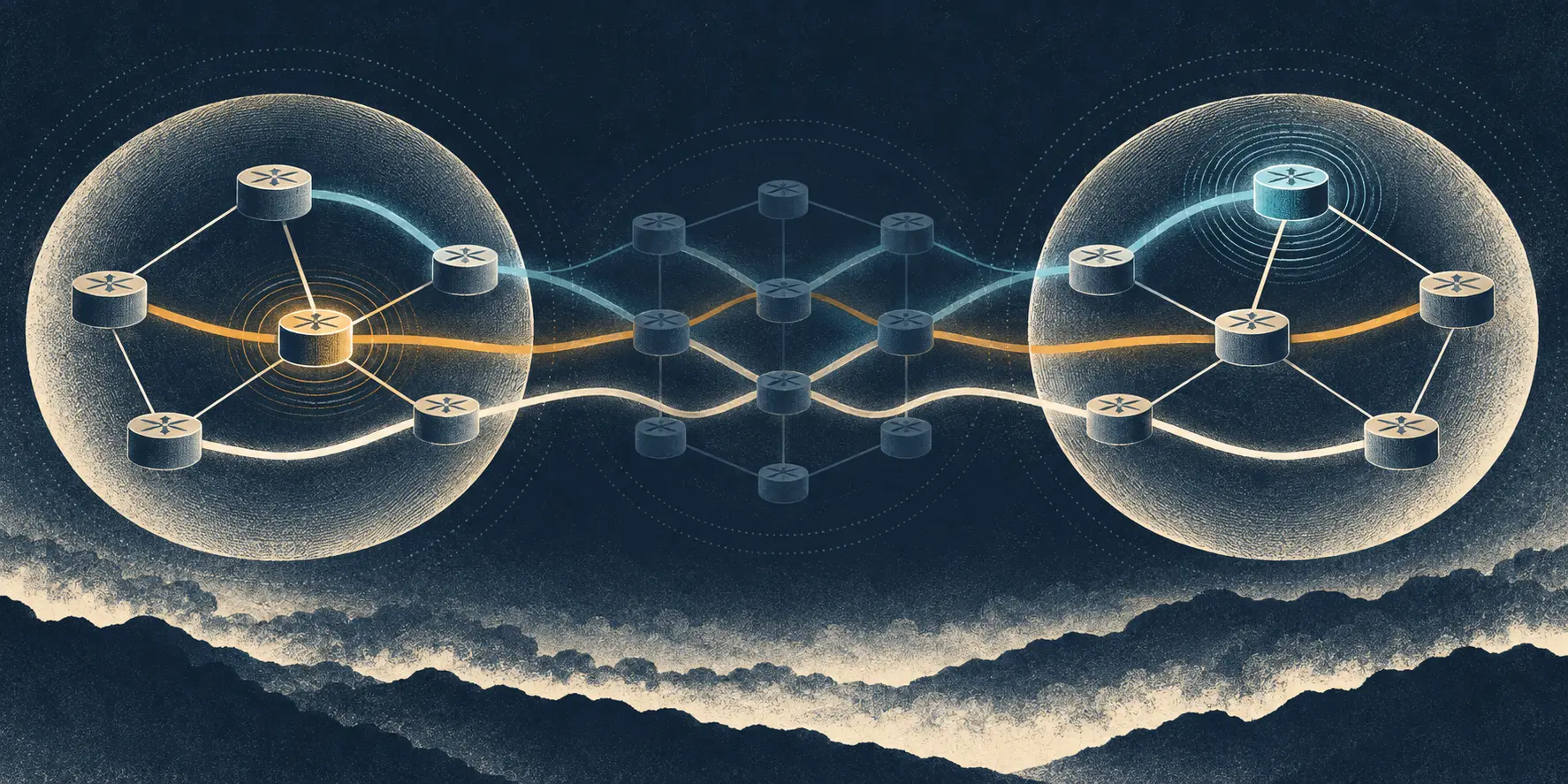
The Feature Was Enabled. The Topology Had No Alternate.
A router can be configured for fast reroute and still have nowhere safe to send one destination when a link fails. RFC 5286 makes that apparent contradiction precise: a loop-free alternate exists only when a candidate neighbour passes a strict, destination-specific distance test…
History
The Best Route Was Not a Stable Answer: RFC 3345
A router can choose the best path in its own table, advertise it, and still help create a loop that makes the next “best” choice different. RFC 3345 showed how that can happen when BGP’s scaling shortcuts reduce which exit paths each router sees.

IETF
The Tunnel Was Open. The Subscriber Had Not Been Authenticated.
The TLS Finished messages crossed cleanly. The server had proved its side of the tunnel, encryption was active, and keying material could be derived. In the ordinary one-way EAP-TTLS branch, the subscriber’s real identity had not even been sent yet. Treating that moment as “user…

History
The AD Bit Reported Validation Policy, Not a Signed Answer: RFC 3655
A DNS reply can contain a one-bit assurance from the resolver that checked it. In 2003, RFC 3655 narrowed what that bit meant—and made clear that trusting the bit depended on trusting the resolver and the path to it.

IETF
Replay Finished. The Missing Beginning Was Still Missing.
The server sent a green `replayComplete` marker. Every notification it could replay for that subscription had been sent. The requested history still began earlier than the oldest event the log retained. Both statements were true, and a dashboard that stored only “complete” turned…

IETF
The Packet Said 3. The Session Knew What 3 Meant.
A packet capture can preserve every RTP byte and still lose the dictionary needed to read its metadata. RFC 5285 made that separation deliberate: compact numbers travel on the wire, while negotiated context decides what those numbers name.

History
The Route Stopped Flapping. Its Penalty Had Not: RFC 2439
The Route Stopped Flapping. Its Penalty Had Not: RFC 2439 intelligence summary explains the development, the public evidence available to readers, the organisations involved, the regional context, market exposure, and the infrastructure consequences that may follow. The History…

IETF
The Handover Had Four Signals. The Dashboard Showed One Green Light.
A mobile system detected a neighboring link, decided to leave, received an order to switch, and finally established a new radio connection. Those are four events with different producers and meanings. RFC 5270 kept them separate. A dashboard that compresses them into “handover…
Session Map
Governance Branch
RIR Watchdog
Five regional sessions tracking allocation policy, board legitimacy, and institutional continuity.
Open RIR WatchdogCase File
Long-cycle governance dossiers with legal, election, and institutional stress analysis.
Open Case FileNumber Resource Society
Membership, charter, and resource-governance intelligence from the NRS ecosystem.
Open NRS SessionICANN
DNS coordination, accountability frameworks, and global multi-stakeholder process dynamics.
Open ICANN SessionIETF
Protocol standardization trajectory and interoperability risk under fragmented policy conditions.
Open IETF SessionHistory of Internet
Long-cycle infrastructure history used for governance interpretation and structural forecasting.
Open History SessionNOGs
Operator-level implementation intelligence from APRICOT plus regional and national NOG ecosystems.
Open NOGs Session