
Policy continuity, legitimacy, and accountability signals across internet governance institutions.
Governance
Governance
Internet governance intelligence tracks institutions, policy processes, standards activity, registry operations, accountability disputes, and implementation signals that affect internet infrastructure. BTW.
RIR WatchdogCase FileNumber Resource SocietyICANNIETFHistory of InternetNOGs

RIR Watchdog, Case File, NRS, ICANN, IETF, History of Internet, and NOG sessions.
Coverage prioritizes implementation evidence and institutional behavior over declarative positions.
Latest Coverage
Latest from Governance
7,617 articles

History
BIND Put DNS Inside 4.3BSD
A distributed name service became a practical part of Unix administration when Berkeley’s BIND arrived as software that operators could configure, run and maintain with the rest of their system.

History
Malawi’s Fidonet Network Turned Call Logs into a Cost per Kilobyte, 1993–94
A university email network in Malawi kept more than messages: its node recorded calls, traffic and telephone bills. Those records let its operator ask what each international kilobyte cost—and what the local phone link could actually deliver.

ICANN
The 2026 gTLD count measures evaluation work, not future domains
ICANN’s October reveal puts more than a thousand applications into public view. The number describes a queue of records at an early stage; it does not yet say how many distinct strings will survive evaluation, contention, objection and contracting to become delegated domains.

History
The Union Dissolved. .su Stayed in the DNS Root
When the Soviet Union disappeared, its country-code domain did not vanish with it. The history of .su is a record of several clocks running at once: a root-zone delegation, a new Russian namespace, local registration rules, and the names that organizations still needed to…

History
The Flag Day Took Two Years: ARPANET’s NCP-to-TCP Transition, 1981–83
The switch from NCP to TCP/IP is often remembered as a midnight deadline. The plan behind it began two years earlier, and its most useful lesson arrived later: the protocol cutover could be declared complete while the services around it were still catching up.
History
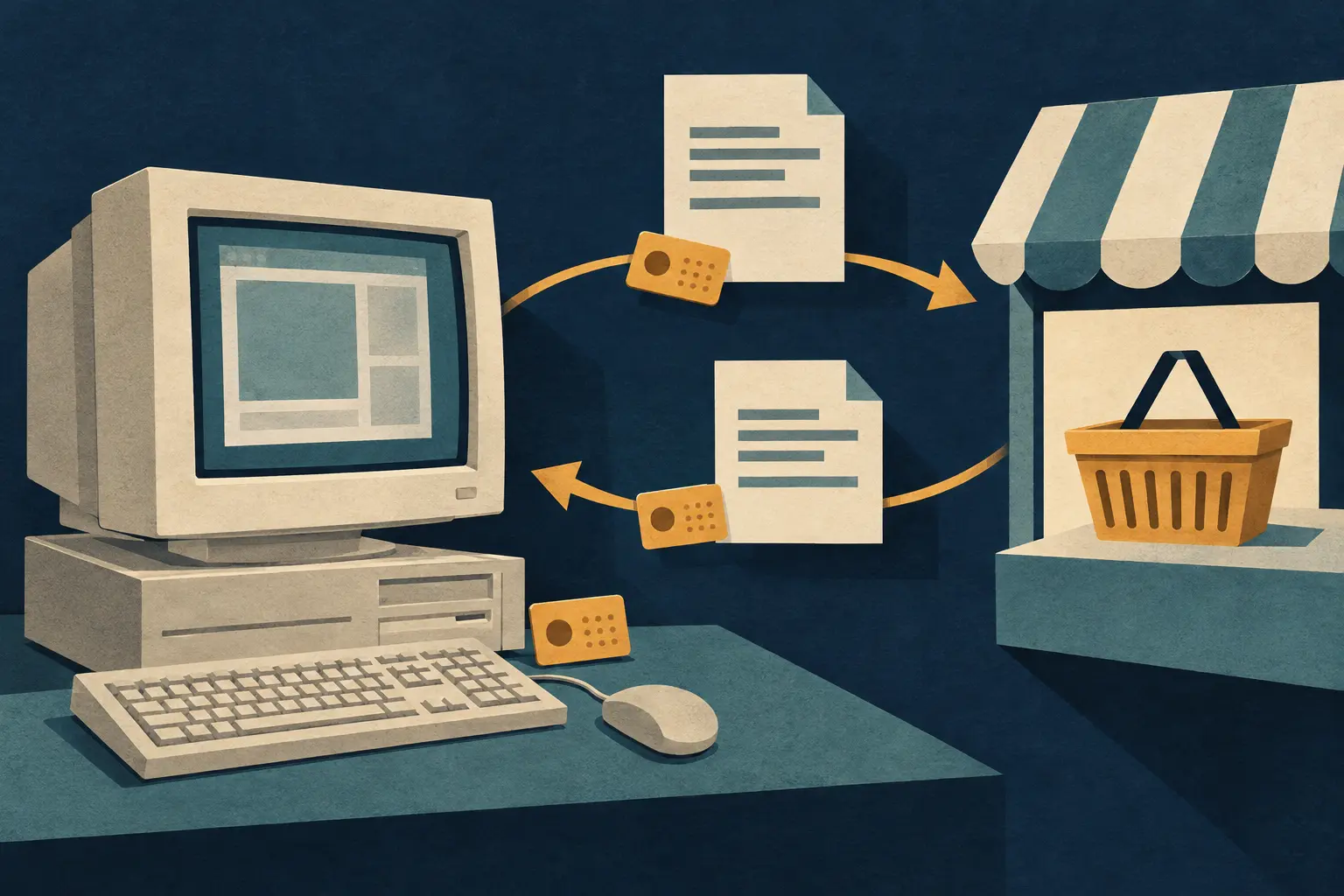
The Shopping Cart That Put Web State in the Browser
Before a Web shop could keep a basket between requests, someone had to decide where its memory would live. In 1994, a project for MCI pushed Netscape toward a small answer stored on the customer’s computer, then turned that customer’s requirement into a general browser mechanism.

ICANN
ICANN’s DNSSEC fast track faces a lock test
ICANN’s assessment and RFC 10026 give registry locks different effects. The difference now sits inside a public review intended to underpin faster registry approvals.

History
The Route Disappeared. Some Egyptian Packets Still Got Out.
In January 2011, Egypt’s Internet became globally difficult to reach in a sequence visible to routing monitors. A network telescope still saw packets sourced from Egyptian addresses. That residue records a surviving path for some traffic; it does not show that the public retained…

History
The Urdu Name Passed in 2011. .پاکستان Reached the Root in 2017
Pakistan’s Urdu-language name entered the DNS root through two distinct stages: review of the script label, then delegation of a manager able to operate it. The record makes clear why “approved” and “delegated” were not the same milestone.

IETF
MASQUE’s Charter Proposal Narrows the Closeout List; Ethernet Draft Remains in IESG Follow-Up
Two public records now describe different stages of the same MASQUE work: the proposed charter has a shorter list for the working group to finish before closing, while an Ethernet draft remains in the IESG’s publication review.

Story
APNIC’s US$3bn cable-repair forecast leaves the funding model open
An APNIC-hosted essay cites a 2040 estimate of US$3 billion to replace 15 submarine-cable repair vessels and add five more. The ITU’s evidence points to the financing question behind that total: who will commit the long-term revenue needed to build and maintain the ships?

Story
A Self-Started RIR Handover Needs a Named Renewal Route
A recommended RIR governance draft gives an affected registry a way to start a temporary handover of its own services. A separate route expressly covers renewal with ICANN and two-thirds of the other RIRs. The draft sets a 90-day ceiling, publication duties and a right to resume…

Story
A database is not a license: APNIC’s proposed terms for ordinary queries
APNIC’s proposal would put a public, versioned rulebook beside ordinary WHOIS and RDAP lookups. The hard question is whether users can tell what they may do before data arrive—and challenge a restriction when the system gets it wrong.

Story
AFRINIC’s co-chair search separates candidate approval from community consent
AFRINIC has opened nominations for one Policy Development Working Group co-chair. Candidates need support from two members; registered entities at the Public Policy Meeting will choose by consensus. The distinction matters because the chair facilitates policy discussion but does…

History
The First Ping Was Only One Route: Mauritius’s Internet, 1993–96
In Mauritius, a 1996 traceroute showed that one named host could be reached from the United Kingdom. It did not show who could use the service, how widely it was available, or when the island first joined the Internet. The record becomes clearer when email relays, a route, a…

History
The Joke Marker Needed No Software Release: CMU, 1982
Three keyboard characters offered a way to mark a sentence as a joke without changing the bulletin-board program. The idea came out of a real dispute about a fake elevator warning, and the surviving thread shows a convention being negotiated before it became a familiar face.

ICANN
Linked domains are leads, not verdicts: ICANN’s proposed DNS-abuse checks
ICANN’s proposed associated-domain checks would move abuse review from one name at a time to evidence about related names held by the same registrar. Their legitimacy will turn on a boundary the draft already recognizes: a signal that links domains can justify an inquiry, but it…

History
A Network Budget Before ARPANET: ARPA Order 471, 1963
In April 1963, ARPA funded two California universities to study remote computer use, interconnection and time-sharing. The plans make an early network more concrete—and show why a funded research program should not be mistaken for the network that later emerged.

History
Email Came Before IP: Morocco’s Uneven Internet Opening, 1993–96
Morocco’s first recorded connection in this story could deliver email, but not the full set of Internet services later associated with a routed IP link. The gap between those milestones shows why “the Internet arrived” needs a service definition.

Story
RIPE NCC’s board proposal gives the CEO a vote—and a separate signature route
RIPE NCC’s October proposal would replace its current Executive Board with one body of executive and non-executive members. The CEO would join its votes, while the draft gives each executive member a separate route to represent the association. Those are related changes, but they…
Session Map
Governance Branch
RIR Watchdog
Five regional sessions tracking allocation policy, board legitimacy, and institutional continuity.
Open RIR WatchdogCase File
Long-cycle governance dossiers with legal, election, and institutional stress analysis.
Open Case FileNumber Resource Society
Membership, charter, and resource-governance intelligence from the NRS ecosystem.
Open NRS SessionICANN
DNS coordination, accountability frameworks, and global multi-stakeholder process dynamics.
Open ICANN SessionIETF
Protocol standardization trajectory and interoperability risk under fragmented policy conditions.
Open IETF SessionHistory of Internet
Long-cycle infrastructure history used for governance interpretation and structural forecasting.
Open History SessionNOGs
Operator-level implementation intelligence from APRICOT plus regional and national NOG ecosystems.
Open NOGs Session