
RIR Watchdog
Five regional sessions tracking allocation policy, board legitimacy, and institutional continuity.
Open RIR WatchdogGovernance
The internet runs on institutions most people never see. We follow the regional registries, ICANN, the IETF and the operator communities through every board vote, policy fight and court case, and tell you what each move means for your network.

Latest Coverage
9,367 articles

CASE FILE
RFC 9896 lets the RFC Production Center change SVG tooling without freezing one implementation forever. It keeps a harder invariant: the concept must survive in text, and every image path must remain consistent with it.

History
An early network-management console could present a serial port with the authority of a control panel: speed, parity, character width, error totals, signal states. When the value on screen differed from the value an operator remembered setting, the easiest story was that somebody…

IETF
The IETF Administration LLC has disclosed a venue-planning state that its public process does not name. Its 1 September report says the slot originally reserved for IETF 131 was given away, so the meetings team is returning to previous Asian venues. It also says the original…

CASE FILE
A DLEP credit window tells a router how many octets it may send toward a modem queue. It does not tell an operator what happened after that boundary. Treating permission as delivery turns a useful control into a false service receipt.

History
In 1991, the Host Access Protocol could return an acceptance for a numbered message at the edge of the Terrestrial Wideband Network. The word sounded conclusive; the specification was not. Acceptance closed a local Host–Wideband Packet Switch question so buffers could move on. It…

CASE FILE
A reusable ticket can spare an authentication system from repeating expensive work. It cannot spare the system from knowing which credential and policy made the earlier decision valid—or whether either one has since changed.

CASE FILE
An ECH key file can be internally correct while the deployed privacy path is wrong. The private key may match one public configuration exactly, yet the server, DNS and cached client can each be operating from a different generation.

History
RFC 1220 gave remote bridges a disciplined moment at which LAN traffic could begin crossing a PPP link: not before the bridge-control protocol opened. That state mattered, but it was only the start of the evidence chain. Frame size, ordering, checksum treatment, spanning-tree…
CASE FILE
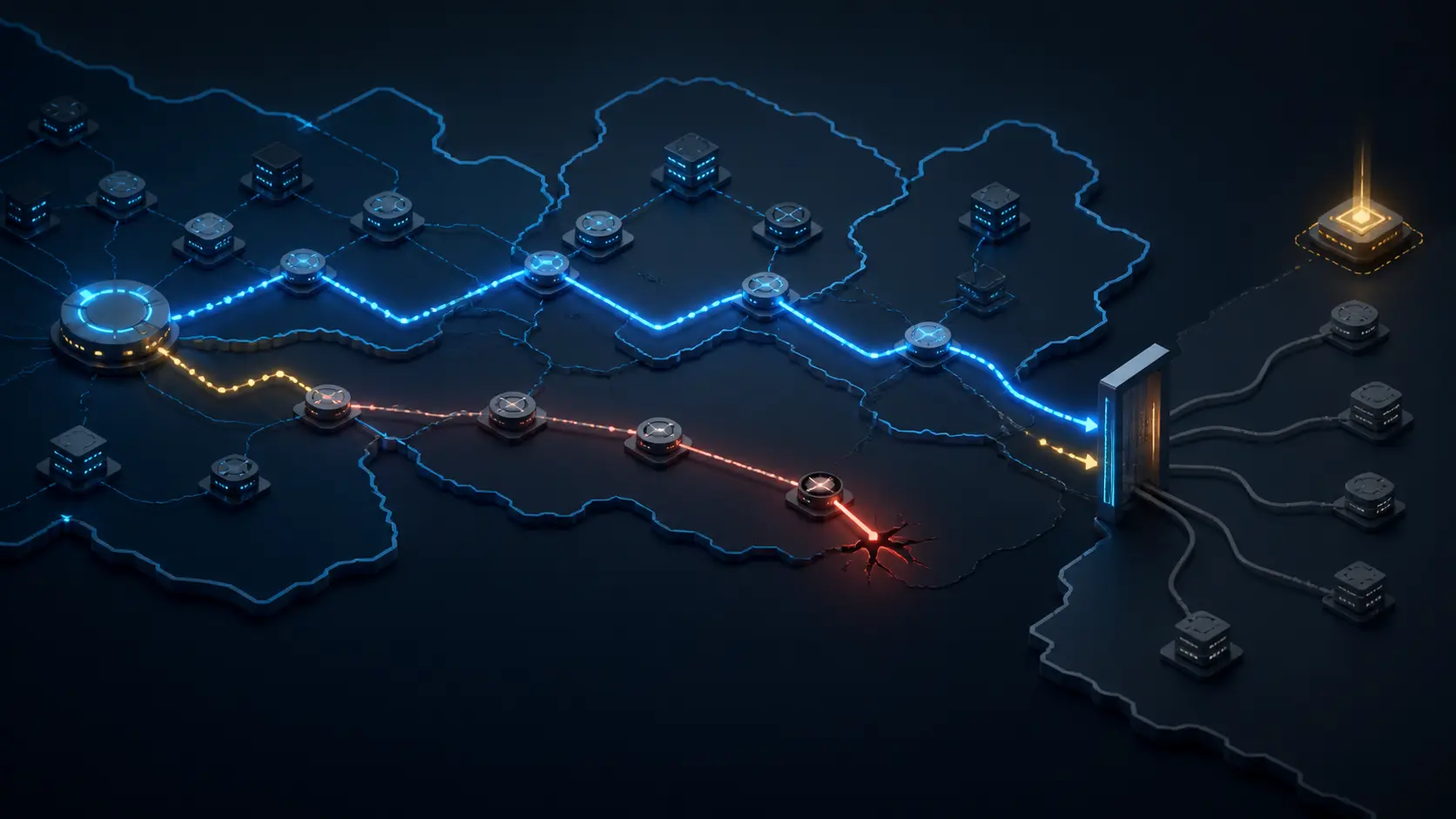
A summary route can remain visible while one of the prefixes beneath it has failed. RFC 9929 lets the network expose that hidden loss, but deliberately stops before telling a receiving system what action it must take.

IETF
The new nameserver was answering perfectly. The old one was quiet. An operator shut it down after the child zone's TTL elapsed—and a minority of users vanished, because their resolvers were still keeping time from the parent.

IETF
Two lines in the IETF 126 record carry different answers from the same room. Asked whether Agentproto’s initial scope was correct, entities answered 38 yes, 124 no and 40 with no opinion. Asked whether to form a Working Group “with this charter,” they answered 154 yes, 51 no and…

CASE FILE
A legacy IPv4 client can receive configuration through an IPv6 service without knowing that a relay spoke on its behalf. That is an elegant migration mechanism. It is not proof that the server saw the access path on which the right configuration depended.

CASE FILE
W3C's public recharter issue says the Linked Web Storage Working Group is making no substantive change. It also says the first charter was aggressively optimistic and the group now hopes to reach Candidate Recommendation in late 2026 or early 2027 before moving into maintenance.…

NPNOG
npNOG can document that it kept opening the room. Its public chronology runs from the first numbered meeting in 2016 to npNOG-11 in 2025, with a virtual programme in 2020. The archive shows workshops, conferences, fellows, committees and technical subjects. That is not trivial…

NPNOG
npNOG describes its mailing list as open, available to anyone and “sometimes moderated”. It also publishes seven content rules. What the reviewed pages do not publish is who moderates, what activates moderation, how a entity is notified or where a disputed decision goes.

History
RFC 1219 offered a way to enlarge subnets or add more of them without changing the addresses already assigned to hosts. The address could stay engraved on the brass plate. Around it, however, the mask boundary still moved, routers still needed to understand several masks, and two…

IETF
A passive observer saw a clean pulse every 200 milliseconds and labelled the path RTT 200 ms. The packets were real and the arithmetic was correct. The conclusion was not: a sparse application was sending every 200 ms across a much faster path.

History
A fingerprint is persuasive because it is short. A file can be many pages or many megabytes; a digest can fit on one line. In 1992, RFC 1319 gave that compactness a precise shape. MD2 accepted a message of arbitrary length and produced a 128-bit message digest. The RFC described…

CASE FILE
A proposed rewrite of the TLS Baseline Requirements would finally say what a relying party must be able to see before a certificate counts as revoked. Yet the deadline would begin at a less visible event: the moment the certificate authority classifies an incoming problem report…

LKNOG
LKNOG3 told authors that papers would be selected first-come, first-served, while also allowing its committee to retain a limited number of slots for exceptionally timely, important or operationally critical presentations. The two clauses made submission time the ordinary rule…
Session Map
Five regional sessions tracking allocation policy, board legitimacy, and institutional continuity.
Open RIR WatchdogLong-cycle governance dossiers with legal, election, and institutional stress analysis.
Open Case FileMembership, charter, and resource-governance intelligence from the NRS ecosystem.
Open NRS SessionDNS coordination, accountability frameworks, and global multi-stakeholder process dynamics.
Open ICANN SessionProtocol standardization trajectory and interoperability risk under fragmented policy conditions.
Open IETF SessionLong-cycle infrastructure history used for governance interpretation and structural forecasting.
Open History SessionOperator-level implementation intelligence from APRICOT plus regional and national NOG ecosystems.
Open NOGs Session