
RIR Watchdog
Five regional sessions tracking allocation policy, board legitimacy, and institutional continuity.
Open RIR WatchdogGovernance
The internet runs on institutions most people never see. We follow the regional registries, ICANN, the IETF and the operator communities through every board vote, policy fight and court case, and tell you what each move means for your network.

Latest Coverage
9,348 articles

History
The circuit could come up before the institution was ready. In February 1994, RFC 1578 explained Internet access to primary and secondary schools by separating things that the verb “connect” made too easy to merge: a path, a set of usable applications, trained people, technical…

Story
On 27 May, a supplier’s work in a manhole disconnected RIPE NCC’s fibre for only a couple of minutes. The connection came back and recovery was automatic. Yet RIPE NCC says it took about thirty minutes for everything to recover. The useful question is not whether automation…

CASE FILE
A green BFD session can now say something useful about packet size, but only if the claim stays as narrow as the packets that earned it. RFC 9764 turns padded control traffic into a recurring lower-bound test. It does not turn one forwarding treatment into a certificate for every…

CASE FILE
An IPv6 packet may name the resource partition it wants at every hop and still emerge without proof that every router recognized the request, used the intended queue or preserved the promised isolation.

History
IPv6 did not begin with a timeless answer to who should sit between a site and the global routing table. Its early documents tried several physical layouts for that authority—and left a remarkably frank account of who would pay when aggregation, portability and resilience pulled…
History
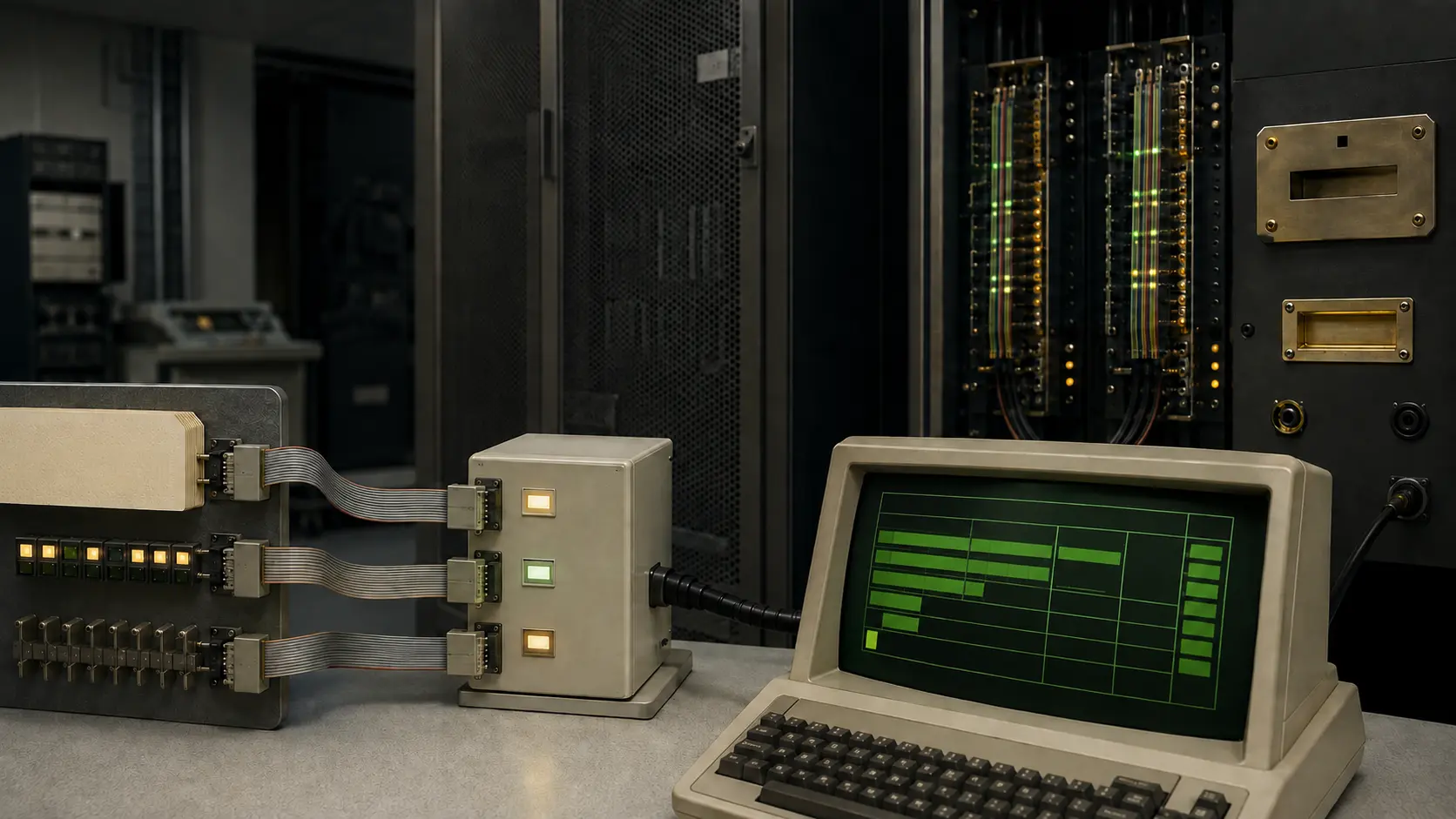
A standard had already designed one explicit switch into 3270 mode. Running systems chose three switches instead. By 1994, Terminal-Type, Binary and End of Record could make an ordinary Telnet connection carry a block-oriented IBM display stream, even though the client still…

CASE FILE
A certificate authority can attest that two credentials belong to the same end entity. It cannot make two private keys act in a live exchange, choose a peer’s trust anchors or decide whether one successful authentication is enough. RFC 9763 is valuable because it draws that line…

History
For 38 days in 1995, one root-server installation answered through an experimental address inside Net 39 as well as through its familiar address. Well over half of roughly 400 million queries reached the new interface. The striking fact is not only that the unfamiliar address…

CASE FILE
An NFS client may re-read a busy directory, see the same names and still tell an application that a growing file has its old size. Revision 11 of a working-group draft answers that failure without pretending to abolish caching: it limits which answer the client may expose after…

CASE FILE
One green boolean can look like permission. RFC 9767 is more disciplined: `active: true` is an authorization server’s answer to a resource server’s specific question about a token, a proof method and, sometimes, minimum access. The resource server still owns the application…

CASE FILE
A collector can ask one network node for one stream of updates and receive data from several publishing processes hidden behind the same address and subscription identifier. Revision 21 of the NETCONF distributed-notification draft corrects the authority that makes this possible…

History
In 1995, an RFC said every host and router had to answer a new kind of name query. In 2013, another RFC recorded that the messages had never been widely implemented or deployed. Between those two sentences lies a useful history of how an Internet standard acquires—or fails to…

History
In one short LDAP expression, `*` could ask whether an attribute existed, widen a value into a substring pattern, or survive as a literal character only if the writer escaped it. The line was made for people to read. The server did not read it as prose. RFC 1558 gave executable…

CASE FILE
A SLSA provenance statement can say something precise about one artifact and the build that produced it. That precision matters. But it does not choose which builders a verifier trusts, define a package’s expected source and parameters, declare a release complete, or decide what…

CASE FILE
Revision 11 of QUIC Stream Resets with Partial Delivery closes an important permission gap: an endpoint may not send `RESET_STREAM_AT` unless its peer advertised support. That rule says the receiver can parse the extension. It does not make the sender's first Reliable Size…

CASE FILE
An acknowledgment disappears. The next one arrives with a three-bit counter advanced, but perhaps not by as little as it seems: the counter may have wrapped while the evidence was missing. RFC 9768 gives TCP a better congestion receipt, not an oracle. The receiver reflects marks…

ICANN
A timely gTLD submission is not complete for processing until ICANN receives the evaluation fee within the separate payment window.

AFNOG
AfNOG’s 2007 call welcomed suggestions and expressions of interest even without all requested proposal information, but the cited page did not explain beside that invitation how these inputs related to a complete proposal.

IETF
A packet trace can show a complete STREAM frame while telling you nothing conclusive about whether an application request was complete, parsed, accepted, or committed.

IETF
An AIS may suppress cascaded client alarms while its L-Flag remains clear, so alarm suppression is not proof of server failure. The server or intermediate node can send the indication downstream in affected client LSPs, but the receiving MEP still validates it and decides the…
Session Map
Five regional sessions tracking allocation policy, board legitimacy, and institutional continuity.
Open RIR WatchdogLong-cycle governance dossiers with legal, election, and institutional stress analysis.
Open Case FileMembership, charter, and resource-governance intelligence from the NRS ecosystem.
Open NRS SessionDNS coordination, accountability frameworks, and global multi-stakeholder process dynamics.
Open ICANN SessionProtocol standardization trajectory and interoperability risk under fragmented policy conditions.
Open IETF SessionLong-cycle infrastructure history used for governance interpretation and structural forecasting.
Open History SessionOperator-level implementation intelligence from APRICOT plus regional and national NOG ecosystems.
Open NOGs Session