
RIR Watchdog
Five regional sessions tracking allocation policy, board legitimacy, and institutional continuity.
Open RIR WatchdogGovernance
The internet runs on institutions most people never see. We follow the regional registries, ICANN, the IETF and the operator communities through every board vote, policy fight and court case, and tell you what each move means for your network.

Latest Coverage
9,343 articles

CASE FILE
A registrar can be told exactly how much spending room it has and still be unable to explain why the next domain command was refused. The emerging EPP balance mapping makes funding state operational; it does not turn that state into an accounting record.

CASE FILE
A Holder-Designated RDAP Referral Extends Discovery, Not Registry Authority intelligence summary explains the development, the public evidence available to readers, the organisations involved, the regional context, market exposure, and the infrastructure consequences that may…

IETF
The certificate was valid for the name the client checked. That sentence sounds like the end of authentication, but it hides the first and more consequential choice: why did the client check that name? Peter Saint-Andre and Rich Salz make the order explicit in RFC 9525. The…

Story
ARIN Lets You Name a ROA. Its Online Search Still Ignores the Name intelligence summary explains the development, the public evidence available to readers, the organisations involved, the regional context, market exposure, and the infrastructure consequences that may follow. The…

CASE FILE
A case study becomes persuasive long before its final paragraph is written. Someone finds it, someone decides it belongs, and other examples never enter the folder. The IGF Policy Network on Artificial Intelligence now wants practical evidence of governance beyond formal…

Story
APNIC built one definition document so the same words would not acquire different meanings as they crossed policy files. The document now has a different problem. Its main web page presents version 004 as a draft; its stable official-text address still presents version 003 as…

CASE FILE
The word “success” can survive on a dashboard long after the observation that produced it has expired. A new EPP proposal would make the result portable; governance begins by refusing to make it timeless.

IETF
The status light turned green. The credentials had been accepted, an identity had been associated with the session, and the exchange was over. Yet the next operation could still be refused without contradiction. The architecture Alexey Melnikov and Kurt Zeilenga set out in RFC…

CASE FILE
A registrar can submit a command naming one domain while the repository must decide whether that command reaches a set too large to list. The protocol message is visible; the rule that draws its boundary may sit somewhere else.

CASE FILE
A consultant is about to inherit a mailing-list archive, a compressed calendar and an unusually delicate verb: synthesize. PNODI also expects that consultant to research and contribute suggestions of their own. Both tasks can improve the Internet Governance Forum's first…
History
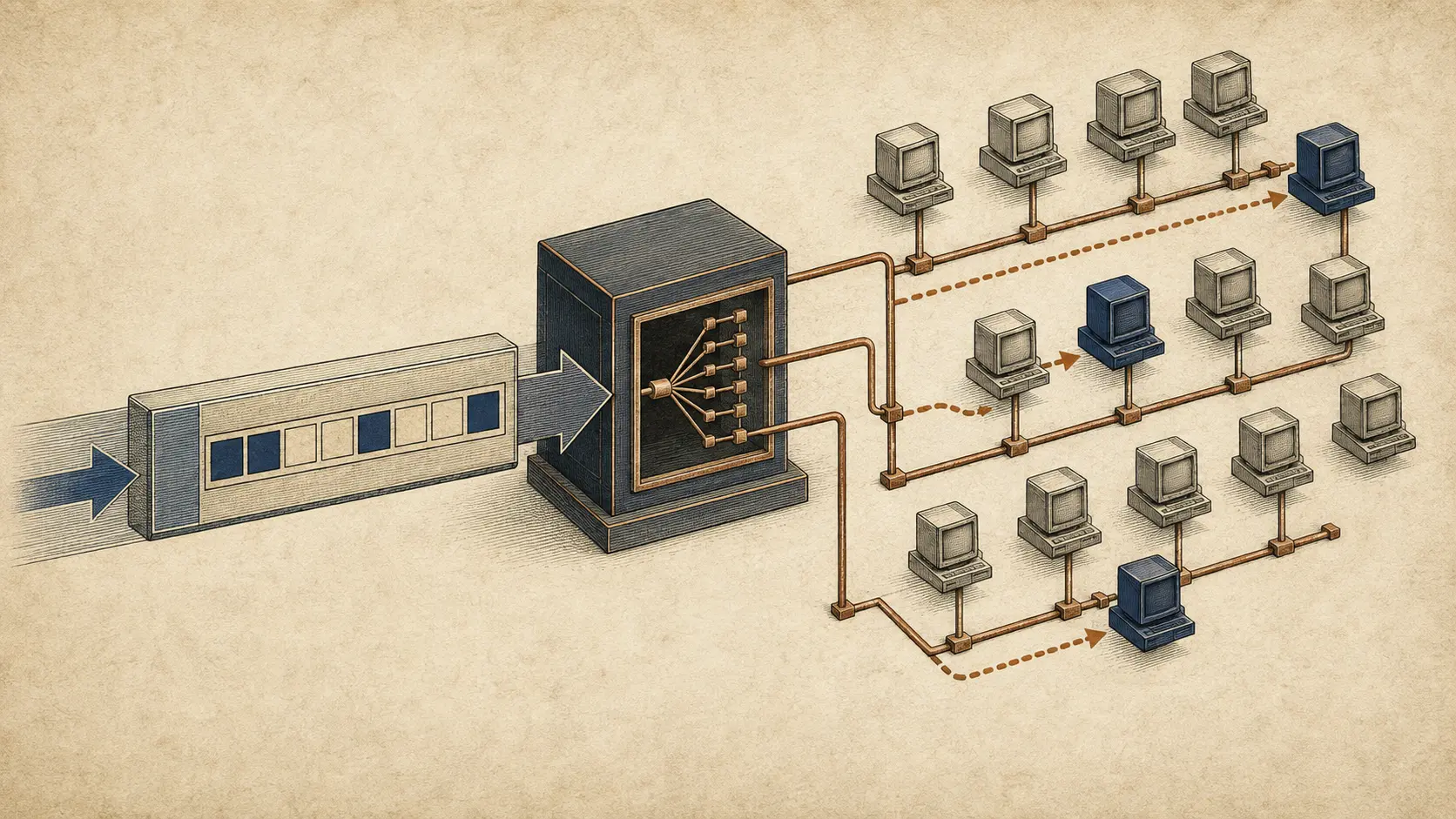
One UDP datagram approached a remote subnet as a broadcast, yet it carried a private instruction inside its IPv4 header: these hosts may listen; the others must stop. Selective Directed Broadcast Mode tried to make the packet itself serve as a temporary membership list.

IETF
The review workbook had answers in every cell: identifiers listed, observers named, retention discussed, defaults justified. What it did not have was a truthful final cell marked “safe”. Alissa Cooper and her co-authors designed RFC 6973 to make privacy reasoning inspectable, not…

Story
APNIC 62 opened its SIG ballot online on 8 September. That describes the voting medium, not the electorate: an individual conference attendee still has to be in Mumbai, check in at the registration desk and show a record of participation in an earlier APNIC or APRICOT meeting.…

IETF
A buyer reviewing certificate operations asks a simple question: if DNS authorizes one certification-authority name with an account and a validation method, does that restriction govern every issuing system behind the name? RFC 8657 makes the answer consequential. A shared CA…

CASE FILE
Two extensions can solve much the same provisioning problem, use different XML namespaces and both deserve a place in the same public registry. That is not a defect in the catalogue. It is the governance fact the catalogue must preserve.

Story
A policy clock is useful only when the institution and its community can identify the event that started it. AFRINIC's current Consolidated Policy Manual starts its six-month implementation expectation at the end of Last Call. AFRINIC's current public explanation starts it at…

IETF
A requirements scanner finds `MUST` in a specification and reports certainty. It has found a word, not yet an obligation. Barry Leiba’s RFC 8174 drew a clean boundary around the special vocabulary of BCP 14, but the boundary works in both directions: capitals activate defined…

CASE FILE
A coalition may be able to reconnect civilians after a shutdown or damaged network. Its first hard problem is not the satellite terminal, fibre route or radio link. It is deciding who may ask the coalition to act, who can lawfully say yes, what may be done, and how the public…

IETF
Web Push can spare a returning device a backlog of obsolete updates. The difficult decision is not how to replace a waiting message, but which information the business can afford to leave behind.

CASE FILE
Bundle-in-Bundle Encapsulation gives a delay-tolerant network two journeys to observe. The outer bundles can reach their configured endpoint one by one, each with a valid delivery report, while the bundle carried inside them never reaches the Bundle Protocol Agent. The new DTN…
Session Map
Five regional sessions tracking allocation policy, board legitimacy, and institutional continuity.
Open RIR WatchdogLong-cycle governance dossiers with legal, election, and institutional stress analysis.
Open Case FileMembership, charter, and resource-governance intelligence from the NRS ecosystem.
Open NRS SessionDNS coordination, accountability frameworks, and global multi-stakeholder process dynamics.
Open ICANN SessionProtocol standardization trajectory and interoperability risk under fragmented policy conditions.
Open IETF SessionLong-cycle infrastructure history used for governance interpretation and structural forecasting.
Open History SessionOperator-level implementation intelligence from APRICOT plus regional and national NOG ecosystems.
Open NOGs Session