
RIR Watchdog
Five regional sessions tracking allocation policy, board legitimacy, and institutional continuity.
Open RIR WatchdogGovernance
The internet runs on institutions most people never see. We follow the regional registries, ICANN, the IETF and the operator communities through every board vote, policy fight and court case, and tell you what each move means for your network.

Latest Coverage
9,349 articles

ICANN
ICANN’s accountability architecture is often described as a system of checks and balances. In practice, it is better understood as three distinct routes with different triggers, eligible users, reviewers and possible effects. The difference matters when a decision affects an…

IETF
A sender can now begin carrying a JPEG 2000 image while that image is still being encoded. That is a useful reduction in one waiting stage. It is not a receipt for the time at which a receiver recovered, decoded and displayed a usable picture.
IETF
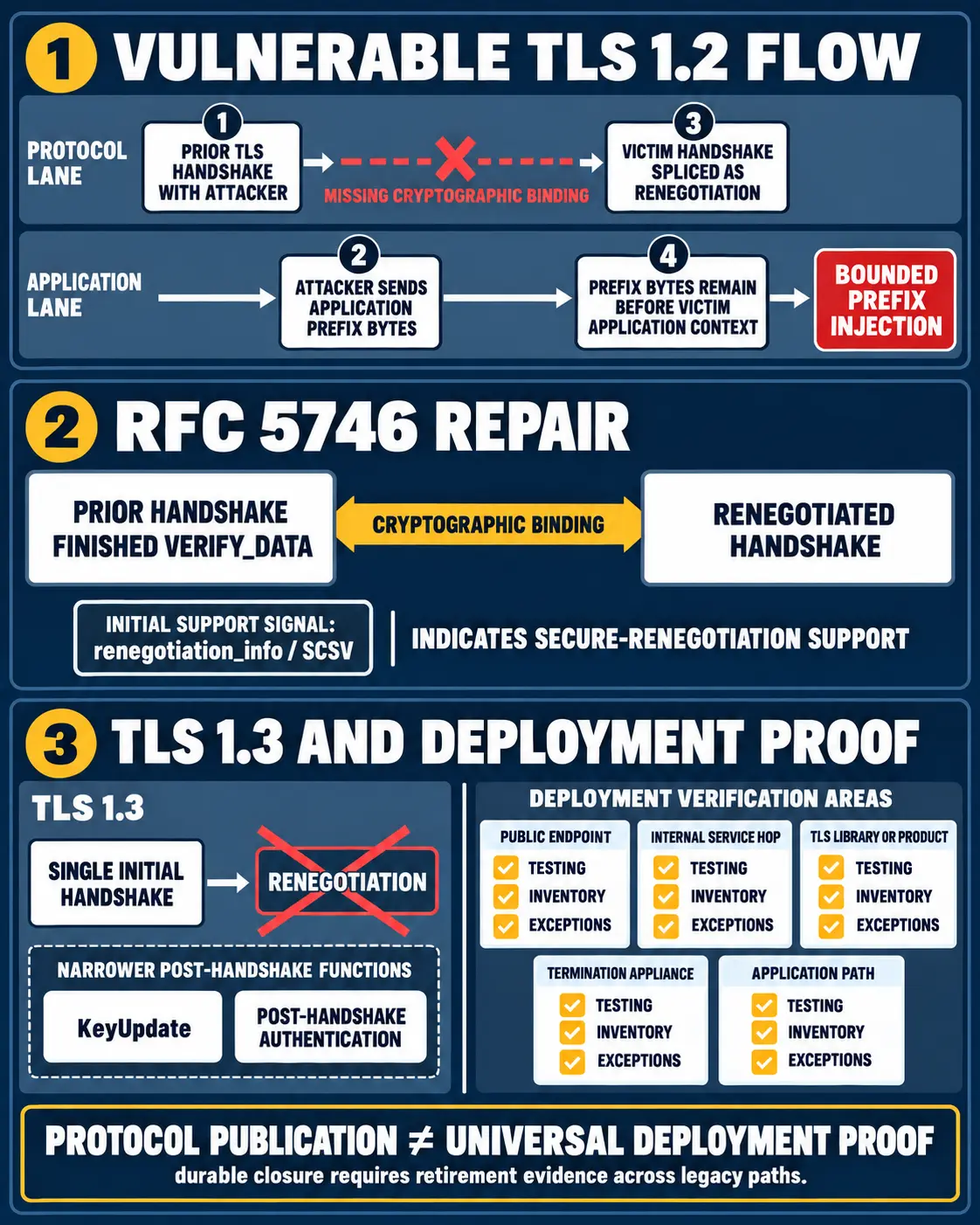
The IETF repaired a dangerous ambiguity in TLS renegotiation. That repair changed the protocol. It did not, by itself, prove that every older library, appliance, endpoint and application path had stopped accepting the unsafe behavior.

IETF
`draft-ietf-netconf-privcand-10` gives each client a private place to prepare configuration and a defined way to detect and resolve overlap before commit. The operational mistake would be to let isolation, an empty comparison or a successful merge inherit authority over…

History
At 02:13, a Zeek row can look wonderfully complete: two addresses, two ports, a protocol, duration, byte counts, state and a compressed history. The temptation is to promote that row from an observation into a transcript. Vern Paxson’s architecture made the row useful precisely…

IETF
A CMC request can cross HTTP successfully and still be pending, rejected or incomplete at the certificate authority. RFC 10003 gives the carrier a precise form; RFC 10002 gives the PKI operation its result. Governance fails when those two receipts are collapsed into one green…

Story
DAOport’s RIPE NCC Membership Shows Governance Access, Not Yet an Operating Network intelligence summary explains the development, the public evidence available to readers, the organisations involved, the regional context, market exposure, and the infrastructure consequences that…

IETF
Revision 01 of a proposed RPKI-to-router message now tells a cache how to withdraw all or part of a Mapping Origin Authorization and tells a router when stale MOA data must disappear. That is useful state discipline. But the draft places the order and fallback between MOA and…

CASE FILE
The Internet Society’s public governance record points to a layered institution rather than a single source of power. Its articles of incorporation, bylaws, Board of Trustees and the District of Columbia nonprofit statute occupy different positions in that structure. The…

History
Nimrod’s sharpest scaling decision was to abandon the comforting fiction of a single, complete map: knowledge could be partial, private and stale, provided that a chosen path did not depend on every router improvising from a different picture.

IETF
RFC 9827 gives IKEv2 a broader and more honest contract for packet sequence numbers. The selected Transform ID describes what should be true when an SA's packets enter the network; it does not certify sender coordination, receiver anti-replay policy, the packet stream that…

Story
LACNIC’s ASPA Explainer Cites a Moving Percentage Without a Snapshot intelligence summary explains the development, the public evidence available to readers, the organisations involved, the regional context, market exposure, and the infrastructure consequences that may follow.…

IETF
RFC 10011 allows a RESTCONF service to sit behind an external TLS terminator. That is not a relaxation of the security model. It is a relocation of the place where encrypted transport and authenticated identity become an administrative claim—and a warning that the terminator, the…

History
RFC 1973 did not make Frame Relay trustworthy. It made a point-to-point conversation legible enough for two peers to notice when the conversation had changed shape—and to begin again before silence became a black hole.

IETF
In 2002, Joyce Reynolds gave an old standards document a more honest job. RFC 1700 would remain a durable record of what the Assigned Numbers tables looked like in 1994, but it would no longer impersonate the changing registry that engineers actually needed.

Story
AFRINIC's daily file gained two IPv4 records on 9 September. The tempting story is two new allocations. The rows tell a more useful one: a conserved block changed shape.

IETF
`draft-ietf-opsawg-scheduling-oam-tests-07` makes network diagnosis programmable as timed, ordered test sequences. The discipline begins when operators refuse to let a stored plan, a green status or a returned metric stand in for the execution, causality, authority and outcome…

IETF
Revision 07 of an individual IETF process draft adds only one short paragraph on conflicts of interest. The paragraph is enough to expose a larger design problem: the IETF has several concrete conflict policies, but each belongs to a defined body or corporate role. A general…

IETF
Three BGP fields can carry the same 32-bit value and still answer different questions. RFC 9832 supplies an ordered mechanism for classful transport; operators still need a chain of receipts proving which namespace, attribute, database, fallback and forwarding state actually…

IETF
A single bit can remove ambiguity from routing data without proving that a single request will succeed. RFC 9983 gives OSPFv2 an explicit way to mark a prefix as anycast, but it also draws an unusually useful governance line: the mark states how the prefix is intended to be…
Session Map
Five regional sessions tracking allocation policy, board legitimacy, and institutional continuity.
Open RIR WatchdogLong-cycle governance dossiers with legal, election, and institutional stress analysis.
Open Case FileMembership, charter, and resource-governance intelligence from the NRS ecosystem.
Open NRS SessionDNS coordination, accountability frameworks, and global multi-stakeholder process dynamics.
Open ICANN SessionProtocol standardization trajectory and interoperability risk under fragmented policy conditions.
Open IETF SessionLong-cycle infrastructure history used for governance interpretation and structural forecasting.
Open History SessionOperator-level implementation intelligence from APRICOT plus regional and national NOG ecosystems.
Open NOGs Session