
Summary
- TLS 1.2 renegotiation could splice a later handshake onto an existing connection without cryptographically binding the two handshakes, enabling a bounded prefix-injection attack.
- RFC 5746 supplied secure-renegotiation signaling and binding material; TLS 1.3 removed renegotiation, but neither standard publication nor protocol design proves universal deployment closure.
The accountability question is not whether the IETF published a repair. It is whether operators and product owners can show that the vulnerable behavior has disappeared from the paths that still matter.
The failure was a handoff problem inside one connection
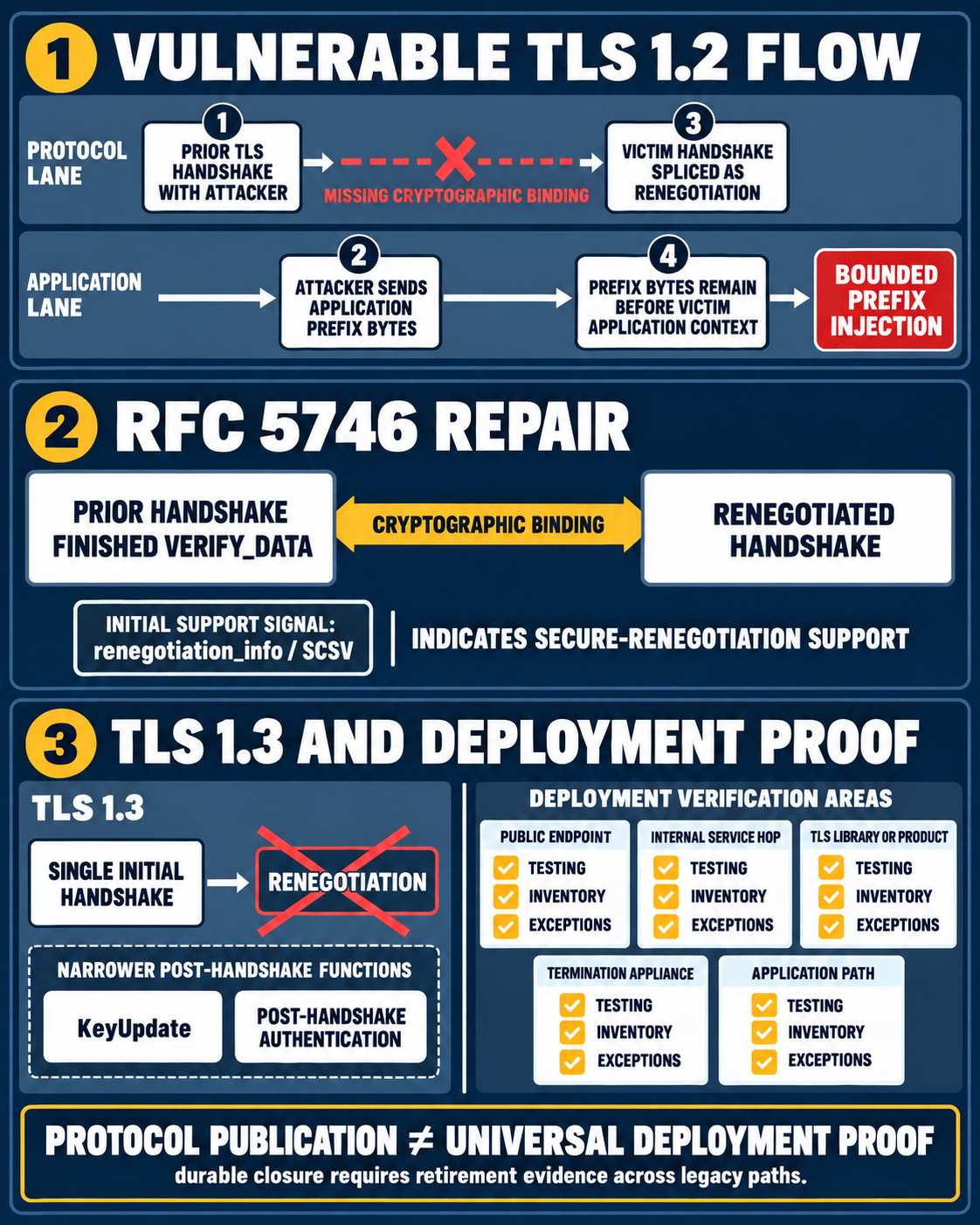
Older TLS renegotiation allowed a new handshake to occur over an existing TLS connection without binding the new handshake to the cryptographic context of the first one. The protocol therefore left room for a server to treat application bytes sent before a victim’s renegotiated handshake as part of the victim’s authenticated session.
The attack described in the IETF’s security analysis was bounded. It was not a universal decryption capability or an arbitrary rewrite of all later traffic. The attacker established a connection, sent a prefix, and caused a victim handshake to be spliced into that same connection as renegotiation. The vulnerable application could then associate the attacker’s preceding bytes with the victim’s authenticated context. The IETF’s attack analysis describes the prefix-injection mechanism and its limits.
That distinction matters operationally. A protocol flaw can be narrow in what it permits and still be serious when the affected connection carries authorization, request routing or application-layer state. The relevant control question is not simply whether encryption is present. It is whether the protocol proves that the new authenticated context belongs to the same cryptographic history as the old one.
RFC 5746 repaired the protocol relationship
RFC 5746 introduced secure-renegotiation mechanisms for the transition. During the initial handshake, implementations could signal support using the renegotiation_info extension or the TLS_EMPTY_RENEGOTIATION_INFO_SCSV signaling cipher suite value. During renegotiation, the protocol carried verify_data from the prior handshake so that the new handshake could be cryptographically tied to the earlier one. RFC 5746 specifies the secure renegotiation extension, signaling transition and binding behavior.
The important distinction is between signaling and binding. A signal indicates that an implementation supports secure renegotiation. The prior handshake’s Finished verify_data supplies the material that connects the renegotiated handshake to its cryptographic predecessor. Treating those as one undifferentiated feature makes it harder to test the repair accurately and easier to mistake capability advertising for proof of correct behavior.
The surrounding IETF guidance also shows why the repair could not be reduced to a single publication event. RFC 5246 defined the TLS 1.2 handshake context in which renegotiation was relevant, while RFC 7525 and its later revision RFC 9325 retained guidance about the risks of older TLS versions and the preference for stronger protocol choices. The TLS 1.2 specification provides the protocol baseline. The earlier operational guidance records the transition risks around older TLS deployments. The later guidance updates recommendations for contemporary TLS use while preserving the legacy-transition problem.
TLS 1.3 removed the old renegotiation path
TLS 1.3 took a different route: it removed renegotiation rather than trying to preserve the earlier mechanism with a stronger binding. It retained narrower post-handshake functions, but those are not a general restoration of TLS 1.2 renegotiation. The TLS 1.3 specification describes the removal of renegotiation and the remaining post-handshake mechanisms.
This is a useful example of protocol repair through reduction. Removing an unsafe state transition can make the security property easier to reason about. It does not make the installed base disappear. A TLS 1.3 front end may coexist with older internal service hops, a legacy library, a termination appliance or an application path that still negotiates older behavior. The standards record establishes what the protocols specify. It does not establish the configuration of any named operator or universal retirement of vulnerable behavior.
The deployment boundary is where accountability changes hands
The IETF controls the design and publication of standards. Implementers translate those standards into libraries, products and appliances. Operators select versions, configure termination points, maintain inventories and decide when exceptions can remain. Application owners determine whether a protocol capability is reachable through dependent paths and whether a safe replacement has been tested.
Those responsibilities overlap, but they are not interchangeable. Publication of RFC 5746 does not prove that an implementation supports it correctly. A product release does not prove that every deployed instance runs that release. A modern public endpoint does not prove that an internal hop or application-specific connector is equally modern. A policy that forbids unsafe renegotiation does not prove that an untracked exception has been removed.
A durable closure case therefore needs several independent forms of evidence: endpoint testing that observes negotiated behavior; an inventory linking services to libraries, products and termination layers; named owners for exceptions; and retirement evidence for systems that cannot be upgraded. The surfaces should be checked independently rather than treated as one chain. Otherwise, a compliant edge can conceal a legacy dependency behind it.
The public record supplied for this briefing does not establish universal RFC 5746 deployment, complete retirement of unsafe legacy behavior or the current configuration of a named operator. That uncertainty is not a weakness in the standards record. It is the point at which a standards success becomes an operational accountability question.
Member Briefing
Deeper Profile Context
Sign in with the right membership level to unlock the full briefing and source notes.
Only for Strategic Circle
Strategic Circle
Open to all readers. Unlock profile briefings after joining and signing in.
Join Strategic CircleOnly for Leadership Alliance
Leadership Alliance
For qualified IP-asset owners and management; sign in to unlock alliance briefings.
Join Leadership Alliance