
Policy continuity, legitimacy, and accountability signals across internet governance institutions.
Governance
Governance
Internet governance intelligence tracks institutions, policy processes, standards activity, registry operations, accountability disputes, and implementation signals that affect internet infrastructure. BTW.
RIR WatchdogCase FileNumber Resource SocietyICANNIETFHistory of InternetNOGs

RIR Watchdog, Case File, NRS, ICANN, IETF, History of Internet, and NOG sessions.
Coverage prioritizes implementation evidence and institutional behavior over declarative positions.
Latest Coverage
Latest from Governance
8,124 articles

CASE FILE
SC-104 Would Move AIA from MUST to SHOULD. Its Two Methods Stay Different
A two-line certificate-profile ballot exposes a larger evidence problem. SC-104 would relax the outer requirement for Authority Information Access, but it would not equalise the two services that may sit inside it—and neither the ballot nor the certificate alone can say what a…

CASE FILE
The Controller Had a Framework. The Deterministic Service Was Not Yet There: RFC 9938
RFC 9938 maps the work a DetNet Controller Plane may need to do. It does not publish the protocol solution, admit a real flow, retain a reservation at every hop or certify a customer's result.

CASE FILE
A Delegated LSP Was Not a Delegated Network
RFC 9504 makes a stateful PCE more useful in GMPLS networks. It does not turn a protocol exchange into an institutional transfer of authority, or a desired LSP into an operating service.

History
The Route Requested the Circuit. It Had Not Made One: RFC 1306
A route can name a direction for a packet and, in one historical experiment, it could also trigger a request to an external switch. Neither act put a usable circuit under the packet. RFC 1306 is valuable because it keeps the states visible: lookup, request, attempted…

NPNOG
Five Minutes for Recognition: How Sponsor Visibility Enters npNOG’s Technical Clock
npNOG-11 put sponsor recognition on the conference clock in three five-minute blocks. That makes commercial visibility measurable. It does not, by itself, show that sponsors controlled what the technical programme said.

CASE FILE
The Algorithm Was Advertised. The Path Still Had to Be Computed: RFC 9502’s IP Flex-Algorithm Boundary
An IGP can publish an algorithm number, a definition, a participating node and a reachable prefix with great precision. Those records matter. They can still be mistaken for a journey that has not happened. RFC 9502 is useful because it makes the missing work visible: a usable IP…

History
The Server Said 250. The Account Might Not Exist: RFC 1204
In RFC 1204, a positive reply to a username was designed not to answer the obvious question. A message-posting server was advised to say `250` when the name was syntactically sound even if it did not recognise the account. The ambiguity protected the user database. Only the next…

IETF
Bob Briscoe and the L4S Mark That Did Not Prove Low Latency
An IP packet can carry the L4S identifier all the way across a network even when one operator deliberately sends it through the Classic queue. That is not a contradiction. It is the clue that a packet's declared treatment, its actual queue and its measured delay are three…

IDNOG
IDNOG's 2024 Platinum Package Priced a Product-Presentation Slot
IDNOG's published 2024 package reserved a 20-minute opportunity to present a sponsor's products for its top paid tier, creating a commercial route into conference attention that its public record does not clearly separate from the Program Committee route for other speakers.

CASE FILE
The Recipient Key Was Named. The Message Had Not Been Opened: RFC 9936
CMS can now carry an ML-KEM recipient path under RFC 9936. An inspectable recipient record can identify a certificate or public key and the ciphertext made for it; it cannot, by itself, certify private-key custody, successful local processing or an organizational decision.

CASE FILE
Internet Society Can Appoint Three Trustees Without a Public Call
Internet Society’s new procedure puts real discipline around an exceptional Board power, but it leaves one consequential choice behind the curtain: the professional search may proceed without a public call. Candidate privacy can remain intact while the route, funnel and final…

History
The Agent Said It Supported the Module. It Had Not Authorized the Change: RFC 1303
An operator can learn a great deal from a device that describes its management surface. It may tell a station which MIB groups it implements, which entities are unavailable, which values it can read, and which values it will accept in a write. That knowledge prevents a management…

IETF
An SD-JWT Credential Can Inherit a Type. It Cannot Inherit Issuer Authority
A digital credential can carry a valid signature, match a familiar type and inherit rules from that type's metadata. None of those facts answers the institutional question of whether this issuer was entitled to make this credential. The IETF's latest SD-JWT VC draft draws that…

CASE FILE
A Bundle Was Received. That Did Not Establish Custody: RFC 9171’s Assurance Boundary
In a delay-tolerant network, the word *received* can sound more conclusive than it is. A node has a copy. A status report may say so. A dashboard may turn that report green. But receipt is not a transfer of custody, a promise to retain the copy, proof that a destination…

CASE FILE
The Prefix Was Registered. The Route Was Still a Local Commitment: RFC 9926
A registered IPv6 prefix can be an important routing fact inside a low-power network. It is not a public title to the prefix, proof that every router accepted a path, a delivery receipt, or evidence that a service behind it worked.
History
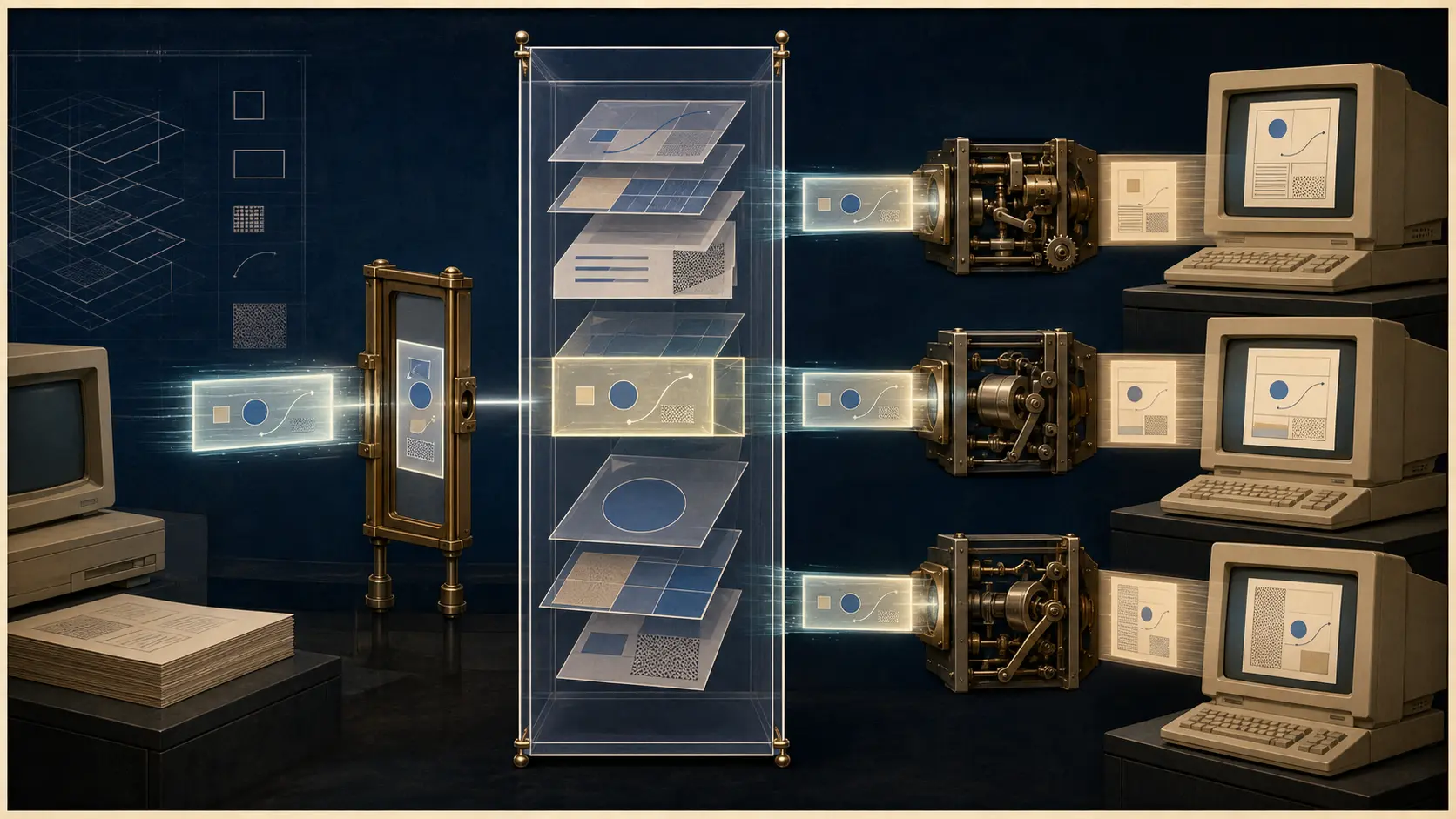
A Paragraph Was Not One of the Standard’s Words: RFC 1197 and the Missing Application Profile
In 1990, a document could be perfectly legible to an international encoding standard and still lack a shared idea of a paragraph. RFC 1197 recorded why that was not a contradiction. Office Document Architecture supplied an abstract model; useful exchange required a narrower…

IETF
Kent Watsen and the UDP Model That Did Not Record the Running Socket
A management system can hold a perfectly valid UDP endpoint configuration while the machine is listening somewhere else—or nowhere at all. RFC 9984 makes the common vocabulary portable, but it deliberately leaves the runtime testimony to the system that executes it.

History
The Ticket Was Not the Outage: RFC 1297's Memory Boundary
An outage does not pause at a shift change. It does not become one event merely because several people call about it, and it does not become repaired because somebody has recorded an escalation. In 1992, RFC 1297 treated the trouble ticket as something more modest and more…

CASE FILE
The Group Reached an Epoch. It Did Not Reach a Decision: RFC 9420’s MLS Boundary
A secure group can arrive at a new cryptographic state with impressive precision: a Commit has been processed, keys have advanced, the group context has changed and a new epoch exists. None of that, by itself, tells an organisation that its people have agreed, understood…

CASE FILE
ITU Gives NOC Two Meanings. One Underline Carries the Proposal
In the official PP-26 action legend, `NOC` can mean that no change proposal exists. Underline the same three letters and it becomes a proposal: a Member State is asking that specified text be maintained without change and should explain why. The distinction is defensible, and the…
Session Map
Governance Branch
RIR Watchdog
Five regional sessions tracking allocation policy, board legitimacy, and institutional continuity.
Open RIR WatchdogCase File
Long-cycle governance dossiers with legal, election, and institutional stress analysis.
Open Case FileNumber Resource Society
Membership, charter, and resource-governance intelligence from the NRS ecosystem.
Open NRS SessionICANN
DNS coordination, accountability frameworks, and global multi-stakeholder process dynamics.
Open ICANN SessionIETF
Protocol standardization trajectory and interoperability risk under fragmented policy conditions.
Open IETF SessionHistory of Internet
Long-cycle infrastructure history used for governance interpretation and structural forecasting.
Open History SessionNOGs
Operator-level implementation intelligence from APRICOT plus regional and national NOG ecosystems.
Open NOGs Session