
Policy continuity, legitimacy, and accountability signals across internet governance institutions.
Governance
Governance
Internet governance intelligence tracks institutions, policy processes, standards activity, registry operations, accountability disputes, and implementation signals that affect internet infrastructure. BTW.
RIR WatchdogCase FileNumber Resource SocietyICANNIETFHistory of InternetNOGs

RIR Watchdog, Case File, NRS, ICANN, IETF, History of Internet, and NOG sessions.
Coverage prioritizes implementation evidence and institutional behavior over declarative positions.
Latest Coverage
Latest from Governance
7,695 articles

ICANN
ICANN’s Authority Is a Chain, Not a Sovereign Grant
ICANN can shape the global identifier system without possessing a general public-law mandate over the internet. Its authority changes form as it moves from corporate purpose to Bylaws, from multistakeholder policy to contractual obligation, and from contract to technical…

Number Resource Society
AS210837’s Continuity Question Is an Evidence-Chain Problem
AS210837’s Continuity Question Is an Evidence-Chain Problem intelligence summary explains the development, the public evidence available to readers, the organisations involved, the regional context, market exposure, and the infrastructure consequences that may follow. The Number…

CASE FILE
The Paths Were Paired. The Round Trip Was Not Proven: RFC 9854
RFC 9854 gives a low-power network two related route discoveries when one radio direction cannot stand in for the other. That pairing prevents control state from being confused; it does not turn two temporary graphs into evidence that a request went out, a response came back, and…

Number Resource Society
AS210057’s visible network footprint still stops short of proving who operates it
AS210057’s visible network footprint still stops short of proving who operates it intelligence summary explains the development, the public evidence available to readers, the organisations involved, the regional context, market exposure, and the infrastructure consequences that…

IETF
Roberto Peon and the HPACK Table That Remembered Fields but Never Cached a Response
A small integer can recover a long HTTP field inside one connection. It cannot say whether a response is fresh, reusable, authentic or even stored anywhere.

IETF
A Read-Only `<system>` Datastore Is Not an Immutable Effective Setting
RFC 10016 makes system-provided configuration visible inside NMDA. That visibility solves a provenance problem; it does not turn a device default into operator approval or a read-only datastore into an immutable outcome. The effective value can still change when hardware…
IETF
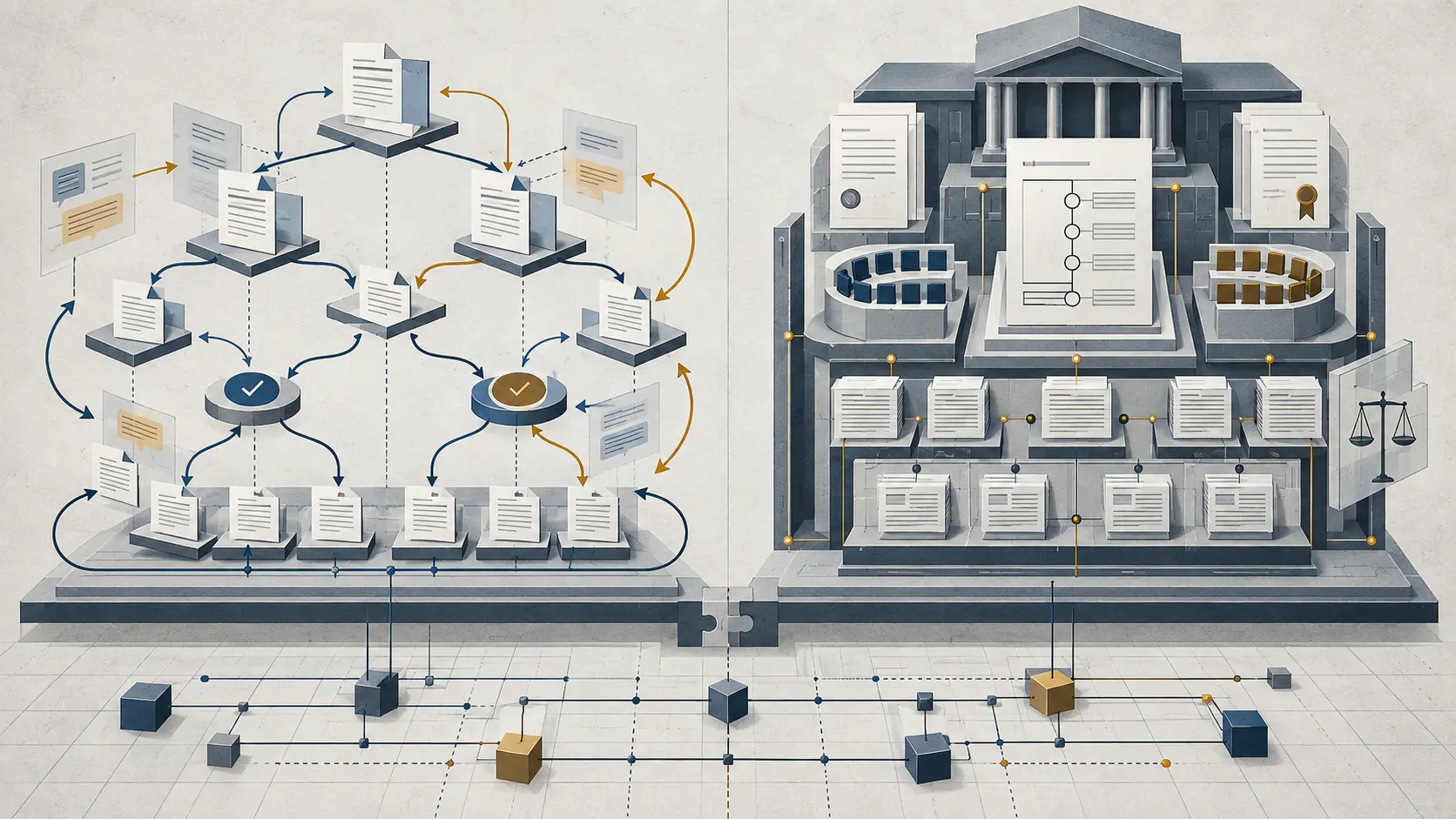
IETF-W3C Is Not One Institution: Authority Depends on the Instrument
The label IETF-W3C suggests a single governance center. The public record describes something more fragmented: the IETF standards process, the IETF Administration LLC, and W3C’s technical and membership structures assign different powers to different bodies. That distinction…

History
One Direction Lost the Dictionary. The Other Kept Moving: RFC 1962
A PPP link in 1996 could agree to compress traffic without pretending that its two directions were identical. RFC 1962 let each receiver say what it could decompress, let the reverse path make a different choice, and gave a damaged direction a reset exchange of its own. That…

IETF
A Live Debate Can Test Command. It Cannot Set the Author Record
An unscripted exchange can reveal whether a person understands a technical proposal. It cannot reveal who supplied each paragraph, where software assistance ended, or who accepted responsibility for the final text. A new Internet-Draft brings that distinction into the IETF’s…

Story
ARIN’s Open 1,024-Character Ticket Is Really About a Private Routing Grammar
An open ARIN suggestion asks for more room in an IRR remarks field. Its motivating case is not really about storage. Lumen documents a parser that can turn a marked remark into the effective membership of an AS-SET, overriding the field that ordinary RPSL readers expect to carry…

Story
RIPE ABUSE: Who Controls the Next Step After a Report?
RIPE ABUSE is often described as a contact point. That is accurate, but incomplete. The published abuse-c field creates a route into a responsibility chain: a report can be addressed to a resource holder or designated organisation, the mailbox can be tested by RIPE NCC, and a…

Story
APNIC and NIXI Cannot Close India’s ROV Plan With One Percentage
On 8 September, APNIC Labs could describe India’s observed ROV filtering as 1.14% or 6.03%. Both figures came from the same dated record. The difference was the window—and it is exactly why a national routing-security promise needs a receipt, not a headline number.

CASE FILE
The Controller Received the State. It Still Needed a Clock: RFC 9857
RFC 9857 gives external controllers a structured view of Segment Routing candidate-path state. The harder operational question begins after receipt: whose observation was it, which generation did it describe, and what later evidence shows that the reported state still governed…

IETF
Jon Callas and the OpenPGP Key ID That Never Identified One Unique Key
An eight-byte label can help a verifier find a key. It cannot make the candidate unique, bind the key to a person, or authorize the action that follows.

IETF
A Deprecated TLS Suite Is Not a Disabled TLS Endpoint
RFC 10015 changes what compliant TLS 1.2 and DTLS 1.2 implementations may offer or select. It does not reach into a listener, rewrite a proxy policy, reload a process or prove what was negotiated yesterday. Closing that gap requires evidence from the registry all the way to the…

History
No Memo Could Command the Network: RFC 1958 and the Right to Change
The most durable sentence in a document about architectural principles may be its warning that the principles will not endure. RFC 1958 treated the Internet less as a monument to be defended than as a city whose streets had to remain open while each block was rebuilt.

IETF
The Principal Signed the Delegation. The Issuer Still Bound the Agent Key
Two valid signatures can sit in one credential without answering the same question. A new AIC-JWT revision puts the principal’s authorization inside an issuer-signed token, yet draws a precise line between the Agent identity the principal authorized and the proof-of-possession…

IETF
Fresh Entropy Entered the Session. Recovery Still Needed Proof in Both Directions
TLS 1.3's ordinary KeyUpdate advances a secret already known to the current chain. The active Internet-Draft for Extended Key Update proposes something stronger: rerun the negotiated key exchange inside a live session and mix fresh input into the next traffic secrets. That can…

History
The URL Carried a Query, Not Its Authority: RFC 1959
In 1996, a directory lookup could be folded into a string short enough to paste into a document or hand to a web client. That convenience was exact but narrow. RFC 1959 could name a server, a place in the directory, the attributes to request, a search scope and a filter. It could…

IETF
A `_for-sale` Record Is a Listing Signal, Not Proof of Seller Authority
RFC 10023 gives a domain holder a public, machine-readable way to say that a name is available. The signal can open a negotiation; it cannot establish who may bind the seller, whether the stated price still applies, or whether a registrar will complete the transfer. Those states…
Session Map
Governance Branch
RIR Watchdog
Five regional sessions tracking allocation policy, board legitimacy, and institutional continuity.
Open RIR WatchdogCase File
Long-cycle governance dossiers with legal, election, and institutional stress analysis.
Open Case FileNumber Resource Society
Membership, charter, and resource-governance intelligence from the NRS ecosystem.
Open NRS SessionICANN
DNS coordination, accountability frameworks, and global multi-stakeholder process dynamics.
Open ICANN SessionIETF
Protocol standardization trajectory and interoperability risk under fragmented policy conditions.
Open IETF SessionHistory of Internet
Long-cycle infrastructure history used for governance interpretation and structural forecasting.
Open History SessionNOGs
Operator-level implementation intelligence from APRICOT plus regional and national NOG ecosystems.
Open NOGs Session