
Policy continuity, legitimacy, and accountability signals across internet governance institutions.
Governance
Governance
Internet governance intelligence tracks institutions, policy processes, standards activity, registry operations, accountability disputes, and implementation signals that affect internet infrastructure. BTW.
RIR WatchdogCase FileNumber Resource SocietyICANNIETFHistory of InternetNOGs

RIR Watchdog, Case File, NRS, ICANN, IETF, History of Internet, and NOG sessions.
Coverage prioritizes implementation evidence and institutional behavior over declarative positions.
Latest Coverage
Latest from Governance
7,582 articles

IETF
Four Buckets Did Not Make a Standard
Revision 00 of YANG Next Agreement turns a crowded GitHub issue pool into four decision lanes. That is useful scope control. It is not, however, a vote, a language specification or evidence that any tool or network can safely run what the lanes contain.

IETF
A Saved Congestion Window Is Not Reusable Capacity
A server remembers that yesterday’s connection moved quickly. A new connection arrives at the same address, so the server is tempted to start where the old one finished. The memory is useful, but the capacity is gone: another flow may occupy the bottleneck, anycast may have…

History
The Tokens Diverged. The Endpoint Was Still Unproven: RFC 2023
RFC 2023 gave early IPv6-over-PPP links a precise local bargain: establish the data link, enter PPP’s network phase, negotiate different 32-bit tokens, and only then admit IPv6. Every receipt in that sequence stopped short of identity, ownership, reachability and delivery.

Number Resource Society
AS211513: What the public record can—and cannot—establish about EBL
AS211513: What the public record can—and cannot—establish about EBL intelligence summary explains the development, the public evidence available to readers, the organisations involved, the regional context, market exposure, and the infrastructure consequences that may follow. The…

ICANN
Anne-Marie Eklund Löwinder and the Key That Could Not Sign the Root
The physical key in Anne-Marie Eklund Löwinder’s custody helped open one compartment in a carefully divided ceremony. Its significance lay not in the power it gave her, but in the power the surrounding system withheld from everyone acting alone.

History
RFC 2022: The Roster Named the Receivers, but the Packet Still Needed a Circuit
RFC 2022 did not turn an IP multicast group into one ATM connection. It split the problem in two: MARS reported the endpoints believed to be listening, while each sender still had to build and repair the one-way circuit that might reach them. The roster was actionable control…

Story
APNIC Will Automate Route-Record Alignment. The Roadmap Does Not Name the Conflict Winner
“Alignment” sounds like database housekeeping. In APNIC’s Q3 2026 roadmap, it means something harder: deciding how resource holdings, a route-management template, Whois route objects and RPKI authorizations should change when they disagree—and preserving enough evidence to show…

IETF
The Reply Came Back. It Did Not Prove the Path Was Measured: RFC 9779
RFC 9779 gives operators a standards-track way to measure loss and delay on SR-MPLS links and policies. Its most important operational lesson is less comfortable: a valid response can arrive by a route different from the traffic direction under examination. Protocol success, path…

CASE FILE
A Million Government URLs Can Show Dependency. They Cannot Prove Who Chose It
A new cross-country study compares the companies behind government websites with those serving commercial sites. Its distinction between market-shaped and government-specific concentration is a useful diagnostic. But an infrastructure measurement cannot identify the official who…

IETF
A Path Can Parse and Still Prove Almost Nothing: The Boundary Proposed by ypath
The Internet-Draft `draft-jgc-netmod-yang-path-00` proposes one compact path notation for YANG schema nodes, data instances and filters. Its value is precision at the interface. Its danger begins when a valid string is mistaken for evidence that the named node exists, the…

IETF
DSCP 45 Is a Behavioural Claim, Not a Low-Latency Entitlement
A packet carrying DSCP 45 can cross one router untouched, enter a shallow queue at the next, and be pushed into a classic queue at the bottleneck after that. The mark has not changed, but its meaning has passed through three different decisions. RFC 9956 makes the first…

Story
ARIN Let Consultant Hiring Advance Before the Control Plane Vote.
ARIN’s draft Board minutes preserve an awkward but legitimate sequence: outside-consultant hiring could keep moving while the Registry Control Plane itself awaited a detailed plan and a later approval meeting. The issue is not whether preliminary expertise is useful. It is how…
ICANN
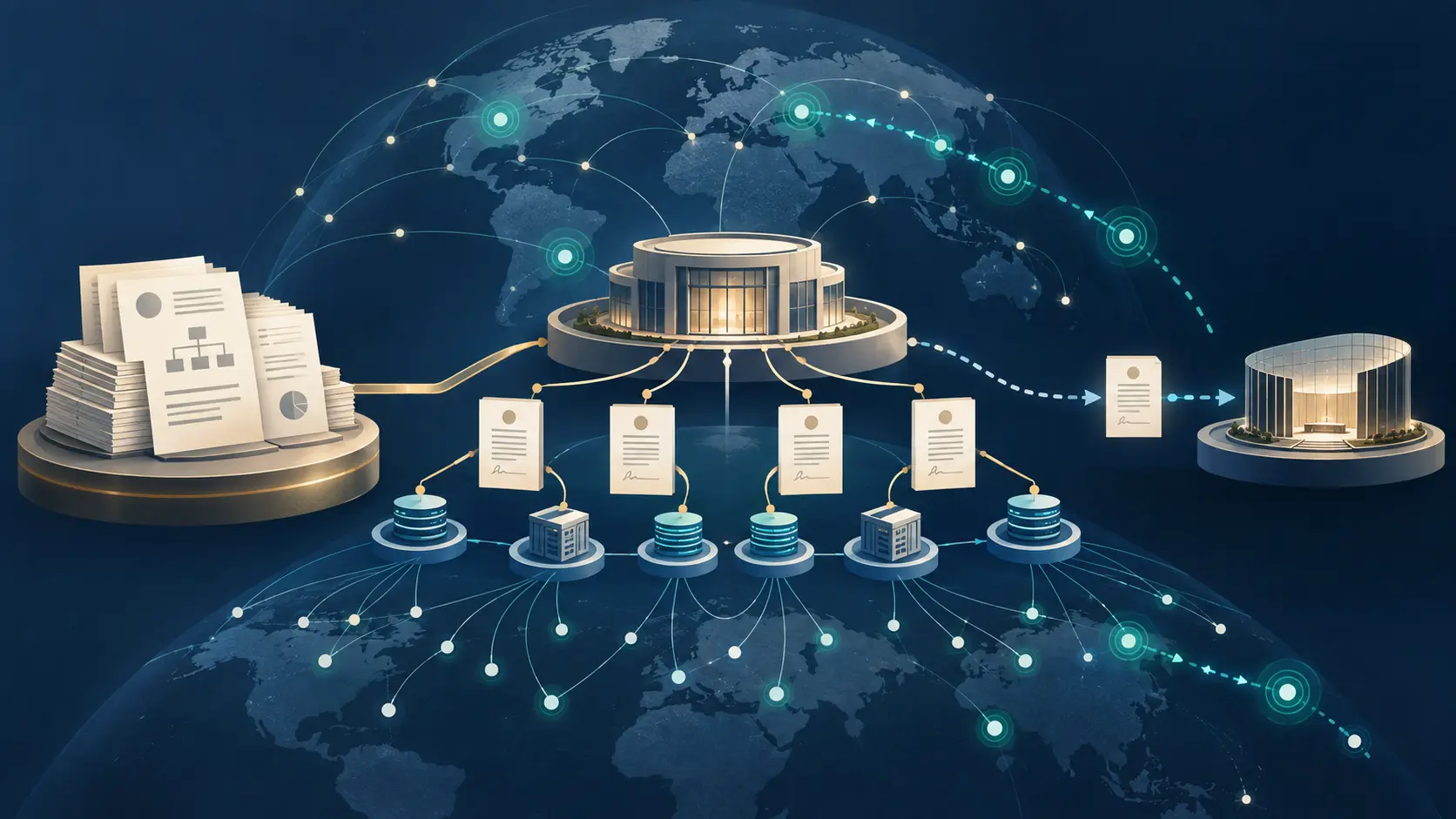
Where ICANN's Authority Becomes Operational Control
ICANN is often described as a coordinator of Internet identifiers. That description is accurate but incomplete. Its practical authority is assembled across several instruments: corporate purpose, Bylaws, registry agreements, registrar accreditation contracts, compliance…

IETF
The Schema Rejected the Sum. It Did Not Prove the Scope
A proposed YANG extension gives telemetry systems a disciplined reason to refuse an aggregation before it reaches a dashboard. That is a useful control. The harder question begins one step earlier: who proves that the scope written into the schema describes the network that…

History
The Catalogue Was Verified. The Training Material Could Still Be Gone: RFC 2007
In 1996, a volunteer directory tried to keep Internet training reusable by recording three different clocks: when a resource changed, when its catalogue entry changed, and when someone last checked it. RFC 2007 shows why those dates were useful—and why none was a promise about…

History
The Directory Could Name a Protocol. The Probe Still Had to Know Its Packets: RFC 2021
RFC 2021 made remote monitors configurable without pretending that a name in a table could replace packet-decoding code.

IETF
A Hybrid Signature Is Only as Hybrid as the Verifier That Accepts It
Imagine one signed procurement record arriving at two desks. The first verifier checks both component signatures and refuses to speak until both results are known. The second, kept alive for compatibility, checks the traditional component and ignores the other. The bytes are…

History
Steve Crocker and the Note That Stayed Provisional Long Enough to Build a Network
RFC 1 did not arrive after the network had proved itself. Steve Crocker dated it 7 April 1969, months before the first ARPANET node began service, and filled it with Host Software questions that still needed other sites to answer. Its authority lay not in pretending the design…

CASE FILE
Britain’s Under-18 Nude-Image Plan Crosses Devices and Apps. Its Duty Map Is Still Missing
The UK government says it will legislate so under-18s cannot take, view or send nude images, with protection extending from cameras to third-party apps. That is a whole-system objective announced before the whole system of duties. Until a bill assigns each action, signal, handoff…

Story
AIRRS Sends “amp;profile”. RIPEstat’s Real AFRINIC Profile Returns 500
A regional statistics portal can look complete while the choice that is supposed to make it regional never reaches the service under the expected name. AIRRS currently demonstrates that uncomfortable distinction: seven tabs can arrive, yet the evidence says they came through…
Session Map
Governance Branch
RIR Watchdog
Five regional sessions tracking allocation policy, board legitimacy, and institutional continuity.
Open RIR WatchdogCase File
Long-cycle governance dossiers with legal, election, and institutional stress analysis.
Open Case FileNumber Resource Society
Membership, charter, and resource-governance intelligence from the NRS ecosystem.
Open NRS SessionICANN
DNS coordination, accountability frameworks, and global multi-stakeholder process dynamics.
Open ICANN SessionIETF
Protocol standardization trajectory and interoperability risk under fragmented policy conditions.
Open IETF SessionHistory of Internet
Long-cycle infrastructure history used for governance interpretation and structural forecasting.
Open History SessionNOGs
Operator-level implementation intelligence from APRICOT plus regional and national NOG ecosystems.
Open NOGs Session