
Policy continuity, legitimacy, and accountability signals across internet governance institutions.
Governance
Governance
Internet governance intelligence tracks institutions, policy processes, standards activity, registry operations, accountability disputes, and implementation signals that affect internet infrastructure. BTW.
RIR WatchdogCase FileNumber Resource SocietyICANNIETFHistory of InternetNOGs

RIR Watchdog, Case File, NRS, ICANN, IETF, History of Internet, and NOG sessions.
Coverage prioritizes implementation evidence and institutional behavior over declarative positions.
Latest Coverage
Latest from Governance
7,552 articles

IETF
A Writable Port Map Needs an Override Receipt
The service orchestrator has found a promising attachment point. One reference tells it which physical port lies beneath the logical choice, and the next capacity query may decide whether the order proceeds. In the IETF’s new Last Call, that small reference is normally…

History
Qiheng Hu and the 64K Link That Needed Authority at Both Ends
By the end of 1993, the network was technically ready. Its domestic backbone joined three academic systems, its team had chosen TCP/IP, and the international circuit had been provisioned. Yet packets still did not cross. Qiheng Hu’s part in China’s full-function Internet…

IETF
A BMP Percentile Is Local Until Its Sampling Method Travels With It
A router can report a P95 that is correctly encoded, correctly attributed and still unsafe to compare with the P95 from the next router. The missing link is not another decimal place. It is the method that selected the observations from which the percentile was made.

IETF
OCM Can Remove a Member Without Rotating the File Key
A person disappears from a federated group. The membership tree advances, the remaining entities receive a new group secret, and the user no longer appears on the current roster. Yet the file they once opened may still be encrypted with exactly the same key. The first Open Cloud…

Story
ARIN’s 2026 Candidate Q&A Is for the Board, Not the Advisory Council
ARIN members will elect trustees and policy advisers in the same October ballot. Yet the only live candidate-questioning event on the current official calendar is expressly for one of those two elected bodies.

Story
LACNIC Asked for a Technical-Committee Charter. Its First Committee Ran the Registry.
LACNIC’s Board has found a sensible reason to create a technical committee and an equally sensible reason to fear one. Directors need a place to understand technologies that may reshape the registry. They do not need a second operations room. The distinction sounds obvious until…
History
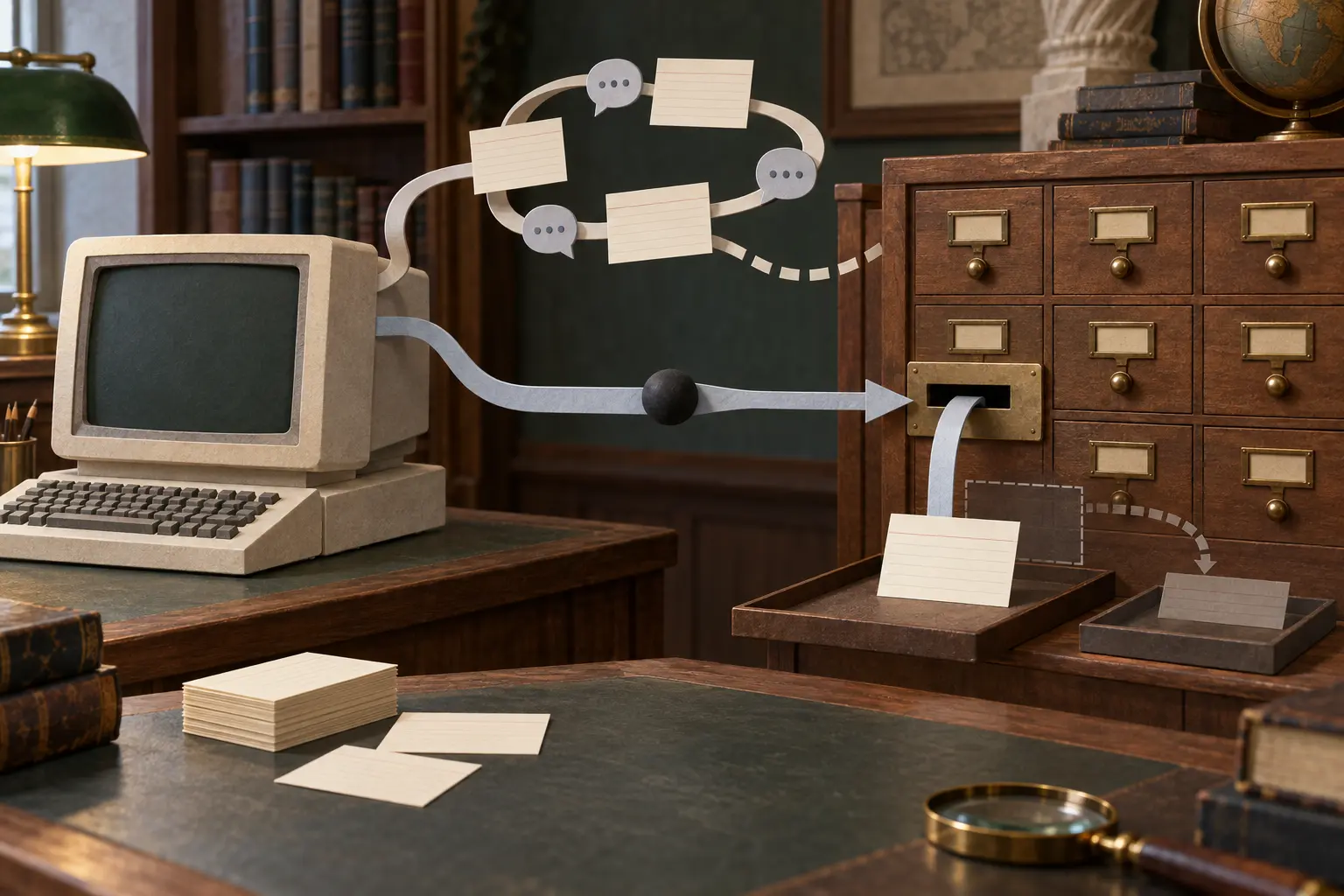
RFC 2056 and the Fork in a Z39.50 URL
In 1996, RFC 2056 gave two URL schemes to Z39.50 because one locator could conceal two very different kinds of work. One scheme entered a continuing, stateful inquiry; the other attempted a tightly bounded retrieval of a server-identified item. The distinction is a small piece of…

CASE FILE
RFC 9747: the neighbour returns a packet, not a health declaration
Unaffiliated BFD Echo removes the need for the far end to speak BFD. That useful simplification leaves the local operator owning both the test and the decision made from its result.

History
Jun Murai and the Address Space That Became a Trust
The number is oddly exact: 14,680,064 IPv4 addresses. They were neither a fresh registry allocation nor abandoned space waiting to be reclaimed. They were seven-eighths of an old Class A block, held through three decades of changing Internet institutions, and in 2020 Jun Murai…

IETF
IPv6-Only Is a Scoped Forwarding Claim, Not an IPv4 Decommission Certificate
The phrase “IPv6-only” sounds like a clean finish line. In an operating network it can describe something much narrower: one link natively forwards IPv6 while IPv4 still reaches users through translation, another plane remains dual-stack, and a management path still depends on…

History
The Walk Could Not Be Repeated: RFC 2041’s Contract Between Trace and Experiment
A wireless failure observed along one route could be taken back to a laboratory, but only after researchers decided what the record meant and which effects a wired testbed could reproduce. RFC 2041 made those decisions unusually visible.

IETF
OCM’s New WG Draft Makes Delegation Invisible to Peers
Open Cloud Mesh has taken a modular turn. Its newly adopted integration draft lets the server that represents a federation hand WebDAV, SSH or web-application work to other systems without telling the receiving side that delegation occurred. That is useful protocol transparency.…

History
Kilnam Chon and the Router Asia Could Not Buy
On 15 May 1982, two computers in South Korea began speaking across a 1,200 bps leased line. The connection was modest; the missing box beside it was more consequential. With no obtainable IP router, Kilnam Chon’s group treated published protocol documents as equipment they could…

Story
A Correct RIR Record Did Not Fix One Geo-IP Error After Two Months
An APNIC 62 case study exposed a small but consequential accountability gap: the registry data could be right, several geolocation databases could agree, and one downstream service could still send a customer to the wrong country.

IETF
A Valid CoSERV Result Is Not a Completeness Proof
A relying party asks for the reference material needed to judge attestation evidence. The query is deterministic, the response is signed, the contents are still valid and every cryptographic check succeeds. That is a strong result—but a bounded one. The exchange proves what was…

Story
ARIN Can Attach a Ticket to an Org ID. That Does Not Make It the Organization’s Decision.
ARIN fixed a mundane but costly support problem: staff no longer need to begin every ambiguous question by asking which organization it concerns. The resulting Org ID selector gives a ticket context and a durable home. That is good service design. It also makes one distinction…

History
The Zero Handle Opened a Door. It Did Not Grant Entry
In 1996, RFC 2054 tried to remove two conversations that stood between an NFS client and its first useful file reference. Its answer was not a new permission system. It was a disciplined gamble: try the port most servers already used, try the newer protocol first, and present a…

History
A Cipher Name Was Not Enough: RFC 2040 and the Missing Identity of RC5
RFC 2040 reads less like a manifesto for a cipher than a parts ledger for agreement. Its lasting historical value is the discipline with which it separates a family name from an executable identity: word size, rounds, key length, expanded state, chaining state and the rule used…

IETF
INTAREA Adopted a Registry Cleanup. IANA Has Not Applied It.
An Internet-Draft can acquire a working group without changing a single live registry. That is what happened on 11 September: INTAREA published its version of a proposal to close one legacy list, assign procedures to three others and remove a fifth. The institutional handoff is…

History
Kees Neggers and the Backbone Europe Built in Parallel
On 26 September 1992, one link between London and Montpellier completed Ebone’s initially defined backbone. The more revealing number was not its line rate but its age: 390 days since a small group had first met outside Amsterdam to ask whether Europe could operate a shared IP…
Session Map
Governance Branch
RIR Watchdog
Five regional sessions tracking allocation policy, board legitimacy, and institutional continuity.
Open RIR WatchdogCase File
Long-cycle governance dossiers with legal, election, and institutional stress analysis.
Open Case FileNumber Resource Society
Membership, charter, and resource-governance intelligence from the NRS ecosystem.
Open NRS SessionICANN
DNS coordination, accountability frameworks, and global multi-stakeholder process dynamics.
Open ICANN SessionIETF
Protocol standardization trajectory and interoperability risk under fragmented policy conditions.
Open IETF SessionHistory of Internet
Long-cycle infrastructure history used for governance interpretation and structural forecasting.
Open History SessionNOGs
Operator-level implementation intelligence from APRICOT plus regional and national NOG ecosystems.
Open NOGs Session