
Summary
- LACNIC’s public 2026 Board table lists six meetings from 23 January to 16 June and links six approved Spanish minutes totalling 24 pages, while every English
Summary of activitiescell is empty. - This is not evidence of missing minutes, missing decisions or concealment. It is a discovery problem: the landing page cannot tell a reader which meeting addressed an issue or where the controlling passage appears.
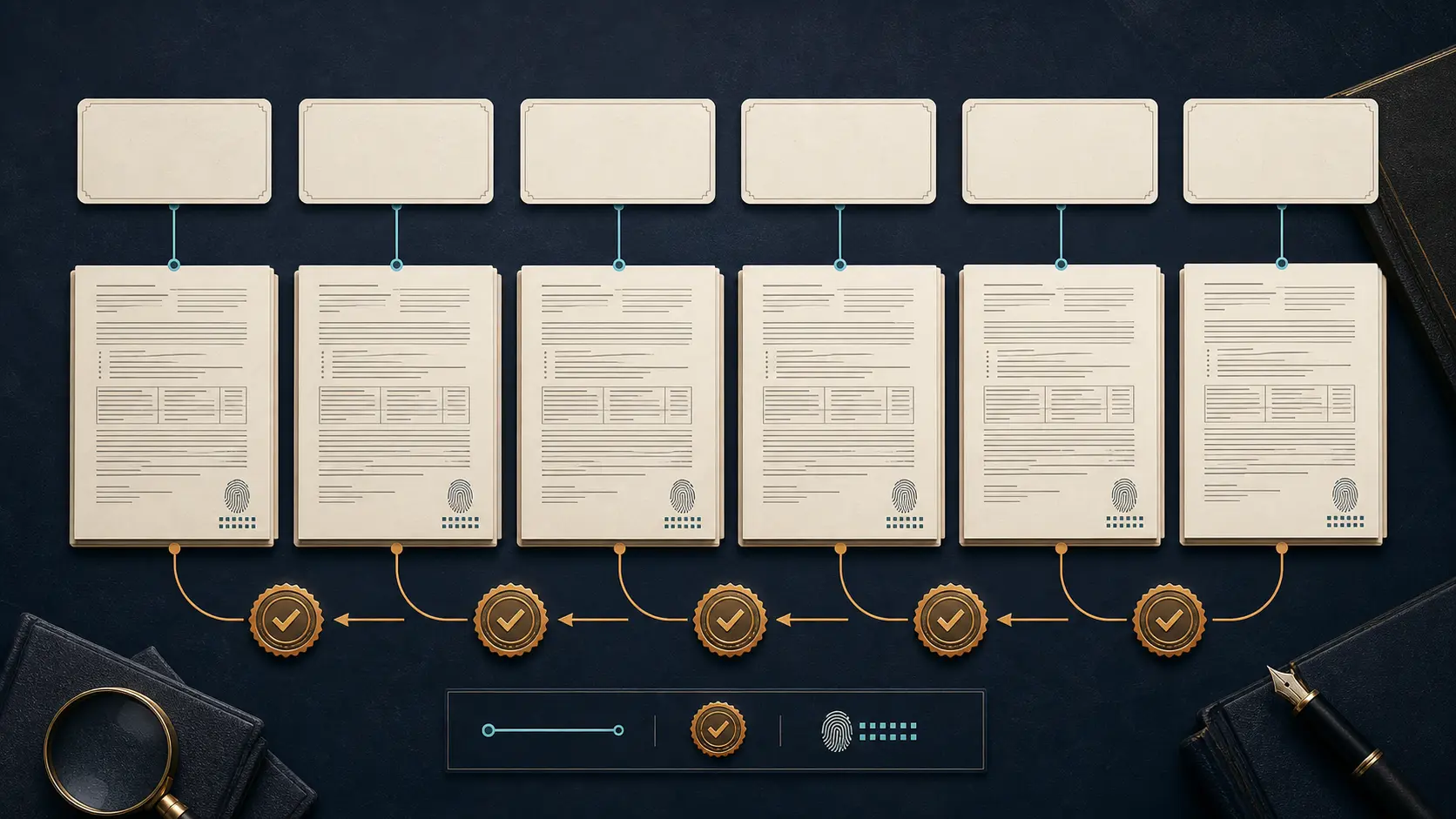
- The minutes reveal a later-approval chain that the table does not expose. Meeting date, drafting, approval, web publication, correction and replacement are different documentary states.
- A compact decision index should bind each issue to the authoritative minute, page or section, disposition, approval lineage, file fingerprint, masking state and correction history without becoming a substitute record.
The six rows look complete at first glance. Each has a meeting number and date. Attendance is displayed through yes/no images. The minutes column leads to a PDF. The table also offers a column expressly named Summary of activities.
Only the last of those fields is empty in every row. The public content record still showed the same six blank summary cells on 27 August 2026. Its linked minutes cover meetings held on 23 January, 23 February, 24 March, 21 April, 24 May and 16 June. The files contain three, seven, three, two, six and three pages respectively: 24 pages of published material, not six absent records.
That makes the narrow fact more important. LACNIC has done the difficult part of producing and publishing approved minutes. It has not completed the cheaper discovery layer that its own table appears designed to provide. A reader asking, “When did the Board consider this issue?” must download and search a set of files rather than follow an issue-level locator from the index.
Publication is not discovery
A document can be public and still be difficult to find from the question a reader actually has. The table answers meeting-level questions: when a meeting occurred, who is shown as attending and where its minutes can be downloaded. It does not answer issue-level questions: which agenda item concerned a named policy, whether the Board resolved, discussed, received information or deferred it, and where that treatment appears.
The distinction prevents two opposite errors. The first is to see an empty summary and report that the minutes are missing. They are not. The second is to see a PDF link and assume that publication alone makes each decision readily auditable. It does not. A link gives document access; it does not give the issue-to-passage join.
The minutes themselves use meaningful documentary classes. They separate prior minutes, resolutive matters, discussion, information and other business. Several contain passages explicitly labelled Resolución. The April minute contains discussion and information but no explicit Resolución: label in the extracted text. An index must preserve that difference. Absence of a resolution label is not permission to invent a resolution, and presence of discussion is not proof of a decision.
Approval runs on a second clock
The meeting date is not necessarily the approval date of its minute. The checked files expose a chain in which a later Board meeting approves an earlier record. That chain is evidence about documentary authority, not merely administrative delay.
| Minute for meeting held | Approval visible in the checked set | What the public table omits |
|---|---|---|
| 23 January 2026 | Approved unanimously on 23 February, together with the 8 December 2025 minute | Approval meeting, date and relation |
| 23 February 2026 | Approved unanimously on 24 March | Approval meeting, date and relation |
| 24 March 2026 | Approved unanimously on 21 April | Approval meeting, date and relation |
| 21 April 2026 | Approved unanimously on 16 June | Approval meeting, date and relation |
| 24 May 2026 | Approved unanimously on 16 June | Approval meeting, date and relation |
| 16 June 2026 | No later approval event appears in this six-file set | State remains unknown from the checked set |
The 24 May minute does not record approval of another minute in its extracted approval section. That does not break the chain; it shows why the chain cannot be generated by assuming that every meeting approves its immediate predecessor. Each relation must come from the relevant source passage.
Four clocks therefore need separate fields. A Board meets. A minute is drafted. A later meeting may approve it. A file is then made available or updated on the website. PDF creation and modification metadata do not establish that last public time. Folding all four into the meeting date produces a clean-looking chronology that the sources do not support.
The index should point, not rule
The smallest useful repair is not a generated retelling of 24 pages. It is a resolution-level discovery index whose entries remain subordinate to the approved file. Every short summary should lead to a specific agenda item, disposition and locator. If wording differs, the minute wins.
| Index field | Function |
|---|---|
| Content group and locale IDs | Joins the English, Portuguese and Spanish public surfaces |
| Meeting identity and date | Names the decision session without treating it as the approval date |
| Minute URL and SHA-256 | Identifies the exact bytes a reader reviewed |
| Web publication or update time | Separates public availability from meeting and approval |
| Approval meeting, date and state | Preserves the later authority chain |
| Agenda identifier and title | Allows issue-level discovery |
| Disposition | Separates resolution, discussion, information, pending and no action |
| Section or page locator | Sends the reader to the controlling passage |
| Source-faithful short summary | Aids search without replacing the minute |
| Masking state and reason category | Says present, absent or unknown for this file |
| Correction or supersession relation | Keeps old and new file identities intelligible |
| Cross-locale parity | Shows whether each public language exposes the same decision identity |
This is a thin coordination function. It does not give the index authority over the Board, invite another committee to interpret every sentence or turn a summary writer into a decision-maker. It preserves document identity and reduces the distance between a public question and the authoritative evidence.
File identity matters because a stable URL is not a version history. A reader can hash the bytes received today, but the current table does not publish a fingerprint, an attachment timestamp or a supersession relation. Without those fields, two readers who visited at different times cannot tell from the landing page whether they reviewed identical bytes. The checked record does not prove that any file was replaced; it proves only that the public surface cannot answer the question.
A generic masking notice is not a file state
The page says that masked text in online versions of certain Board minutes may protect privacy and personal data, confidentiality surrounding a specific matter or legal advice. That is a legitimate class of reason. It is not evidence that any passage in these six files was masked.
A useful index would assign each file or item one of three states: masking present, absent or unknown. Where present, it could disclose a reason category and authority without exposing the protected text. A generic disclaimer leaves the reader unable to distinguish “this minute contains a protected omission” from “the site carries a standing notice for other minutes”.
The same discipline applies to attendance. The public content response uses yes/no image assets for the directors but does not provide textual alternatives in that response. That observation supports a machine-readable text field in the index. It does not establish what every browser or assistive technology presents on the live client.
What the checked record cannot establish
The sources do not say why the six summary cells are blank, whether LACNIC intends to fill them, when each PDF link first appeared, whether a file has ever been replaced or how a correction would be announced. They do not identify which, if any, of these six minutes contains masked text. They also do not make PDF metadata a publication clock.
Nor does this review judge the legality, wisdom or operational effect of any substantive Board decision. The problem can be demonstrated without deciding whether a resolution was good. Publication and discoverability are separate documentary states; improving the second need not reopen the first.
Sources
Member Briefing
Deeper Profile Context
Sign in with the right membership level to unlock the full briefing and source notes.
Only for Strategic Circle
Strategic Circle
Open to all readers. Unlock profile briefings after joining and signing in.
Join Strategic CircleOnly for Leadership Alliance
Leadership Alliance
For qualified IP-asset owners and management; sign in to unlock alliance briefings.
Join Leadership Alliance