Summary
- ARIN's RPKI pages state that “only direct resource holders can participate in RPKI” and that “any downstream organization must have their upstream provider submit ROAs on their behalf”. The majority of RPKI users at ARIN use the hosted service, where ARIN holds the certificate authority and signs the ROAs.
- On 17 November 2026 ARIN added BGP announcement tools to ARIN Online: “allowing users to review and address their BGP announcements and their validity”. The release note runs to one sentence and describes no export, no threshold and no separate view for downstream customers.
- ARIN's RPKI adoption was 45.82% of IPv4 and 62.30% of IPv6 on 27 November 2026, against 77.82% and 46.38% at the RIPE NCC — a 32.00-point IPv4 gap between the two registries whose IPv4 histories differ most.
One level, by design
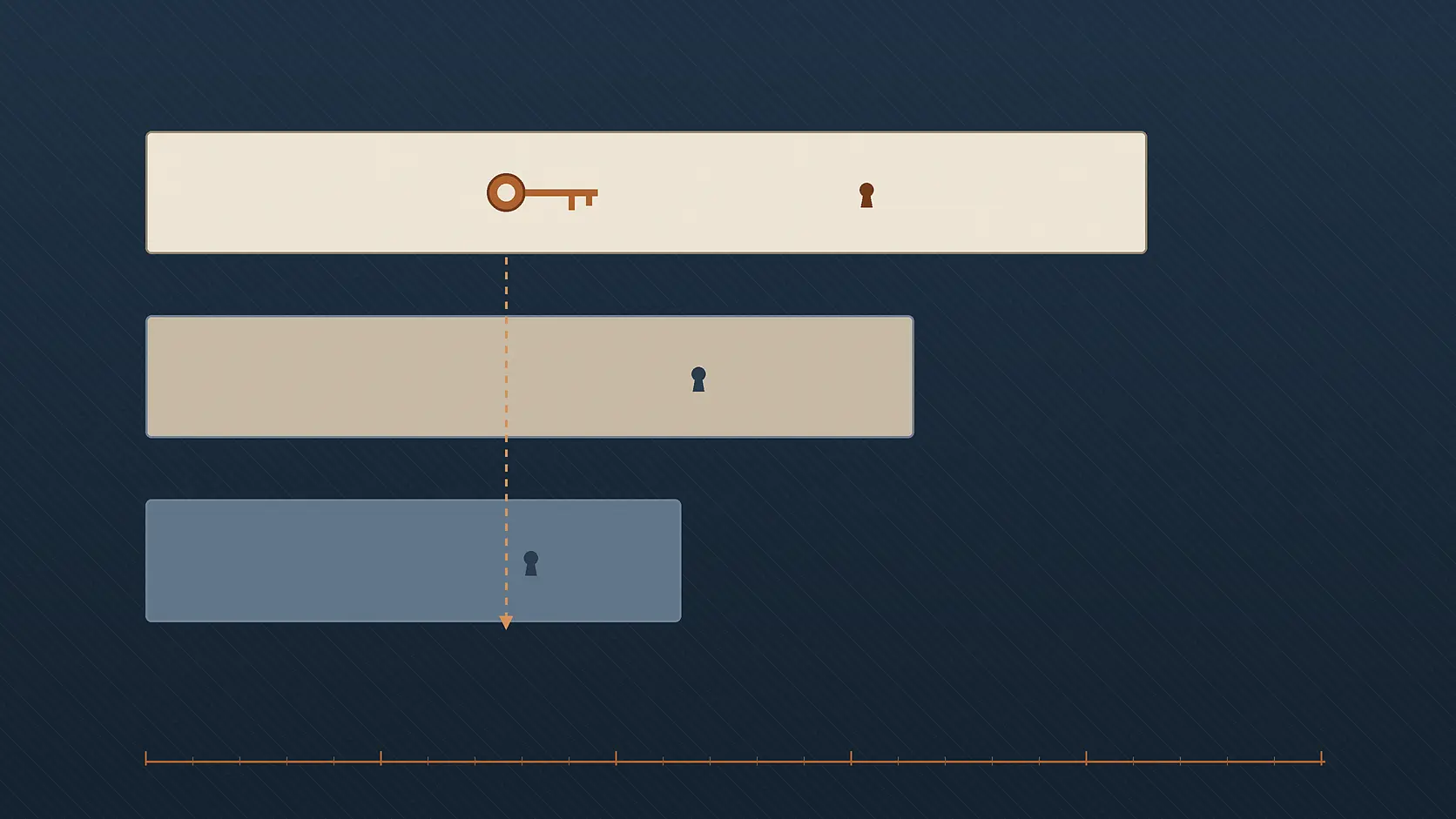
Start with the rule as written. ARIN's RPKI documentation is unusually clear about who is allowed to create a Route Origin Authorisation: “Only direct resource holders can participate in RPKI. Any downstream organization must have their upstream provider submit ROAs on their behalf.”
That sentence describes a system with one level of authorship. The certificate authority belongs to the registry — ARIN hosts a CA and signs the ROAs for resources in its region — and the right to point an ASN at a prefix belongs to the organisation whose name is on the allocation. Everyone else, including every ISP that holds its addresses as a reassignment from a larger provider, signs through the layer above it.
The documentation also says where the keys usually live: “The majority of RPKI users at ARIN utilize the Hosted service.” That is a sensible default for small holders and it means that, for most of the region's signed space, the registry holds the certificate and the holder makes a request.
Two escape hatches exist, and both belong to direct holders. Delegated RPKI lets a holder request its own resource certificates, run its own CA, sign its own ROAs and issue certificates to its customers. The Repository Publication Service, described as hybrid RPKI, lets a user keep control of private keys while publishing through ARIN. Both options start from the same premise: you must be the direct holder to be offered them.
What the chain looks like from below
Follow a prefix down the chain. A large holder has an allocation and signs a ROA naming the ASN authorised to originate it. A downstream ISP receives a reassignment, numbers customers from it, and announces it under its own ASN. For that announcement to validate as Valid rather than NotFound, the ROA must exist, must name the downstream ASN, and must be created by whoever can create ROAs for the block.
If the holder signs only for itself, the downstream announcement is NotFound. If the holder signs on the tenant's behalf — which is exactly what the documentation describes as the mechanism — the tenant's routes validate, but the object that makes them valid lives in the holder's account.
That is the structural point, and it is not a criticism of anybody's competence. The tenant cannot sign for itself. Its legitimacy under route origin validation is an output of a business relationship, and the object that encodes it is created, and can be withdrawn, one level up.
What November's tool changes
The 17 November release adds BGP announcement tools to ARIN Online, signed by ARIN's Chief Software Development Officer, with a release note that reads in full: “New BGP announcement tools have been added to ARIN Online, allowing users to review and address their BGP announcements and their validity.”
Read it as an operator would. The account that sees the verdict is the account that holds the resources — the same account that already holds the signing right. A downstream organisation that buys transit and address space from a member will not find its own prefixes in its own dashboard unless ARIN has built a per-customer view that the announcement does not mention.
So the tool closes a loop for the party that was never the bottleneck. The holder can now see, inside the registry's own interface, which of its announcements validate; the tenant still learns about its route validity from its provider, or from a looking glass, or not at all.
None of that makes the tool useless. It shortens the path between a bad ROA and the person who can fix it, and it removes the excuse of not knowing. It just does not change who can act.
Why the ratio looks like that
ARIN's IPv4 adoption on 27 November was 45.82%, the lowest of the five registries; the RIPE NCC's was 77.82%, the highest. The gap is 32.00 percentage points, and the IPv4 inheritance explanation — a large share of ARIN's space allocated before the RPKI existed — is the usual reading.
The one-level rule adds a second reason, and it is testable in a way the inheritance story is not. Adoption is measured over address space, but authorship belongs to holders. A region whose space sits with many direct holders should sign at a rate set by those holders' decisions; a region whose space is concentrated in fewer allocations, and then reassigned widely, will look different, because each signing decision covers more addresses. Neither is more competent. One has fewer signatures to collect.
What the published number cannot tell you is how many of ARIN's announcements are Valid, NotFound or Invalid, or how much of the unsigned space is held by organisations that have a portal, a certificate and simply have not signed. ARIN publishes the ratio to the registry level and stops there.
What is not published
Five figures would turn this from a structure into a diagnosis, and none of them appears in the sources: the number of ARIN holders using hosted, delegated and hybrid RPKI; the number of ROAs in the repository; the count of announcements in each validation state; how often the new BGP tool refreshes and whether it exports; and whether a downstream customer's prefixes appear anywhere in its provider's view or in its own account.
The last one matters most for the argument here. If tenants can see their own validity, the tool reaches the level where the problem is created. If they cannot, it reaches the level where the problem can be fixed but is not always the one being harmed.
The number that would settle the whole question is the split between hosted and delegated participation, because it tells you whether the key sits with the registry, with the holder, or with nobody. ARIN's page says the majority is hosted without giving the share.
Sources: ARIN RPKI; New Features Added to ARIN Online, 17 November 2026; NRO RPKI RIR adoption report, 27 November 2026.
Member Briefing
Read the full trend briefing
Members read the full briefing with the source notes behind every finding.
Strategic Circle
A daily briefing in your language, built from changes we have verified.
Join for USD 20/monthCancel anytime.
Members also get the full research library, a daily briefing on the networks they follow and the private forum.