
Summary
The canonical page is titled
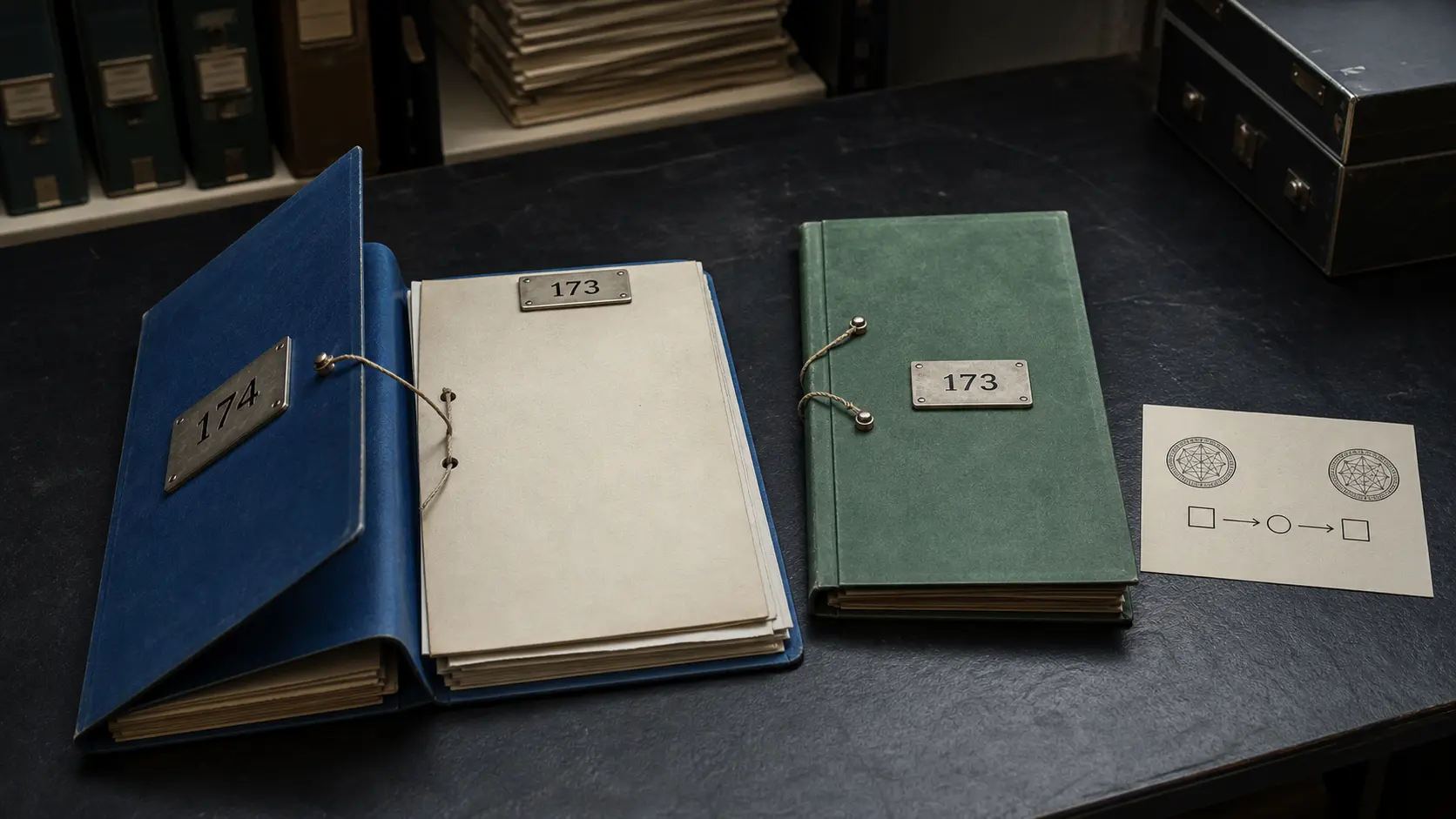
prop-174: Align implementation of Prop-125 in APNIC Policy (APNIC-127), sits at a URL containing/prop-174/and links toprop-174-v001.txt. Yet the linked file beginsprop-173: Align implementation of Prop-125 in APNIC Policy (APNIC-127). The remaining title words match, and both surfaces name Alban Kwan, but the identifier conflict is literal.APNIC’s navigation separately lists
prop-173: Copyright and Acceptable Use Terms for APNIC Directory Services. The linked body instead concerns Prop-125 and abuse contacts. Matching title, author and substance make the attachment recognisable as the abuse-contact text linked from theprop-174page; they do not authorise an outside editor to decide which identifier APNIC intended to be authoritative.A proposal number is a join key among the index, canonical page, attachment, mailing-list publication, version history, Secretariat impact assessment, meeting papers, minutes, consensus record and eventual decision. When two public surfaces disagree, later references can remain syntactically exact yet point to different institutional objects. An in-place edit may make the current page look coherent while erasing what early participants actually received.
The minimum remedy is a correction receipt. It should preserve the original URL, publication time and SHA-256; state the authoritative ID and title; identify every affected surface; publish the corrected URL, version and digest; classify the change as header-only, metadata or substantive; provide a textual diff; attribute the correction; notify the mailing list; propagate the relation into assessments and meeting records; and retain any unresolved uncertainty.
The conflict is literal, not inferred
The proposal page records status Published to Mailing List, version 1 posted on 17 August 2026, no previous version and no Secretariat impact assessment. Its title, path and linked filename use prop-174. The attachment’s first substantive line uses prop-173. The rest of the title is the same, and Alban Kwan is named on both surfaces.
The surrounding navigation makes the collision material. prop-173 is already the identifier of a separate proposal, Copyright and Acceptable Use Terms for APNIC Directory Services. The attachment linked from the prop-174 page concerns Prop-125 and abuse contacts: monitored, email-capable abuse-mailbox contacts; handling of automated reports; no web-form-only route; six-monthly validation; Invalid marking; a MyAPNIC limitation; staged notice; and possible referral under Membership Agreement breach provisions.
Those features support recognising the attachment as the page’s linked abuse-contact text. They do not establish which publication surface introduced the wrong number. The page and filename may carry the intended identifier; the internal header may preserve an earlier numbering state; or another publication step may explain the mismatch. The checked sources contain no explicit erratum, correction notice, superseding attachment or explanation.
The proper conclusion is therefore bounded. There is one linked text with two public numerical identities. The relationship is evident from title, author and body. The authoritative identifier is not for an outside editor to repair silently.
A proposal number is a join key
A proposal number does institutional work. The index uses it to distinguish proposals. The canonical page uses it to collect status, version and authorship. The attachment uses it to identify itself. The mailing-list post uses it to invite discussion. An impact assessment may use it to define the text assessed. Meeting papers and minutes use it to connect oral debate to a written object. A consensus or decision record uses it to identify what was decided.
That chain is reliable only if the identifier is stable or every change is expressed as a visible relation. Here, two joins are possible. A meeting paper could cite prop-174 and accurately point to the canonical page. An archived attachment could call itself prop-173 with equal textual accuracy. Because APNIC already has a different prop-173, a later reference containing only number and version may be exact in form yet ambiguous in object.
Title and author help a careful reader today. They are weak substitutes for an institutional correction. Later records may abbreviate the title, omit the author or say only version 1. A digest can prove which bytes were reviewed, but only if it is published and bound to an authoritative proposal identity. A version label alone does not close the join when filename and internal header diverge.
The current status makes this the least costly moment to repair the chain. The page shows publication to the mailing list, but no previous version and no Secretariat impact assessment. No checked source establishes consensus, adoption or implementation. That does not prove nobody has relied on the file; it means the verified record has not yet accumulated the later institutional acts that would make correction harder to propagate.
How identity drift accumulates
The problem is not that a mismatched header automatically invalidates discussion. It is identity drift: later records can each appear coherent while no public relation proves that they concern the same preserved text.
An assessment might say it covers prop-174 version 1 without publishing a digest. A reader could not then prove whether the assessor received the file carrying the prop-173 header, a corrected copy or another byte sequence. If the attachment were edited in place, the assessment’s citation might remain visually correct while its evidentiary target changed.
Meeting material presents the same risk. A paper may use prop-174; a participant’s archived copy may display prop-173; minutes may refer only to the number. A later consensus record may link to the canonical page without naming the exact version and digest. None of those acts must be careless. They may simply follow different public surfaces.
The separate directory-terms prop-173 makes abbreviated references especially fragile. Context may help where a document discusses IRT, abuse-c, abuse-mailbox, MyAPNIC or Whois. Institutional memory should not depend on contextual detective work when APNIC can publish a stable correction relation.
An in-place edit is therefore the most dangerous easy remedy. Replacing the first line could make the present attachment agree with the page, yet early participants may have received the conflicting file. Without preserving its bytes and digest, the public record could no longer show that their references were faithful to what APNIC published at the time.
That would not prove corrupted storage, malicious alteration, invalid discussion, legal invalidity or wrong consensus. It would be a narrower loss: the current file would cease to prove the historical file, and later acts could become difficult to bind to the text their authors actually saw.
Correction must preserve what it corrects
A sound correction has two duties. It must declare which proposal identity APNIC treats as authoritative for future use. It must also preserve the conflicting publication that earlier readers may have encountered.
The first duty requires an attributable APNIC statement. Matching title and author establish relationship, not authority. APNIC should state the authoritative ID and title, identify every affected page, file and notice, and say whether the change is confined to the header, extends to metadata or alters substantive text.
The second duty rules out silent replacement. The original prop-174-v001.txt, its publication time and SHA-256 should remain retrievable or verifiably preserved. A corrected object should receive its own URL or immutable version identity and digest. The relation should state whether it supersedes the original for future assessment while retaining the original as evidence of first publication.
An erratum may be enough if APNIC determines that only the identifier line is wrong. A new version may be preferable if any public textual change requires versioning. A full repost may be needed if the mailing-list distribution must be reset. The method is secondary to the controls: preservation, attribution, diff, supersession and propagation.
A compact correction receipt
| Receipt field | Minimum public content | Control supplied |
|---|---|---|
| Correction ID | Stable identifier for the correction event | Gives every later record one object to cite |
| Authoritative identity | Proposal ID and full title declared by APNIC | Resolves future naming without external inference |
| Affected surfaces | Canonical page, navigation, attachment, mailing-list post and other public records carrying either number | Defines the complete correction scope |
| Original object | Original URL, publication time and SHA-256 | Preserves proof of the bytes first published |
| Conflicting identifier | Exact conflicting text and its location | Records the defect literally rather than as a generic typo |
| Corrected object | Corrected URL, version, publication time and SHA-256 | Identifies the bytes future assessments should use |
| Change classification | Header-only, metadata or substantive | Separates identity repair from policy revision |
| Textual diff | Complete line-by-line or machine-readable diff | Lets readers verify the declared scope |
| Publisher attribution | Responsible APNIC publisher or function and correction time | Makes the correction an institutional act |
| Mailing-list notice | Stable notice linking original, correction and authoritative identity | Reaches the channel used for version 1 |
| Downstream propagation | References to impact assessment, APNIC 62 material, minutes, consensus and implementation records annotated or updated | Prevents later acts from inheriting ambiguity |
| Supersession relation | Whether the corrected object supersedes, replaces or annotates the original | Distinguishes history from the text governing future review |
| Unresolved uncertainty | Any fact APNIC cannot determine, including where the conflict arose | Prevents unsupported certainty from entering the record |
The receipt should travel with the proposal. The canonical page should display its correction ID. The preserved original should carry an annotation without losing its bytes. The corrected object should link back to the original and diff. Any later assessment, meeting paper, minutes or decision should cite the authoritative ID, exact version and digest.
Identity repair is not a merits decision
Correcting the number would not assess the merits of monitored abuse-mailbox contacts, automated-report handling, six-monthly validation, Invalid marking, MyAPNIC limitation, staged notice or possible Membership Agreement referral. It would establish which text those discussions concern.
Nor could later policy agreement repair the record by implication. A meeting might understand the abuse-contact subject perfectly and still leave an archival conflict if its papers cite one number while the attachment carries another. Consensus on substance, should it ever occur, would not prove which bytes participants considered unless the decision record binds itself to a preserved version.
The proposed notice stages and referral language must also remain proposals. No checked source establishes an impact assessment, consensus, adoption, implementation, an actual breach or resource revocation under this text. A correction receipt would make the proposal identifiable; it would not make any proposed enforcement step current APNIC policy.
What the evidence supports
The frozen record supports a precise conclusion. APNIC’s canonical page, URL and attachment name identify prop-174; the attachment’s first substantive line identifies prop-173; APNIC separately uses prop-173 for a directory-services proposal; and no checked source supplies an explicit correction or explanation. Matching title, author and body make the attachment recognisable, but they do not prove which surface contains the original mistake.
The mismatch alone does not prove that any participant, assessor or decision-maker relied on the wrong identity. It does not invalidate discussion or establish operational harm. The risk is prospective: incompatible identifiers can be repeated into assessments, meeting records and decisions until exact citations no longer guarantee a common object.
APNIC can prevent that drift without rewriting history. Preserve the original file and digest. Declare the authoritative ID. Publish a corrected immutable object and diff. State whether the change is header-only. Notify the mailing list. Propagate the relation into every downstream record. Proposal identity should be settled before later institutional acts make the ambiguity expensive to unwind.
Sources
Member Briefing
Deeper Profile Context
Sign in with the right membership level to unlock the full briefing and source notes.
Only for Strategic Circle
Strategic Circle
Open to all readers. Unlock profile briefings after joining and signing in.
Join Strategic CircleOnly for Leadership Alliance
Leadership Alliance
For qualified IP-asset owners and management; sign in to unlock alliance briefings.
Join Leadership Alliance