
Summary
- AFRINIC’s official call and 2026 hosting guide list eight host opportunities from 2027 through 2030, combining four June Africa Internet Summit meetings with four late-November stand-alone meetings.
- The same public material describes a stand-alone programme as six days, although each listed November window spans three dates; it asks proposals to arrive early but gives no public deadline or selection timetable.
Analysis
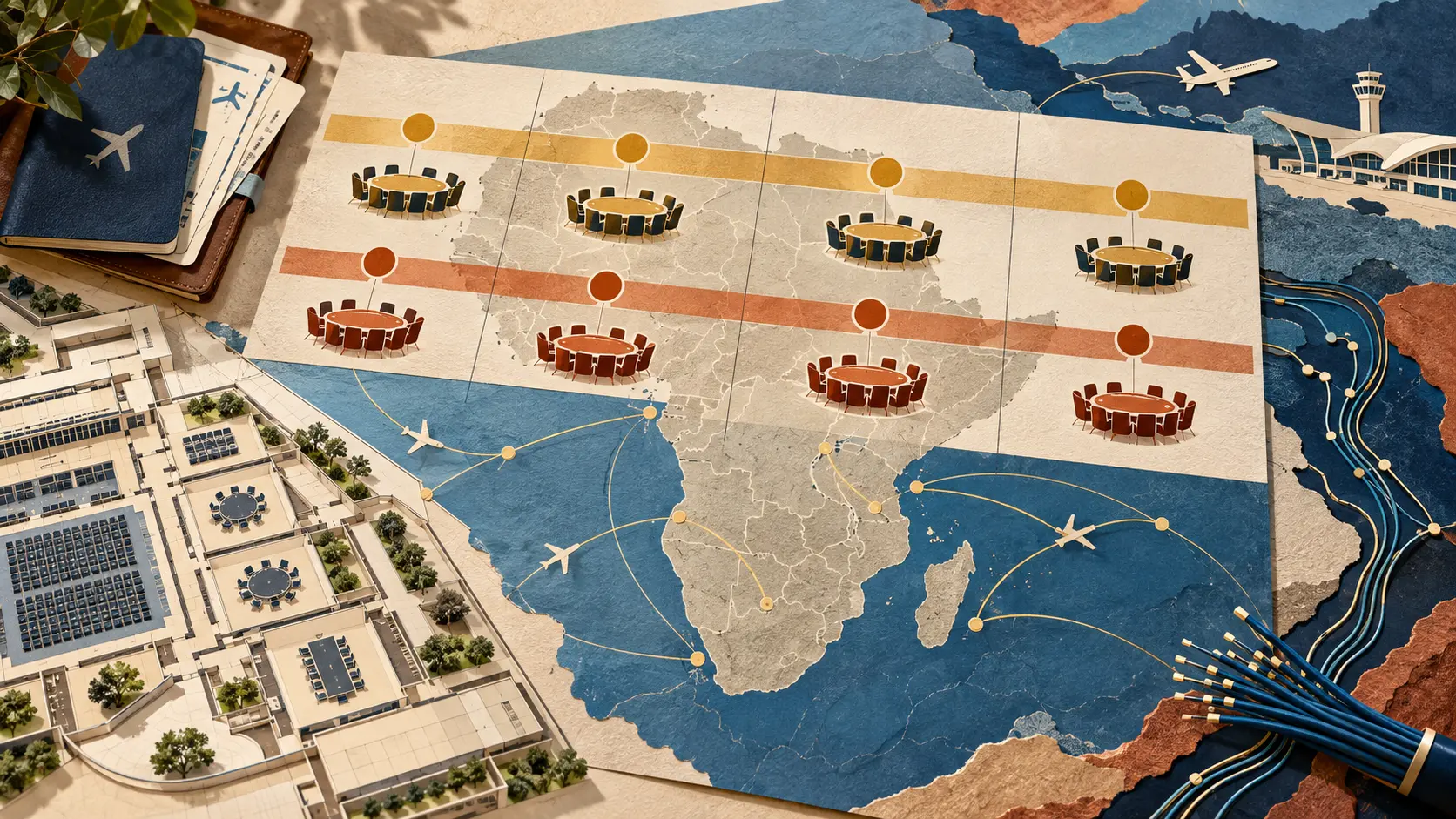
The host call has the shape of a four-year events pipeline. Each June Africa Internet Summit (AIS) is paired respectively with AFRINIC-39, -41, -43 and -45: 21–25 June 2027, 19–23 June 2028, 18–22 June 2029 and 17–21 June 2030. The four November opportunities—AFRINIC-40, -42, -44 and -46—each have a three-date window, from 29 November to 1 December in 2027 and 2028, 28–30 November 2029, and 27–29 November 2030.
That calendar does not match the page’s description of a stand-alone meeting as a “six-day deep dive”. The separate 2026 hosting guide repeats the same November dates but does not explain how the three-date windows relate to the six-day description. The published record therefore leaves a practical question unanswered; it does not establish whether the programme will be shorter, whether the dates are incomplete, or whether some days fall outside the listed window.
The distinction matters to a prospective host’s budget and commitments. AFRINIC’s call asks for an international airport, a modern venue for more than 350 people, several meeting rooms and reliable high-speed connectivity. The 2026 guide is more exacting: it recommends at least nine rooms and a plenary hall for more than 350, prefers a hotel with 150 rooms, expects the venue to permit network equipment, and says airport-to-venue travel should take no more than an hour. It also describes at least three local connectivity sponsors and typical bandwidth above 100 Mbps.
Local work goes beyond finding a hall. The guide lists staffing, logistics, visa assistance, local outreach, transport and procurement support. The host helps AFRINIC reach local sponsors and may contribute to the meeting programme and concept; specific responsibilities are formalised in a memorandum of understanding after hosting arrangements are agreed. Since meetings are free to attend, sponsor coordination is part of the operating model.
For applicants, the public timeline is less concrete than the venue checklist. The call says proposals should arrive “well in advance”; the guide says “as early as possible” and names an email address. Neither gives a cutoff, a selection sequence or a date by which host decisions will be announced. That is a statement about the published documents, not proof that AFRINIC lacks an internal process.
The local host can bring knowledge, capacity and ideas into the event. That role can make a programme more relevant to its setting, but it does not itself grant authority over AFRINIC’s policy decisions. A clear public brief should distinguish logistical obligations from any programme input and specify what a host is being asked to provide.
Before organisations commit staff, rooms and sponsors across this slate, AFRINIC could publish the intended number of programme days for each stand-alone meeting, reconcile it with the dates, and state the proposal deadline and selection milestones. Those clarifications would let interested organisations price the same task and plan against the same calendar.
Sources
Member Briefing
Deeper Profile Context
Sign in with the right membership level to unlock the full briefing and source notes.
Only for Strategic Circle
Strategic Circle
Open to all readers. Unlock profile briefings after joining and signing in.
Join Strategic CircleOnly for Leadership Alliance
Leadership Alliance
For qualified IP-asset owners and management; sign in to unlock alliance briefings.
Join Leadership Alliance