
Strategic Circle Briefing
Join to unlock strategic briefings after signing in.
Join Strategic CircleGovernance / IETF
The IETF writes the protocols every network runs on. We follow the drafts, the working-group fights and the standards that ship, and explain what each one changes for operators before it reaches production.

Latest Coverage
1,668 articles

IETF
`draft-ietf-netconf-udp-notif-26` makes high-frequency YANG notifications cheaper to move across a controlled network. It also makes an important distinction unavoidable: transport evidence can show what a receiver assembled, but only a wider chain can show what the network…

IETF
The IETF-Wide Dispatch session can influence where emerging protocol proposals go next, but its leverage lies in routing and coordination—not in independently approving standards.

IETF
The hexadecimal value `0xffff` can describe a link that remains reachable at the highest cost or a link that must be excluded from a shortest-path calculation. RFC 10041 does not resolve that ambiguity with a local switch. It makes the meaning depend on evidence from every router…

IETF
A sender can now begin carrying a JPEG 2000 image while that image is still being encoded. That is a useful reduction in one waiting stage. It is not a receipt for the time at which a receiver recovered, decoded and displayed a usable picture.
IETF
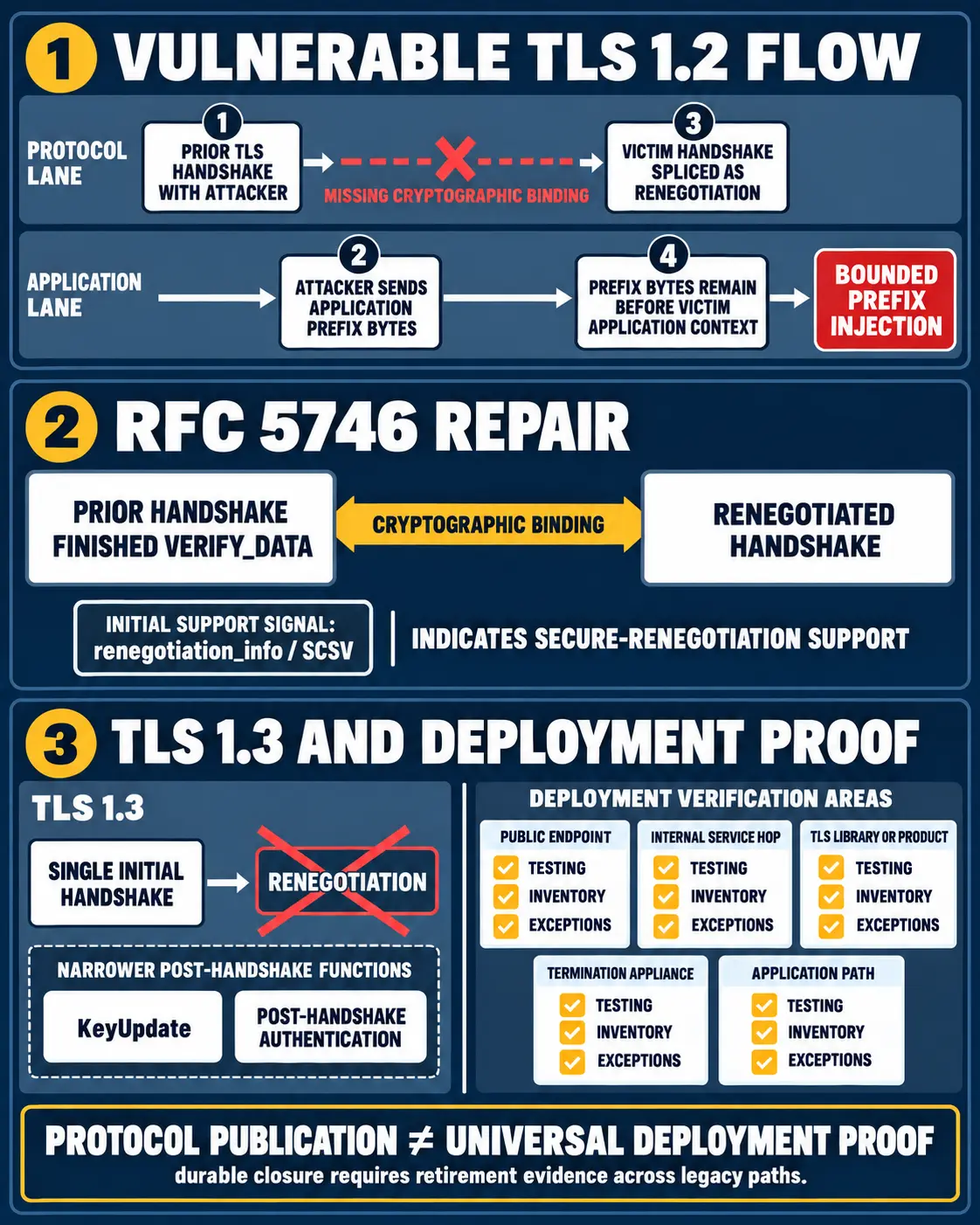
The IETF repaired a dangerous ambiguity in TLS renegotiation. That repair changed the protocol. It did not, by itself, prove that every older library, appliance, endpoint and application path had stopped accepting the unsafe behavior.

IETF
`draft-ietf-netconf-privcand-10` gives each client a private place to prepare configuration and a defined way to detect and resolve overlap before commit. The operational mistake would be to let isolation, an empty comparison or a successful merge inherit authority over…

IETF
A CMC request can cross HTTP successfully and still be pending, rejected or incomplete at the certificate authority. RFC 10003 gives the carrier a precise form; RFC 10002 gives the PKI operation its result. Governance fails when those two receipts are collapsed into one green…

IETF
Revision 01 of a proposed RPKI-to-router message now tells a cache how to withdraw all or part of a Mapping Origin Authorization and tells a router when stale MOA data must disappear. That is useful state discipline. But the draft places the order and fallback between MOA and…

IETF
RFC 9827 gives IKEv2 a broader and more honest contract for packet sequence numbers. The selected Transform ID describes what should be true when an SA's packets enter the network; it does not certify sender coordination, receiver anti-replay policy, the packet stream that…

IETF
RFC 10011 allows a RESTCONF service to sit behind an external TLS terminator. That is not a relaxation of the security model. It is a relocation of the place where encrypted transport and authenticated identity become an administrative claim—and a warning that the terminator, the…

IETF
In 2002, Joyce Reynolds gave an old standards document a more honest job. RFC 1700 would remain a durable record of what the Assigned Numbers tables looked like in 1994, but it would no longer impersonate the changing registry that engineers actually needed.

IETF
`draft-ietf-opsawg-scheduling-oam-tests-07` makes network diagnosis programmable as timed, ordered test sequences. The discipline begins when operators refuse to let a stored plan, a green status or a returned metric stand in for the execution, causality, authority and outcome…

IETF
Revision 07 of an individual IETF process draft adds only one short paragraph on conflicts of interest. The paragraph is enough to expose a larger design problem: the IETF has several concrete conflict policies, but each belongs to a defined body or corporate role. A general…

IETF
Three BGP fields can carry the same 32-bit value and still answer different questions. RFC 9832 supplies an ordered mechanism for classful transport; operators still need a chain of receipts proving which namespace, attribute, database, fallback and forwarding state actually…

IETF
A single bit can remove ambiguity from routing data without proving that a single request will succeed. RFC 9983 gives OSPFv2 an explicit way to mark a prefix as anycast, but it also draws an unusually useful governance line: the mark states how the prefix is intended to be…

IETF
One DNS response can carry an authoritative alias, a cached destination and helpful address records under a single AA flag. The bit has done its job; the database that stamped the whole packet “authoritative” has not.

IETF
A power graph can move down while the network’s carbon cost, workload allocation and service risk remain unknown. RFC 9845 makes visibility useful; it does not let one meter speak for the whole system.

IETF
The WIMSE practices draft shows how platforms can replace embedded secrets with short-lived workload credentials. Its harder lesson is that every safer credential still sits inside a longer chain of facts that must not be compressed into one green authentication event.

IETF
A failed email can be both a diagnostic clue and somebody else's private correspondence. RFC 9991 does not solve that tension by awarding the domain owner every available header and body. It standardizes a request and a report while leaving the receiving operator responsible for…

IETF
A signed DNS record can preserve every octet and still leave one historical question outside the signature: which edition of an external registry gave those octets meaning? Two newly assigned resource-record types make that boundary concrete. UNECE is now type 69 and ISO is type…
Member Unlock
Login is required to unlock full profile briefings and deep-dive sections.
Join to unlock strategic briefings after signing in.
Join Strategic CircleFor IP-asset owners and leadership teams: alliance briefings, private reports and direct analyst support.
Join Leadership Alliance