
Open standards body with worldwide implementation impact.
Governance / IETF
IETF
IETF governance intelligence tracks institutions, policy processes, standards activity, registry operations, accountability disputes, and implementation signals that affect internet infrastructure. BTW.
GlobalProtocol GovernanceInteroperability Risk

Protocol process and standards legitimacy.
Spec-to-implementation gap across vendors and operators.
Major standards shifts usually affect systems over 120d+ cycles.
Latest Coverage
Latest from IETF
1,002 articles

IETF
The Hidden Service Answered. The Onion Key Had Not Yet Spoken: RFC 9799
The hidden service answered over Tor, the ACME account was valid, and the final CSR was ready. None of those facts yet proved that the applicant controlled the `.onion` identity. RFC 9799 makes that missing proof explicit—and shows why issuance authority, descriptor visibility…

IETF
IETF–W3C: A Relationship Record, Not a Single Institution
The label “IETF–W3C” compresses two standards institutions into one directory entry. The public record supports a narrower description: the organizations have documented channels of cooperation, but the evidence reviewed does not establish one legal entity, one administrative…

IETF
A Company-Certs Endpoint Cannot Prove Who Approved a Trust-Anchor Rollover
At 10:00, an application retrieves two valid private-CA chains from its company’s well-known HTTPS endpoint. The older chain still works; the newer chain has the later `valid_from`, so the client selects it exactly as the draft describes. TLS validation passed, the JSON parsed…

IETF
The Cursor Knew the Position. It Did Not Know the Moment
YANG list pagination can preserve the exact filter, sort field, locale, direction and continuation token used to reach the next page. That makes the traversal auditable. It does not make nine requests one observation, or an ordered page a frozen dataset.

IETF
Michael Tüxen and the Zero SCTP Checksum That Still Needed Error Detection
Zero usually looks like absence. In RFC 9653, a zero in SCTP's checksum field means something narrower: one endpoint may omit the correct CRC32c only after its peer has named an acceptable alternative error-detection method for that association. Michael Tüxen's work on the…

IETF
A Workload Credential Can Outlive the Attestation Decision Behind It
At 09:00 a workload proves that it is running in Germany and receives an eight-hour credential. At 09:05 the orchestrator moves it to France. The credential still verifies, the key is still under the workload’s control, and the unchanged service still accepts it. Yet one fact…

IETF
Mark Handley and the SDP Version You Cannot Compare Across Origins
A controller receives two session descriptions. One places version 391 in its `o=` line, the other 402. A dashboard sorts the larger number to the top and calls it latest. The arithmetic is flawless and the conclusion can still be wrong: the two descriptions carry different…

IETF
A Key Transparency Proof Cannot Audit Who Was Allowed to Look
Alice searches a Key Transparency log for Bob and receives a valid proof. Fred makes the same request and is stopped by the application before the log sees it. The proof can show that Alice’s answer fits an authenticated, globally consistent tree. It cannot show why Alice was…

IETF
The Stream Was Ordered. The Network Was Not Yet Proven
At the instant a controller receives `<rpc-reply><ok/></rpc-reply>`, the change can feel complete. The bytes arrived in order, the peer was authenticated, and the server returned success. Yet each of those facts belongs to a different evidentiary layer from the question operators…

IETF
Agent Discovery Leaks Intent Before Any Agent Is Chosen
A procurement agent asks for a French-hosted inference service that accepts a rare credential, supports a particular model family and can start within an hour. No supplier has been contacted and no agent has been selected. Yet the query has already described the buyer’s…

IETF
An RPKI Validator Needs an Audit Trail, Not Just a Green Cache
The routing dashboard is green at 09:10. At 09:40 a repository refresh succeeds, the cache changes and the earlier state disappears. When an operator later asks which RPKI objects, failures, trust anchors and local exceptions informed a route decision at 09:10, the green light…

IETF
The Envelope Parsed. The Observation Is Not Yet Proven
`draft-ietf-netconf-notif-envelope-05` gives YANG-Push notifications a header that can travel with the message. That makes correlation easier. It does not collapse identity, continuity, time, provenance and operational truth into one successful parse.

IETF
A Delegation Chain Narrows Authority but Cannot Carry Intent
An OAuth resource server may one day receive a chain whose signatures, key links, audiences, time bounds and permission subsets all validate. That green result would be meaningful: no downstream client could have validly enlarged the authority it received. It would still leave a…

IETF
A Physical-Site Receipt Can Be External to the Issuer—and Still Controlled by the Site Owner
Revision 03 of a proposed receipt for work at physical sites fixes several ambiguities with admirable candour. It also names a trust edge its own bytes cannot carry. A transparency service may be independent of the receipt issuer yet operated by the owner of the site whose…

IETF
The Message Reassembled. The Telemetry May Still Be Incomplete
`draft-ietf-netconf-udp-notif-26` makes high-frequency YANG notifications cheaper to move across a controlled network. It also makes an important distinction unavoidable: transport evidence can show what a receiver assembled, but only a wider chain can show what the network…

IETF
ALLDISPATCH Is a Routing Forum, Not a Standards Authority
The IETF-Wide Dispatch session can influence where emerging protocol proposals go next, but its leverage lies in routing and coordination—not in independently approving standards.

IETF
RFC 10041 Makes OSPF Unreachability an Area-Wide Decision
The hexadecimal value `0xffff` can describe a link that remains reachable at the highest cost or a link that must be excluded from a shortest-path calculation. RFC 10041 does not resolve that ambiguity with a local switch. It makes the meaning depend on evidence from every router…

IETF
The First Packet Left Before the Image Existed. It Still Did Not Prove Low Latency: RFC 9828
A sender can now begin carrying a JPEG 2000 image while that image is still being encoded. That is a useful reduction in one waiting stage. It is not a receipt for the time at which a receiver recovered, decoded and displayed a usable picture.
IETF
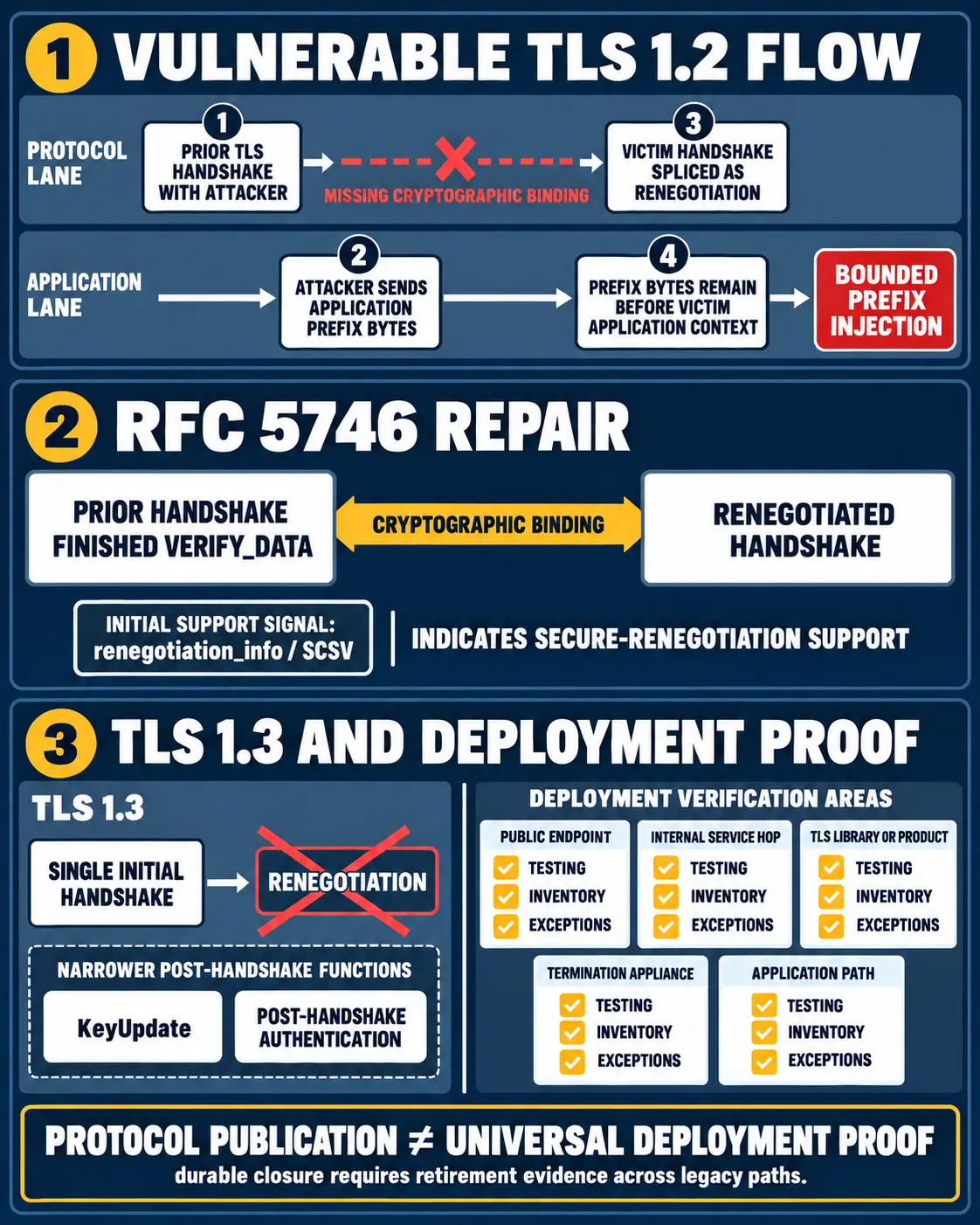
TLS Renegotiation Was Repaired. Deployment Closure Is a Separate Claim.
The IETF repaired a dangerous ambiguity in TLS renegotiation. That repair changed the protocol. It did not, by itself, prove that every older library, appliance, endpoint and application path had stopped accepting the unsafe behavior.

IETF
The Merge Was Clean. The Baseline May Not Be: NETCONF Private Candidates
`draft-ietf-netconf-privcand-10` gives each client a private place to prepare configuration and a defined way to detect and resolve overlap before commit. The operational mistake would be to let isolation, an empty comparison or a successful merge inherit authority over…
Member Unlock
Restricted Profile Intelligence
Login is required to unlock full profile briefings and deep-dive sections.
Strategic Circle Briefing
Join to unlock strategic briefings after signing in.
Join Strategic CircleLeadership Alliance Briefing
For qualified IP-asset owners and management; sign in to unlock alliance briefings.
Join Leadership Alliance