
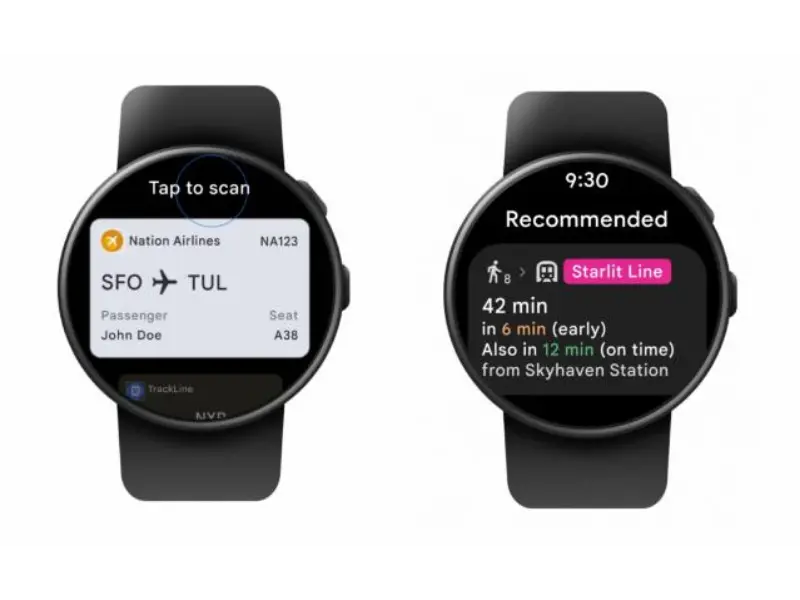
- Google has just revealed some new treats that are headed to your wrist – including a useful new Google Maps feature to make your journeys a little smoother.
- Owners of Wear OS watches will finally be able to see any tickets they’ve added to their Google Wallet on their wrist, including the QR codes that’ll be scanned on entry.
Google has unveiled new updates for its Wear OS smartwatches, including a feature that will enhance the Google Maps experience for users. The announcement was made during the MWC 2024 event, where other notable watches like the OnePlus Watch 2 and Xiaomi Watch 2 were also unveiled.
Experience upgrade of Google Maps
The new public transit directions for Google Maps on Wear OS will allow users to view departure times for buses, trains, and ferries directly on their wrist. Previously, Wear OS only displayed driving, cycling, and walking options. This update not only provides phone-free public transit routes but also offers compass-guided directions to help users reach their destinations.
Also read: Google Maps adds underground tunnels as quest to map everything continues
The introduce of Wallet passes
Wear OS users can now access Wallet passes on their smartwatches. This means that features such as boarding passes, gym memberships, gig tickets, and loyalty cards can now be conveniently stored and accessed on the wrist. This functionality has long been available to Apple Watch owners, but now Wear OS users can enjoy the same convenience.
Also read: Apple vs. Masimo: Smartwatch showdown – innovation, patents, and the price of progress!
Long working-time
Meanwhile, OnePlus has introduced a groundbreaking feature in its new OnePlus Watch 2 that could significantly improve battery life for future Wear OS watches. The OnePlus Watch 2 offloads notification processing from the application processor (AP) to the watch’s microcontroller unit (MCU). This allows users to view and dismiss notifications without involving the AP, allowing it to remain inactive and conserve battery power. The OnePlus Watch 2 boasts an impressive claimed battery life of 100 hours, surpassing many other smartwatches on the market.
According to Bjorn Kilburn, Vice President of Wear OS by Google, other manufacturers will be able to implement this battery-saving technology in their Wear OS devices, potentially revolutionizing the industry.
Difficulties and opportunities
While these updates demonstrate that Wear OS is still receiving attention and improvements, the platform continues to face challenges. Wear OS has been somewhat neglected by both Google and smartwatch manufacturers in recent years, leading to an inconsistent user experience. Fossil’s recent announcement of quitting smartwatches also raised concerns about Wear OS’s ability to compete with the dominant Apple Watch.
However, the arrival of new watches from OnePlus and Xiaomi indicates that Wear OS is not solely reliant on Samsung and Google to stay afloat. With hopes for more significant upgrades in 2024, these latest updates could mark the beginning of a revival for Wear OS, restoring its position as a competitive player in the smartwatch market.