
Summary
- Reuters reported at 12:46 UTC on 21 July that Google had connected Nuvem to Sines; the Azores government separately recorded an official launch ceremony in Lisbon.
- The disclosed system links Myrtle Beach and Sines, with landing branches to Bermuda and São Miguel in the Azores. It uses 16 fibre pairs across its segments.
- The FCC filing gives about 24Tbps of design capacity per pair, or roughly 384Tbps for the system. These are engineering limits, not evidence of capacity currently lit, sold or carrying traffic.
- Google's subsidiaries own the cable segments. The filing anticipated U.S. commercial operation as soon as the second half of 2026, with use by affiliates or third parties through individually negotiated IRUs.
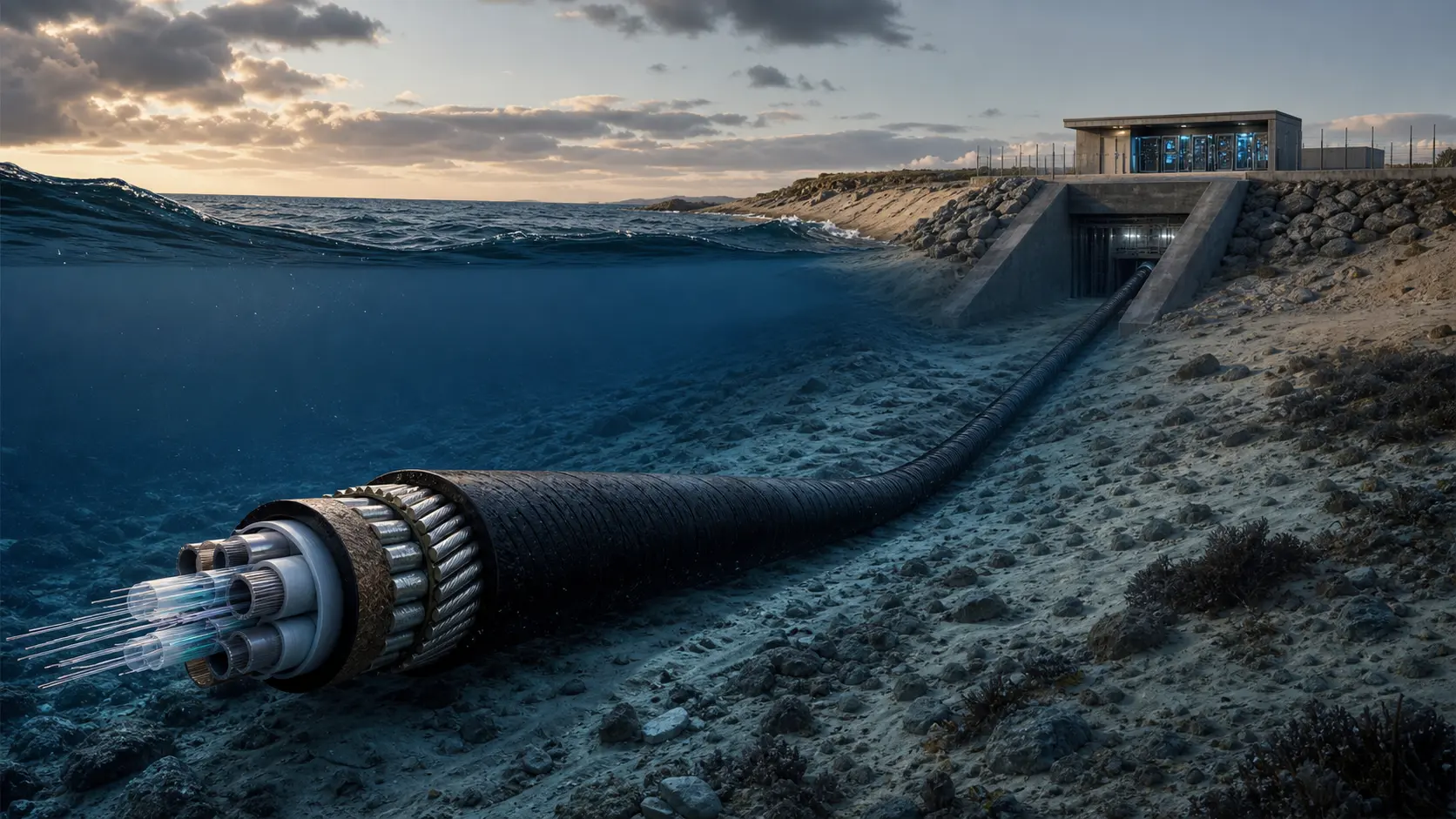
The valuable object at Sines is not a headline number. It is a junction between seabed infrastructure and terrestrial networks. Once the cable end is connected, Google has a physical path that can be tested, powered, integrated and eventually allocated. Until those further steps occur, the beach manhole marks an option rather than a finished capacity product.
Nuvem's main transatlantic segment is about 6,900 kilometres from Myrtle Beach to Sines. A 170-kilometre branch reaches Bermuda and a 124-kilometre branch reaches São Miguel. The regulatory description assigns 16 fibre pairs to each segment and approximately 24Tbps of design capacity to each pair. Multiplying those figures produces the often-quoted 384Tbps total.
That multiplication is technically useful and commercially incomplete. A design ceiling says what the optical system is intended to support. It does not say how many pairs have terminal equipment installed, how much spectrum has been activated, whether acceptance tests have passed, which routes are protected, or how much capacity has been reserved for internal use. Nuvem can be connected and still have none of those answers in public.
Geography creates the option
The system is notable for its landing pattern. It is the first disclosed cable directly linking the United States with both the Azores and mainland Portugal, and the first transatlantic system with a Bermuda landing. Those facts do not guarantee a faster or more resilient service. They do provide another set of physical decision points for a network operator deciding where traffic may enter, leave or divert across the Atlantic.
Route diversity becomes valuable when it is paired with terrestrial backhaul, compatible network architecture and operating agreements. A landing on an island can improve local connectivity or add a recovery path, but only if capacity is made available and connected onward. The Azores government's language about latency, resilience and economic opportunity therefore describes intended benefits. No source in the ledger publishes a measured latency reduction, a restoration performance record or a price change.
Control also matters. The FCC notice says Google subsidiaries own the relevant territorial and international segments. That gives the group influence over how capacity is lit and assigned, subject to licences and operating obligations. It does not make the route exclusively internal. The filing envisaged bandwidth for Google affiliates and third parties through individually negotiated indefeasible rights of use, or IRUs.
An IRU can turn physical fibre capacity into a long-term wholesale right, but “individually negotiated” leaves the market opaque. There is no disclosed customer, price, term, committed volume or service-level agreement. The arrival at Sines therefore expands the set of potential transactions without revealing whether any transaction has occurred.
Six states lie behind one launch verb
Submarine projects are easy to compress into a single ceremonial moment. Their economics are not. The cable must be physically landed and connected, tested end to end, equipped and lit, declared ready for service, allocated or sold, and then used by traffic that produces internal value or revenue. A launch ceremony can accompany one of these stages without proving the rest.
The original 2023 announcement targeted service in 2026. The later U.S. filing said commercial operation could begin as soon as the second half of 2026. “As soon as” is a planning expectation rather than an exact service date. The 21 July connection is consistent with that schedule, but the reviewed sources do not publish a ready-for-service certificate or a first-customer activation.
This distinction changes how investors and network planners should read 384Tbps. If only part of the system is initially lit, the usable capacity will be lower than the design ceiling. If Google reserves most capacity for affiliates, the external wholesale market could be smaller even when the system is heavily used. If IRUs are sold, their economic value will depend on price, term, route protection and onward connectivity, none of which is public.
What would turn the route into evidence
The next meaningful disclosures would be operational rather than ceremonial: completion of marine and terrestrial acceptance, a ready-for-service date, the number of fibre pairs or spectrum bands initially lit, disclosed backhaul arrangements at each landing, and the first affiliate or third-party capacity commitment. Later, utilisation, outage performance and route-switching records could test the promised resilience.
Nuvem has crossed an important boundary. A planned line has become a connected physical system spanning four geographies. That is enough to create strategic value for its owner and a possible new Atlantic option for customers. It is not enough to book 384Tbps as active supply. The cable has reached shore; the commercial facts still have to travel the rest of the distance.
