
Summary
- A July 14 financing report says GMI Cloud is seeking NT$20.45 billion, or about $635 million, through GMI Cloud Phoenix Ltd.'s Taiwan branch, supported by customer GPU-use contracts and intended for its Taiwan AI-factory project. The transaction is proposed, not a completed financing.
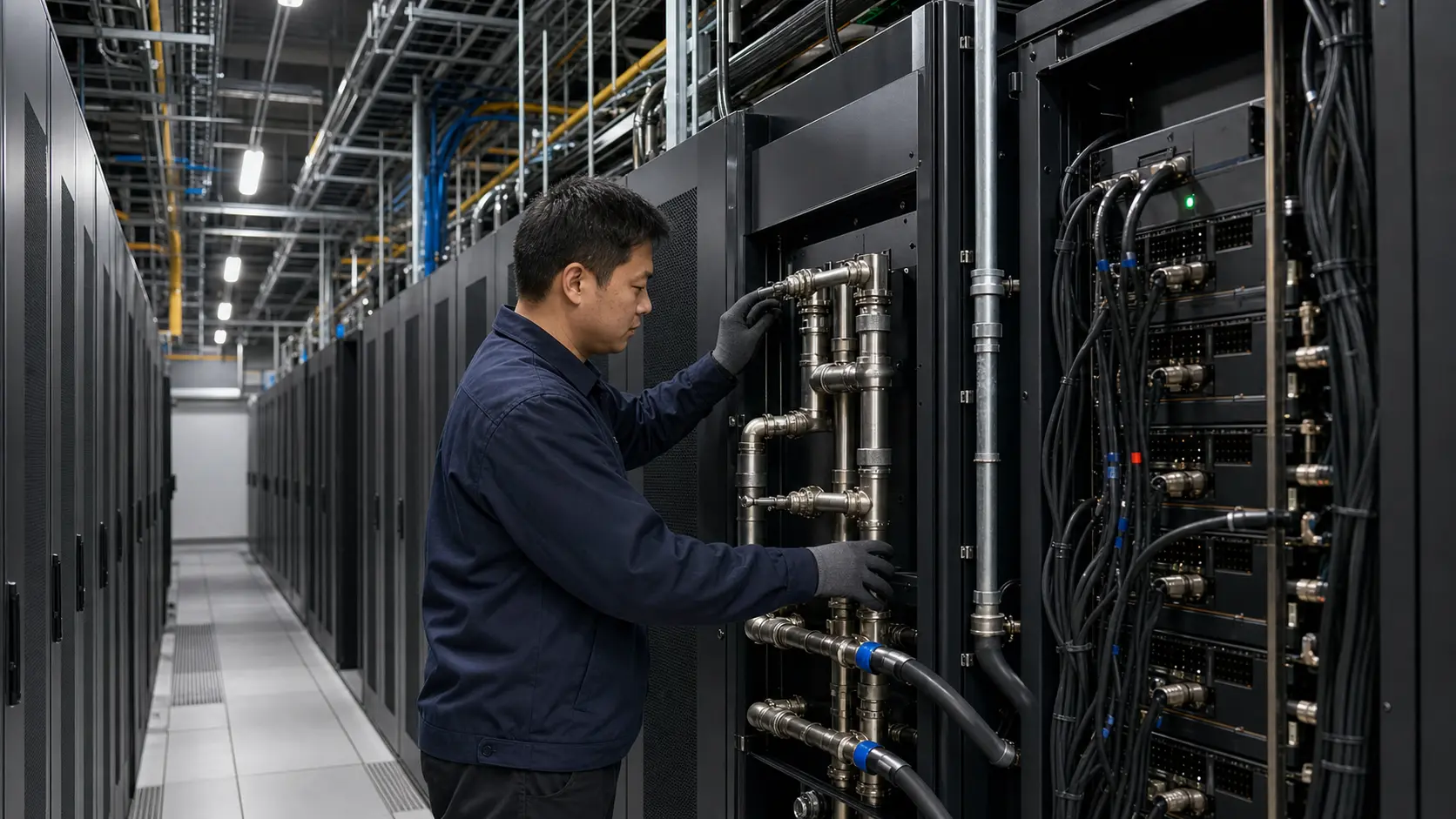
- The strongest physical evidence comes from Taiwan Mobile: a 25MW TAIDC facility in Guishan, Taoyuan, designed to Tier III parameters with N+1 systems, liquid cooling and a stated PUE below 1.2. Those are facility and design claims; they do not establish that all 25MW is energised, occupied by GMI Cloud, or available to a failed workload.
- AS131632 gives the Phoenix Taiwan branch a direct, current network identity. At the 2026-07-15 20:45:27 UTC+8 snapshot, Hurricane Electric showed two observed IPv4 peers, AS9924 and AS13335; IPinfo and CIDR classified AS9924 as an upstream; and the APNIC registered policy named AS9924 and AS3462. Those categories are not interchangeable, and none proves active AS3462 service or physically diverse access paths. Its three visible route entries remain one /23 and two more-specific /24s within the same 512-address block.
A financing term sheet exposes the machinery behind the cloud
On July 14, 2026, a report carried by Taiwan's Economic Daily News and Bloomberg described a financing that is unusually revealing for a private cloud provider. GMI Cloud was said to be seeking NT$20.45 billion, about $635 million, in several tranches. The support for the borrowing was not simply the resale value of processors. It was customer contracts to use those processors. In other words, future payments for access to compute were being presented as a financeable infrastructure stream.
A more detailed summary of the proposed package says the borrower is arranging the deal through GMI Cloud Phoenix Ltd.'s Taiwan branch. It identifies a NT$13.9 billion five-year term loan being syndicated, a NT$6.4 billion twelve-month bridge loan and a NT$150 million five-year revolving facility. CTBC Bank is described as sole coordinator. Pricing is reported at 175 basis points above Taibor, or roughly 3.43 percent using the then-current three-month benchmark. Bank commitments were invited by August 28, with signing scheduled for September 11. None of those dates makes the facility closed today.
The proposed use of proceeds is the Taiwan AI-factory project in Taoyuan, supported by contracts from qualified customers. That is the evidence-specific reason to examine this particular branch now. A contract-backed loan links four things that cloud marketing often leaves separate: the legal borrower, the customers obligated to pay, the machines expected to perform, and the site that must supply power, cooling and network access. If any link is weaker than the financing assumptions, an impressive GPU count can coexist with unavailable customer capacity.
The borrowing report should still be read as attributed financial reporting, not as a filed loan agreement. The participating bank list, security package, assignment rights, covenants, customer concentration, advance rate, amortisation profile and conditions to draw have not been published. It is therefore accurate to say that GMI Cloud Phoenix is seeking the financing and that customer contracts are reported support. It is not accurate to say the branch has already borrowed $635 million, that the contracts are irrevocable, or that every asset mentioned elsewhere is pledged.
The name on the route is not automatically the owner of every rack
The company name in the BTW directory entry is awkward because it closely follows an internet-registry description: GMI Cloud Phoenix LTD. Taiwan Branch (CAYMAN ISLANDS REPUBLIC). The direct public anchor is AS131632. The Hurricane Electric BGP record reproduces the APNIC object, including the GMICLOUD-ASN-PHOENIX name, a Neihu administrative address and a January 30, 2026 modification date. This establishes that a resource holder using the Phoenix branch name has a Taiwan network identity.
It does not establish the complete corporate chain behind the GMI Cloud brand. GMI Cloud's privacy policy identifies GMI Cloud US Inc. and its parents, affiliates and subsidiaries collectively for data-policy purposes. Its current console terms say the customer agreement is with GMI Cloud US Inc., unless an affiliate appears on the applicable invoice. A separate general terms page has also named GMI Computing US Inc. as owner of site content. The Phoenix Taiwan branch does not appear as the default counterparty on those public pages.
That distinction matters because network registration, borrowing, customer billing, GPU title and facility operation can sit in different companies. The financing report specifically connects the Phoenix branch to the proposed debt. APNIC connects it to AS131632. Taiwan Mobile connects the GMI Cloud brand to a Guishan AI facility. Those are three strong observations, but no public corporate chart or executed agreement reviewed here joins them into a single ownership claim.
The boundary is made more complex by older disclosures from Taiwan-listed G.M.I. Technology. Its 2024 annual report describes 52 GPU servers built in 2024 and leased under a five-year finance lease to related party GMI Computing International Ltd. It also says equipment for a further build had reached a Denver data centre but remained unfinished at the end of 2024. The 2025 audited financial statements describe finance leases covering 127 and 52 GPU servers, a later transfer of the 127 H200 server units to GMI USA, a change of lessee to GMI Cloud US Inc., and termination and sale of 31 servers after market conditions changed.
Those audited records are valuable evidence of how assets and operating rights have moved among related parties. They are not evidence that GMI Cloud Phoenix succeeded GMI Computing, owns the Denver equipment, or owns the new Taoyuan system. The names must remain separate unless a registration, contract or company filing expressly connects them.
The Taoyuan project began as a 16MW, 7,000-GPU plan
GMI Cloud's November 2025 AI-factory announcement set the first widely reported project baseline. It described a $500 million investment in Taiwan, 7,000 NVIDIA GPUs across 96 high-density racks and performance of up to two million tokens per second. It presented the site as an Asian infrastructure hub for large-scale inference, fine-tuning and multimodal work. The release did not name a street address, disclose the building owner or state how much of the investment represented GPUs rather than building, network, software or financing costs.
Reuters reporting added several essential qualifiers. The centre was expected online by March 2026, was expected to draw around 16MW, and was described as using Blackwell GB300 chips. Founder and chief executive Alex Yeh said GPU utilisation across the company was almost full and estimated about $1 billion in total contract value once the project became fully operational. Reuters also named initial customers or participants including NVIDIA, Trend Micro, Wistron, Chunghwa System Integration, VAST Data and TECO.
These statements described a project and a schedule. A planned online date is not a commissioning certificate. A projected token rate is not a metered service rate. A total contract-value estimate is not recognised revenue. A customer list does not disclose minimum take-or-pay obligations, cancellation terms, ramp dates or whether each party rents GPUs, buys managed services, validates equipment or participates in another role.
Even the word "GPU" needs a unit boundary. Seven thousand accelerators are not seven thousand servers. Ninety-six GB300 NVL72 racks, if that is the final configuration, are rack-scale systems with many processors and tightly coupled networking. Capacity depends on how many systems are installed, accepted, powered, linked and scheduled; how many are held for maintenance; and how customer entitlements are divided. Counting chips alone conceals the power, cooling, fabric and software needed to make them useful.
By April, the physical host was describing a 25MW facility
The most concrete facility account comes not from GMI Cloud but from Taiwan Mobile. An April 30 iThome report says Taiwan Mobile was building a 25MW AI-compute centre in Taoyuan with GMI Cloud. It places the centre in Taoyuan, says it was designed to Uptime Tier III parameters with N+1 redundancy, states a PUE target below 1.2, and describes liquid cooling capable of supporting more than 135kW per rack. It also reports that the site obtained its 25MW electricity allocation before restrictions on new large data-centre connections in northern Taiwan and that the facility was fully sold during presale.
Taiwan Mobile's June 2 Computex release narrows the geography to Guishan, Taoyuan, and calls the site Taiwan Mobile's TAIDC facility. It says the operator had built an architecture of roughly 7,000 NVIDIA GB300 NVL72 GPUs across 96 high-density cabinets. Yet the same release says the highest-specification GB300 NVL72 service was expected to come online around mid-year. That wording is crucial: physical preparation and commercial allocation can precede final service availability.
The 16MW and 25MW figures therefore describe different scopes unless the parties disclose otherwise. Sixteen megawatts was the reported draw of GMI Cloud's announced project. Twenty-five megawatts is Taiwan Mobile's total facility power capacity. The difference may include non-GMI tenants, future expansion, cooling and electrical overhead, reserve, or a revised project design. It cannot be treated as nine megawatts of spare GMI capacity. Nor can a 25MW supply agreement be read as proof that the site has continuously delivered 25MW under production load.
The ownership language also needs discipline. Taiwan Mobile says it created the TAIDC facility and describes GMI Cloud as a strategic partner. GMI Cloud says it is investing in and building an AI factory. Both can be true if one party owns or operates the building and critical plant while the other supplies, finances, leases or commercialises compute. The public sources do not reveal the lease term, title to the GPU racks, responsibility for maintenance, control of the meet-me room, rights to replace the facility operator, or the treatment of assets if a loan defaults.
A March operating claim does not resolve the GB300 timetable
There is meaningful evidence that substantial compute was operating before the June release. In a March 2026 NVIDIA GTC session, GMI Cloud's head of engineering said the company had about 7,000 Hopper GPUs up and running and 16MW of capacity while discussing the Taiwan AI factory. He also explained that a correctly configured Blackwell system could reach around two million tokens per second and warned that moving software from Hopper to Blackwell requires engineering changes.
This is stronger than a future-tense launch announcement because it is an explicit operating statement made by an engineering executive in a dated technical venue. It is still not enough to conclude that the 96-rack GB300 system was fully accepted. Hopper covers the H100 and H200 generation, while the Taiwan Mobile release describes GB300 deployment and mid-year service. The statements may refer to an existing 7,000-GPU fleet feeding into a new facility, a staged replacement, a mix of regions, or an imprecise verbal summary. The public record does not settle which.
The right status description on July 15 is therefore layered. There is evidence of operating GMI Cloud GPU capacity and a direct claim of about 7,000 running Hopper GPUs. There is partner evidence of a constructed Guishan high-density facility and an allocated 25MW supply. There is a stated plan for roughly 7,000 GB300 GPUs in 96 cabinets, with mid-year availability. There is no public, independent commissioning document showing that all GB300 systems are powered, customer-accepted and delivering the advertised token rate at sustained load.
This distinction is not pedantry. A lender cares about when customer payments begin and whether they survive delayed acceptance. A customer cares about whether reserved instances can start today, not whether the room can eventually host them. An operator cares about whether cooling and electrical systems can hold the final density. Each audience uses the word "available" differently.
AS131632 is real route evidence, but its redundancy is narrower than its registry policy
The Phoenix branch's clearest directly attributable operating asset is its autonomous system. The APNIC record, reproduced in the AS131632 route page, lists import, export and default policy with AS9924 Taiwan Fixed Network and AS3462 Chunghwa Telecom. That is registered policy, not proof that both relationships are active. In the single snapshot observed at 2026-07-15 20:45:27 UTC+8, Hurricane Electric showed two observed IPv4 peers, AS9924 and AS13335 Cloudflare, and no observed IPv6 peer. The Hurricane Electric page itself was marked updated at 2026-07-14 13:28 PDT.
At that same timestamp, IPinfo classified AS9924 as the upstream, and the CIDR Report view likewise showed AS9924 as an upstream adjacency. These labels answer a different question from Hurricane Electric's peer list. An observed AS13335 peer is not, by itself, proof that Cloudflare supplies alternate transit for the originated block. Conversely, AS3462's presence in the registered policy is not proof of an active session. The evidence therefore supports three separate statements: Hurricane Electric observed peers AS9924 and AS13335; IPinfo and CIDR classified AS9924 as upstream; and APNIC registered policy named AS9924 and AS3462. It does not support a claim of active AS3462 service, two simultaneously usable transit paths or physically diverse carrier entrances.
Route scale is easy to overstate. The public table shows 151.158.88.0/23 plus 151.158.88.0/24 and 151.158.89.0/24. The two /24s sit inside the /23. They are more-specific announcements, not additional address space. IPinfo's AS131632 page correctly summarises the originated IPv4 space as 512 addresses and reports no IPv6 addresses; in the timestamped snapshot, its upstream classification remained AS9924. The /23 and both /24 entries are shown as RPKI-valid. The prefix record shows route objects created by AS9924's maintainer in May 2026 and no public DNS or certificate results attached to addresses in the block at the time of that view.
This is enough to say the Phoenix branch has a recently established, validly originated public network. It is not enough to say customer services use the block, that the block terminates in Guishan, that every GPU cluster egresses through AS131632, or that the route survives a failure of Taiwan Fixed Network. The observed AS13335 peer does not establish its commercial role, full-prefix transit, failover behaviour or physical path. A ping observed near Taipei is a reachability sample, not a facility location test. IP geolocation describes where databases believe an address belongs; it does not trace the fibre into a rack.
The Neihu address is an administrative marker, not a data-hall coordinate
APNIC gives the Phoenix branch an address at 6F, No. 618, Ruiguang Road, Neihu District, Taipei. That is useful for legal and network administration. It should not be plotted as the AI factory. Taiwan Mobile's account places the high-density facility in Guishan, Taoyuan, without publishing a street address. The two places serve different evidentiary purposes.
This separation also applies to GMI Cloud's wider footprint. The company says it offers multi-region infrastructure across the United States, Asia-Pacific and Europe on its GPU product page. Other company pages name Taiwan, Thailand, Malaysia, Silicon Valley and Colorado. The marketplace has exposed a Denver instance location. None of those regional labels proves which building hosts a given customer, which company signs the colocation contract, or whether two regions share a backbone, identity service, storage layer or operations team.
For the Taoyuan system, the map can safely show Guishan district as the reported physical area and Neihu as an administrative contact location. It cannot safely draw a route between them, place the building on a particular parcel, or infer the cable entrances. A marketing region is not a surveyed fibre path. A network contact address is not evidence that servers are upstairs.
Power is both the project's moat and its first concentration risk
The unusual value of the Guishan site is its electricity entitlement. Taiwan Power Company explained in 2024 that it had paused new data-centre applications above 5MW in Taoyuan and areas farther north because northern generation and grid construction lagged demand. The utility's public explanation asked large facilities to move toward regions with more available supply. Taiwan Mobile says its 25MW allocation predates that restriction.
The regulatory standard is also becoming more explicit. Taiwan's Ministry of Economic Affairs says that new or expanded hyperscale and colocation facilities with contracted capacity of at least 5MW must submit energy-utilisation manuals and adopt best available techniques under the amended energy rules. At 11:52:30 on July 15, Economic Daily News reported that Taiwan Power was considering a conditional reopening for data-centre applications near power plants. The reported option was conditional and had not been implemented at publication; it was not an approval for this project or evidence of delivered power. Policy can change, but a pre-existing 25MW connection remains an economically significant advantage.
An allocation is not the same as delivered resilience. The public evidence does not identify the substation, number of utility feeders, voltage level, transformer configuration, generator runtime, fuel contract, battery autonomy, maintenance bypass, black-start procedure or load-shedding priority. N+1 means there is one additional component relative to the required count at a defined design load; it does not mean every upstream grid event is covered. A facility can meet a design topology and still have common dependencies in switchgear, controls, cooling water, fuel or carrier ducts.
The proposed loan makes those details financially material. If customer GPU-use contracts support debt service, a prolonged power limitation affects both service revenue and collateral performance. The useful diligence measure is not only installed megawatts but failure-condition megawatts: how much contracted compute remains deliverable when one utility feed, transformer, cooling train or generator is unavailable, and how long it remains deliverable.
Cooling turns 96 cabinets into an engineering system, not an inventory list
Taiwan Mobile's stated support for more than 135kW per rack and use of liquid cooling are plausible responses to GB300 NVL72 density. They are also a reminder that the system's unit of failure is larger than one GPU. A rack-scale platform couples accelerators, CPUs, NVLink fabric, network adapters, power shelves and liquid loops. A cooling alarm, pump problem, manifold leak, water-quality issue or facility-control error can remove a whole rack or force power capping even when the processors themselves are healthy.
The PUE figure below 1.2 is best treated as a design or stated operating target unless time-series data defines it. PUE divides total facility energy by IT-equipment energy. It varies with weather, load, measurement boundary and commissioning stage. A lightly occupied building can report a different ratio from a full 25MW site. The available sources do not publish monthly PUE, water usage, cooling redundancy at final density or independent certification of the claimed boundary.
Likewise, a Tier III design statement is not the same thing as a named certification award. iThome says the facility is designed to Uptime Tier III specifications. No public certificate reviewed here ties the GMI Cloud workload, the Phoenix branch or this Guishan address to an Uptime Institute design, constructed-facility or operational-sustainability award. Customers can request the certificate number if one exists, or accept a private engineering report that describes the exact scope.
The capacity that matters is the number of racks that can stay within thermal and electrical limits during maintenance and failure, not the number physically present. If one cooling train is removed, are all contracted racks still usable? If a liquid loop is isolated, can workloads move to spare machines? If a rack is drained for repair, who owns the spare parts and who has authority to work on it? Those questions connect facility engineering to the customer contract supporting the loan.
Sold, reserved, installed and usable capacity are four different ledgers of value
Taiwan Mobile says the TAIDC facility was 100 percent sold during presale. That is a strong demand signal, but it does not reveal the commercial denominator. It could refer to power allocations, racks, halls, contract value, an initial phase or the entire 25MW facility. It does not state how much is paid, how much is conditional, how much belongs to GMI Cloud, or how much has reached service commencement.
GMI Cloud's GPU page presents H100 and H200 as available, B200 as limited, GB200 NVL72 as available and GB300 NVL72 as preorder. Prices shown during this review included $2.00 per GPU-hour for H100, $2.60 for H200, $4.00 for B200 and $8.00 for GB200 NVL72. Those are platform-wide offers. They do not identify a Taiwan region, minimum term, network charge, stock quantity or failover entitlement. The company's pricing documentation explicitly sends users to the console because rates change by product and region.
Installed capacity means hardware has been placed and connected. Powered capacity means it can draw power. Operational capacity means the stack has passed acceptance and can run work. Sold or reserved capacity means someone has a commercial claim. Usable capacity means it is available to that customer under the current failure condition. One GPU can occupy all four categories in normal operation and only the sold category during an outage.
Contract-backed finance makes this vocabulary essential. Lenders should know which customer contracts are take-or-pay, when acceptance begins, what service credits apply, whether a hardware delay excuses payment, whether a customer can terminate after repeated failure, and whether revenue is concentrated in one buyer. Customers should know whether "reserved" guarantees a particular model and region or merely priority in a shared fleet. Neither side should use the advertised GPU count as a substitute for those answers.
NVIDIA status validates a platform relationship, not a site warranty
GMI Cloud is not inventing its NVIDIA relationship. NVIDIA's partner marketplace lists it as a preferred cloud partner with Reference Platform NCP specialisation. NVIDIA's cloud-partner page also includes GMI Cloud among reference-platform providers, and the NVIDIA newsroom named it among providers bringing capacity to DGX Cloud Lepton.
Those references support the product and ecosystem claim. They do not make NVIDIA the operator of the Guishan building, guarantor of customer uptime or owner of AS131632. The $500 million project announcement describes NVIDIA support and partnership, while the July loan report describes customer contracts as financial support. Unless final loan documents say otherwise, neither phrase should be turned into an NVIDIA guarantee of repayment.
Reference architecture can reduce design risk, but it cannot remove local dependencies. The site still needs accepted utility capacity, tested cooling, spare systems, carrier diversity, trained technicians, security controls and customer-specific recovery. The software still needs scheduling, image management, identity, billing and monitoring. A partner badge is evidence of a relationship; it is not a substitute for a site acceptance record or a customer's failover test.
Data sovereignty follows contracts, storage and support, not the flag beside an IP address
The Taiwan facility is marketed partly as a sovereign-compute asset. A customer may indeed gain lower latency and in-country processing by running in Guishan. But sovereignty is a workload property, not a regional label. The customer must know where inputs, model weights, snapshots, logs, support captures, account metadata, encryption keys and backups are stored and who can access them.
The legal pages make the question concrete. The privacy policy uses GMI Cloud US Inc. as its named entity. The console agreement also defaults to that US company or an invoicing affiliate. The remote GPU services agreement leaves the company identity to the applicable order. This structure may be commercially normal for a global platform, but it means a Taiwan IP address alone cannot tell a buyer which entity holds data, which law governs a dispute, or which affiliate promises service.
Network routing adds another layer. AS131632 is registered in Taiwan, but the public record does not show that every control-plane request, model API, object store or backup remains on that AS. GMI Cloud also participates in global services and advertises multi-region deployment. Traffic may traverse shared identity, content-delivery, model or monitoring providers even when inference runs locally. A customer requiring Taiwan-only handling needs a data-flow schedule and an order that names all approved locations and subprocessors.
True locality should be testable. The provider can name the billing entity, service entity, facility country, backup country, support-access countries and key-control boundary. It can explain whether administrators outside Taiwan can reach systems, whether diagnostic logs leave the country, and whether a customer can disable cross-region replication. Without those details, "Taiwan region" is a useful placement option but not a complete sovereignty assurance.
Multi-region claims do not create recovery unless the customer buys and tests it
GMI Cloud advertises deployment across the United States, Asia-Pacific and Europe, and its about page claims more than 30,000 deployed GPUs and 99.99 percent platform availability. Those are group-level marketing metrics. They are not Phoenix-branch inventory, audited fleet counts or a promise that one Taoyuan customer's workload will fail over to another region.
Multi-region recovery requires duplicate capacity, data replication, compatible GPU types, network policy, DNS or traffic steering, identity continuity and an application that tolerates the move. Reserved GB300 capacity in Guishan may not have a like-for-like spare in Denver or Bangkok. A model checkpoint may be portable while a high-volume dataset is not. An inference API may route globally while a dedicated bare-metal cluster cannot move without customer work.
The company's managed-cluster documentation says customers choose a data-centre location and must contact support to activate a requested cluster. That confirms a service process, not automated regional recovery. It leaves open how long activation takes, whether spare capacity is held, how data moves, and which configurations can be recreated elsewhere.
A buyer should therefore distinguish four designs. Multiple regions listed in a console are geographic choice. A second reserved cluster is spare compute. Continuously replicated data plus tested traffic steering is service redundancy. A rehearsed export to another provider is portability. Only the last three address failure, and each costs money. The public evidence does not show that standard Phoenix-branch contracts include them.
The failure chain begins below the GPU and ends at the customer's exit path
The first failure domain is the facility. A grid constraint, switchgear event, cooling problem, fire response or maintenance error can reduce usable racks. The second is the high-density system: one failed network fabric, power shelf, liquid loop or management plane can affect more than a single accelerator. The third is external routing. At the timestamped snapshot, IPinfo and CIDR classified AS9924 as upstream while Hurricane Electric also observed AS13335 as a peer.
Without evidence of AS13335's transit role, accepted routes and tested failover, an AS9924 failure or policy mistake could impair reachability even if the facility is healthy; the public data do not establish whether it would remove every route.
The fourth domain is control. A customer needs the console, identity system, orchestration layer, image registry, storage and billing state required to start or recover machines. GMI Cloud's public network may be separate from those dependencies. The fifth domain is staffing and commercial authority. During a failure, someone must be able to coordinate Taiwan Mobile, carriers, hardware vendors, liquid-cooling specialists, customer support and any lender-imposed restrictions on assets.
The sixth domain is inventory. GB300-class systems are not repaired like commodity web servers. Spare trays, networking components, cables, coolant parts and qualified technicians have lead times. G.M.I. Technology's audited history, in which leases changed and 31 servers were sold after market conditions changed, illustrates why installed fleet is not a permanent number. It does not indicate a problem with the current project; it demonstrates that equipment ownership and deployment can change over a financing term.
The final domain is customer exit. If a contract is terminated, an invoice is disputed, a provider changes affiliate, or service repeatedly fails, can the customer export data and model artefacts promptly? Can it retain IP addresses? Can it rebuild on another GPU generation? Does it have independent DNS, keys and backups? A cloud service is recoverable only when the customer can either restore within it or leave it.
Who is exposed if one boundary fails
Direct GPU customers are the first exposed group. Training jobs can lose expensive state; inference services can miss latency and availability commitments; regulated users can breach locality rules if emergency recovery moves work without approval. Startups using on-demand capacity may experience queueing or price changes. Enterprises with reserved clusters may face a harder problem: their contract can remain in force while the expected model, region or start date is unavailable.
The next group is downstream users who never chose the provider. A video, cybersecurity, manufacturing or public-service application can depend on GMI Cloud through another software company. These users see delayed results, failed transactions or unavailable features, not a rack alarm. If several customers depend on the same 96-cabinet fabric, a common incident can create correlated failure across unrelated products.
Taiwan Mobile is exposed as facility operator and commercial partner. Carriers are exposed to traffic shifts, filtering and incident coordination. Hardware and cooling suppliers are exposed to replacement deadlines. Banks would be exposed if contract payments weaken at the same time that pledged equipment loses value or cannot be moved. The Phoenix branch itself is exposed if it is the borrower but does not directly control every asset needed to perform the supporting contracts.
This is why the legal and operating boundaries matter more than a generic cloud score. The party promising service needs enforceable rights over the facility, machines, network and staff for at least as long as the customer commitment. If those rights are split, the contracts between suppliers are part of service resilience.
What a customer should verify before placing a critical workload
First, identify the counterparty. The order should name the company providing compute, the company invoicing, the company holding customer data and the affiliate operating in Taiwan. If the Phoenix branch is not the service counterparty, the provider should explain its role in financing and network operation. A guarantee or support agreement may be appropriate where the service company depends on assets held elsewhere.
Second, identify the physical allocation. The provider should state the facility city, operator, hall or failure zone, rack type, GPU model, quantity, planned service date and whether the allocation is installed, powered, accepted, reserved or generally available. It should separate the GMI allocation from Taiwan Mobile's total 25MW. It should disclose the tested capacity remaining during N+1 maintenance and the cooling response to a rack or loop failure.
Third, identify the network path. The provider should explain whether the workload uses AS131632, which prefixes and addresses it receives, which networks supply transit and what role the observed AS13335 peer performs. It should demonstrate failover between AS9924 and AS3462 only if both are actually active and sold as redundant; registered policy alone is not enough. It should identify physically diverse entrances, route-origin controls, denial-of-service procedures and who can change DNS and reverse DNS during an incident.
Fourth, identify recovery. The contract should state backup ownership, storage location, restore time, snapshot frequency, spare hardware, activation time in another region and service credits. A witnessed restore and carrier-failover exercise is more valuable than an architecture diagram. The customer should monitor the workload from outside GMI Cloud and keep credentials and runbooks available when the main console is down.
Fifth, identify exit. Data formats, transfer bandwidth, egress fees, deletion timing, key return, address portability and post-termination access should be written. For a dedicated cluster, the customer should know whether it can move containers and checkpoints to H200, GB200 or another provider if GB300 capacity is delayed. For regulated data, the exit destination must meet the same locality rules.
What a lender should verify before treating contracts as infrastructure collateral
The bank's question is related but not identical. It needs to know whether the contracts are assigned, cancellable, concentrated, conditional on acceptance or subject to large credits. It needs the start date and remaining term for each commitment, the currency of revenue, the customer's credit quality and the extent to which obligations survive hardware substitution or site outage.
It also needs an asset map. Who owns the GPUs? Are they already subject to a vendor, lease or facility lien? Who owns the racks, network fabric and cooling distribution? Can the equipment be removed without breaching a colocation contract, damaging liquid infrastructure or interrupting other tenants? Does the Phoenix branch have title, a lease, a licence or only a revenue right? The financing report does not answer these questions publicly.
Technology risk matters over a five-year loan. Hopper, Blackwell and Rubin generations can overlap, but customer preference and market price can change faster than the debt matures. The reported bridge loan is only twelve months, which suggests a staging or refinancing need, but its exact purpose is not public. Sensible collateral analysis should use stressed utilisation, price and residual value, not current headline demand alone.
Finally, the lender should test dependency rights. If Taiwan Mobile controls the facility and AS9924 is the only upstream identified by the timestamped IPinfo and CIDR classifications, while AS13335 appears only as an observed peer and AS3462 only in registered policy, does the borrower have durable access and cure periods? Can a lender or replacement operator step in after default? Are customer data and export controls protected during enforcement? Contract collateral is only as durable as the physical and legal chain that delivers it.
Evidence that would raise confidence
Confidence in the Phoenix branch would rise with a current Taiwan corporate filing that states its registration, authorised activities, directors and relationship to GMI Cloud US. A published group chart would reduce confusion with GMI Computing International and G.M.I. Technology. Executed financing disclosure after closing would settle the borrower, security and proceeds rather than leaving them at reported term-sheet stage.
Operational confidence would rise with a dated commissioning statement for the Guishan facility. The strongest version would separate 25MW facility capacity from GMI IT load; identify how many GB300 racks are installed, accepted and customer-available; provide measured PUE at a stated load; and name the scope of any Tier certification. A facility-status page and incident history would allow customers to evaluate maintenance and recovery rather than infer them from silence.
Network confidence would rise if the operator documented the transit and peering roles of AS9924 and AS13335, established whether the registered AS3462 policy is active, and supplied evidence of diverse entrances and tested failover. IPv6 deployment, a looking glass, current PeeringDB records and a network-status history would add useful context. None is mandatory for a functioning private service, but each narrows uncertainty.
Commercial confidence would rise with a service schedule that states availability by GPU model and region, spare policy, customer acceptance tests, restoration objectives and export rights. Independent customer evidence of a full restore or regional failover would be especially useful. So would confirmation that the reported supporting contracts have begun billing and remain in force after the facility's ramp.
Evidence that would lower confidence
Confidence would fall if the proposed signing date passed without a disclosed closing while the project continued to be described as fully financed. It would fall if a 25MW facility number were repeatedly presented as GMI's live IT load without a scope statement, or if the same 7,000 count shifted among Hopper, GB300 and group-wide fleet descriptions without reconciliation.
It would also fall if the two-network registered policy were marketed as proven redundancy while only AS9924 remained classified as upstream, AS13335's observed peer role remained unexplained and no AS3462 activation or private failover evidence was supplied. A route can be valid and still concentrated. Loss of RPKI validity, stale route objects, repeated prefix withdrawal or failed abuse contacts would be stronger warning signals.
At the facility level, delayed GB300 acceptance, cooling derating, inability to demonstrate N+1 at contracted load, or lack of spares would directly affect usable capacity. At the contract level, a change of invoicing affiliate, unclear data location, customer cancellation, extended free-service periods or disputes over acceptance would matter because the financing is reported to depend on customer payments.
The absence of public evidence should not be confused with evidence of failure. Private infrastructure companies do not publish every lease, circuit or test. But when customer contracts are offered as the basis for hundreds of millions of dollars of debt, the burden shifts toward precise definitions and dated proof.
The assessment on July 15, 2026
GMI Cloud Phoenix's Taiwan branch is not a name attached only to a sales page. It is the registered holder of AS131632, with a validly originated 512-address IPv4 block and, in the timestamped snapshot, two Hurricane Electric-observed IPv4 peers. The broader GMI Cloud platform has official NVIDIA partner status, public products and substantial operating claims. Taiwan Mobile identifies a physical 25MW TAIDC facility in Guishan and describes a 96-cabinet, roughly 7,000-GPU architecture associated with GMI Cloud. These are meaningful infrastructure signals.
The confidence limit lies at the boundaries. Two observed peers are not two proven transit providers or demonstrated physical carrier diversity; one IPinfo/CIDR upstream classification and a two-network APNIC registered policy describe different logical evidence. A 25MW electricity allocation is not 25MW of live GMI compute. Seven thousand running Hopper GPUs are not automatically the same seven thousand planned GB300 GPUs. A Taiwan region is not a complete data-sovereignty contract.
A proposed $635 million facility is not closed debt, and customer contracts are not durable collateral until their acceptance, cancellation and performance terms are known.
The resulting evidence grade is Medium. The project itself has stronger physical corroboration than many private GPU-cloud announcements because a major telecom operator names the facility, power envelope and deployment. The Phoenix branch has direct network evidence. Yet ownership, exact installed GB300 status, failure-condition capacity, active second-path routing, customer portability and the final financing package remain partly unknown.
That is not a verdict against the service. It is a buying and financing instruction. Treat the Guishan facility as a real, significant project; treat its 16MW, 25MW, 7,000-GPU and two-million-token figures according to their separate scopes; and require contracts that connect the legal borrower to the machines, power, routes and recovery rights on which performance depends. The cloud becomes dependable not when its headline count is large, but when every party can show what remains usable after one of those links fails.