
Summary
- One paid connection is the useful starting point: a 2025 public procurement record shows FTICOM supplying internet access to a Donetsk-region village council for 9,000 UAH including VAT across 12 service units, a narrow but concrete revenue anchor in a market where most of the company's price book is not public.
- One service interruption is the matching cost test: in wartime Ukraine, an access provider's margin is consumed not only by upstream capacity, support labour and normal maintenance, but also by backup power, damaged plant, truck rolls, batteries, generators and replacement network equipment that may be priced in dollars or euros.
- The company is not a blank profile. Public registry, RIPE, BGP, UA-IX, PeeringDB and IP-intelligence records connect LLC "FTICOM" with EDRPOU 21949777, AS3261, dipt.ua, visible IPv4 address space, upstreams, downstreams and exchange presence.
- The company is also not transparent enough for a hard scale claim. No public subscriber count, current tariff sheet, active coverage map, outage statistics, supplier list, wholesale transit invoice, repair budget or audited financial statement was found in the public material reviewed.
- The investable question is therefore conditional: FTICOM can make local reliability pay only if recurring access customers are dense enough, sticky enough and willing enough to pay for responsiveness that mobile operators, national carriers or satellite alternatives cannot fully substitute.
- The facts that would change the judgment are practical rather than rhetorical: active access lines, ARPU by segment, churn, outage minutes, repair cost per incident, backup-power cost, upstream mix, and the share of replacement equipment exposed to USD or EUR pricing.
One paid connection, one interruption
The cleanest way to think about FTICOM is to reduce the company to one connection and one outage. The connection generates a fixed recurring fee. In the public procurement anchor available for 2025, the customer is Andriivka village council in Kramatorsk district, Donetsk region. The object is internet access. The reported contract value is 9,000 UAH including VAT, with 12 service units and a service period running through 2025. If those units are monthly service units, the arithmetic is 750 UAH including VAT per unit, or 625 UAH excluding VAT. That is not a company-wide tariff.
It is not proof of residential pricing, enterprise pricing or wholesale pricing. It is simply the sort of hard number that makes a regional ISP economics article honest: one modest paid circuit can be seen, and the operator has to make the contribution from such circuits survive the next interruption.
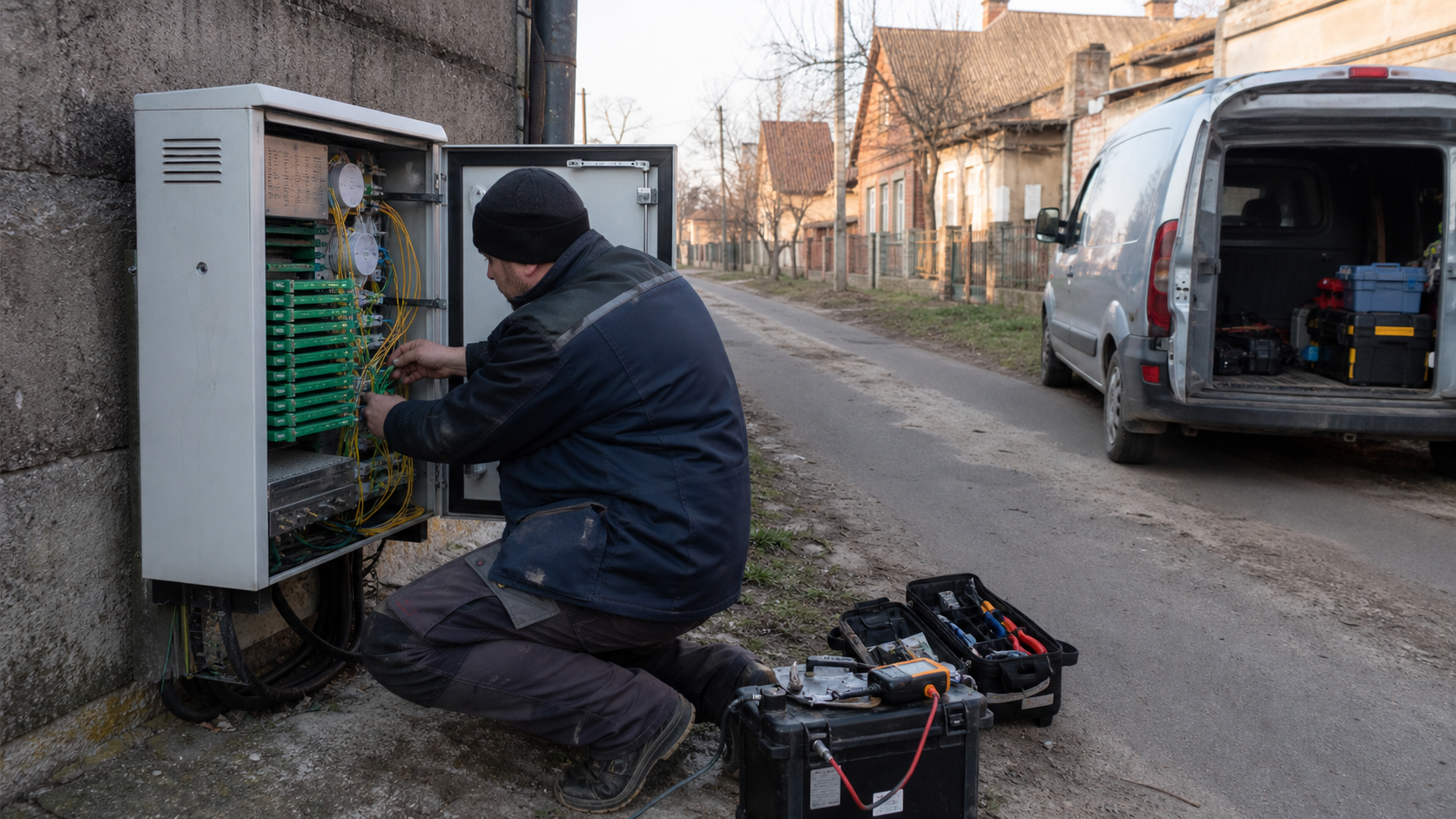
The interruption is harder to price because the public record does not give FTICOM's outage logs. In Ukraine, however, the category of interruption is not abstract. Energy infrastructure has been repeatedly attacked, rolling cuts have affected civilians, and power insecurity has become a structural input into network reliability. A local ISP can keep billing through that environment only if it keeps enough of the access network alive when grid power, damaged plant or backhaul availability fail. That turns reliability from a service promise into a capital and operating cost. Batteries degrade. Generators need fuel and maintenance.
Field teams need time, vehicles and spares. Routers, switches, optics, customer premises equipment and power systems have to be replaced or repaired. If those items are imported or priced against hard currencies, the revenue collected in hryvnia has to absorb exchange-rate exposure.
This is why the article should not start with a generic profile of a Ukrainian telecommunications company. The useful question is whether the contribution from many small paid connections can fund an increasingly physical business. Regional internet service providers often look like software-adjacent businesses because their product is bandwidth and because their public evidence is made of prefixes, autonomous-system numbers and exchange ports. In practice, a local access network is a logistics and maintenance business wrapped around IP routing.
If an operator has the density to send one technician to fix many revenue lines, local support is an advantage. If it has to maintain dispersed infrastructure with limited recurring revenue, support becomes a margin drain.
FTICOM's public evidence points in both directions. The network-resource record is real: AS3261 is visible across routing databases, with multiple upstreams, exchange evidence and 10,496 originated IPv4 addresses in one major BGP view. The corporate and procurement record, though, describes a small company in financial terms. Opendatabot reports 2025 revenue of 4.779 million UAH, net profit of 75,400 UAH and three employees. Those figures should be treated as aggregator-presented registry data, not audited public-company disclosure, but they still constrain the analysis.
A company with that reported scale cannot be assumed to have spare margin for repeated shocks. Its economic defence has to come from disciplined repair, low churn, route reuse, dense customer pockets and a willingness among customers to pay for continuity.
What the identity evidence proves
The identity match is strong enough for analysis but not strong enough to answer every operating question. Opendatabot lists EDRPOU 21949777 as TOV "FTICOM", with a full legal name corresponding to a limited liability company, a Dnipro address on Belyaeva Street, incorporation on 31 January 2007 and main activity code 61.10 for wired telecommunications. It also lists VAT registration and identifies the company as present in the register of electronic communications network and services providers.
RIPE's organisation record for ORG-SF2-RIPE lists LLC "FTICOM", country UA, registration number 21949777 and local internet registry status. That is the important boundary: the company in the business registry and the company in the network-resource registry are not just sharing a similar name.
The identity also has history. Opendatabot's change history shows earlier addresses and name/activity changes around 2017, including Donetsk and Dnipro address references. NKEK and Rada regulatory records from 2007 show FTICOM or its predecessor in Donetsk-region radiofrequency and radio-relay contexts. A court decision concerning conduct in 2017 states that a relevant IP address was in a RIPE NCC range allocated to FTICOM and that FTICOM supplied internet access under a telecom-services contract. UA-IX lists FTICOM LLC as the business name for AS3261 and points to dipt.ua.
DNS evidence connects dipt.ua with donbass.net infrastructure through mail and name-server records. Taken together, those records support continuity between a legacy Donetsk-region telecommunications identity and a currently registered Ukrainian company.
They do not, however, support a clean claim about the company's current physical coverage. Donetsk-region evidence appears in exchange records, historical spectrum decisions, user-review sites and the 2017 service reference. Current legal registration points to Dnipro. Public BGP and DNS records show network resources, but network resources can be routed, relocated, leased, delegated, used for hosting, or held for customers. The safe conclusion is that FTICOM has a real operating and network-resource identity with Donetsk-region roots and Dnipro corporate registration.
The unsafe conclusion would be a detailed current coverage map without a current coverage source.
The same discipline applies to ownership and control. Opendatabot lists current director and owner/founder data, including Ihor Hryhorovych Myropolskyi and other stakeholders. That is sufficient to say the public aggregator records a local ownership and management profile. It is not enough to infer governance quality, capital support, related-party supply terms or owner willingness to inject cash after a network shock. For a regional ISP, those unknowns matter. A larger national operator can often finance repairs through group liquidity or supplier credit.
A smaller local operator may depend on owner discipline, cash conversion and the timing of customer receipts.
The visible network is stronger than the visible disclosure
FTICOM's routing evidence is the strongest part of the public record. Hurricane Electric's BGP Toolkit identifies AS3261 as LLC "FTICOM" in Ukraine, with 19 originated IPv4 prefixes, no originated IPv6 prefixes, 25 announced IPv4 prefixes, 18 RPKI-valid originated IPv4 prefixes and 10,496 originated IPv4 addresses at the time viewed. bgp.tools similarly lists AS3261 as active under RIPE, registered in August 2002, with 19 IPv4 originated prefixes and no observed IPv6 originated prefixes.
Both monitors list a visible prefix set including 5.153.128.0/19, many more-specific 5.153.x /24s, 5.153.160.0/22, 92.242.100.0/24, 92.242.101.0/24 and 193.106.200.0/24.
That is meaningful infrastructure evidence, but it has to be interpreted correctly. IPv4 space is not the same as subscribers. A provider can originate address space used for residential broadband, business access, hosting, internal infrastructure, routed customers, downstream networks or dormant assignments. The 193.106.200.0/24 line is especially important because it is labelled in several places as tied to Private enterprise "InformService" while appearing under AS3261 routing context. That supports a downstream or routed-customer relationship, not a claim that FTICOM owns or directly retails every address in that block.
Good network-resource evidence tells the reader that an operator has real routing surface. It does not reveal the revenue attached to each route.
The interconnection evidence is also real. UA-IX lists FTICOM LLC, AS3261 and member addresses on the exchange. PeeringDB identifies the network as DIPT, aka LLC FTICOM, with an AS-DIPT IRR set, regional scope and open peering policy. bgp.tools lists upstreams including Fiord Networks, RETN, Satelit Servis, Eurotranstelecom and Objedinenie Group. Hurricane Electric lists a broad peer table and exchange count. DN-IX and UA-IX pages place AS3261 in exchange contexts, though the wartime physical status and traffic meaning of a Donetsk exchange table should not be overread.
From an economics standpoint, route diversity is not free. It reduces dependence on one path, gives the operator more ways to steer traffic, and can lower marginal delivery cost for locally exchanged traffic. But it brings cross-connects, port fees, router capacity, configuration labour, monitoring and contractual complexity. For a national carrier, those costs are spread across a large base. For a small regional operator, the difference between useful resilience and overbuilt overhead depends on density.
If FTICOM's revenue is concentrated in a small number of high-value enterprise or wholesale relationships, visible routing depth may make commercial sense. If most revenue comes from low-priced access lines, the same routing depth must be ruthlessly cost-controlled.
The IPv6 evidence illustrates why public data must be handled cautiously. PeeringDB's self-described fields show IPv6-related capability or prefix-limit information, while major BGP monitors reviewed show no originated IPv6 prefixes. That is not necessarily a contradiction in a scandalous sense. It may reflect configured policy, historical data, exchange capability, private arrangements or simply a gap between declared readiness and globally visible route origination. The economic point is narrower: public evidence does not support claiming that FTICOM has a visible IPv6 access base.
If IPv6 is not actively routed to customers, future upgrade requirements could be another small but real engineering burden.
Business model: recurring access first, optional wholesale second
The public record supports recurring access revenue. It does not reveal the full business mix. The Andriivka procurement record is an access-service sale. Opendatabot lists wired telecommunications as the main activity and other telecom/data-related activities as additional lines. The court reference describes internet access under a telecom-services contract in 2017. Review sites place FTICOM or donbass.net among local ISP choices. BGP and RIPE records show the operator can sit above customers or downstream networks.
Each of those facts points to an access-and-network business, but none splits revenue between residential broadband, SME circuits, public-sector customers, IP transit, hosting, telephony or routed downstreams.
The distinction matters because the cost structure is different. Residential access is usually high volume, lower ARPU and sensitive to service interruptions. Small business and public-sector access can carry higher service expectations and more explicit contract terms, but the buyer may be price constrained. Wholesale or downstream routing can produce better revenue per operational relationship, but it also requires credible uptime and route quality. Hosting or address-space services can use IP resources differently from last-mile broadband.
Without a segment split, the fair approach is to model FTICOM as a recurring access provider with possible wholesale and enterprise components rather than presenting a precise mix.
In such a model, the first margin layer is VAT and collection. A 750 UAH VAT-inclusive monthly public-sector service unit, if that interpretation of the 12 units is right, leaves 625 UAH before VAT for the operator. From that amount, the operator must pay for upstream transit or peering costs, access infrastructure, customer support, billing, taxes, premises, power, maintenance and field repair. If the customer is a public body and payment timing is reliable, the low headline amount may still be useful. If many customers pay late or churn when outages occur, even a higher nominal tariff can produce weak cash contribution.
The second margin layer is capacity. Bandwidth costs have fallen over the long run, and exchange participation can reduce the cost of local traffic, but a small ISP still has to buy enough capacity for peak use and enough path diversity for outages. Underprovisioning causes congestion, which increases churn and support calls. Overprovisioning consumes cash. FTICOM's visible upstream and peer relationships suggest it has options. The missing question is how much paid traffic sits behind those options. A rich interconnection map serving thin revenue is a burden.
A well-used interconnection map serving dense demand is a competitive advantage.
The third margin layer is local support labour. Opendatabot's reported employee count of three for 2025, if accurate and complete, would imply an exceptionally lean operating base relative to the routing surface. It may omit contractors or related-party support. It may not reflect field labour actually used. But if it is directionally right, FTICOM's model cannot depend on a large permanent workforce. That pushes the economics toward selective response, outsourcing, owner-operated technical work, concentrated routes, or a mix of automation and relationship-based support.
Local reliability can be a differentiator only if the operator has enough people or contractors to restore service faster than customers expect from larger substitutes.
The retained-contribution test
The article's core test is retained contribution after the costs that arrive before profit. Start with the paid connection. Remove VAT. Remove the cost of backhaul and upstream capacity. Remove exchange and routing overhead. Remove power. Remove support time. Remove equipment depreciation and spares. Remove the expected cost of outages and repairs. What remains has to cover general overhead and profit. In FTICOM's case, Opendatabot reports a 2025 net profit of 75,400 UAH on 4.779 million UAH revenue. That is around 1.58 percent, a thin reported margin.
It may be incomplete or affected by accounting choices, but it is not a number that invites casual optimism.
The revenue trend also deserves caution. Opendatabot's 2025 revenue is above 2024 but far below 2021. The same source shows revenue of 22.692 million UAH in 2021, 9.598 million UAH in 2022, 6.018 million UAH in 2023, 4.091 million UAH in 2024 and 4.779 million UAH in 2025. That pattern is consistent with severe disruption followed by modest stabilisation, although the public record does not tell us the precise causes. A wartime Ukrainian telecom operator with Donetsk-region roots may face customer displacement, asset damage, payment disruption, route relocation and administrative changes.
The article should not turn that into a dramatic but unsupported story. It can say the reported revenue base is materially smaller than before the full-scale invasion period and that a small rebound in 2025 does not remove the repair burden.
The public-procurement picture is useful but limited. Opendatabot reports tender participation and annual public-procurement sales, while Clarity reports a larger procurement history across its tenderer profile. The named 2025 contracts visible in Opendatabot are small: 9,000 UAH, 6,750 UAH and 3,000 UAH examples appear in recent tender snippets. That suggests public-sector access contracts can be low-ticket maintenance revenue rather than transformative customer wins.
A handful of small local-government or education customers may still matter to a local ISP because they are sticky, reputationally important and geographically tied to existing plant. They do not by themselves fund major network rebuild.
For a company with a small reported profit, the cost of one bad outage can matter. A truck roll, a replacement switch, several optical transceivers, a battery bank or a generator repair can absorb the profit from many small lines. When the network interruption is caused by area power failure rather than a single customer fault, the support burden multiplies: customers call, field staff diagnose, batteries discharge, generators run, upstream paths may need rerouting, and the provider's brand is judged even when the root cause sits in the power grid or war damage.
The smaller the margin, the more important it becomes to distinguish between outages the provider can prevent and outages it can only ride through.
This is where density becomes decisive. If FTICOM's paying customers are clustered around existing nodes and routes, one backup-power investment can protect many bills. If customers are dispersed across expensive last-mile segments, each repair protects too little revenue. Public BGP evidence cannot answer this. A /19 and several /24s may look large, but address blocks do not show fibre density. The 2025 procurement record shows a service in Donetsk region, but not how close it is to other revenue lines.
The economic judgment therefore has to remain conditional: the same nominal ARPU can be attractive in a dense pocket and inadequate in a scattered footprint.
Power, repair and replacement economics
Ukraine's power-risk environment changes the ISP equation. IEA and OHCHR evidence describes repeated attacks against energy facilities, large outages, rolling cuts and damage to generation, transmission and distribution infrastructure. For an access provider, grid unreliability does not simply mean its office lights go out. Active access gear, aggregation routers, wireless links, server rooms, customer premises equipment and building-level switches all have power dependencies. Some parts of the network can be protected centrally. Other parts require distributed batteries or customer-side resilience.
The more distributed the active equipment, the more expensive outage survival becomes.
Backup power also has a lifecycle. Batteries are not one-off purchases; they degrade, especially under repeated deep discharge. Generators need fuel, oil, service and secure storage. Inverters and chargers fail. Diesel or petrol logistics become local operational risk. When the grid returns irregularly, charging windows may be short. A provider can tell customers it has backup power, but the real question is how many hours, at which nodes, after how many prior outages, and at what fuel cost. Public sources do not provide those answers for FTICOM. That absence should be read as an uncertainty, not filled with assumptions.
Repair economics are similarly physical. A damaged fibre span, mast, power feed or access cabinet is not fixed by routing policy. It requires access to the site, parts, tools and people. In wartime or near-frontline areas, site access may be constrained by safety, occupation, military activity or damaged roads. Even away from direct hostilities, supply chains and labour markets are affected by mobilisation, displacement and general inflation. A local ISP can sometimes outperform national operators precisely because it knows the plant and the customers. But that advantage costs money.
If customers are not paying for fast restoration, the provider subsidises resilience from already thin margins.
Replacement equipment creates the currency mismatch. FTICOM collects revenue in UAH. Many network components, especially branded routers, switches, optical modules, batteries, power electronics and specialist wireless equipment, are imported or benchmarked to hard currencies. On 10 August 2026, the NBU official rates were 44.7579 UAH per USD and 51.6148 UAH per EUR. A USD 1,000 part is not just a thousand units in an abstract budget; it is 44,757.90 UAH before logistics, tax, distributor margin or installation. A EUR 1,000 part is 51,614.80 UAH on the official rate.
Against reported 2025 profit of 75,400 UAH, a few unplanned import-priced replacements could consume a large share of annual profit.
That does not mean FTICOM is uneconomic. Small operators often extend equipment life, buy refurbished hardware, standardise parts, reuse spares, rely on local technicians and avoid overbuilding. Those practices can be rational. They also create hidden fragility if the network depends on ageing gear that fails during power events. The better the operator is at preventive maintenance, inventory discipline and route simplification, the more likely recurring access revenue covers the repair cycle. The worse it is at those basics, the more each outage becomes a cash event.
Suppliers, customers and concentration
No public supplier list was located. That is a material limit. Without supplier data, it is impossible to say whether FTICOM depends on one equipment vendor, one upstream carrier, one local contractor or one fuel source. BGP records show visible upstream diversity, but routing diversity is not the same as procurement diversity. A provider can have five upstreams and still depend on one router platform, one tower landlord, one field subcontractor or one source of imported optics. Supplier concentration is therefore an unresolved risk rather than a proven weakness.
Customer concentration is also unresolved. Procurement records give named public customers, but they do not reveal the full customer base. Opendatabot's tender summary lists public-sector buyers and small annual tender sales. Clarity shows a procurement history. These records prove FTICOM sells or has sold services to public bodies. They do not prove public bodies dominate revenue. In fact, Opendatabot's reported 2025 revenue of 4.779 million UAH is much larger than the 18,750 UAH of 2025 tender sales shown in its tender-sales row, suggesting public procurement visible there is not the whole business.
But the absence of a customer list means we cannot know whether a few private or wholesale customers carry the economics.
The public-sector anchor is still valuable because it shows price sensitivity. Local councils, schools, utilities and public health entities often buy communications under budget constraints. They may value continuity, but they also procure under administrative discipline. If the operator raises prices to cover backup power and replacement equipment, it may meet resistance. If it does not raise prices, reliability investment must come from efficiency, cross-subsidy or owner capital.
That is the central tension in the assignment: can recurring access revenue cover bought capacity, backup power, field repair and imported replacement equipment while customers remain price-sensitive?
The honest answer is: only under disciplined conditions. The operator needs enough customers per route and per powered node. It needs enough low-cost peering or efficient transit to protect gross margin. It needs support practices that prevent small faults from becoming repeated truck rolls. It needs customers who believe local service is worth a stable monthly fee even when mobile data looks cheaper in normal conditions. And it needs working capital to buy spares before failures, not after customers are already down. Public evidence proves some pieces of this structure; it does not prove the whole system is in balance.
Competition and substitutes
Ukraine's fixed-internet market is resilient and fragmented. NKEK's 2025 report puts fixed-internet revenue at 24.4 billion UAH, up 8.2 percent from 2024, with communications-sector capital investment at 33.9 billion UAH. NKEK's fixed-access analysis shows fixed-access lines relatively stable around the 8 million range through wartime disruption, with rural fixed-access lines growing from Q1 2021 to Q1 2025. That is a favourable market backdrop for regional ISPs: demand for fixed access has not disappeared, and rural or local connectivity still matters.
Fragmentation cuts both ways. It creates space for local operators that know their streets, buildings and municipal customers. It also means customers may have alternatives where networks overlap. National carriers and larger regional groups can bundle mobile, fixed broadband, television and business services. They may have stronger procurement power for equipment and better access to capital. Mobile operators can substitute for fixed access during normal use, especially as smartphone use dominates everyday connectivity.
Satellite and direct-to-cell experiments add another layer of resilience narrative, even when they do not replace a stable wired connection for price-sensitive customers.
Fixed broadband has a performance advantage when it works. DataReportal's Ukraine 2025 report, using Ookla figures, shows median fixed download speed well above median mobile download speed at the start of 2025. That supports the local ISP value proposition: a stable fixed line can be better for homes, offices, schools and municipal functions than mobile data alone. But service interruptions weaken that advantage. If power cuts or damaged local plant make fixed access unreliable, users fall back to mobile, national roaming, Starlink-type solutions or a second provider. Reliability is therefore not an optional premium feature.
It is the defence against substitution.
The public record does not show FTICOM's churn. That missing fact matters more than the size of the address block. In a price-sensitive market, customers may tolerate occasional trouble if local support is quick and human. They may leave if outages are frequent, communication is poor or substitutes are easy. Review sites list FTICOM or donbass.net in provider rankings, but those are unofficial signals only. They can tell us the name has been visible to users; they cannot establish satisfaction, churn or current quality.
The article should therefore treat consumer sentiment as a weak signal and put weight on verifiable network and contract evidence.
Regulatory and geopolitical risk
FTICOM's regulatory history is old but informative. The 2007 NKEK/Rada decisions show FTICOM connected to radiofrequency and radio-relay permissions in Donetsk region. Those decisions help explain the company's historical infrastructure identity. They do not prove current spectrum rights because the terms cited in the records expired years ago. Any current wireless access or radio-relay claim would need a live licence or register entry. For this article, the safe use of the evidence is historical: FTICOM was not merely a web-hosting shell; it had telecom and radio infrastructure roots.
The geopolitical risk is direct. Donetsk-region evidence is visible in historical licences, exchange records, procurement customers, review sites and a 2017 court reference. Donetsk region has been profoundly affected by war, occupation, displacement and infrastructure damage. A company with roots or customers in that environment faces unusual uncertainty about asset control, customer continuity, repair access and local demand. Current Dnipro registration may reduce some administrative risk, but it does not erase the operating uncertainty attached to legacy footprint and regional customers.
There is also regulatory adaptation risk. Ukraine is aligning electronic communications regulation with European frameworks. NKEK's annual reports emphasise EU integration, consumer protection, quality tools and regulatory activity. For a small ISP, that can improve market credibility but also increase reporting, compliance and quality obligations. If the operator already runs lean, each new reporting or customer-rights process consumes management time. The cost may be justified, but it is still a cost.
The numbering evidence adds another narrow point. e164.com lists a geographic number range for FTICOM. Numbering resources can support voice or legacy telecom services, but the public data is too thin to infer an active voice business or material revenue. Like the old spectrum records, it supports a picture of a telecom operator with more than a bare website, not a quantified business line.
Unofficial signals and what not to infer
Unofficial market signals are useful precisely because the formal disclosure is thin, but they must remain in their lane. 2IP.ua and Providersnetua list FTICOM or donbass.net among Ukrainian or Donetsk provider ratings, with review counts and star categories. That shows market name recognition. It may hint that the operator had or has retail-facing service in the Donetsk provider ecosystem. It does not prove current service quality, current coverage, active subscriber count or churn.
IP-intelligence tags also need care. IPinfo and other services may identify hosted domains, pingable IPs, BitTorrent or VPN tags, geolocation, connection type or company labels. These are useful for triangulating whether address space is alive and how third-party datasets classify it. They are not a customer ledger. A pingable IP in Kyiv latency tests does not mean the access network is healthy. A VPN tag does not define the business model. A Dnipro geolocation does not prove all customers are in Dnipro.
The biggest analytical mistake would be to confuse address space with operating scale. 10,496 originated IPv4 addresses sounds substantial for a company with reported 2025 revenue under 5 million UAH. But the address space may reflect legacy allocation, routed customers, hosting infrastructure or more-specific route engineering. The better inference is that FTICOM has network resources that could support a larger or more complex role than its public financials suggest. The worse inference would be to multiply addresses by an assumed subscriber revenue and call that the business.
The second mistake would be to assume a national-carrier cost base. FTICOM's public profile is not Kyivstar, Ukrtelecom, Datagroup/Volia or Vodafone. Larger operators can spread capex, negotiate equipment pricing, staff network operations centres and absorb regional shocks differently. A local provider competes on local knowledge, speed of response, relationships and sometimes lower overhead. But those advantages are only durable when they translate into lower repair cost per customer or lower churn. If the same local team has to cover too much geography with too little cash, localness becomes strain rather than advantage.
What would change the judgment
The first decisive fact would be active access lines by geography. If FTICOM has dense clusters of paying customers near protected nodes, the economics are more plausible. If customers are sparse or concentrated in hard-to-repair locations, the same revenue is weaker. The public record does not provide this.
The second decisive fact would be segment ARPU and churn. A mix weighted toward SMEs, public institutions, wholesale links or premium fixed access could support repair and route diversity. A mix weighted toward low-priced residential lines with high churn would make the economics fragile. The Andriivka contract is too small and too specific to generalise.
The third fact would be outage and restoration data. In a wartime power environment, customers may tolerate interruptions if restoration is clear, fast and better than substitutes. They may leave if the provider cannot communicate, cannot reach sites or cannot keep powered nodes alive. Outage minutes and repeat faults would tell us whether reliability is a cost sink or a differentiator.
The fourth fact would be capex and spares inventory. If FTICOM has already replaced vulnerable equipment, standardised its network and stocked critical spares, future interruptions may be manageable. If it is deferring replacement, each shock could force emergency purchases at bad exchange rates. Public sources do not show the equipment base.
The fifth fact would be upstream cost and contract structure. BGP shows route diversity, but the commercial terms matter. Low-cost peering and well-priced transit can protect margins. Expensive or underused capacity can drain them. The same visible upstream list can be economically attractive or unattractive depending on traffic volume and terms.
The sixth fact would be working capital. A small reported profit does not automatically mean weak cash if depreciation, owner support or payment timing are favourable. Conversely, revenue without cash collection is not useful for repair. Public financial snippets are not enough to model liquidity.
Bottom line
FTICOM's public record supports a serious but cautious company-research conclusion. It is a real Ukrainian telecom operator, not merely a name in a directory. It has AS3261, RIPE organisation evidence, visible IPv4 routes, exchange presence, DNS infrastructure and public procurement examples. It also has disclosure gaps that prevent confident claims about scale, current footprint, customer concentration, suppliers and resilience spending.
The economic burden is therefore clear. FTICOM must make local reliability pay. Its network-resource evidence gives it the technical surface to matter locally. Its small visible contracts and reported financials show why every hryvnia of retained contribution matters. Wartime power risk and repair risk mean reliability cannot be funded from slogans; it has to be paid for by enough recurring customers on enough dense routes with low enough churn and high enough willingness to stay. If that condition holds, a local ISP can defend a niche that national carriers and mobile substitutes do not fully own.
If it does not hold, the very things that make FTICOM useful - local support, route diversity, legacy infrastructure and willingness to serve difficult places - become costs that recurring access revenue may not cover.
Sources
- https://opendatabot.ua/c/21949777
- https://clarity-project.info/tenderer/21949777
- https://public.api.openprocurement.org/api/2.5/tenders/a8f40f47774448e38942dff8b2fbdcde
- https://tender.uub.com.ua/tender/UA-2025-07-07-002975-a/
- https://clarity-project.info/tender/a8f40f47774448e38942dff8b2fbdcde
- https://ix.net.ua/en/user/143
- https://www.peeringdb.com/api/net?asn=3261
- https://www.peeringdb.com/net/7351
- https://bgp.he.net/AS3261
- https://bgp.tools/as/3261
- https://rest.db.ripe.net/search.json?query-string=AS3261&source=ripe
- https://rest.db.ripe.net/search.json?query-string=ORG-SF2-RIPE&source=ripe
- https://ipinfo.io/AS3261
- https://ipgeolocation.io/browse/asn/AS3261
- https://whois.ipip.net/AS3261
- https://www.iplocate.io/AS3261
- https://www.ip2location.com/as3261
- https://2ip.io/as/3261/
- https://ipregistry.co/AS3261/193.106.200.0/24
- https://www.ipaddress.com/ipdb/ipv4-public/5.153.128.0/19/
- https://www.ipaddress.com/ipdb/ipv4-public/92.242.100.0/23/
- https://ipinfo.io/AS3261/5.153.144.0/24
- https://www.bigdatacloud.com/network-lookup/5.153.163.0/24
- https://www.ipaddress.com/website/dipt.ua/
- https://bgp.he.net/exchange/DN-IX
- https://bgp.tools/ixp/UA-IX
- https://www.e164.com/directory/operators/ukr/fticom-limited-liability-company
- https://2ip.ua/ua/services/providers-rating?act=2&asid=44673&city=%D0%94%D0%BE%D0%BD%D0%B5%D1%86%D0%BA
- https://providersnetua.com/rating-of-providers-ukr/
- https://nkek.gov.ua/npas/risennia-no-792-vid-200607-risennia-pro-vidacu-licenzii-na-zdiisnennia-diialnosti-u-sferi-telekomunikacii-ta-na-koristuvannia-radiocastotnim-resursom-ukrayini
- https://zakon.rada.gov.ua/rada/show/vr941634-07
- https://zakononline.ua/court-decisions/show/83370007
- https://www.data-ua.com/doc/60845384/persons
- https://nkek.gov.ua/pro-nkek/zvity-nkek/rz2025
- https://nkek.gov.ua/news/analiz-podannia-zvitnosti-postachalnykamy-posluh-fiksovanoho-dostupu-do-internetu-ch-2
- https://www.undp.org/ukraine/publications/mobile-communications-and-internet-access-ukraine-results-sociological-survey
- https://datareportal.com/reports/digital-2025-ukraine
- https://datahub.itu.int/data/?e=UKR
- https://sdg.ukrstat.gov.ua/9-6-1/
- https://ukraine.ohchr.org/en/Attacks-against-Ukraine-s-energy-infrastructure-and-update-on-the-human-rights-situation-in-Ukraine-1-December-2025-31-May-2026
- https://www.iea.org/reports/ukraines-energy-security-and-the-coming-winter/ukraines-energy-system-under-attack
- https://bank.gov.ua/NBUStatService/v1/statdirectory/exchange?valcode=USD&date=20260810&json
- https://bank.gov.ua/NBUStatService/v1/statdirectory/exchange?valcode=EUR&date=20260810&json
- https://stat.gov.ua/uk/publications/indeksy-tsin-u-hrudni-2025-roku-ekspres-vypusk
- https://data.worldbank.org/country/ukraine
Member Briefing
Deeper Profile Context
Sign in with the right membership level to unlock the full briefing and source notes.
Only for Strategic Circle
Strategic Circle
Open to all readers. Unlock profile briefings after joining and signing in.
Join Strategic CircleOnly for Leadership Alliance
Leadership Alliance
For qualified IP-asset owners and management; sign in to unlock alliance briefings.
Join Leadership Alliance