Summary
- In RFC 794, Vint Cerf proposed that a terminal-host process could keep a TCP
LISTENopen while serving existing users, then decide whether a higher-precedence arrival displaced a lower-precedence connection. - His flash-override FTP example made pre-emption an application decision at the receiving host; a saturated initiating host might also need operating-system action before the urgent request could even leave.
Host X is already moving a routine file to Host Y. From Host Z comes a flash-override request for an FTP connection to X. The SYN reaches the port. Who gets told to leave? A priority bit can announce the visitor, but it cannot tidy up the interrupted transfer. Vint Cerf's September 1981 RFC 794 put the awkward part of pre-emption exactly where work was underway: in the processes using TCP.
Cerf began outside the computer room. A telephone circuit, once taken, held its bandwidth even while idle; a higher-priority caller could cut off a lower-priority one in a saturated circuit system. A store-and-forward message switch could hurry an important message and even interrupt a printer. Packet switches offered a different bottleneck: when full, they could sort traffic waiting to enter. These were three ways of rationing scarce resources. Precedence mattered when the system was crowded; the scarce thing changed from circuit to processor to entry into the packet network.
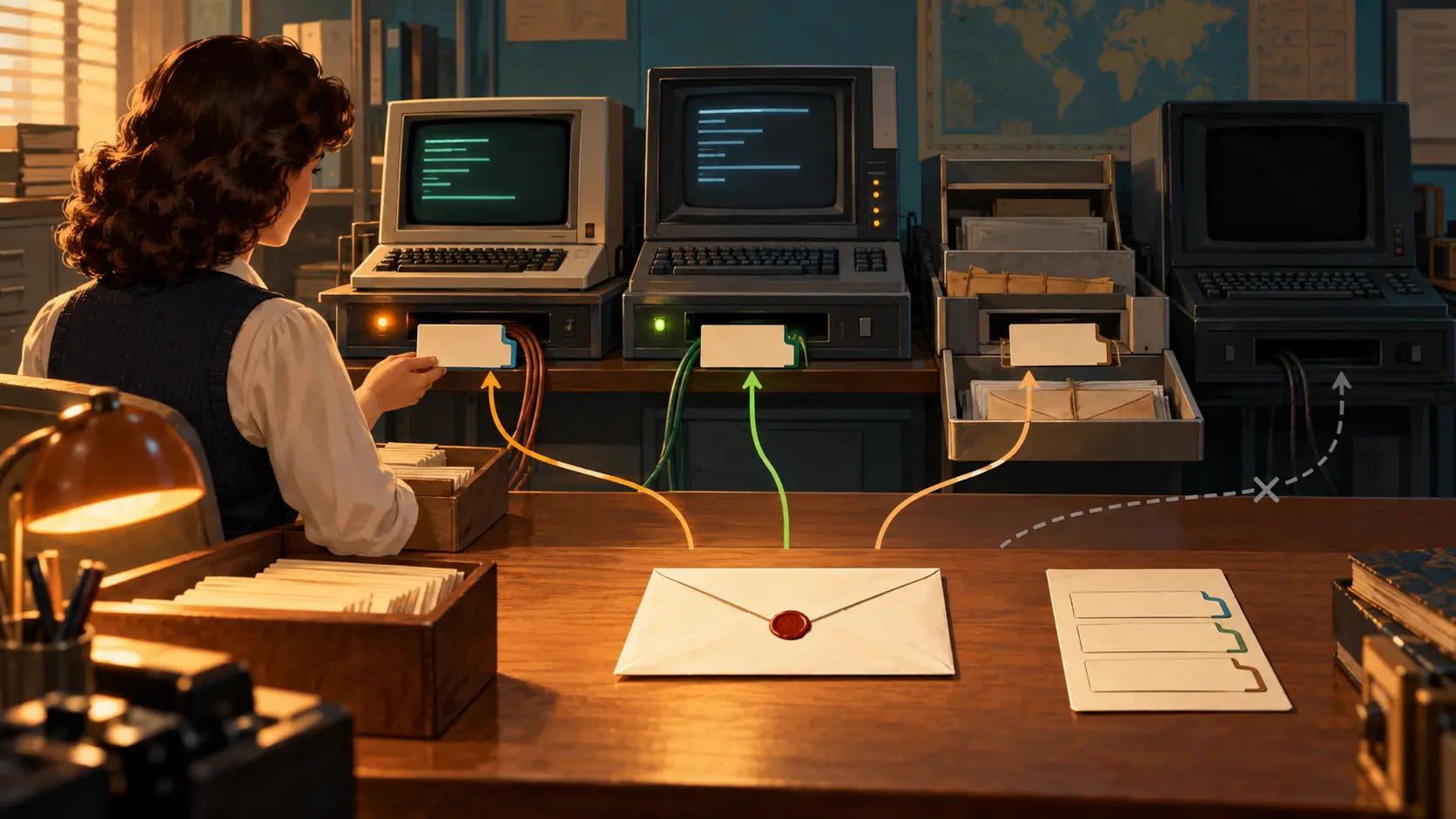
At a terminal in AUTODIN II, the scarce resource was more personal. Cerf imagined the terminal-host process, or THP, keeping a LISTEN posted on a terminal's port while one or more connections were already active. A new connection could arrive and reveal its precedence. The THP would compare it with the live sessions, close or abort the lowest-ranked one if necessary, switch the user to the newcomer, and post another LISTEN. The machine could receive the knock without promising every caller a seat.
That design asked for the precedence of an incoming connection to be visible to the process. Cerf did not propose a grand new TCP eviction engine. TCP generally served processes; it did not create a terminal-serving process merely because a new request arrived. A disconnected or switched-off terminal would make such a creation particularly silly. The process facing the user knew whether there was a user to switch, which work would be interrupted and what cleanup the interruption required. Cerf also noted the security limits on letting one terminal juggle several connections. The doorman needed a view of the room.
The FTP case made the cost concrete. Host X's FTP service could keep an extra LISTEN available while handling routine transfers. When Z's flash-override SYN arrived, FTP could serve it by displacing a lower-precedence user if it could not accommodate another one. FTP, rather than a bare transport flag, could start the cleanup. A process that kept no pending LISTEN while serving its current users was, under this strategy, non-pre-emptable. The extra open door was a design choice, not a magic property of every TCP session.
There was a second door. Suppose Z's own FTP or TCP resources were already saturated. The urgent user could have priority at X and still be unable to start a request. Cerf moved the decision to Z's operating system: it might have to free local resources, even by logging out lower-precedence users. He left room for precedence to attach to a user or a terminal, and for the operating system or a TCP implementation to make different local choices. The caller could be a VIP; the lobby still needed space.
The two-page memo is a neat piece of architectural restraint. It does not ask one packet field to perform a social act that only a running service can perform. It shows an arriving connection, an occupied host, a process with an extra LISTEN, and a possible cleanup bill. The person losing a file transfer would experience pre-emption as an interruption. Cerf located the decision with the software able to account for that interruption.
Member Briefing
Deeper Profile Context
Sign in with the right membership level to unlock the full briefing and source notes.
Only for Strategic Circle
Strategic Circle
Open to all readers. Unlock profile briefings after joining and signing in.
Join Strategic CircleOnly for Leadership Alliance
Leadership Alliance
For qualified IP-asset owners and management; sign in to unlock alliance briefings.
Join Leadership Alliance