
Summary
- Firmus and SUBCO describe an approximately US$300 million investment for up to 150 Tbps of dedicated APX East capacity over 25 years. “Up to” supplies a ceiling, not a disclosed minimum, assigned fibre count, activated service or traffic measurement.
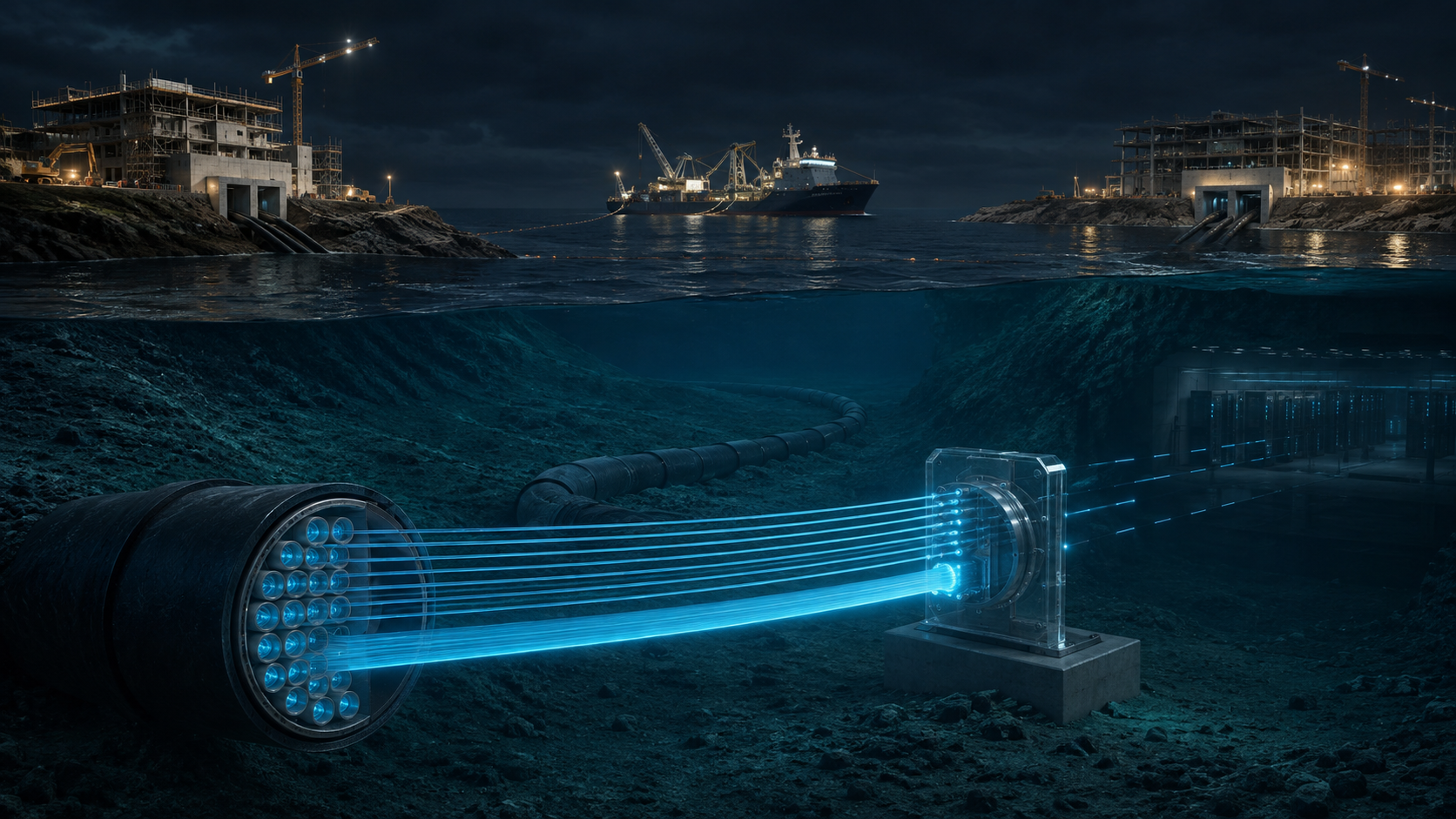
- APX East is designed as a 16-fibre-pair express system between Sydney and Los Angeles, with target ready-for-service in Q4 2028. The 16 pairs belong to the whole-cable description and cannot be assigned to Firmus from the public record.
- The useful market test is a state ledger: contract rights and payment milestones, permits, supply and manufacture, marine installation, landing and backhaul, terminal equipment, testing, RFS, customer acceptance, activated capacity and observed traffic.
There is a single conditional phrase in the Firmus–SUBCO announcement that governs every number around it. Firmus will become a cornerstone customer of APX East “once it is built”. The construction condition comes before the approximately US$300 million investment, before the 25-year term and before the ceiling of 150 terabits per second can become a delivered service.
That does not make the announcement empty. New submarine systems need credible demand well before they generate network revenue. A customer willing to organise a long-dated commitment can improve a developer's financing case, help equipment orders move from option to contract and give data-centre planners a route around which to design future capacity. Firmus, for its part, can try to reserve trans-Pacific connectivity before AI factories make the route more contested.
The analytical error is to skip the middle. A commercial reservation, a financed project, an installed wet plant, accepted optical capacity and live traffic are different assets. They can be connected by one contract, but they do not occur on the same day and they are not evidenced by the same receipt.
The capacity number has a ceiling but no public floor
“Up to 150 Tbps” is grammatically and economically asymmetric. It tells a reader the largest capacity described by the announcement. It does not disclose the smallest volume Firmus must take, the first tranche it will activate, the number of fibre pairs allocated to it or the date from which capacity charges run. No reviewed source supplies those fields.
This is why 150 Tbps cannot be treated as current Firmus traffic. It is also why a unit-cost calculation would manufacture precision. Dividing US$300 million by 150 Tbps would combine an approximate investment with a maximum capacity, without knowing the committed floor. Dividing again by 25 years would assume a service and payment clock that the public announcement does not define. A neat dollar-per-terabit figure would be arithmetically reproducible and commercially unsupported.
The 25-year term matters in a different way. It signals that the parties are organising around the economic life of long-lived infrastructure rather than buying a short cloud contract. Yet the start of that term, renewal rights, indexation, take-or-pay provisions, performance remedies and termination rights are not public. Duration is evidence of long exposure; it is not a complete cash-flow schedule.
The US$300 million also needs its own label. The parties call it an investment. They do not publicly split it among capacity prepayments, construction finance, equity, landing facilities, terminal equipment or later service charges. None of those structures would be surprising in a large infrastructure agreement, but choosing one without the contract would replace reporting with invention. The immediate receipt is commitment, not cost allocation.
Sixteen fibre pairs describe the system, not Firmus's share
SUBCO's January announcement presents APX East as a 16-fibre-pair express system between Sydney and Los Angeles, without intermediate landings or regeneration, and targets ready-for-service in the fourth quarter of 2028. The project page repeats the two endpoints and its performance claims, while listing the primary data-centre locations as “coming soon”.
Those details define an intended system architecture. They do not show that Firmus receives all 16 pairs, a fixed fraction of them or even capacity delivered through a particular ownership form. Modern cable economics can separate fibre ownership, spectrum, wavelengths, indefeasible rights of use and managed capacity. The public material uses “dedicated capacity” but does not disclose which legal or optical layer carries that dedication.
The distinction is especially important because 150 Tbps and 16 pairs invite false division. Capacity per pair depends on the optical design, spectrum, terminal equipment, modulation, margins and upgrade generation. The announced customer capacity is not a licence to infer any of those choices. The cable-level fibre count and the customer-level capacity ceiling are two separate disclosed facts, not the numerator and denominator of an engineering specification.
SUBCO also markets APX East as an unregenerated express path with low latency and resilience, including the ability to operate from one end in a cable fault scenario. These are meaningful design intentions. They remain design claims until the installed route, repeaters, power-feed equipment, shore ends, backhaul and submarine line-terminal equipment are tested together. A route can be physically continuous while customer service is not yet accepted; an RFS declaration can exist before a specific buyer activates its full contracted capacity.
A Q4 2028 target contains a two-year production chain
The date is easy to repeat and harder to decompose. Submarine projects must turn survey data and supplier commitments into thousands of kilometres of manufactured cable, repeaters and branching equipment; obtain vessels and weather windows; complete shore works and landing facilities; splice segments; connect terrestrial backhaul; install terminal equipment; and pass optical, power and protection testing.
Australian regulation creates a visible control point. The Australian Communications and Media Authority says an international submarine cable installed in Australian waters requires a permit and that only a licensed carrier may apply. An application includes the route, ownership and control information and supporting material. ACMA consults the Attorney-General's Department and Home Affairs. Its published processing periods can be extended, and the clock can pause while information is supplied.
The permit is not a ceremonial final stamp. ACMA says a permit normally remains in force for 18 months. An extension request is expected to show a project plan and progress against milestones including marine survey work, supplier engagement, cable manufacture, landing facilities, the start of cable lay and proposed ready-for-service. The regulator's list is useful because it converts “build” into observable states.
The source set reviewed for this article does not include a project-specific APX East permit receipt. That is not evidence that no permit exists, and the article makes no such claim. It means only that permit identification and its conditions belong on the monitoring ledger rather than inside an assumed completion state. The same treatment applies to manufacturing awards, vessel schedules and landing-site readiness: absence from this source set is a request for a receipt, not a verdict.
SUBCO's account of another cable shows the vocabulary of later stages. Its April 2026 SMAP update reports the final splice, 59 installed repeaters, four landings and terrestrial backhaul, followed by end-to-end testing before RFS. SMAP does not prove anything about APX East's schedule. It demonstrates why “announced”, “manufactured”, “laid”, “spliced”, “tested” and “in service” should not be used as synonyms.
The demand narrative is not the customer commitment
The project announcement frames APX East around a sharp increase in AI connectivity. There is a small but instructive inconsistency inside SUBCO's own publication record. The live web page says future AI systems may need 75 to 150 Tbps of international capacity. The attached announcement PDF says 100 to 200 Tbps.
Neither range should be silently preferred or blended. They are scenario language in two versions of company material, not metered demand and not Firmus's disclosed minimum commitment. The discrepancy may reflect a revised page, a different benchmark or ordinary communications drift. Without an explanation, it shows precisely why demand narratives need dates, definitions and workloads attached.
Firmus's rationale is nevertheless legible. AI factories need more than accelerators and electricity. Training data, checkpoints, models, inference requests and customer output must cross networks, often between jurisdictions. Reserving a direct Australia–United States route could reduce dependence on congested intermediate hubs and provide more control over performance and procurement. It could also make Firmus a meaningful wholesale buyer rather than a passive retail customer.
But “AI capacity” is not one workload. Training transfers can be large and bursty; distributed inference may care more about latency and consistency; backup and model replication care about recovery windows; customer traffic depends on where users and datasets sit. The commercial value of 150 Tbps cannot be assessed from accelerator count alone. It requires the workload mix, activation profile, utilisation, route diversity and price alternatives that the announcement does not disclose.
A cornerstone customer changes finance before it changes traffic
The clearest near-term effect may occur on SUBCO's side of the ledger. A named cornerstone customer can support project financing, supplier negotiations and the credibility of future sales. It can also concentrate risk: a developer may shape route economics around one large buyer whose requirements, credit or timetable change before service.
For Firmus, early commitment trades option value for priority. If Australian AI compute expands as expected and trans-Pacific capacity tightens, an early reservation may secure economics and delivery that are unavailable later. If equipment efficiency improves, workloads localise, rival routes arrive or the AI-campus timetable slips, the reserved volume may outrun demand. The public contract does not reveal how those risks are shared.
This is why the relevant market question is not whether US$300 million sounds large. It is which obligations become irreversible before which construction receipts arrive. An equity cheque, non-refundable capacity prepayment, contingent milestone payment and pay-as-activated service contract expose Firmus differently. They also provide SUBCO with different financing value. Until those distinctions are disclosed, “investment” should remain the widest truthful word.
The agreement also sits within a broader sovereignty pitch. A direct path can add route diversity and reduce reliance on intermediate landing jurisdictions. It does not make the service sovereign by itself. Cable ownership, landing stations, terminal equipment, cloud control planes, encryption keys, maintenance vessels, repair depots and upstream interconnection distribute control across firms and borders. Geography can shorten a path without simplifying its dependency graph.
The receipt that matters arrives after RFS
Ready-for-service is an important threshold: it says the system has reached an operational handover state. It is not the last threshold for this article's thesis. Firmus must still accept the service, activate capacity and place workloads on it. Measured throughput, latency, availability and failover then show what the commercial ceiling has become in practice.
A disciplined ledger would therefore preserve at least four capacity values if they become available: the contractual maximum, the minimum commitment, the installed technical capacity and the activated customer capacity. Traffic is a fifth measure. They may converge, but there is no reason to assume they begin equal.
The Firmus–SUBCO announcement is consequential because it links an AI-infrastructure buyer to a long-lead trans-Pacific asset before construction completes. Its strongest information is that the parties are willing to organise capital and capacity around that future. The next proof is not a larger adjective. It is the orderly conversion of a conditional commercial promise into permitted, manufactured, laid, tested, accepted and used infrastructure.
Sources
Member Briefing
Deeper Profile Context
Sign in with the right membership level to unlock the full briefing and source notes.
Only for Strategic Circle
Strategic Circle
Open to all readers. Unlock profile briefings after joining and signing in.
Join Strategic CircleOnly for Leadership Alliance
Leadership Alliance
For qualified IP-asset owners and management; sign in to unlock alliance briefings.
Join Leadership Alliance